As artificial intelligence model training clusters and accelerated inference workloads expand across North American power corridors, electrical power availability has become the decisive pacing constraint for modern digital infrastructure. For hyperscale cloud operators and institutional colocation providers, the transition to high-density computing architectures has transformed data centers from passive commercial real estate into complex industrial power plants. High-density GPU clusters require unprecedented electrical power, yet regional transmission organizations face interconnection queue delays spanning three to seven years. To bridge the gap between grid energization dates and mission-critical uptime guarantees, hyperscale developers deploy utility-scale arrays of data center backup generators authorized through state environmental air permits.
Why AI Data Centers Require Heavy Backup Generators: Grid Interconnection and Uptime Demands
High-performance artificial intelligence workloads have fundamentally rewritten the power density rules of enterprise computing facilities. Conventional cloud computing architectures historically operated at modest power densities between 5 and 10 Kilowatts: per server rack. In sharp contrast, modern high-density AI training environments deploying accelerated hardware routinely require between 40 and 100 Kilowatts: per server rack, with advanced direct-to-chip liquid-cooled architectures reaching upwards of 120 Kilowatts: in advanced facilities.
When hundreds of high-density server racks operate simultaneously within a single hyperscale computing facility, a modern campus demands electrical power draws ranging from 100 to 500 Megawatts:. However, public utility grids and regional transmission organizations such as PJM Interconnection and ERCOT face unprecedented interconnection backlogs. High-voltage transmission upgrades, step-down transformer lead times, and substation engineering timelines frequently face waiting periods extending from 3 to 5 Years: across primary data center corridors.
Under contractual uptime commitments, hyperscalers must guarantee uninterrupted continuous availability across an entire operating year. Even momentary electrical frequency sags or localized brownouts can corrupt distributed training checkpoints and destabilize billion-dollar compute clusters. To establish uninterrupted mission-critical resilience, data center developers install industrial-scale on-site generator farms designed to achieve full electrical synchronization within 10 to 15 Seconds: of a primary grid failure, backed by on-site fuel autonomy spanning 48 to 72 Hours: of continuous full-load operation.
Sizing Generator Capacity: Nameplate Megawatts, Tier Topology, and IT Load Boundaries
Designing utility-scale emergency power systems requires balancing electrical redundancy topology against capital expenditure. Industry engineering standards established by the Uptime Institute categorize data center physical resilience into distinct tiers. While Tier II facilities utilize basic N+1 redundancy, mission-critical hyperscale campuses adhere to Tier III or Tier IV fault-tolerant architectures utilizing 2N Redundancy: or distributed concurrent maintainability systems such as N+2 Topologies:.
In a 2N fault-tolerant architecture, every individual megawatt of critical compute load is supported by two entirely independent electrical distribution paths, each equipped with its own dedicated standby generator capacity. Consequently, a hyperscale facility supporting an active compute load of 100 Megawatts: may install and permit nameplate emergency generation capacity reaching 200 to 240 Megawatts: once cooling infrastructure overhead, power distribution losses, and mechanical power usage effectiveness (PUE) factors are incorporated.
Methodology & Infrastructure Boundary: Permitted backup-generator MW is an upper bound on on-site backup capacity, not IT load; we do not convert it. Operating power draws vary dynamically based on server utilization, power usage effectiveness, and grid availability.
Institutional infrastructure analysts must recognize this crucial technical boundary. Permitted emergency generator capacity represents the legal and physical ceiling of installed combustion generation, not the instantaneous electrical consumption of operating servers. Data hall power draws fluctuate based on active computational batching, model inference spikes, ambient temperature variations, and cooling pump overhead. Tracking permitted generation metrics provides market participants with verifiable insight into the ultimate physical scale of an infrastructure campus years before full energization.
Decoding State Air Permits: Virginia DEQ, Georgia EPD, and Generator Authorizations
Because utility-scale standby generators rely on stationary reciprocating internal combustion engines that emit nitrogen oxides, carbon monoxide, and fine particulate matter, developers cannot install or operate backup generation assets without obtaining legal authorizations from state environmental regulators. In the United States, state air quality boards enforce Clean Air Act Title V minor New Source Review frameworks. In Northern Virginia—the world's most concentrated digital infrastructure market—the Virginia Department of Environmental Quality (DEQ) oversees stationary source permits across Northern Virginia and surrounding regional corridors.
Under Virginia DEQ permitting regulations, data center operators submit detailed engineering filings specifying engine displacement, manufacturer model numbers, nameplate electrical kilowatts, exhaust stack heights, and cumulative facility emission caps. To prevent emergency generators from operating as merchant peak-shaving power plants, environmental permits strictly cap non-emergency operational maintenance and readiness testing to 100 Hours: per engine per calendar year.
In quantitative infrastructure coverage, public environmental records provide unprecedented point-in-time clarity into data center construction and capacity expansion. Across Virginia digital infrastructure hubs, verified dataset coverage indicates that 92.2% Coverage: (accounting for 107 of 116 Known Sites:) carries explicit permitted backup generator megawatt values, with 171 of 194 Permits: detailing verified generation figures. In secondary Southeastern digital corridors, public state air-permit registries document 46 Permitted Records: in Georgia, 34 Permitted Records: in Texas, and 15 Permitted Records: in Arizona (with 10 Dated Authorizations: containing explicit issue dates). Within Georgia, 8 Operating Sites: carry 10 Verified Filings: recording permitted backup capacity. Furthermore, federal regulatory filings reveal that 79 of 81 Known Sites: across Texas, Georgia, Ohio, and Arizona maintain formal registrations under federal air-program oversight. Researchers analyzing institutional filings can cross-reference these environmental benchmarks against our historical analysis of data center air permits to observe how regional emission thresholds influence data hall design.
Manufacturer Landscape and Fuel Systems: Industrial Diesel vs Low-Emission Alternatives
The physical execution of data center backup generation is dominated by heavy industrial engine manufacturers engineering multi-megawatt reciprocating combustion units. Global original equipment manufacturers—principally Caterpillar, Cummins, Kohler, and MTU Rolls-Royce Power Systems—supply standardized modular generator packages with nameplate ratings ranging between 2.0 and 3.5 Megawatts: per individual engine block.
Diesel reciprocating engines remain the entrenched industry standard because of their unmatched transient load response and self-contained energy density. When primary utility transmission drops, modern industrial diesel engines can accelerate from cold standstill to synchronous grid frequency and accept 100% Block Load: within 10 to 12 Seconds:. Furthermore, on-site sub-base fuel storage tanks and bulk fuel polishing yards ensure that campuses maintain emergency fuel reserves for 72 Hours: without depending on vulnerable external delivery pipelines.
However, escalating corporate sustainability mandates and municipal zoning scrutiny are driving hyperscale operators to explore lower-emission alternatives. Leading cloud developers are piloting Hydrotreated Vegetable Oil paraffinic biofuel drop-ins, which reduce net carbon emissions by up to 85 to 90 Percent: while utilizing existing diesel engine infrastructure. Simultaneously, natural gas reciprocating generators are gaining traction in regions with robust pipeline redundancy, although pipeline pressure volatility during severe winter storms limits their adoption in Tier IV environments. Over longer capital horizons, developers are actively modeling behind-the-meter small modular nuclear reactors and stationary battery energy storage systems capable of delivering 2 to 4 Hours: of clean burst support to shave initial generator spin-up requirements.
Physical Telemetry and Entity Resolution: Mapping Generators to Listed Hyperscale Operators
For quantitative hedge funds, sovereign wealth managers, and private infrastructure allocators, the primary obstacle in analyzing digital infrastructure data is not the scarcity of public filings, but the structural complexity of corporate ownership structures. Hyperscale operators and listed real estate investment trusts rarely submit state air permit applications or municipal land rezoning requests under their primary publicly traded corporate identities. Instead, developers establish specialized, single-purpose limited liability companies or asset-specific holding entities to insulate parent balance sheets and conceal geographical land acquisitions from competitors.
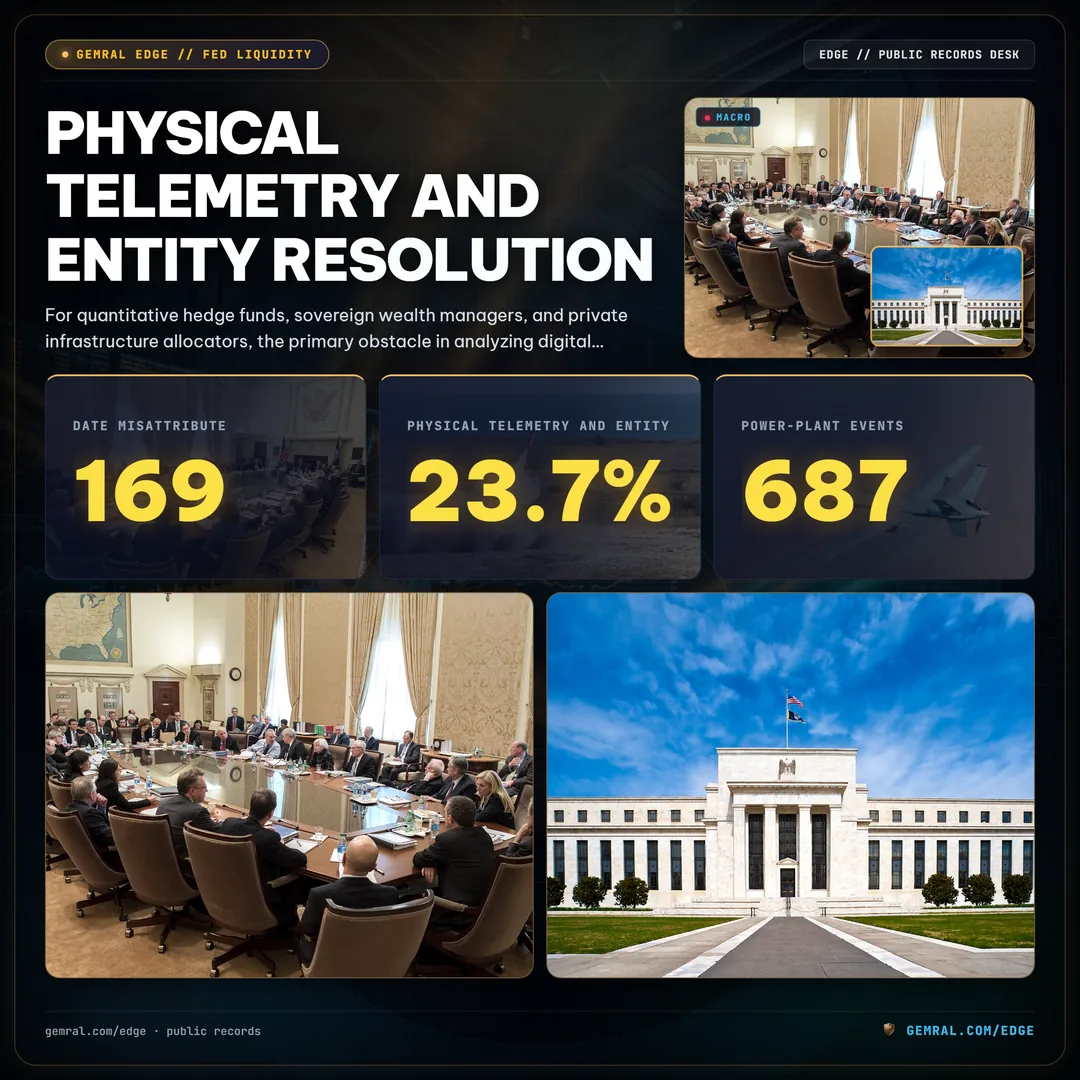
When data providers rely on naive text matching against raw company names, public asset databases fail to connect critical infrastructure milestones to traded equity tickers. For example, a multi-building campus permitted under a cryptic county holding company may represent hundreds of millions of dollars in capital expenditure by a listed cloud titan. Without robust point-in-time entity resolution, historical datasets suffer severe survivorship and attribution bias. In empirical infrastructure audits, attributing site events through today's corporate owner table rather than the verified owner valid on the publication date would erroneously misattribute 40 of 169 Permit Events: (or 23.7% Misattribution:) and 70 of 687 Power-Plant Events: (representing 10.2% Misattribution:) across historical filings.
To establish defensible institutional intelligence, physical infrastructure mapping requires multi-layered entity linkage that resolves legal land titles, municipal utility agreements, state environmental permits, and corporate subsidiaries back to the listed parent company at the precise moment each public filing occurred. Point-in-time parent-subsidiary mapping allows capital allocators to track whether capital expenditure disclosures reported in quarterly regulatory filings correspond to physical generation assets breaking ground in real-world energy corridors. Detailed methodology frameworks can be examined in our review of the federal and commercial contracts infrastructure and our ongoing tracking of data center transformers.
Substation Proximity and Grid Stress: Evaluating Campus Interconnection Feasibility
Standby emergency generators do not operate in physical isolation; they function as an integral layer within a broader regional power grid topology. A data center campus requires continuous high-voltage utility feeds for baseline operations, reserving backup generators exclusively for transmission failures, maintenance cycles, and severe grid stress contingencies. Consequently, the commercial feasibility of a data center development is bounded by its geographic proximity to high-voltage substations and transmission corridors capable of wheeling utility-scale electrical power volumes.
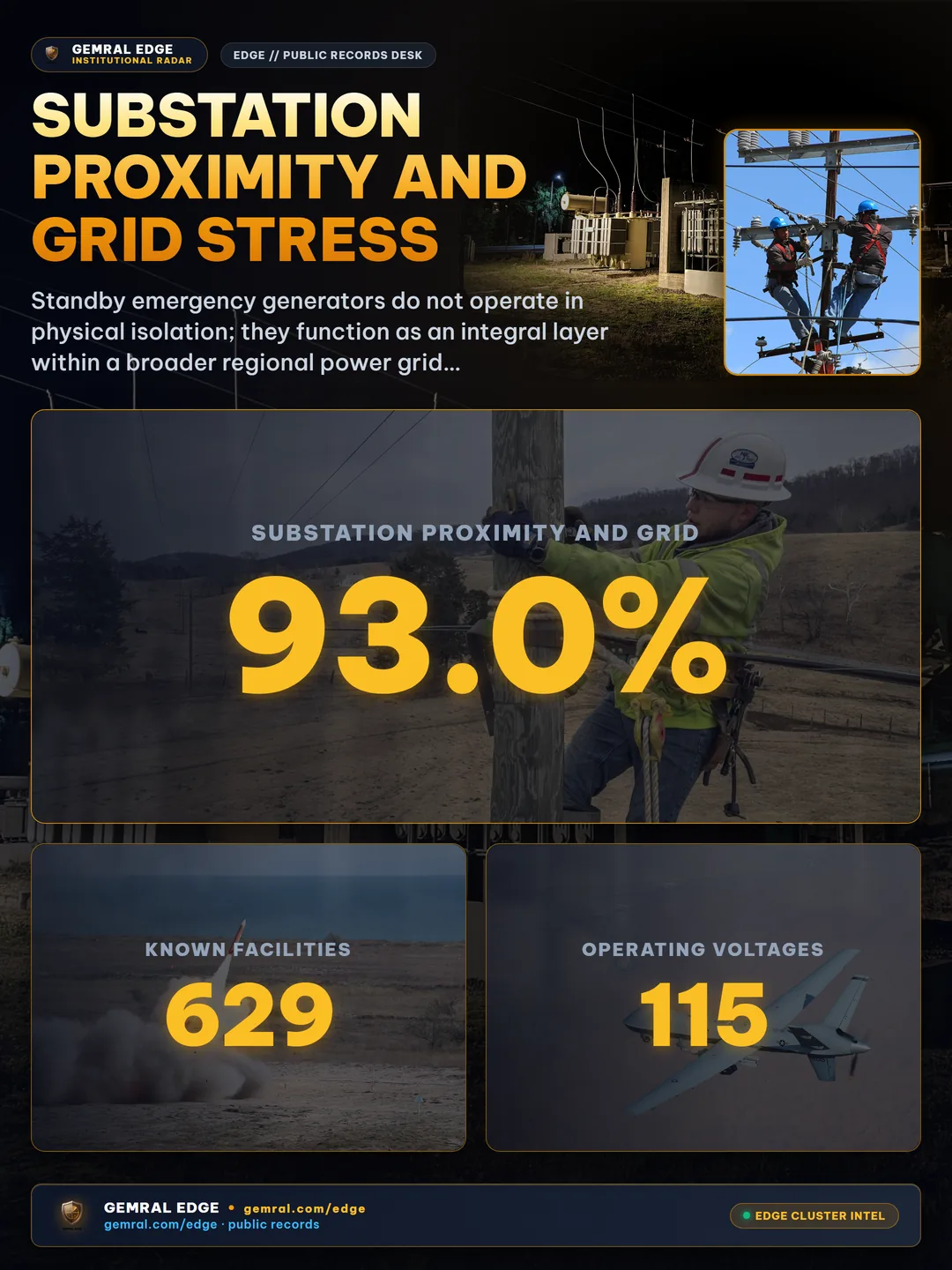
Empirical geospatial telemetry across North American digital infrastructure markets demonstrates that data center campuses exhibit extreme spatial clustering around bulk power delivery infrastructure. Within comprehensive physical infrastructure registries, 93.0% Coverage: (encompassing 629 of 676 Known Facilities:) is situated within 5.0 Kilometers: of a high-voltage substation operating at voltages of 115 Kilovolts: or higher. Across the entire universe of mapped facilities, the median distance to the nearest bulk transmission substation is a remarkably compressed 1.02 Kilometers:.
Proximity to transmission infrastructure determines interconnection capital costs and physical line loss overhead. When a hyperscale developer sites a 250 Megawatt: campus adjacent to a high-voltage transmission corridor, construction of a dedicated on-site step-down substation requires capital investments ranging between $30 Million and $60 Million:. As regional balancing authorities navigate high summertime peak demand and winter freeze events, monitoring regional transmission demand alongside localized backup generator capacity permits institutional investors to gauge the real-world operational resilience of the global computing backbone. Institutional market participants can also review our parallel investigations into the congress stock trades website ecosystem to track how policy disclosures intersect with industrial energy procurement.
In an era defined by exponential artificial intelligence computing demands, the ultimate pacing constraint on digital technology is physical, thermodynamic, and regulatory. As public utilities struggle to expand regional high-voltage transmission networks, data center backup generators provide the mission-critical insurance policies that make hyperscale cloud computing viable. By monitoring state environmental air permits, nameplate generator megawatts, and geospatial substation proximity, institutional investors and infrastructure analysts can pierce the veil of corporate holding entities and track the physical expansion of artificial intelligence infrastructure in point-in-time reality.
Frequently asked questions
Why do AI data centers require large backup generator arrays?
High-density AI training and inference facilities require 99.999% uptime availability. Because utility transmission lines face localized contingencies and multi-year interconnection queue backlogs, operators deploy heavy backup generators to sustain data hall computing, power distribution units, and liquid cooling infrastructure during grid disruptions.
How does permitted backup generator capacity relate to data center IT load?
Permitted backup-generator MW is an upper bound on on-site backup capacity, not IT load; we do not convert it. Operational IT load is determined by active chip utilization, power usage effectiveness (PUE), transformer capacity, and thermal cooling loads, which typically sit below total nameplate emergency generation.
Which state environmental agencies permit data center backup generators?
In major digital infrastructure corridors, state environmental agencies oversee stationary internal combustion engine permits under Title V minor New Source Review (NSR) programs. Key regulators include the Virginia Department of Environmental Quality (DEQ), the Georgia Environmental Protection Division (EPD), and the Texas Commission on Environmental Quality (TCEQ).
What fuel types power data center emergency backup generators?
Heavy industrial stationary diesel reciprocating internal combustion engines remain the predominant industry standard due to immediate 10-to-15 second fast-start capability and dedicated on-site fuel storage. However, natural gas reciprocating engines, hydrotreated vegetable oil (HVO), and emerging behind-the-meter small modular reactors (SMRs) are increasingly evaluated for secondary power resilience.