Drone Companies with Government Contracts: Tracking Replicator Initiative Awards, DIU Solicitations, and Defense Procurement
A forensic public record analysis of publicly traded unmanned aerial system manufacturers securing Pentagon contracts under the Replicator initiative, fast-tracked Defense Innovation Unit solicitations, and federal procurement appropriations.
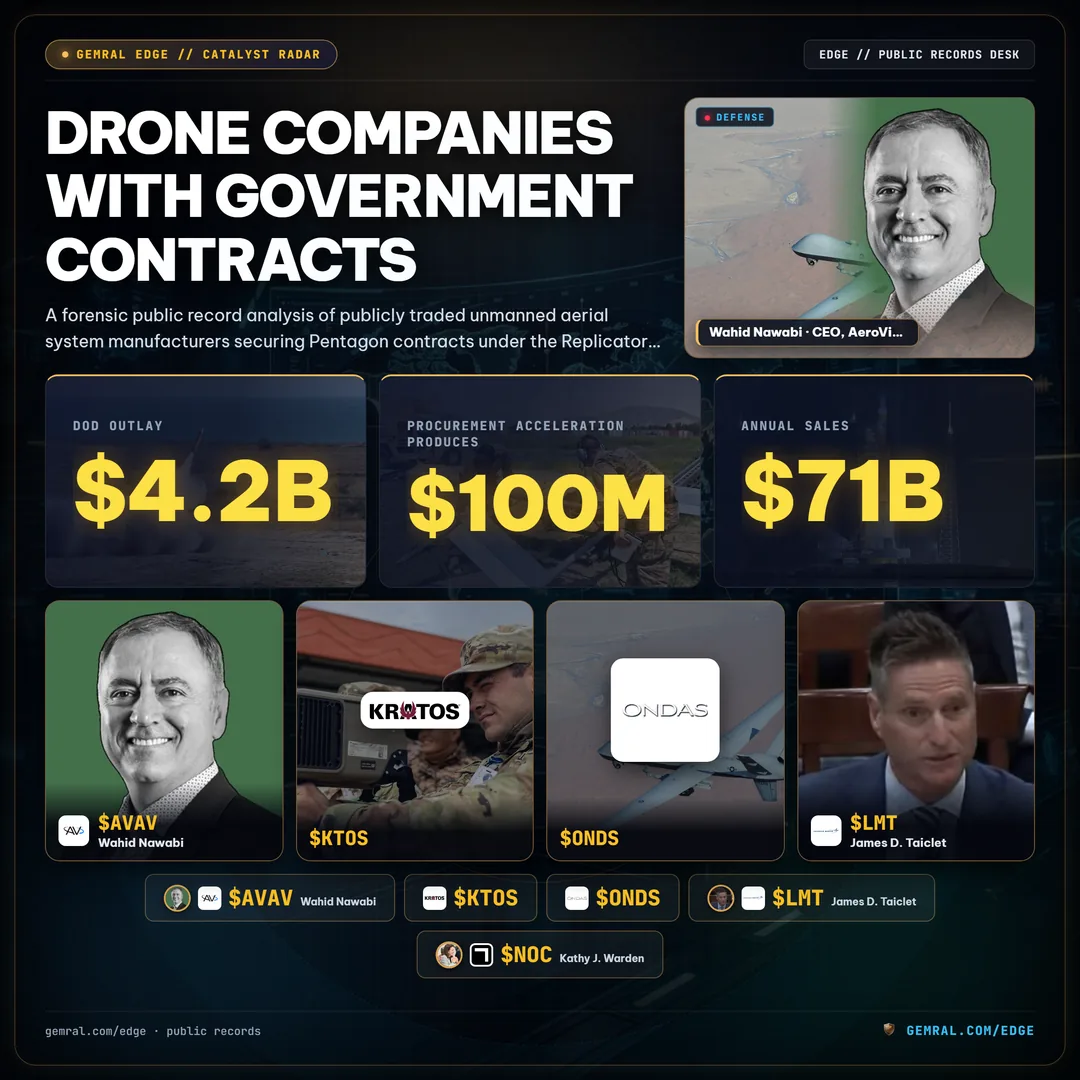
Federal expenditure on uncrewed systems and tactical autonomy has entered an aggressive acceleration phase. For institutional desks and defense industry analysts, tracking drone companies with government contracts requires continuous monitoring of statutory Department of Defense disclosures, Other Transaction Authority awards, and commercial solutions openings. The transition from legacy high-cost aerial platforms toward distributed, attritable uncrewed aerial systems (UAS) has shifted federal procurement outlays into specialized commercial vendors and agile aerospace contractors.
As modern battlefield operational requirements prioritize mass, attritability, and autonomous electronic countermeasure resilience, the Pentagon has established dedicated procurement vehicles designed to bypass traditional multi-year acquisition cycles. Institutional researchers tracking defense equity exposure examine federal procurement databases alongside our comprehensive federal contract tracker, cross-referencing contract velocity with our research on defense contractor stock contract obligations and companies with government contracts.
Public Drone Companies Securing Federal Defense and Pentagon Contracts
Public equity markets provide specialized access to the federal uncrewed defense supply chain through a spectrum of pure-play manufacturers and legacy aerospace systems integrators. The primary publicly traded pure-play contractor in tactical unmanned systems is AeroVironment (NASDAQ: AVAV). AeroVironment maintains deep statutory franchise positions across small unmanned aircraft systems (SUAS) such as the RQ-20 Puma and loitering munition systems through the Switchblade 300 and Switchblade 600 platforms. In August 2024, the U.S. Army awarded AeroVironment a landmark indefinite-delivery/indefinite-quantity (IDIQ) contract modification valued at an aggregate ceiling of $990 million for Switchblade systems, consolidating its posture as the primary production contractor for organic tactical precision loitering weapons.
Operating alongside tactical loitering developers, Kratos Defense & Security Solutions (NASDAQ: KTOS) provides jet-powered target drones and advanced collaborative combat aircraft (CCA) prototypes. Kratos manages an active uncrewed systems backlog exceeding $580 million across U.S. Air Force, Navy, and allied programs, driven by platforms such as the BQM-167 target system and the XQ-58A Valkyrie attritable uncrewed aerial vehicle. The company's focus on low-cost high-subsonic jet manufacturing positions its facilities as core industrial assets for the Pentagon's attritable mass doctrine.
In the infrastructure inspection and tactical autonomous base defense domain, Ondas Holdings (NASDAQ: ONDS) operates through its American Robotics and Airobotics subsidiaries. Holding certifications for automated uncrewed flight under Federal Aviation Administration (FAA) waivers and securing security task orders from governmental authorities, Ondas manufactures autonomous "drone-in-a-box" surveillance systems deployed across critical infrastructure perimeter security and tactical defense operations.
How the Pentagon Awards Drone Contracts Through Replicator and DIU Solicitations
Historically, procurement of unmanned aircraft proceeded through the cumbersome Federal Acquisition Regulation (FAR) Part 15 contracting pathway, requiring up to 7 years from initial requirement definition to full-rate production. To confront contemporary operational realities, the Department of Defense launched the Replicator initiative under the Defense Innovation Unit (DIU), establishing an agile institutional pathway to procure and field attritable autonomous systems at scale within 18 to 24 months.
Replicator utilizes Commercial Solutions Openings (CSOs) authorized under 10 U.S.C. § 4022 Other Transaction Authority (OTA). Unlike standard cost-plus defense contracts, OTA solicitations operate under flexible statutory provisions:
- Problem-First Solicitations: DIU issues broad operational problem statements rather than prescriptive hundreds-of-pages technical specifications, allowing commercial drone vendors to submit off-the-shelf and dual-use designs.
- Competitive Fast-Track Prototyping: Vendors enter competitive fly-offs and operational demonstration trials within 60 to 90 days of solicitation closing, drastically reducing bid and proposal cycles.
- Direct Follow-On Production: Solicitations successfully validated under prototype OTAs can transition directly into non-competitive follow-on production contracts without reopening open-market competition.
Under Replicator Tranche 1 and Tranche 2, the Pentagon dedicated $500 million in FY2024 congressional reprogramming authorizations and requested an additional $500 million in FY2025 appropriations. These funds directly target low-cost loitering munitions, uncrewed surface vehicles, and counter-uncrewed aerial systems (C-UAS). Commercial contractors participating in DIU solicitations secure non-traditional defense contractor (NDC) status, exempting commercial hardware lines from rigid Cost Accounting Standards (CAS) and speeding time to award.
Contract Ceilings and Budget Outlays Across Department of Defense Drone Programs
Systematic analysis of federal procurement data reveals that uncrewed and autonomous systems funding is distributed across multiple budget titles within the annual Department of Defense budget. In the FY2025 defense appropriations request, procurement and research, development, test, and evaluation (RDT&E) outlays for unmanned aerial systems exceeded $4.2 billion across the Army, Navy, Air Force, and Special Operations Command (USSOCOM).

A critical distinction in tracking federal drone obligations is the structural difference between contract ceiling and cumulative obligated amount:
- Indefinite-Delivery/Indefinite-Quantity (IDIQ) Ceilings: Represents the statutory maximum value of task orders that a military branch may obligate to the vendor over the contract lifetime (typically 5 years). An IDIQ announcement of $990 million guarantees contract authority but does not disburse immediate cash until discrete delivery orders are executed.
- Firm-Fixed-Price (FFP) Delivery Orders: The discrete funding actions that disburse Treasury obligations upon milestone delivery of UAS units, ground control stations, and spare battery assemblies.
- Foreign Military Sales (FMS) Modifications: Add-on contract modifications funded by allied foreign governments through the Defense Security Cooperation Agency (DSCA), frequently expanding base contract backlogs by 35% to 50% without separate congressional budget allocations.
For example, AeroVironment's Switchblade contract vehicles regularly incorporate FMS line items for allied European and Indo-Pacific defense forces, converting federal IDIQ procurement ceilings into realized commercial revenue at gross operating margins exceeding 38%.
Pure-Play Autonomous Drone Manufacturers vs Diversified Aerospace Primes
When analyzing defense industrial capabilities, desks must differentiate between pure-play unmanned contractors and legacy diversified defense primes. While pure-play contractors capture rapid unit volume growth in tactical attritable systems, legacy defense primes control high-altitude, long-endurance (HALE) strategic franchise programs.
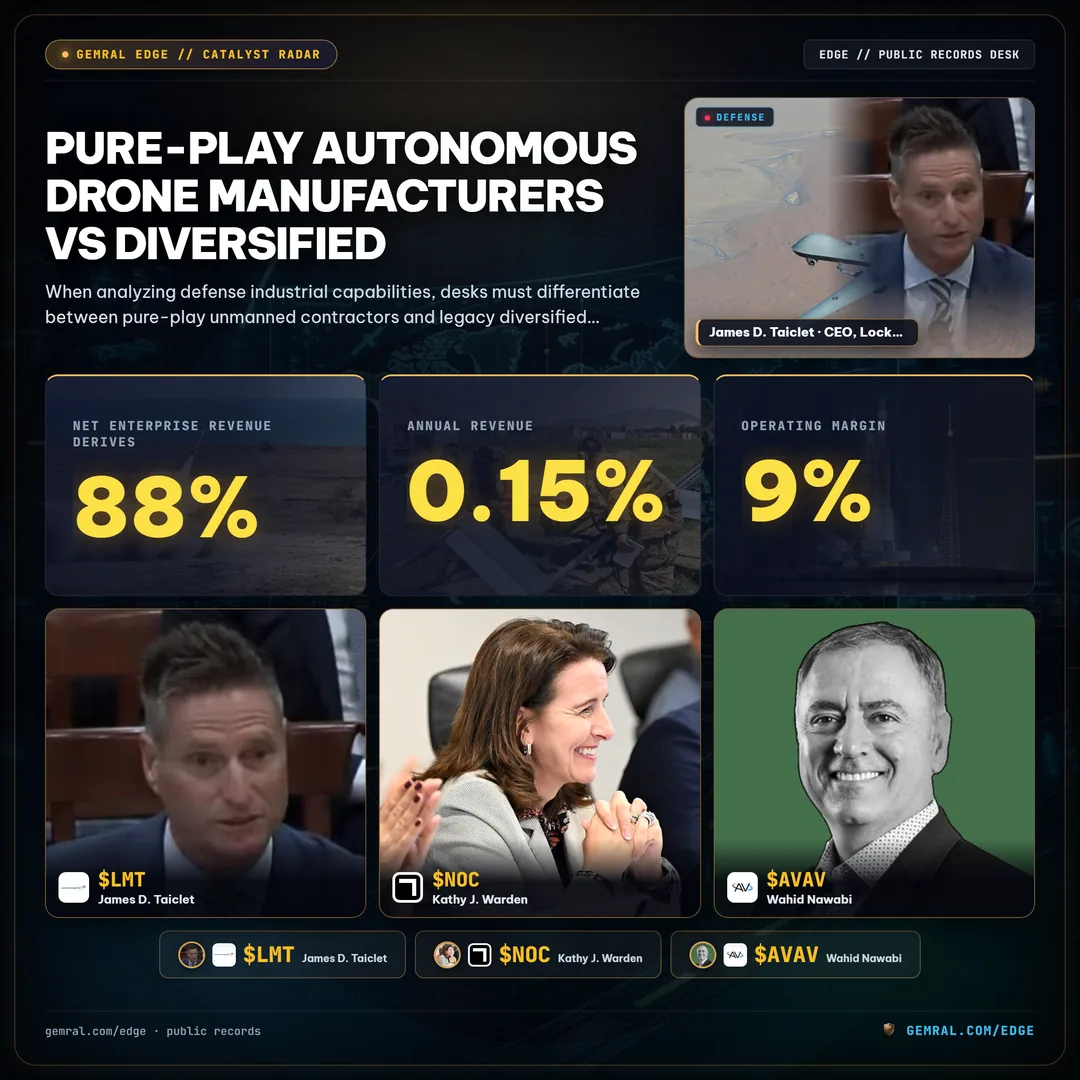
Diversified prime contractors—including Lockheed Martin (NYSE: LMT), Northrop Grumman (NYSE: NOC), and General Atomics (privately held)—dominate large-scale strategic uncrewed reconnaissance and strike aviation. Northrop Grumman produces the RQ-4 Global Hawk and MQ-4C Triton strategic surveillance platforms, while Lockheed Martin's Skunk Works develops stealth reconnaissance UAS and autonomous collaborative combat aircraft.
However, the capital allocation and revenue mechanics between these two tiers diverge sharply:
- Revenue Purity: For AeroVironment (AVAV), over 88% of net enterprise revenue derives directly from unmanned systems and loitering weapons. Consequently, an unexpected $100 million procurement acceleration produces an immediate, measurable catalyst on annual guidance. In contrast, for Lockheed Martin ($71 billion in annual sales), a $100 million UAS contract modification represents less than 0.15% of annual revenue.
- Margin Structure: Prime contractors typically execute under cost-plus-incentive-fee structures averaging 9% to 11% operating margin on major airframe franchises. Pure-play tactical drone makers selling commercial off-the-shelf and firm-fixed-price production units achieve gross margins between 36% and 42%.
- Production Scalability: Modern tactical combat doctrine demands production rates of thousands of autonomous units per month. Pure-play developers optimized for automotive and commercial electronics manufacturing techniques can scale output 5x faster than traditional clean-room aerospace prime facilities.
Auditing Federal Drone Awards: Point-in-Time Disclosures and Subcontract Verification
Auditing public records to evaluate federal drone awards requires navigating the Department of Defense Daily Contract Disclosures, statutory federal procurement obligation databases, and federal contract award notices. Contracts valued at $7.5 million or higher must be published daily at 17:00 ET by the Office of the Assistant Secretary of Defense for Public Affairs.
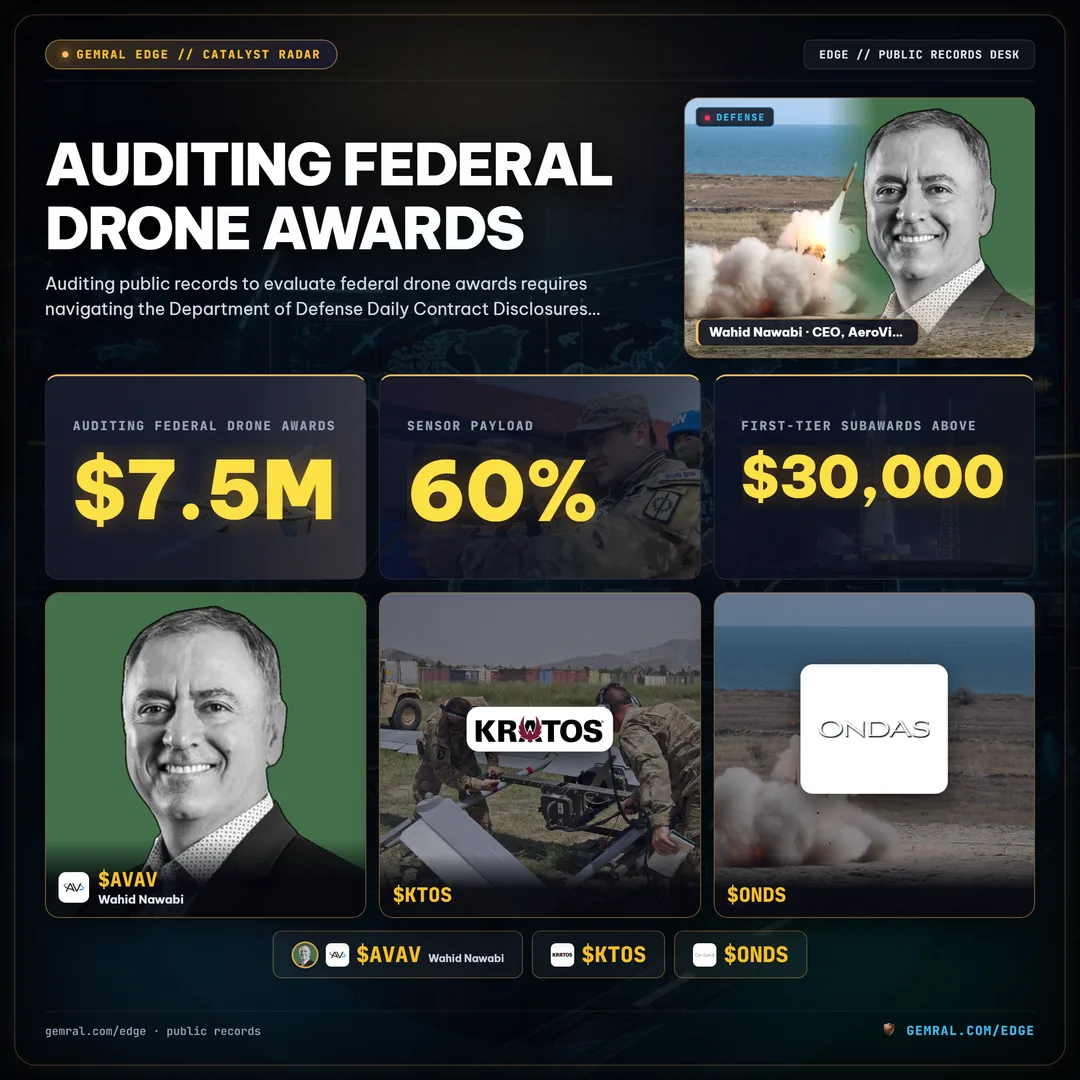
However, point-in-time disclosure tracking reveals structural information friction. Major primes frequently win the headline award while subcontracting up to 60% of sensor payload, propulsion, and software engineering value to specialized uncrewed subsystem suppliers. Under federal reporting guidelines, first-tier subawards above $30,000 must be reported to the Federal Subaward Reporting System (FSRS), but reporting delays can span 30 to 90 days from prime contract award execution.
By establishing systematic ingestion pipelines that ingest daily Pentagon procurement notices, extract North American Industry Classification System (NAICS) codes—specifically 336411 (Aircraft Manufacturing) and 541715 (R&D in Physical, Engineering, and Life Sciences)—and parse Product and Service Codes (PSC) like 1550 (Drones/Unmanned Aircraft), research desks can reconstruct the real-time supply chain topology. Correlating statutory contract award timing against corporate inventory accumulation and backlog disclosure provides actionable visibility into federal procurement cycles before quarterly 10-Q filings.
Drone Companies with Government Contracts FAQ: Procurement, Solicitations, and Backlogs
Which public drone companies hold major U.S. government contracts?
Key publicly traded drone contractors include AeroVironment (NASDAQ: AVAV, producing Switchblade loitering munitions and Puma UAS), Kratos Defense & Security Solutions (NASDAQ: KTOS, producing Valkyrie and target drones), Ondas Holdings (NASDAQ: ONDS, autonomous drone-in-a-box infrastructure), and major prime contractors including Lockheed Martin (NYSE: LMT) and Northrop Grumman (NYSE: NOC).
What is the Pentagon Replicator Initiative and how does it fund drone contracts?
The Department of Defense Replicator initiative accelerates the fielding of all-domain attritable autonomous (ADA2) systems, providing dedicated tranches of funding (exceeding $1 billion across FY24 and FY25) to scale low-cost, mass-manufactured autonomous uncrewed systems through fast-tracked DIU Other Transaction Authority (OTA) solicitations.
How do investors and analysts track federal drone contract obligations?
Federal contract awards are documented publicly through the Department of Defense Daily Contract Disclosures, statutory procurement award feeds, federal contract opportunity postings, and Defense Innovation Unit (DIU) commercial solutions opening (CSO) awards.
What are the primary differences between pure-play drone contractors and prime aerospace defense contractors?
Pure-play drone contractors like AeroVironment derive the vast majority of enterprise revenue from unmanned aircraft and autonomous loitering munitions, experiencing high revenue velocity from rapid procurement cycles. Diversified prime contractors like Lockheed Martin and Northrop Grumman integrate autonomous drone systems into broader multi-decade franchise programs with higher contract ceilings but longer programmatic cycle times.
Regulatory Disclaimer & Public Transparency Notice
Public data · not investment advice. All contract ceiling figures, DIU solicitation disclosures, and federal procurement obligations cited in this report are sourced from official public records maintained by the Department of Defense, Defense Innovation Unit, and federal procurement authorities. Gemral Edge provides systematic public record aggregation, entity resolution, and policy telemetry for compliance and quantitative research desks. Institutional data feeds and API access are available through our Edge Data Plans ($39 Pro, $299 B2B, $2000 API).