Data Center Air Permit: Tracking Generator Capacity, State Environmental Filings, and AI Compute Expansion
An institutional analysis of state air permitting disclosures across Virginia, Georgia, Texas, and Arizona, detailing why backup generator capacity reveals physical AI infrastructure scaling before quarterly financial filings.

In the rapidly accelerating buildout of artificial intelligence compute clusters, searching for a data center air permit has emerged as a crucial investigative workflow for institutional allocators, power market analysts, and infrastructure investors. While public hyperscalers and wholesale colocation providers frequently highlight planned gigawatt compute expansions in corporate press releases, physical deployment on the ground is governed by strict statutory milestones. Before thousands of high-density graphics processing units can be installed in data halls, operators must secure legally binding environmental authorizations to install and operate on-site emergency backup diesel engines and natural gas turbines.
Under federal Clean Air Act regulations and delegated state operating programs, every stationary combustion unit capable of generating atmospheric emissions must obtain a formal state air operating authorization or stationary source permit. Because a single modern AI data center campus routinely requires between 50 megawatts and upwards of 350 megawatts of emergency backup generation capacity, environmental permitting filings provide an audited, unvarnished window into physical capacity delivery schedules. Institutional researchers tracking these capital commitments can review verified multi-layer records across our public data infrastructure at the Public Datasets & Machine Feeds catalog and inspect operational utility disclosures on the Datacenter Power Contracts Intelligence page.
The Regulatory Function: Why AI Compute Campuses Require State Air Permits
A data center air permit is not a routine municipal building sign-off; it is a legally enforceable operating standard administered by state departments of environmental protection. Emergency diesel generator sets (gensets) are classified as stationary internal combustion engines under New Source Performance Standards (NSPS) and National Emission Standards for Hazardous Air Pollutants (NESHAP). When hundreds of diesel generators are co-located at an enterprise AI campus, their combined potential to emit nitrogen oxides (NOx), carbon monoxide (CO), sulfur dioxide (SO2), and fine particulate matter (PM2.5) elevates the facility into major stationary source categories or requires federally enforceable state operating permits (FESOP) with synthetic minor emission limits.
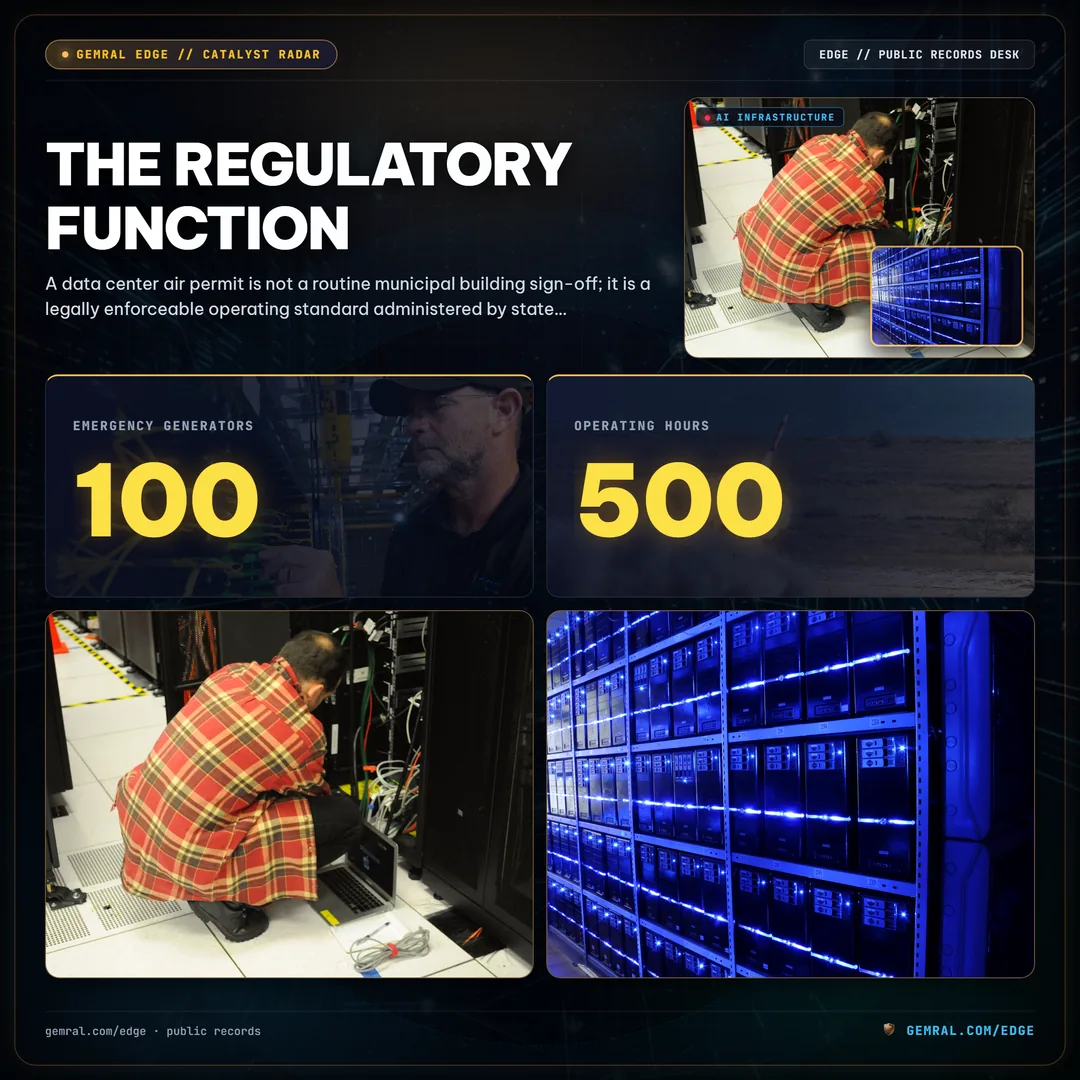
State environmental agencies enforce rigorous testing and run-time limitations. In major digital infrastructure corridors, emergency generators are typically restricted to between 100 and 500 operating hours per year for routine testing, scheduled maintenance exercises, and emergency grid interruption events. To satisfy these caps while maintaining Tier III or Tier IV uptime redundancy, operators submit comprehensive engineering documentation detailing generator nameplate mechanical ratings, fuel storage capacities, stack heights, exhaust temperatures, and dispersion modeling analyses.
| Permit Parameter | Regulatory Meaning | Institutional Equity Significance |
|---|---|---|
| New Permit (permit_new) | Initial stationary source construction approval | Validates newly broken ground and committed greenfield capacity |
| Permit Modification (permit_modification) | Formal amendment to add units or expand capacity | Confirms active campus expansion and phased capital expenditure |
| Permitted Backup MW | Total nameplate electrical rating of approved gensets | Establishes the upper physical boundary on site power redundancy |
| Federal Air Registration | Identification under Clean Air Act tracking programs | Enables cross-state normalization when state portals lack uniformity |
Tracking the transition from an initial permit application to a finalized permit modification offers fundamental analysts early, independent verification of infrastructure scale. Corporate financial filings disclose aggregate quarterly capital expenditures across global business units, but environmental permits pinpoint the exact geographic campuses where capacity is physically arriving. Additional analysis of power procurement dynamics is discussed in our research on AI Data Center Power Demand and Grid Capacity.
Permitted Backup Generator MW: Measuring the Physical Scale of On-Site Generation
A central metric extracted from state environmental engineering filings is the total permitted backup-generator capacity, quantified in megawatts (MW). However, institutional modeling teams frequently commit a critical interpretive error by directly equating permitted backup generation with active IT server compute load. Institutional research methodology maintains a strict boundary: permitted backup-generator MW is an upper bound on on-site emergency generation capacity, not IT load; we do not convert it.

Emergency generators are sized to supply mechanical resilience across an entire physical plant during utility grid blackouts or localized transmission outages. This includes supporting chillers, cooling towers, computer room air handlers (CRAH), pumps, lighting, and uninterruptible power supply (UPS) charging systems, in addition to compute servers. Furthermore, data center engineering designs often incorporate N+1, N+2, or 2N electrical architectures, meaning the total generator nameplate capacity significantly exceeds the facility's peak operational draw.
In audited field datasets across Virginia, empirical measurement confirms 92.2% empirical dataset coverage. Among 116 primary data center campuses with established corporate links, 107 facilities carry permitted backup generator MW records—achieving 92.2% empirical coverage. Across the broader inventory of 194 evaluated state operating permits in the Commonwealth, 171 individual authorizations explicitly record parsed generator nameplate capacities. In the state of Georgia, 8 primary data center campuses feature 10 distinct state records documenting permitted backup generation totals.
Individual public filings demonstrate the colossal physical scale of these installations. For example, regulatory filings for the Aligned Data Centers ATL01 campus in Georgia establish 145.0 MW of total permitted backup emergency generation capacity, approved under permit documentation in 2024. The physical equipment list specifies 48 individual 3,000 kW diesel-fired emergency generators paired with a 1,000 kW auxiliary unit. In contrast, older suburban commercial facilities, such as the Valo Park campus in Fairfax County, reflect legacy requirements with 4.0 MW of permitted emergency capacity across four 1,000 ekW units permitted in 2009.
State Permitting Portals: Georgia, Texas, and Arizona Environmental Records
Navigating environmental disclosures across multiple state jurisdictions requires standardizing disparate regulatory systems into a unified point-in-time schema. Unlike federal securities filings, which adhere to centralized electronic formatting, state environmental protection divisions maintain distinct administrative portals with varying update frequencies, document formats, and search capabilities.
In Georgia, the Environmental Protection Division publishes detailed stationary source air permits through its online registry. The Feed 2 physical infrastructure catalog tracks 46 state air-permit records for known data center campuses in Georgia, comprising 25 new construction authorizations and 21 formal permit amendments. In Texas, the Commission on Environmental Quality (TCEQ) records 34 state air-permit events across major colocation hubs, consisting of 11 new permits and 23 modifications. In Arizona, state environmental records account for 15 data center air permits, with 10 documents containing explicit, verified permit issuance dates.
Certain states present structural disclosure gaps. For instance, the state of Ohio does not maintain a dedicated public online database for state-level data center air permits. To overcome these jurisdictional limitations without sacrificing dataset integrity, institutional telemetry cross-references federal Clean Air Act program registrations. Across Texas, Georgia, Ohio, and Arizona, 79 of 81 known primary data center sites carry an active federal air-program registration, representing a 97.5% coverage rate. This multi-tiered capture ensures that campuses in states lacking localized electronic portals are systematically tracked within a synchronized national inventory.
Point-in-Time Entity Resolution: Avoiding Look-Ahead Bias in Data Center Ownership
For quantitative researchers and algorithmic trading desks, the primary obstacle in utilizing alternative physical infrastructure data is entity look-ahead bias. When historical datasets are constructed by naively taking today's corporate ownership table and projecting it backward onto past events, historical simulation results become fatally distorted.

Data center campuses routinely undergo multi-year development lifecycles before acquisition by publicly traded operators. A parcel of agricultural or industrial land is typically acquired by a private, local limited liability company (LLC) or specialized development syndicate. This local entity spends two to four years securing zoning approvals, negotiating utility interconnection queues, and filing initial state air permit applications. Only after environmental authorizations are granted and structural concrete is poured does a listed hyperscaler or real estate investment trust (REIT) acquire the site.
Empirical infrastructure auditing reveals the scale of this distortion: joining site events through today's corporate owner attaches an equity ticker too early or to the wrong corporate entity for 40 of 169 permit events (23.7%) and 70 of 687 power-plant status events (10.2%). An algorithm operating under static ownership assumptions would falsely attribute capital expenditures, permitting momentum, and capacity milestones to a public equity years before that company legally acquired the underlying assets. Point-in-time entity resolution solves this by tagging each regulatory filing with the parent company and trading ticker that were valid on the exact date the record became public.
The Five-Layer Physical Stack: From High-Voltage Substations to Satellite Telemetry
A data center air permit does not exist in isolation; it represents one critical tier in a broader multi-layered physical infrastructure stack. Understanding true compute readiness requires synthesizing environmental filings with electrical transmission telemetry, parcel ownership records, and orbital observation.

Across our audited national footprint, 107 data-center sites carry all five public-record layers simultaneously: verified corporate owner entity, nearest high-voltage electrical substation, balancing authority grid zone, dated state air permit or environmental registration, and monthly satellite measurements. Of these multi-layer campuses, 92 are concentrated in Virginia, highlighting the intense physical clustering of global compute power in the region.
Electrical transmission proximity is a vital co-factor. Analyzing 676 primary campuses across the United States demonstrates that 93.0% of sites (629 campuses) sit within 5 kilometers of an identified high-voltage substation of 115 kV or greater, with a median proximity distance of just 1.02 kilometers. Pairing high-voltage substation distance with permitted backup generator MW enables researchers to evaluate whether an announced facility possesses both the incoming grid interconnection capacity and the required on-site mechanical redundancy to support gigawatt-scale AI workloads. Further technical details regarding transmission interfaces are explored in Data Center Substation Grid Interconnection and Capacity.
Finally, monthly satellite measurements provide an objective physical baseline that cannot be delayed or manipulated by corporate reporting choices. By tracking normalized surface heat signatures and built-up land indices across documented site parcels, orbital sensors capture structural roof completion, cooling equipment installation, and thermal heat rejection patterns long before initial revenue recognition appears in quarterly filings.
Supply Chain Bottlenecks: Utility Queues and Equipment Lead Times
The convergence of environmental air permitting and electrical interconnection highlights the acute physical bottlenecks constraining modern artificial intelligence infrastructure. While capital markets have demonstrated virtually unlimited liquidity to fund compute infrastructure, the physical components of the electrical grid operate under severe manufacturing constraints.
High-voltage step-down transformers, switchgear assemblies, and high-capacity electrical distribution breakers currently face global supply chain lead times extending between 36 and 48 months. Consequently, data center developers are increasingly utilizing emergency backup diesel and natural gas generators as bridging solutions while waiting for regional utilities to construct dedicated transmission substations. This dynamic has driven surging demand for industrial engine manufacturers like Caterpillar and Cummins, whose order books for multi-megawatt emergency power units have expanded to historic highs.
Simultaneously, regional grid operators and state environmental regulators are scrutinizing the cumulative atmospheric impact of dense generator clusters. In major data center corridors, air quality officials monitor regional airsheds to ensure that simultaneous generator testing does not violate national ambient air quality standards (NAAQS). As a result, permit modifications increasingly require advanced selective catalytic reduction (SCR) systems and low-sulfur diesel fuel formulations to achieve synthetic minor status, adding both capital cost and engineering complexity to compute delivery timelines.
Institutional Due Diligence: Evaluating Data Center Supply Chains Before Earnings
For quantitative allocators, fundamental equity analysts, and credit risk desks, Feed 2 telemetry delivers an institutional-grade, point-in-time perspective on physical AI infrastructure. Tracking 49 US-listed AI-infrastructure companies across 7 specialized industry groups—spanning hyperscalers, colocation REITs, server manufacturers, optical networking providers, and power equipment suppliers—Feed 2 grounds equity research in verifiable public records.

Every data layer incorporated into the feed undergoes continuous mechanical verification against primary public documents. Across all monitored facilities, graded site permits total 101 verified documents and 58 capacity records. Independent mechanical testing confirms 100% audit precision. Delivered through standardized Parquet data exports, a REST API, and Model Context Protocol (MCP) server endpoints, these datasets allow allocators to integrate point-in-time physical infrastructure tracking directly into proprietary valuation and risk models.
To review complete data schema structures, historical depth metrics, and real sample records across our physical infrastructure inventory, visit our Data Coverage & Completeness portal and explore sample tables on the Data Preview terminal.
Explore Point-in-Time AI Infrastructure Telemetry
Access standardized point-in-time data center site registries, state air permits, backup generator capacities, high-voltage substation proximities, and regional grid telemetry for US-listed infrastructure companies. Explore the data on the Edge Intelligence terminal.
Frequently asked questions
What is a data center air permit and why is it legally required?
A data center air permit is a mandatory environmental authorization granted by state regulatory bodies—such as state departments of environmental protection—governing stationary combustion sources. Modern data centers deploy substantial backup diesel generator capacity (often 50 MW to over 300 MW per campus) to protect against grid interruptions. These generators are stationary sources subject to regulatory emission caps, necessitating formal permits before installation and commercial operation.
How does permitted backup generator MW relate to IT compute load?
Permitted backup-generator MW represents an upper bound on permitted on-site emergency generation capacity, not actual IT server compute load. Regulators permit generating equipment based on maximum nameplate mechanical output and fuel consumption limits, whereas server power draw depends on data hall server density, cooling architecture, and utilization rates. Gemral Edge explicitly treats backup MW as an upper ceiling without arbitrary conversion to IT load.
Which US states publish electronic data center air permitting records?
Virginia maintains state air permit records documenting new authorizations and amendments across major data center corridors. Georgia, Texas, and Arizona disclose state environmental filings and issue dates through regional environmental protection divisions, while facilities in Ohio register under federal Clean Air Act programs. Gemral Edge normalizes these disparate state and federal filings into a unified point-in-time dataset.
Why do quantitative models fail when analyzing data center campus ownership?
Models that join data center site events using current corporate ownership introduce look-ahead bias. Across historical site events, mapping through today's owner attaches a public ticker too early or to the wrong corporate entity for 23.7% of air permit events and 10.2% of power plant lifecycle status changes, because campuses frequently undergo mergers, acquisitions, or multi-year holding company development phases before listed operator consolidation.