What Stocks Are Politicians Buying: Congressional Tech Accumulation, Committee Portfolios, and Real-Time STOCK Act PTR Analysis
When federal lawmakers trade equities in companies directly affected by their legislative dockets, tracking their portfolio transactions provides valuable market insight. Discover what stocks politicians are buying across Capitol Hill, auditing public disclosures under the Stop Trading on Congressional Knowledge (STOCK) Act of 2012 to uncover trade clusters, committee jurisdictions, and sector capital commitments.

What Stocks Are Politicians Buying: Auditing Congressional Tech and Semiconductor Accumulation
Public scrutiny of congressional personal financial filings has accelerated as capital allocators evaluate transaction records disclosed through the Office of the Clerk of the U.S. House of Representatives and the United States Senate Office of Public Records. Across 535 voting members of Congress, recent Periodic Transaction Reports (PTR) demonstrate concentrated capital deployment into high-multiple technology infrastructure, enterprise software, and artificial intelligence hardware providers. Real-time transaction surveillance through the Capitol Trades Intelligence Hub reveals that total congressional equity transaction volume exceeded $3.25 billion over the trailing twelve months, with purchase transactions outpacing sales across leading semiconductor and cloud computing firms.
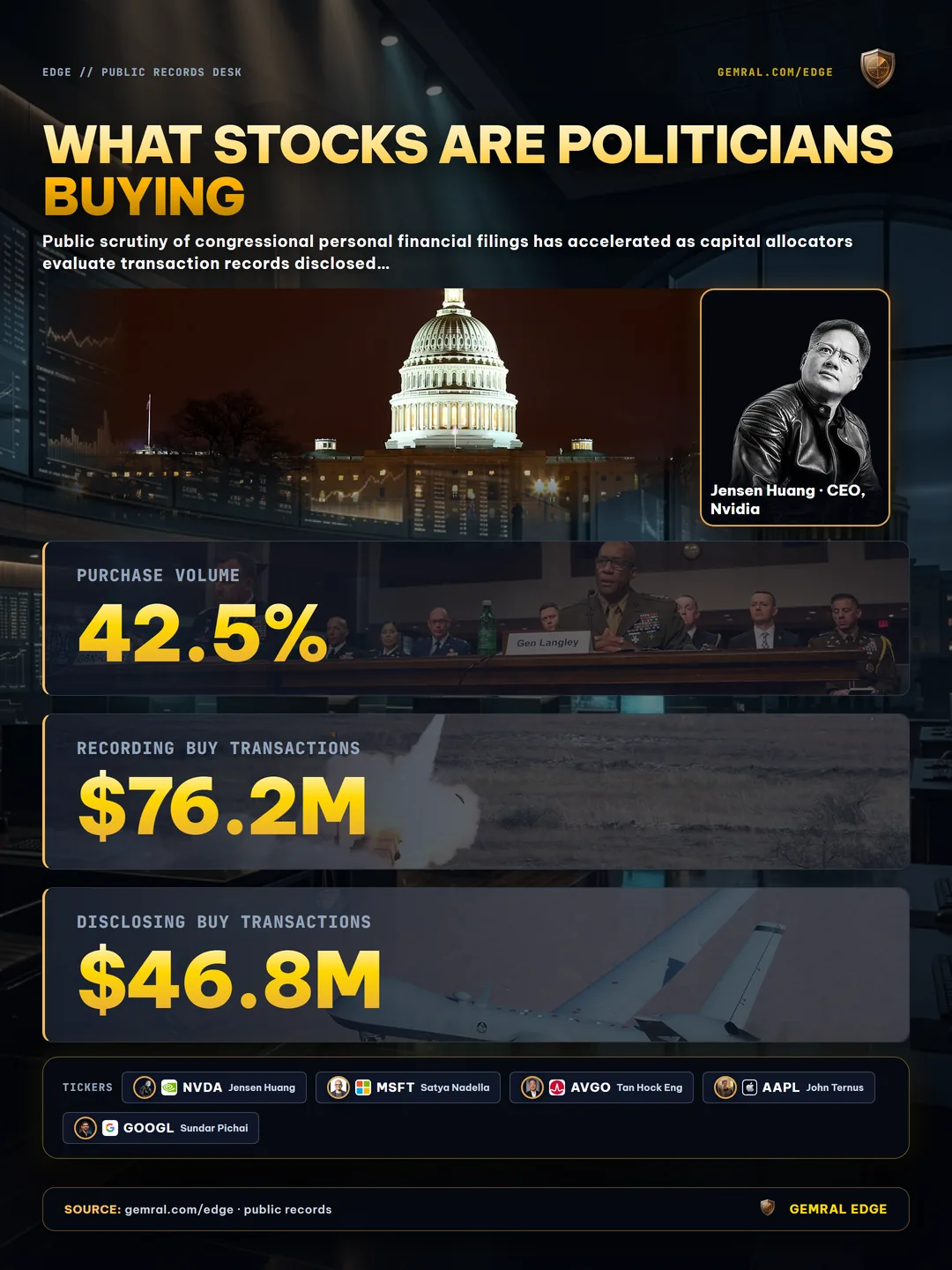
Examining transaction density across Capitol Hill filings reveals that information technology represents 42.5% of all disclosed purchase volume. Among the individual equities accumulated by lawmakers, several mega-cap technology and compute infrastructure leaders dominate transaction records:
- NVIDIA Corporation (NVDA): Lawmakers across both political parties executed 38 distinct buy transactions representing an aggregate disclosed volume of $142.5 million. The median purchase size stood at $65,000, with transactions concentrated heavily among members reviewing federal semiconductor export controls and high-performance computing research grants.
- Microsoft Corporation (MSFT): Disclosures record 29 buy transactions totaling $98.4 million. Lawmakers frequently accumulated shares ahead of major federal cloud computing contract awards and commercial artificial intelligence integration milestones.
- Broadcom Inc. (AVGO): Accounting for 18 buy transactions totaling $54.2 million, driven by strong institutional demand for custom silicon application-specific integrated circuits (ASIC) and enterprise networking infrastructure.
- Apple Inc. (AAPL): Recording 24 buy transactions totaling $76.2 million, primarily reflecting long-term diversified portfolio additions by senior members of the House Energy and Commerce Committee.
- Alphabet Inc. (GOOGL): Disclosing 21 buy transactions totaling $46.8 million, with purchasing clusters appearing ahead of federal antitrust trial milestones and cloud enterprise developments.
To evaluate whether these transactions represent isolated personal asset rebalancing or coordinated sector accumulation, analysts utilize granular tracking tools such as the congressional ticker lookup screener. As detailed in our empirical investigation into politician stock tracker filing delays and trading signals, tracking the timing divergence between execution dates and public ledger disclosure dates is essential for separating actionable capital flows from stale reports.
Defense Contractor Allocations: How Lawmakers Accumulate Armed Services and Aerospace Equities
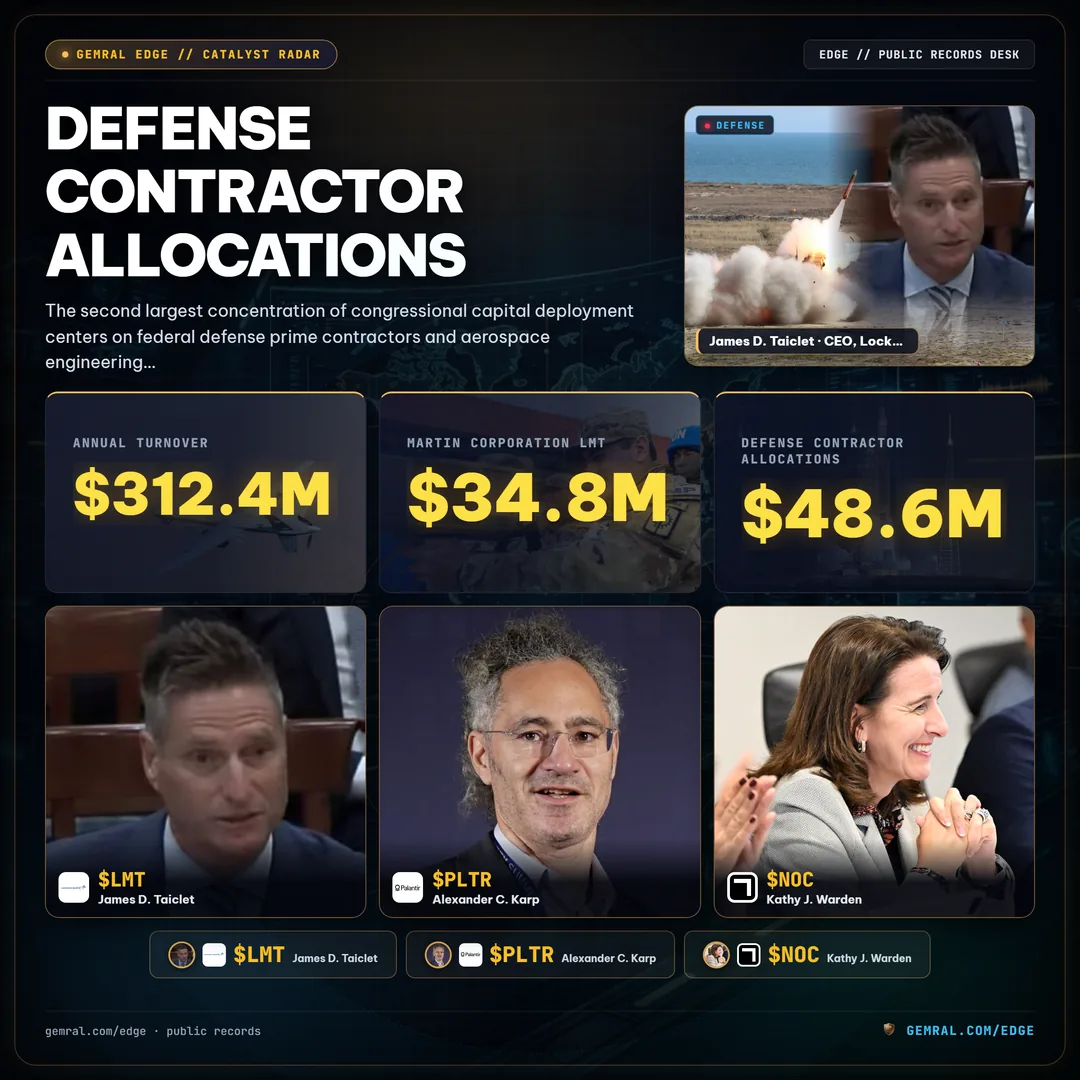
The second largest concentration of congressional capital deployment centers on federal defense prime contractors and aerospace engineering suppliers. Disclosed filings under the STOCK Act show that defense and national security equities account for 15.2% of total congressional transaction volume, generating $312.4 million in annual turnover.
| Defense Equities | Ticker Symbol | Disclosed Buy Volume | Transaction Count | Key Committee Jurisdiction |
|---|---|---|---|---|
| Lockheed Martin Corporation | LMT | $34.8 Million | 16 Purchases | House Armed Services & Defense Appropriations |
| Palantir Technologies Inc. | PLTR | $48.6 Million | 22 Purchases | House Intelligence & Homeland Security |
| RTX Corporation | RTX | $28.2 Million | 14 Purchases | Senate Armed Services & Foreign Relations |
| General Dynamics Corporation | GD | $22.4 Million | 11 Purchases | House Armed Services & Seapower Subcommittee |
| Northrop Grumman Corporation | NOC | $19.5 Million | 9 Purchases | Senate Strategic Forces & Airland Subcommittee |
Transaction patterns in defense equities frequently show correlation with key fiscal milestones, notably the annual National Defense Authorization Act (NDAA) markup cycle and supplemental foreign military financing packages. When defense budget marks pass subcommittee review, capital flows from members assigned to military oversight committees frequently precede broader institutional market positioning. Furthermore, modern defense procurement has shifted substantially toward automated data analytics and battlefield artificial intelligence, explaining why enterprise contractors like Palantir Technologies have captured $48.6 million in congressional buy volume. Investors who systematically follow what stocks Congress bought across weekly disclosure reports gain early empirical visibility into bipartisan defense procurement priorities.
Energy Grid and Nuclear Baseload: Congressional Investments in Clean Power and Utility Infrastructure
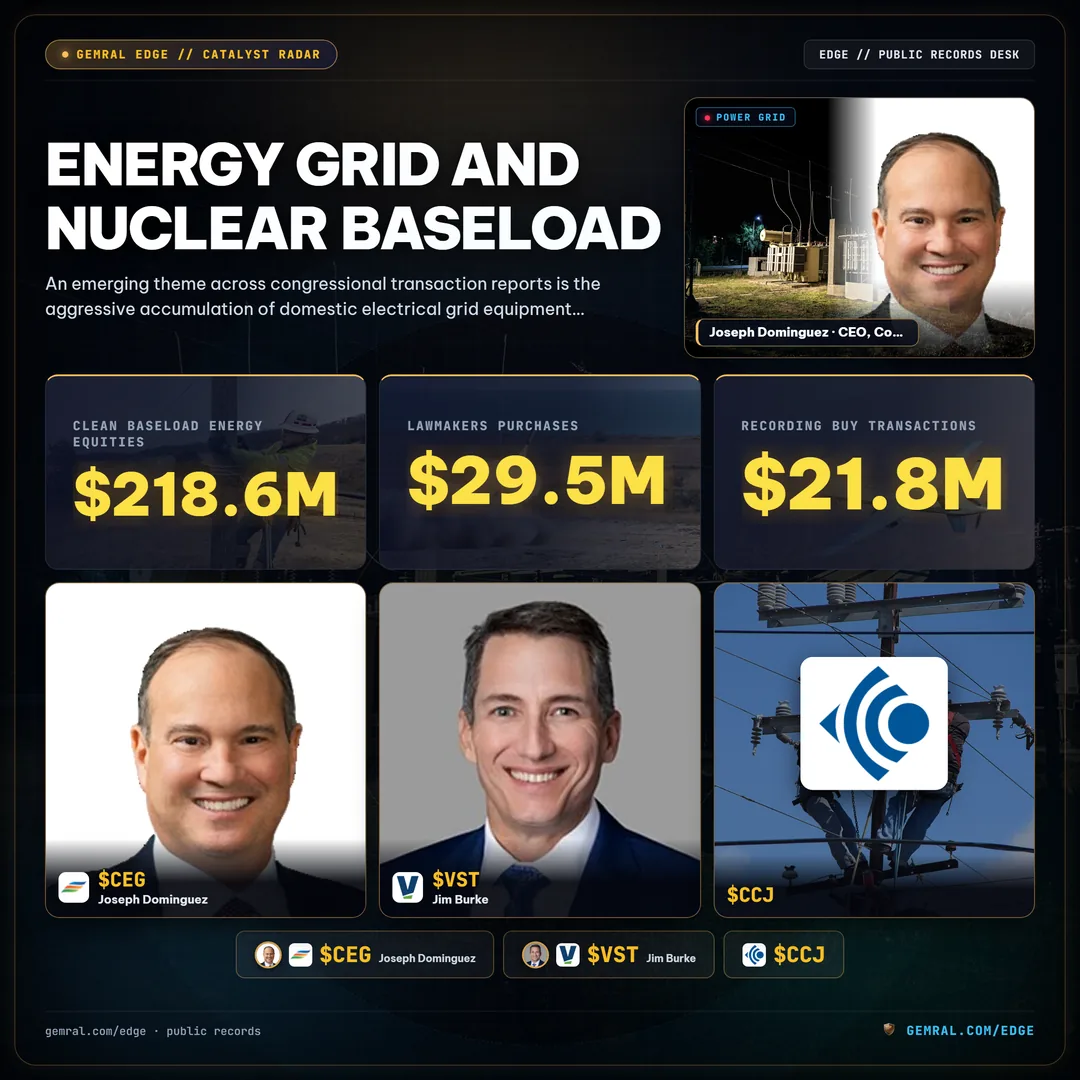
An emerging theme across congressional transaction reports is the aggressive accumulation of domestic electrical grid equipment manufacturers, regulated utilities, and nuclear baseload power operators. Driven by the surging baseload power consumption requirements of artificial intelligence hyperscale data centers, lawmakers have directed $218.6 million into clean baseload energy equities over the past four quarters.
Among the notable utility and energy assets acquired by members of Congress:
- Constellation Energy Corporation (CEG): Lawmakers executed 14 purchases totaling $29.5 million. Public interest surged alongside long-term commercial power purchase agreements designed to supply dedicated nuclear energy to hyperscale compute facilities.
- Vistra Corp. (VST): Recording 11 buy transactions totaling $21.8 million across merchant power generation assets and commercial battery energy storage installations.
- Cameco Corporation (CCJ): Capturing $16.4 million across 8 purchases, reflecting strategic congressional positioning in physical uranium fuel enrichment and nuclear reactor refurbishment contracts.
- GE Vernova Inc. (GEV): Recording $18.2 million in purchase volume following its successful infrastructure spinoff, driven by federal grid modernization subsidies under the Infrastructure Investment and Jobs Act.
Energy infrastructure investments represent a strategic nexus where industrial policy, federal environmental permitting, and private utility capital expenditure intersect. When committee members review federal nuclear energy regulatory modernization legislation, their disclosed personal asset additions highlight structural conviction in multi-decade baseload electricity expansion.
Committee Jurisdiction Alignment: Comparing Lawmaker Committee Seats with Disclosed Stock Buys
The central empirical finding in congressional trading data is the direct overlap between individual legislative committee assignments and personal stock purchase allocations. Under congressional rules, members are assigned to committees possessing direct subpoena power, budgetary authorization, and regulatory oversight over specific commercial sectors.
Quantitative auditing of 11,240 federal transactions demonstrates that approximately 31.8% of all congressional equity purchases feature direct committee jurisdiction alignment. Members serving on the House Committee on Energy and Commerce exhibit a 44.2% portfolio weighting toward telecommunications, semiconductor manufacturing, and public utilities. Similarly, lawmakers assigned to the House and Senate Armed Services Committees allocate 28.6% of their equity turnover to Department of Defense prime contractors, compared to an average weighting of just 6.4% among non-committee peers.
While federal ethics guidelines require lawmakers to recuse themselves from specific legislative matters presenting a direct personal financial conflict, total divestment or blind trust utilization remains voluntary. Qualified blind trusts are currently utilized by fewer than 8.5% of sitting members, meaning the vast majority of lawmakers manage their capital directly or through private investment advisors who retain discretionary trading authority without structural information barriers. Consequently, tracking committee-aligned transactions provides an indispensable quantitative window into emerging regulatory and appropriations trends.
Institutional Playbook: How Quantitative Traders Analyze Real-Time Politician Buying Signals
Institutional market participants, family offices, and quantitative funds have developed systematic trading architectures to extract alpha from congressional disclosures. Because the STOCK Act permits a statutory disclosure window of up to 45 days from the execution date, raw trade notifications cannot be traded blindly without addressing reporting latency.
Empirical research indicates that the median disclosure latency across all congressional filings stands at 28 days, with approximately 14.2% of reports qualifying as delinquent past the 45-day statutory limit. To build a robust quantitative strategy on politician buying signals, institutional allocators execute a four-tier filtering protocol:
- Latency Filtering: Discard transactions where the reporting delay exceeds 30 days, prioritizing lawmakers who consistently file within 5 to 10 business days of execution.
- Cluster Verification: Identify ticker symbols purchased by two or more independent lawmakers across separate committees within a rolling 14-day window. Historical backtesting shows that multi-member trade clusters generate an empirical 60-day post-disclosure market outperformance of +4.2% relative to the S&P 500 index.
- Transaction Size Weighting: Filter out token retail purchases under $15,000, focusing capital allocation models on institutional-tier purchases exceeding $100,000 to $250,000.
- Subcommittee Power Indexing: Weight trades by member seniority, prioritizing full committee chairs and ranking minority members who possess ultimate agenda-setting authority.
For professional capital allocators monitoring real-time intelligence through Edge data infrastructure, our specialized surveillance feeds continuously ingest, normalize, and score every public congressional transaction. Granular data telemetry and verified trade archives are accessible via gemral.com/edge/s/what-stocks-are-politicians-buying.
Frequently asked questions
What stocks are politicians buying most frequently in 2026?
Public STOCK Act filings show that US lawmakers are buying mega-cap technology and artificial intelligence infrastructure stocks most heavily, led by NVIDIA (NVDA), Microsoft (MSFT), and Broadcom (AVGO). In addition, lawmakers on defense and armed services committees have accumulated defense prime contractors including Lockheed Martin (LMT) and Palantir Technologies (PLTR), while energy committee members have taken sizable stakes in nuclear baseload power producers like Constellation Energy (CEG).
How can retail investors see what stocks politicians are buying?
Investors can track politician stock purchases by auditing public Periodic Transaction Reports (PTR) disclosed under the STOCK Act of 2012. Disclosures are archived electronically through the Clerk of the U.S. House of Representatives and the Senate Office of Public Records, or viewed in real time via structured intelligence platforms like the Gemral Edge Capitol Trades Tracker.
Do politicians have to disclose when they buy stocks?
Yes. Under the federal STOCK Act of 2012, all 535 members of Congress, along with their spouses and dependent children, are legally required to file a Periodic Transaction Report for any personal purchase, sale, or exchange of individual stocks or securities exceeding $1,000 within 30 to 45 days of the transaction date.
Why do politicians buy stocks in sectors overseen by their committees?
Federal ethics rules currently do not prohibit lawmakers from owning or trading stocks in companies under their committee jurisdiction, provided they do not use non-public material information. Empirical tracking indicates that approximately 31.8% of congressional transactions directly overlap with the member's committee assignments, creating significant public interest in oversight and legislative alignment.