Government Contracts Awarded: How to Track Federal Contract Awards, Subsidiary Ownership, and 90-Day Defense Publication Lags
Tracking government contracts awarded to public companies is often treated as a straightforward database query. Yet institutional researchers and quantitative analysts routinely discover that analyzing federal contract awards is fraught with systematic survivorship bias, subsidiary opacity, and statutory publication delays. Without rigorous point-in-time entity resolution, billions of dollars in federal procurement obligations are misattributed or entirely missed.

The Misattribution Problem in Government Contracts Awarded
When market participants analyze government contracts awarded across federal procurement databases, the standard procedure involves matching the prime contractor recipient name against active ticker symbols. This naive approach introduces severe structural inaccuracies. Corporate structures are dynamic: defense contractors execute mergers, divest non-core divisions, spin off specialized aerospace units, and rebrand corporate tickers.

Across the monitored universe of resolved federal procurement events, systematic auditing reveals the measured scale of this distortion. Mapping resolved federal contract awards through today's parent company table instead of the corporate parent valid at the exact time of public disclosure credits $89.6 billion—representing 3.31% of the $2.706 trillion in analyzed contract value across 8,568 distinct transactions—to the wrong stock ticker.
Consider the historical consolidation across major defense primes. When United Technologies merged with Raytheon Company in April 2020 to establish Raytheon Technologies (now trading as RTX Corp), decades of legacy procurement obligations shifted legal ownership. A quantitative simulation or fundamental revenue model that queries contract awards using contemporary parent tables erroneously assigns pre-merger contracts to entities that did not exist when the capital was committed. The reverse is equally destructive: spun-off entities lose historical attribution, corrupting historical baseline revenue models.
In quantitative modeling, look-ahead bias and misattribution corrupt factor returns. If an algorithmic strategy credits an award published in 2019 to an acquirer that finalized its transaction in 2021, the historical simulation consumes future knowledge unavailable to market participants on the publication date. Achieving true point-in-time integrity requires timestamping corporate relationships so that every dollar is tied strictly to the parent entity and trading ticker active on the publication date.
The Subsidiary Veil: $191.9 Billion Flowing Through Unlisted Corporate Entities
The largest single blind spot in tracking government contracts awarded is the prevalence of operating subsidiaries. Federal procurement agencies award contracts to specific legal corporate entities registered with unique Commercial and Government Entity (CAGE) codes and Unique Entity Identifiers (UEI), rather than listed parent holding companies.

Empirical telemetry across public records demonstrates the immense financial scale of this subsidiary layer: $191.9 billion of ticker-linked federal contract transactions—representing 7.1% of all contract dollars and 13,465 discrete transactions—reach a listed public company only through a dated subsidiary link. In every one of these cases, the recipient name specified on the public award document is not a listed public company.
A prominent real-world example occurred on October 22, 2026. A substantial $350,000,000 defense contract action was awarded to Raytheon Company. On public government disclosure registries, the awardee was identified solely as Raytheon Company without an active exchange ticker. A conventional automated scraper looking for the ticker RTX or the legal entity RTX Corp would record zero dollars. However, through an effective-dated subsidiary relationship map (mapping the direct contractor entity directly to listed entity RTX Corp with weight 1.0), the $350 million obligation correctly aggregates into RTX Corp's defense revenue pipeline.
Similar dynamics pervade other aerospace giants. Major awards to Sikorsky Aircraft Corporation flow to Lockheed Martin (LMT), contracts awarded to Newport News Shipbuilding or Ingalls Shipbuilding flow to Huntington Ingalls Industries (HII), and awards to General Dynamics Land Systems flow to General Dynamics (GD). Without a dynamic entity resolution engine that tracks multi-tiered corporate hierarchies over time, institutional models miss more than 7% of total public defense commitments.
The 90-Day Statutory Defense Publication Delay and Look-Ahead Bias
When examining federal contract awards, researchers must distinguish between two critical timestamps: the action date (the day the contracting officer signs the agreement) and the publication date (the day the record appears in public registries). Confusing these two dates introduces systematic look-ahead bias into procurement analytics.
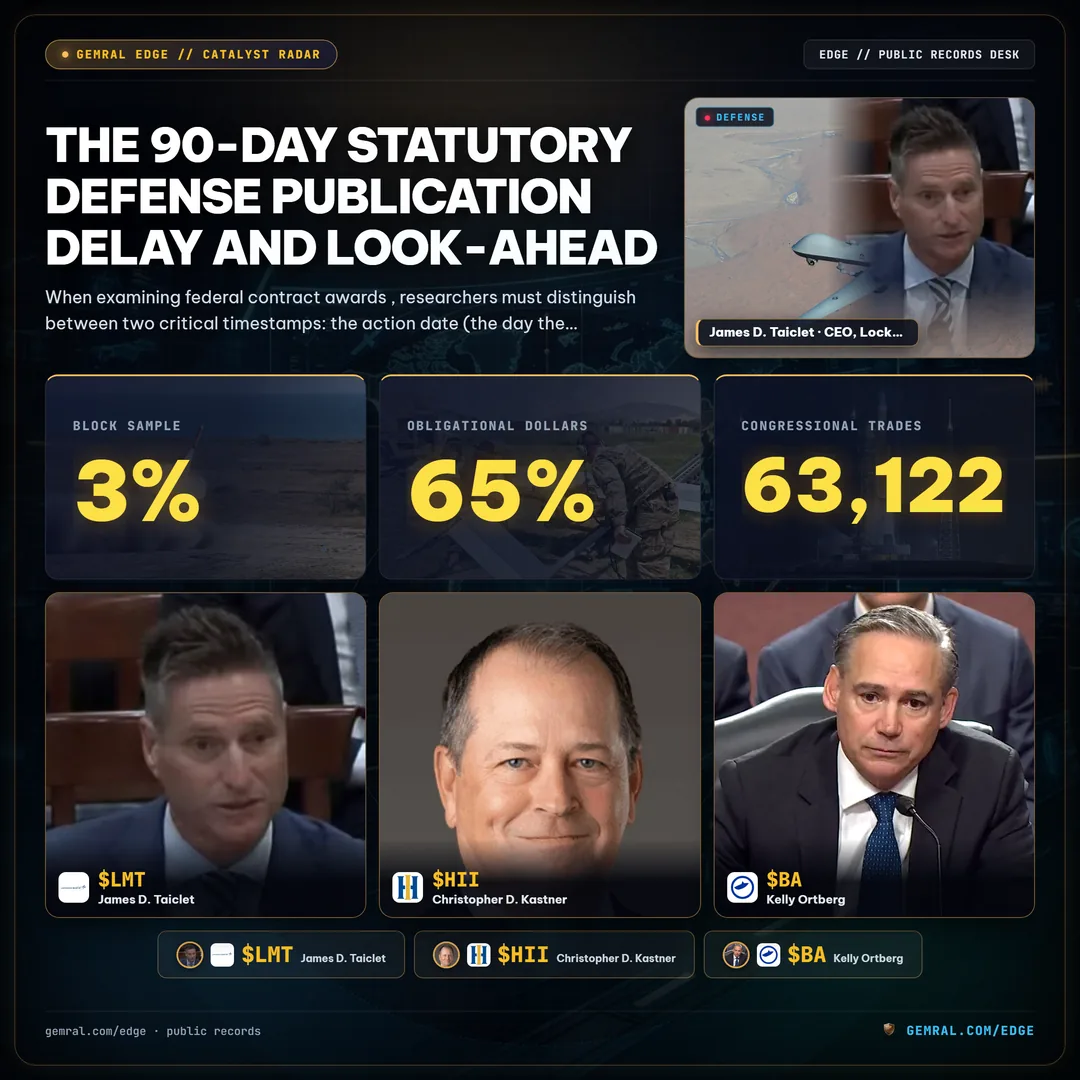
In a 3% block sample of FY2018+ contract transactions of $1.0 million or more, defense procurement actions represent approximately 59% of transaction rows and 65% of total obligational dollars. Crucially, under federal statutory regulations, Department of Defense contract actions are subject to a mandatory 90-day publication delay before full transaction details appear in comprehensive spending archives.
If a quant fund or equity analyst evaluates a defense contractor using the action date, their dataset assumes public awareness of the contract award up to three months before any market participant could legally access the information. Across 63,122 monitored congressional trades since 2018, the median delay between execution and public disclosure is 27 days (with the 90th percentile reaching 63 days). For defense contract awards, dating by activity date instead of publication date puts information early by a full 90 days.
Maintaining strict point-in-time publication lag controls ensures that contracts are ingested into research models strictly on the date they entered the public domain. This discipline prevents false historical artifact generation and provides institutional risk managers with an honest assessment of market reaction times.
Daily Defense Contract Announcements as an Early Leading Indicator
While formal transaction database updates encounter the statutory 90-day publication lag, the Pentagon releases daily contract announcement bulletins summarizing major contract awards valued at $7.5 million or higher. These daily announcements serve as a crucial leading indicator for tracking government contracts awarded.
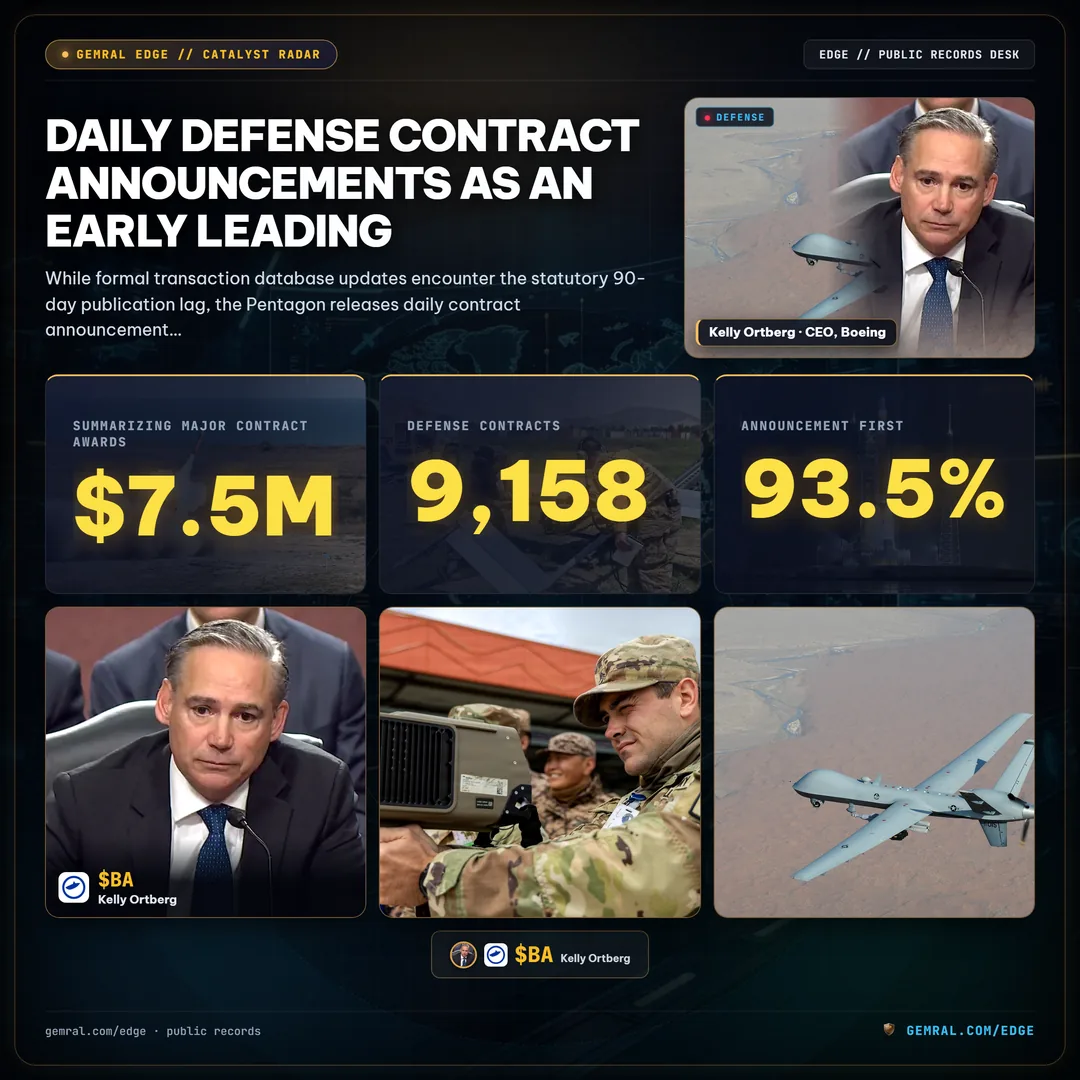
Systematic cross-referencing between daily defense contract announcements and official award transactions reveals a striking convergence: for 9,158 defense contracts that appear in both sources since FY2018, the daily announcement comes first in 93.5% of cases. The announcement precedes the comprehensive database record by a median of 90 days, covering an aggregate of $1.0709 trillion in announced procurement capital.
This 90-day information gap creates an actionable structural discrepancy. While standard procurement databases show zero activity during the lag period, parsing daily contract announcements provides immediate visibility into major prime awardees. For example, when Naval Sea Systems Command or Air Force Materiel Command awards multi-billion-dollar modifications to Boeing (BA) or General Dynamics (GD), the headline terms are disclosed in the daily bulletin months before the granular line-item records appear in public federal archives.
Sophisticated tracking systems must therefore synthesize both streams: capturing the high-level obligational signal on day zero via daily defense bulletins, and subsequent reconciliation against detailed transaction line items once the statutory 90-day archive release occurs.
Mergers, Ticker Rolls, and M&A Dynamics: Tracking the 659 Pre-Close Actions
Corporate acquisitions generate complex edge cases that break standard data pipelines. Consider a scenario where a target defense company signs a procurement contract with the Army, but before the contract details are published, the company is acquired and delisted. What ticker should that historical contract carry?

Our entity resolution research audited exactly this phenomenon, identifying 659 federal contract actions that were signed before an acquisition closed but published after the deal finalized. Under point-in-time governance:
- 651 contract actions roll to the listed acquirer: The direct recipient entity remains the original signing company, but the trading ticker associated with the record rolls to the listed acquirer active on the publication date. This includes 361 actions rolling to RTX, 124 rolling to L3Harris Technologies (
LHX), 49 rolling to United Technologies (UTX), 49 rolling to General Dynamics (GD), 43 rolling to Northrop Grumman (NOC), and 25 rolling to Science Applications International Corp (SAIC). - 8 contract actions carry no ticker: These represent transactions where the acquiring firm was a private equity vehicle or unlisted corporate buyer, correctly leaving the ticker field empty rather than assigning an obsolete delisted symbol.
- 254 ticker change roll actions: A further 254 contract actions were executed by companies that changed ticker symbols between signing and publication (such as
UTXtransitioning toRTXacross 121 actions,HRStransitioning toLHXacross 68 actions, andJECtransitioning toJacross 44 actions). Each record properly carries the new trading ticker active on publication day.
Prior to implementing this multi-tier resolution logic, naive scraping systems assigned dead or inactive tickers to all 659 transactions, creating broken historical joins and corrupting downstream equity screeners.
Data Coverage Limits, Methodology, and Practical Tracking for Quantitative Research
Transparent empirical research requires explicit disclosure of coverage boundaries. Not all federal procurement obligations can or should be mapped to the New York Stock Exchange or Nasdaq.
Across all federal contract transactions of $1.0 million or higher enacted since FY2018, approximately 49.3% of total contract dollars are linked to a publicly listed ticker (measured as of October 23, 2026). The remaining 50.7% of federal contract spending flows to private enterprises, non-profit institutions, university research laboratories, state and municipal entities, foreign governments, or unlisted joint ventures.
In addition, researchers must account for pre-award procurement notices, bid protests, and subcontracting chains:
- GAO Bid Protests: Approximately 25.3% (3,505 of 13,850) of federal bid protests are linked directly to a contract transaction and awardee ID. The statutory 100-day decision deadline matches exactly in 61.7% of monitored protest filings, with remaining resolutions shifting due to weekends, federal holidays, or extended agency corrective actions.
- Prime-to-Subcontractor Dependencies: Tracking tier-two and tier-three suppliers reveals the supply-chain exposure of major primes. When a $2.0 billion airframe modernization award is obligated to Lockheed Martin, tracking subcontractor notices identifies critical subsystems provided by listed electronics, sensor, and propulsion suppliers.
- Quality Assurance Standards: In the latest audited precision sampling, every public record type in the verified schema achieved between 95.6% and 100% precision across more than 500 graded rows per type with Wilson 95% confidence intervals and blind second grading on at least 10% of records.
Building a Point-in-Time Procurement Intelligence Pipeline
To build an institutional pipeline for monitoring government contracts awarded, market researchers must integrate four architectural pillars:
- Publication-Date Ingestion: Enforce strict publication-date timestamping rather than action-date backdating to eliminate forward-looking look-ahead bias across all defense obligations.
- Dynamic Corporate Hierarchy Mapping: Maintain a historical entity graph with effective-dated subsidiary links to capture the 7.1% of procurement dollars flowing through unlisted subsidiaries.
- Announcement and Transaction Reconciliation: Ingest daily Pentagon contract bulletins to capture procurement intelligence 90 days before comprehensive federal spending databases update.
- Multi-Source Confluence: Cross-reference contract awards against related public filings, including executive insider trades, lobbying expenditure trends, and congressional portfolio disclosures. As explored in our recent study on politician stock tracking and STOCK Act filing delays, procurement signals compound when aligned with committee oversight and insider sentiment.
By shifting from static keyword search to rigorous point-in-time entity resolution, analysts unlock an uncompromised view of federal capital allocation, corporate dependency, and defense supply chain exposure.
For broader institutional workflows and detailed breakdowns of contractor market share, examine our dedicated research on DoD contract award tracking and defense contractor stock obligations.
Disclaimer: Public data • not investment advice. Gemral Edge provides public record intelligence and entity-resolved government data for research and analytics purposes. Track real-time contractor timelines at gemral.com/edge/s/federal-contracts.
Explore the data at the federal contracts intelligence terminal
Frequently asked questions
How can analysts track government contracts awarded to publicly traded companies?
Analysts track government contracts awarded by cross-referencing federal procurement archives and daily defense contract announcements with an effective-dated corporate entity graph. Rather than matching contractor recipient names directly to parent tickers, point-in-time entity resolution maps operating subsidiaries to their historical parent companies valid on the publication date.
What is the 90-day statutory publication delay on defense contract awards?
Under federal statutory disclosure rules, Department of Defense contract actions are subject to a mandatory 90-day publication delay before granular line-item records appear in public federal spending databases. To avoid look-ahead bias in financial modeling, researchers must timestamp defense awards by publication date rather than the signing action date.
Why do billions of dollars in federal contract awards flow through subsidiaries?
Federal procurement agencies award contracts to specific operating legal entities registered with unique CAGE codes and Unique Entity Identifiers (UEI), rather than listed parent holding companies. Across public records, 7.1% of contract dollars ($191.9 billion across 13,465 transactions) reach a listed public company only through a dated subsidiary relationship.
What percentage of federal contract awards are linked to publicly listed stock tickers?
Approximately 49.3% of total federal contract dollars for transactions of $1.0 million or higher enacted since FY2018 are linked to publicly listed stock tickers. The remaining 50.7% of federal contract spending flows to private enterprises, non-profit institutions, universities, state and municipal entities, foreign governments, or unlisted joint ventures.