DoD Contract Awards: Tracking Daily Defense Procurement, Prime Vendor Obligations, and Budget Outlays
Every business day at 5 PM Eastern Time, the United States Department of Defense publishes its official record of prime procurement awards exceeding $7.5 million. Analyzing these public obligation notices provides institutional analysts with a real-time data stream of sovereign capital allocation, program milestones, and defense industrial base backlogs.

How the Department of Defense Announces Daily Contract Awards and Prime Obligations
Federal defense procurement operates under stringent statutory transparency mandates designed to preserve accountability in public expenditure. Under the Defense Federal Acquisition Regulation Supplement (DFARS) Subpart 205.303, the Department of Defense is legally bound to publish public announcements for all contract actions that equal or exceed $7.5 million. These disclosures, coordinated by the Office of the Assistant to the Secretary of Defense for Public Affairs, provide a daily accounting of prime obligations committed across United States military services.

In a typical federal fiscal year governed by an authorized National Defense Authorization Act (NDAA) budget reaching $895.2 billion, the Pentagon obligates more than $430.0 billion into contracts with commercial entities and defense prime vendors. On any standard operating business day, the Pentagon releases between 15 and 35 distinct contract actions, representing aggregate daily obligations ranging from $150.0 million to more than $3.5 billion during peak fiscal quarter reconciliations.
Each daily release itemizes the specific military contracting activity, the corporate legal entity selected, the precise dollar figure obligated at award, the overarching contract structure, the place of performance, and the scheduled completion date. Understanding the mechanics of these announcements allows market participants to separate newly appropriated capital from routine administrative modifications and delivery order options.
Navigating Daily Defense Contract Awards Databases and Verification Feeds
Systematic tracking of daily defense contract awards requires navigating multiple public disclosure systems. The primary source remains the official Department of Defense contracts portal, which archives daily releases published at 5 PM Eastern Time. While these notices deliver immediate headline intelligence, comprehensive institutional analysis requires cross-referencing daily releases against secondary federal transaction registries.

Specifically, daily DoD releases transition into formal accounting records archived within the Federal Procurement Data System (FPDS) and primary federal procurement registries. While daily announcements summarize high-level contract scope, official archives contain granular data elements including North American Industry Classification System (NAICS) designations, Product Service Codes (PSC), competitive bidding indicators, and exact subcontracting plan requirements.
Contract awards are historically distributed across major service branches. The Department of the Navy, encompassing both naval architecture and Marine Corps procurement, typically commands approximately 32.0% of daily award value, heavily weighted toward long-cycle shipbuilding and naval aviation. The Department of the Air Force accounts for roughly 30.0%, driven by advanced aerospace systems, space surveillance platforms, and strategic deterrents. The Department of the Army represents approximately 26.0% of obligations, centering on ground combat vehicles, tactical munitions, and soldier modernization systems. The remaining 12.0% is allocated across defense-wide agencies including the Defense Logistics Agency (DLA), Missile Defense Agency (MDA), and Defense Information Systems Agency (DISA).
Comparing Defense Procurement Allocations Across Prime Contractors and Budget Years
A critical analytical exercise in defense tracking is distinguishing how procurement allocations vary between prime contractors and across consecutive fiscal budget years such as 2024, 2025, 2026, 2027, and 2028. Contract structures disclosed in daily notices fundamentally govern the operational and financial profile of prime awardees.
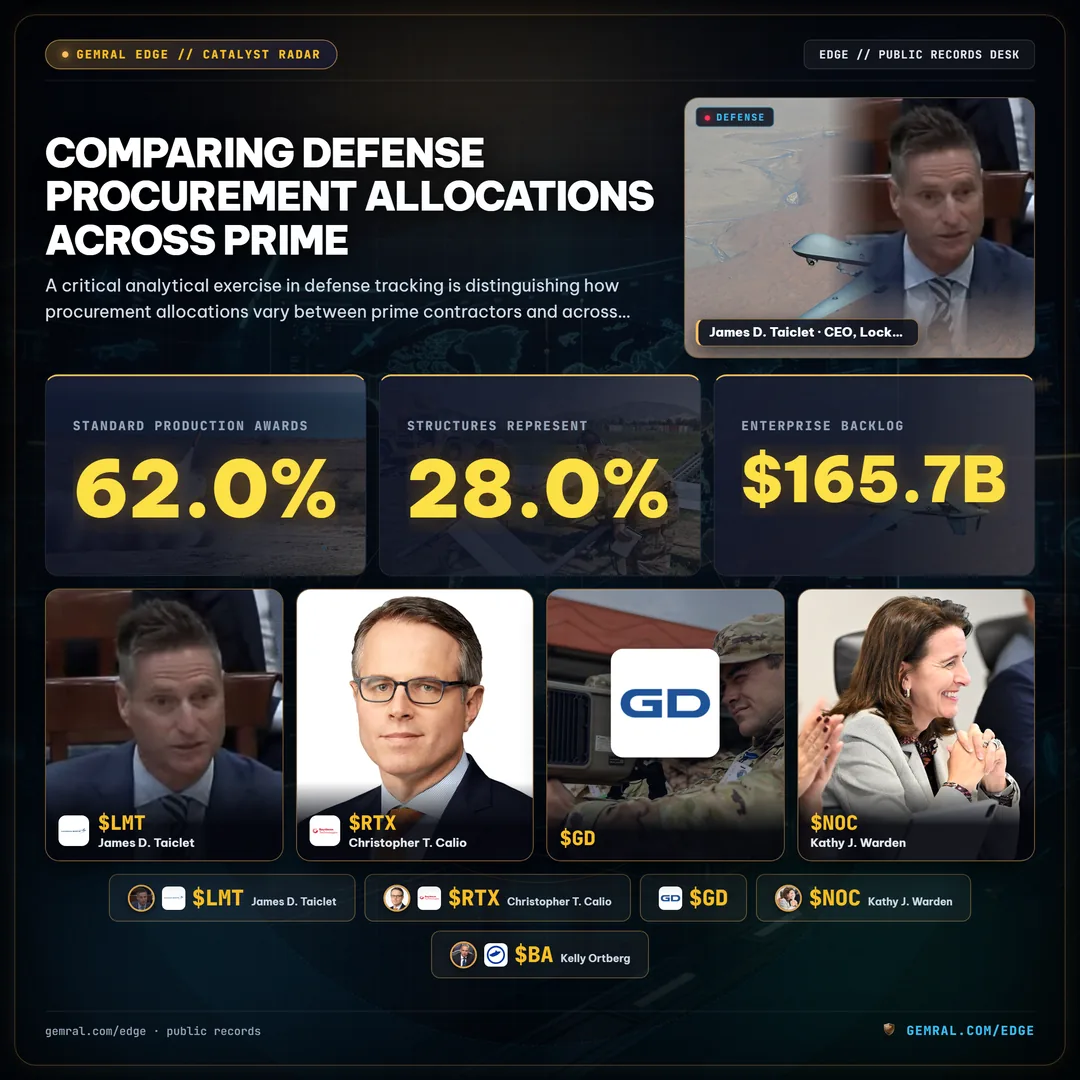
Firm-Fixed-Price (FFP) contracts constitute approximately 62.0% of standard production awards. In an FFP contract, the contractor agrees to deliver specified defense articles or services at a predetermined ceiling, absorbing inflationary pressures while maximizing operating margins on mature, serialized production lines. Conversely, Cost-Plus-Fixed-Fee (CPFF) and Cost-Plus-Incentive-Fee (CPIF) structures represent roughly 28.0% of daily notices, primarily reserved for high-risk research, development, test, and evaluation (RDT&E) initiatives such as sixth-generation air dominance and hypersonic glide interceptors. Time-and-materials and Indefinite Delivery Indefinite Quantity (IDIQ) task orders represent the remaining 10.0% of daily contract volume.
Daily award monitoring provides visibility into the competitive distribution among tier-one primes:
- Lockheed Martin (LMT): Disclosures routinely feature multi-billion-dollar lot procurements and sustainment modifications for the F-35 Joint Strike Fighter, PAC-3 air defense interceptors, and HIMARS rocket systems, supporting an enterprise backlog of $165.7 billion.
- RTX Corporation (RTX): Daily awards frequently detail missile systems and radar arrays including Patriot missile replenishments, AMRAAM deliveries, Tomahawk cruise missiles, and AN/SPY-6 radar installations, reinforcing a backlog of $206.0 billion.
- General Dynamics (GD): Prominent in naval systems awards covering Virginia-class and Columbia-class submarine construction, DDG-51 Arleigh Burke destroyers, and Abrams combat vehicle upgrades, maintaining a $91.4 billion backlog.
- Northrop Grumman (NOC): Recurring awards reflect classified aerospace developments, B-21 Raider long-range strike bomber production lots, and Sentinel intercontinental ballistic missile modernization, underpinning an $85.3 billion backlog.
- Boeing Defense (BA): Disclosures capture ongoing orders and modifications for maritime surveillance (P-8A Poseidon), tactical aviation (F-15EX Eagle II), and aerial refueling platforms (KC-46A Pegasus), representing a defense backlog of $62.1 billion.
Integrating Defense Department Awards into Broad Federal Procurement and Backlog Tracking
Tracking daily DoD contract awards is not an isolated exercise; it forms the backbone of comprehensive federal procurement monitoring. While defense contracts account for the lion's share of discretionary federal procurement, correlating defense releases with civilian agency awards across the Department of Energy, NASA, and the Department of Homeland Security provides an integrated picture of national security industrial capacity.
For quantitative researchers, daily award tracking serves as an early indicator of revenue realization. As explored in our analysis of defense contractor stock valuations and rankings of the top defense contractors by revenue, contract awards announced at 5 PM EST represent sovereign commitments that subsequently flow into corporate funded backlog schedules disclosed in quarterly SEC Form 10-Q and Form 10-K filings. By monitoring cumulative daily award announcements over 30-day, 60-day, and 90-day intervals on the Defense Contracts Hub, researchers can estimate book-to-bill multiples and verify corporate guidance well before quarterly earnings announcements.
Automated intelligence platforms like Gemral Edge track these public regulatory filings, mapping statutory contract awards, Congressional trade disclosures, and institutional ownership shifts to provide systematic market transparency.
Frequently asked questions
What are DoD contract awards and what is the statutory disclosure threshold?
DoD contract awards are daily public notices published by the Office of the Assistant to the Secretary of Defense for Public Affairs. Under Defense Federal Acquisition Regulation Supplement (DFARS) Subpart 205.303, the Department of Defense is legally required to announce any federal contract action, modification, or delivery order that equals or exceeds a statutory threshold of $7.5 million.
What time are daily Department of Defense contract announcements published?
Daily DoD contract awards are routinely released at 5 PM Eastern Time on official federal business days via defense.gov. Each announcement categorizes awards by military department (Army, Navy, Air Force, and Defense Agencies) and specifies the contracting activity, contractor name, award value, contract structure, and expected completion date.
How do daily defense contract awards impact prime contractor backlogs?
When the Pentagon announces a contract award, the obligated dollar value represents legally committed sovereign capital. For publicly traded prime contractors like Lockheed Martin, RTX Corporation, and General Dynamics, these awards directly augment funded and total backlog, providing transparent revenue visibility that spans multiple fiscal budget cycles.
What is the difference between an unclassified DoD contract notice and a full FPDS record?
Daily defense.gov announcements provide immediate, headline-level notice of major contract actions valued at $7.5 million or more. Detailed transaction reporting containing precise accounting line items, North American Industry Classification System (NAICS) codes, and sub-tier obligation breakdowns is subsequently archived in the Federal Procurement Data System (FPDS) and federal award databases within 30 to 90 days.