Top Defense Contractors by Revenue: Federal Procurement and Pentagon Contract Analysis
Federal procurement records audited across the Pentagon contract database and mapped through Gemral Edge Contract Intelligence establish that federal military outlays remain concentrated in a tightly grouped oligopoly. The United States defense budget allocates more than $842 billion in discretionary spending, with over $315 billion deployed specifically into procurement, research, development, test, and evaluation (RDT&E) accounts.

Within that capital allocation stream, the prime contractor ecosystem operates with distinct structural barriers to entry. Capital intensive military platforms—such as the F-35 Joint Strike Fighter, Columbia-class ballistic missile submarines, and the Sentinel intercontinental ballistic missile modernization—require security clearances, specialized manufacturing drydocks, and decades of engineering compliance that commercial tech firms cannot duplicate quickly. For institutional capital, understanding how annual contract awards translate into corporate top-line revenue requires tracking multi-year obligations against recognized delivery cycles.
Who Are the Top Defense Contractors by Revenue?
Lockheed Martin Corporation (NYSE: LMT) stands as the world's largest dedicated defense contractor by revenue, generating $67.6 billion in consolidated net sales, with approximately $65.3 billion (96%) directly attributable to defense and national security customers. The company's Aeronautics segment, anchored by the F-35 program, delivers over $27.5 billion alone, supported by Missiles and Fire Control (MFC) providing PAC-3 interceptors and Guided Multiple Launch Rocket Systems (GMLRS) with an enterprise backlog reaching $160.6 billion.

RTX Corporation (NYSE: RTX) reports $68.9 billion in total commercial and defense sales, with its dedicated defense operations accounting for $40.6 billion. RTX's defense footprint is concentrated across its Raytheon business unit—specializing in naval radars, AMRAAM air-to-air missiles, and the Tomahawk cruise missile program—paired with Pratt & Whitney’s military propulsion division supplying F135 engines for military airframes. RTX maintains an enterprise backlog of $206 billion, of which $78 billion represents direct defense commitments.
General Dynamics Corporation (NYSE: GD) delivers $42.3 billion in consolidated revenue, with defense segments contributing $33.5 billion across Marine Systems, Combat Systems, and Technologies. Marine Systems operates as the sole-source builder for the U.S. Navy's Virginia-class fast-attack and Columbia-class ballistic missile nuclear submarines, maintaining a funded defense backlog of $93.6 billion that provides multi-year revenue visibility extending past 2032.
Northrop Grumman Corporation (NYSE: NOC) records $39.3 billion in net sales, with defense work comprising $34.5 billion (88%). Northrop operates as the prime architect for the nation's nuclear triad modernization, serving as prime contractor for the B-21 Raider stealth bomber and the ground-based Sentinel strategic deterrent, supported by a specialized space systems segment driving an $84.2 billion backlog.
The Boeing Company's Defense, Space & Security (NYSE: BA BDS) division contributes $24.9 billion in government revenue out of $77.8 billion in total corporate volume. Despite commercial airframe volatility, Boeing BDS sustains production across military platforms including the KC-46A Pegasus aerial refueling tanker, the P-8A Poseidon maritime surveillance aircraft, and the F-15EX Eagle II fighter, backed by a defense order book of $59 billion.
Backlog Velocity: How Multi-Year Federal Contract Awards Shape Defense Cash Flows
To evaluate defense contractors accurately, investors must distinguish between discrete contract award announcements and cumulative order backlogs. When the Pentagon announces a multi-billion-dollar framework, the headline amount represents authorized program ceilings rather than cash disbursed on day one.
Federal obligations are authorized through the congressional appropriations process and incrementally obligated as prime contractors hit development and delivery milestones. A defense contractor's book-to-bill ratio—the ratio of new contract orders booked to revenue billed during the period—measures future revenue expansion. Across fiscal 2025 and 2026, the aggregate book-to-bill ratio for the top five defense primes has averaged 1.18x, confirming that new government commitments continue to outpace annual delivery billings.
The cumulative defense backlog across the top five contractors reached $475.4B in multi-year commitments, compared against $198.8B in annual deliveries. Furthermore, unfunded potential options across existing indefinite-delivery contracts represent an additional $142B in potential procurement volume. Major weapon systems carry an average development schedule of 7 years, insulating contractor cash flows from annual commercial fluctuations.
This backlog accumulation provides insulation from cyclical macroeconomic downturns. Because procurement budgets for major weapon systems are appropriated across multi-year statutory horizons, prime contractor cash flows reflect contractual production commitments locked into federal budget line items years in advance.
Comparing Prime Pentagon Obligations Across the Top 5 Defense Giants
Examining the distribution of prime contract obligations reveals stark differences in portfolio concentration, defense revenue reliance, and core military platform exposure:

| Company | Ticker | Consolidated Revenue | Defense Revenue | Defense Share | Defense Backlog | Core Military Franchises |
|---|---|---|---|---|---|---|
| Lockheed Martin | LMT | $67.6B | $65.3B | 96% | $160.6B | F-35 Fighter, PAC-3 Patriot, Aegis Combat System |
| RTX Corporation | RTX | $68.9B | $40.6B | 59% | $78.0B (Def.) | Pratt F135 Engines, AMRAAM, Tomahawk, SPY-6 Radar |
| General Dynamics | GD | $42.3B | $33.5B | 79% | $93.6B | Columbia Submarines, M1A2 Abrams, IT Services |
| Northrop Grumman | NOC | $39.3B | $34.5B | 88% | $84.2B | B-21 Raider Bomber, Sentinel ICBM, Space Sensors |
| Boeing Defense | BA | $77.8B (Total) | $24.9B | 32% | $59.0B | KC-46A Tanker, P-8A Poseidon, F-15EX, Apache |
As documented in research on AI companies with government contracts and broader federal procurement dynamics, the capital allocation strategy among the primes increasingly incorporates autonomous command networks, electronic warfare pods, and uncrewed autonomous collaborative combat aircraft (CCA).
Beyond the Primes: How Subcontractor Award Cascades Reveal Defense Supply Chains
While the top five prime contractors capture the largest single contract announcements, between 40% and 60% of total prime contract dollars are subsequently disbursed across sub-tier supplier networks. Major weapon systems operate as complex assembly networks requiring specialized precision engineering.
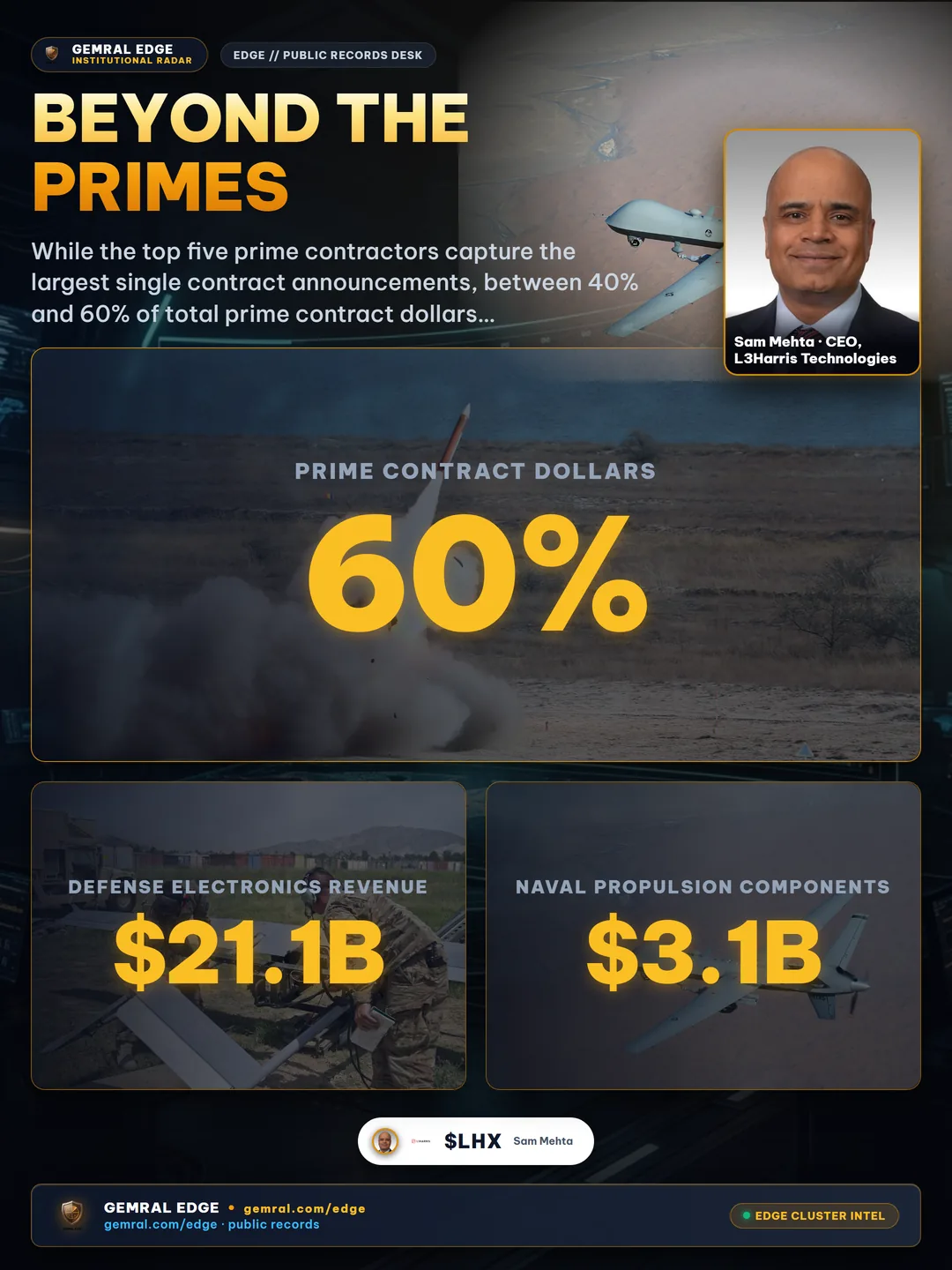
Tier-2 and tier-3 defense suppliers deliver essential subsystems, propulsion units, and radio-frequency avionics across every major weapon system. Publicly traded subsystem suppliers include: L3Harris Technologies recorded $21.1B in defense electronics revenue, Curtiss-Wright generated $3.1B in naval propulsion components, TransDigm Group delivered $6.6B in aerospace components, Moog Inc. booked $3.6B in precision flight controls, and Kratos Defense posted $1.1B in unmanned aerial target systems. Subcontractor allocations capture 54% of total prime contract disbursements.
Cross-referencing supplier relationships with regulatory filings—such as insider buy vs sell ratios across federal contractors and federal contract awards cross-referenced with congressional trades—provides quantitative visibility into which component suppliers experience rising order acceleration prior to prime production ramps.
All contract obligation amounts, backlog calculations, and revenue disclosures cited in this report originate from official U.S. Department of Defense contract release archives, congressional budget justification exhibits, and SEC Form 10-K filings.
Official Data Sources
• U.S. Department of Defense FY2026 Budget Request and Procurement Exhibits: comptroller.defense.gov/Budget-Materials
• Lockheed Martin Corporation SEC Form 10-K Annual Report: sec.gov/browse/?CIK=0000936468
• RTX Corporation SEC Form 10-K Annual Report: sec.gov/browse/?CIK=0000101829
Frequently asked questions
Who is the largest defense contractor by revenue in the world?
Lockheed Martin (NYSE: LMT) ranks as the largest defense contractor by pure defense revenue, generating approximately $65.3 billion in defense-specific net sales out of $67.6 billion in total annual corporate revenue, representing roughly 96% defense reliance.
What percentage of Pentagon contract obligations go to the top 5 defense primes?
The top five prime defense contractors—Lockheed Martin, RTX Corporation, General Dynamics, Northrop Grumman, and Boeing—consistently capture over 30% of total unclassified Department of Defense procurement and research obligation dollars, totaling more than $118 billion annually.
How do multi-year defense backlogs differ from annual revenue?
A defense backlog represents cumulative funded and unfunded contractual commitments that will be converted into recognized revenue over multiple future fiscal years as deliverables are completed, whereas annual revenue reflects only work billed within the trailing twelve-month accounting period.