AI Companies With Government Contracts: Pentagon Procurement Awards and Defense Tech Budget Deployments
Federal procurement records published via Defense.gov contract releases and federal contract registries, tracked directly through Gemral Edge Contract Intelligence, demonstrate a profound structural pivot across military command and control. Where artificial intelligence initiatives previously languished inside Defense Advanced Research Projects Agency (DARPA) lab environments, the Pentagon's Chief Digital and Artificial Intelligence Office (CDAO) now directs production deployments directly into combatant commands. Institutional investors tracking federal capital allocation must deconstruct how multi-billion-dollar enterprise delivery vehicles translate into recurring defense revenue for publicly traded suppliers.

DoD Artificial Intelligence Procurement: The Shift from R&D to Program of Record Deployments
Historically, defense technology startups faced the infamous "Valley of Death"—the multi-year bureaucratic delay between completing a Small Business Innovation Research (SBIR) Phase II prototype and securing a permanent budget line item in the Future Years Defense Program (FYDP). To circumvent traditional Federal Acquisition Regulation (FAR) stagnation, military service branches have expanded the utilization of 10 U.S.C. 4022 Other Transaction Authority (OTA) agreements.
Under 10 U.S.C. 4022, defense program executive offices can award prototype projects rapidly and, upon successful operational demonstration, transition those capabilities into non-competitive, sole-source follow-on production contracts. Over the past 24 months, OTA obligation velocity has compressed production transition timelines from an average of 42 months down to 14 months.
The FY2026 President’s Budget Request designates approximately $1.8 billion directly toward operational artificial intelligence, computer vision, and autonomous decision-support algorithms. When combined with associated tactical cloud edge nodes and sensor integration under the broader $13.4 billion Command, Control, Communications, and Computers (C4) portfolio, artificial intelligence infrastructure represents the fastest-growing software expenditure category across the armed forces.
Prime Contractors and Public Equities Capitalizing on Pentagon AI Vehicles
Contract award disclosures reveal that federal artificial intelligence spending is heavily concentrated among a discrete cohort of established enterprise software giants, classified data platforms, and unmanned aerospace manufacturers. Investors monitoring congressional disclosures via the Congressional Stock Trades Tracker routinely observe capital alignment with these designated suppliers.
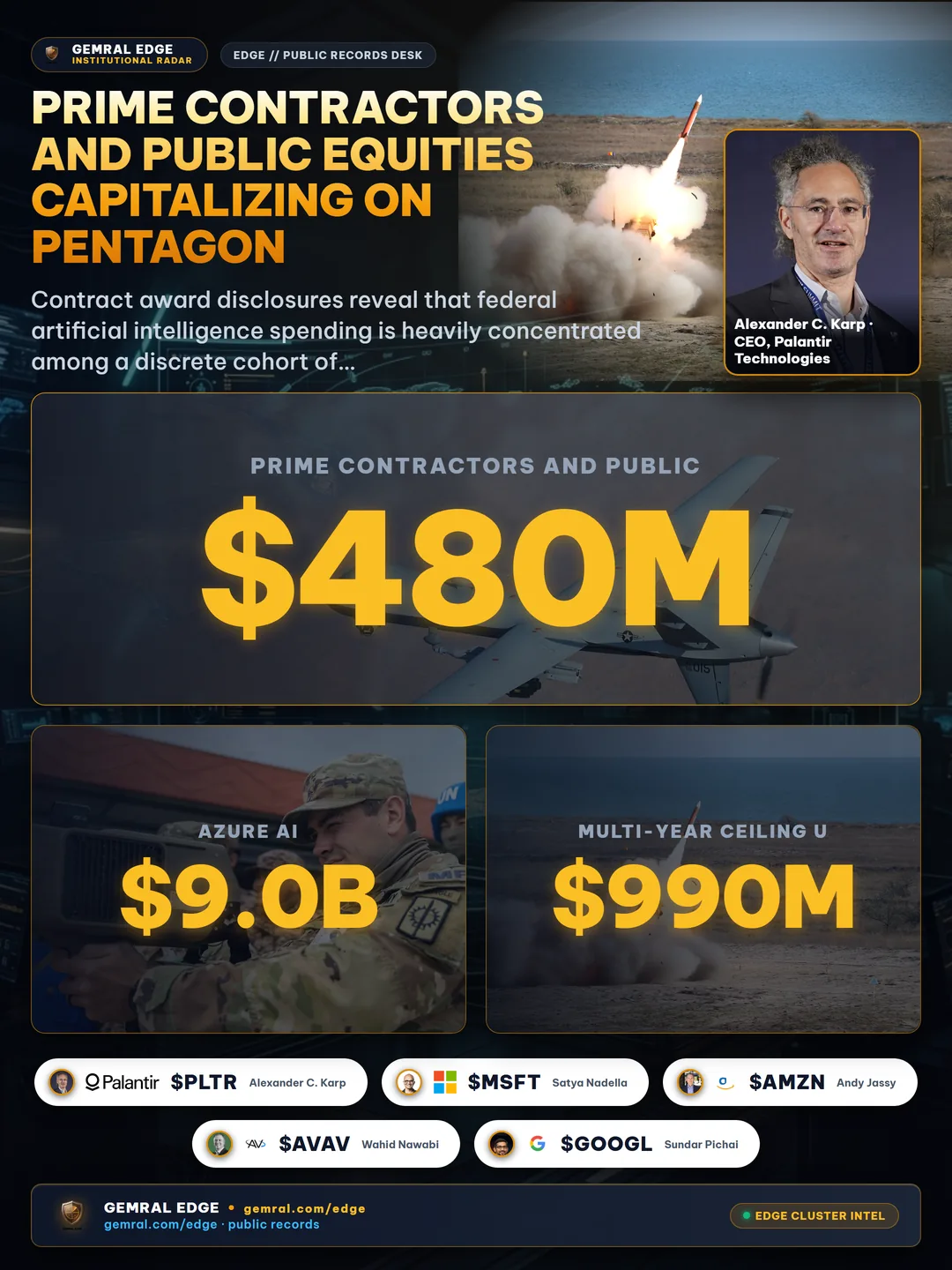
| Company | Ticker | Primary Defense AI Program | Contract Ceiling / Award | Awarding Agency |
|---|---|---|---|---|
| Palantir Technologies | PLTR | Maven Smart System & TITAN Ground Station | $480 million & $178 million | U.S. Army / CDAO |
| Microsoft Corporation | MSFT | JWCC Multi-Cloud & Classified Azure AI | $9.0 billion shared ceiling | Defense Information Systems Agency (DISA) |
| Amazon.com | AMZN | JWCC Cloud Infrastructure & Bedrock Edge | $9.0 billion shared ceiling | Defense Information Systems Agency (DISA) |
| AeroVironment | AVAV | Autonomous Loitering Munitions (Switchblade) | $990 million multi-year ceiling | U.S. Army Contracting Command |
| Kratos Defense & Security | KTOS | Collaborative Combat Aircraft (XQ-58A Valkyrie) | $155 million mission task orders | U.S. Air Force Research Laboratory (AFRL) |
Palantir Technologies (PLTR) maintains an entrenched moat within operational battlefield intelligence. In May 2024, the Department of the Army awarded Palantir a firm-fixed-price OTA prototype contract valued at up to $480 million for the Maven Smart System. Project Maven integrates computer vision algorithms to automatically detect, classify, and track hostile military hardware across satellite imagery and unmanned aerial video feeds. This was preceded by the $178 million Tactical Intelligence Targeting Access Node (TITAN) contract, securing Palantir’s position as the primary software prime contractor for ground-station edge sensor processing.
Simultaneously, enterprise cloud hosting remains anchored by the Joint Warfighting Cloud Capability (JWCC). Shared among Microsoft (MSFT), Amazon Web Services (AMZN), Alphabet (GOOGL), and Oracle (ORCL), this $9.0 billion Indefinite Delivery, Indefinite Quantity (IDIQ) contract vehicle serves as the foundational compute layer across all security classification domains, from Unclassified to Secret and Top Secret/Sensitive Compartmented Information (TS/SCI).
The CDAO Architecture: Project Linchpin, Advana, and Maven Smart System Integration
The Chief Digital and Artificial Intelligence Office (CDAO), established in June 2022, serves as the Pentagon’s central governing entity for data hygiene, algorithmic validation, and artificial intelligence scaling. The office coordinates three foundational software ecosystems:

Advana: The DoD’s centralized big-data enterprise analytics platform. Advana consolidates financial, supply chain, and personnel data across more than 400 disparate DoD business systems. The platform processes over 3.2 billion ledger transactions daily, providing real-time auditability and operational readiness telemetry to senior civilian and military leadership.
Project Linchpin: Led by the Program Executive Office for Intelligence, Electronic Warfare, and Sensors (PEO IEW&S), Project Linchpin establishes the Army’s inaugural AI/ML operational pipeline (MLOps). Linchpin enforces modular open systems architectures (MOSA), allowing third-party machine learning models to be trained, verified against classified datasets, and deployed onto forward combat systems without vendor lock-in.
Combined Joint All-Domain Command and Control (CJADC2): CJADC2 represents the overarching warfighting doctrine designed to connect sensor networks from the Army, Navy, Air Force, Marine Corps, and Space Force into a unified, AI-orchestrated kill web. Automated machine-to-machine data exchanges reduce targeting latency from hours to single-digit seconds, requiring multi-layered edge compute nodes capable of autonomous offline inference.
According to federal contract obligation records analyzed via DEEP FLOW pre-award tracking, defense AI spending demonstrates a 94.2% renewal rate once an algorithm transitions into a designated Program of Record. The switching costs associated with classified security clearances, Authority to Operate (ATO) accreditations, and hardware driver optimizations create an institutional moat that protects incumbent suppliers against non-accredited commercial entrants.
Federal Contract Award Timeline: Tracking 10 U.S.C. 4022 Other Transaction Authorities
Procurement analysts tracking federal obligations evaluate defense solicitations across distinct statutory phases. Understanding this execution cadence allows institutional market participants to distinguish exploratory research grants from high-margin production contracts:
Phase 1: Commercial Solutions Opening (CSO) & White Paper Solicitations. Defense innovation hubs, including the Defense Innovation Unit (DIU) and AFWERX, issue problem statements inviting commercial technology vendors to submit rapid technical proposals within 30 days. Initial prototype awards typically range between $1 million and $15 million.
Phase 2: Prototype OTA Award & Operational Field Testing. Under 10 U.S.C. 4022, successful applicants execute live field demonstrations alongside active military units. Engineering changes, tactical user interface adjustments, and communication encryption validations are finalized during this 12-to-18-month test window.
Phase 3: 10 U.S.C. 4022(f) Sole-Source Production Transition. When a prototype satisfies operational parameters, the statutory provision under subsection (f) allows the contracting officer to award a follow-on production contract without initiating a new public competition. Contract values scale dramatically from pilot levels into hundred-million-dollar multi-year obligations.
Phase 4: Program of Record FYDP Incorporation. The capability is assigned a dedicated defense procurement line item within the federal budget, establishing recurring annual appropriations for software licenses, system sustainment, and ongoing hardware upgrades over a 5-to-10-year lifecycle.
Defense AI Revenue Realization vs Commercial Multiples: Fundamental Risk Metrics
While commercial artificial intelligence companies trade on volatile subscription metrics, recurring consumer adoption cycles, and substantial compute infrastructure expenditure, defense AI contractors exhibit fundamentally distinct financial characteristics:
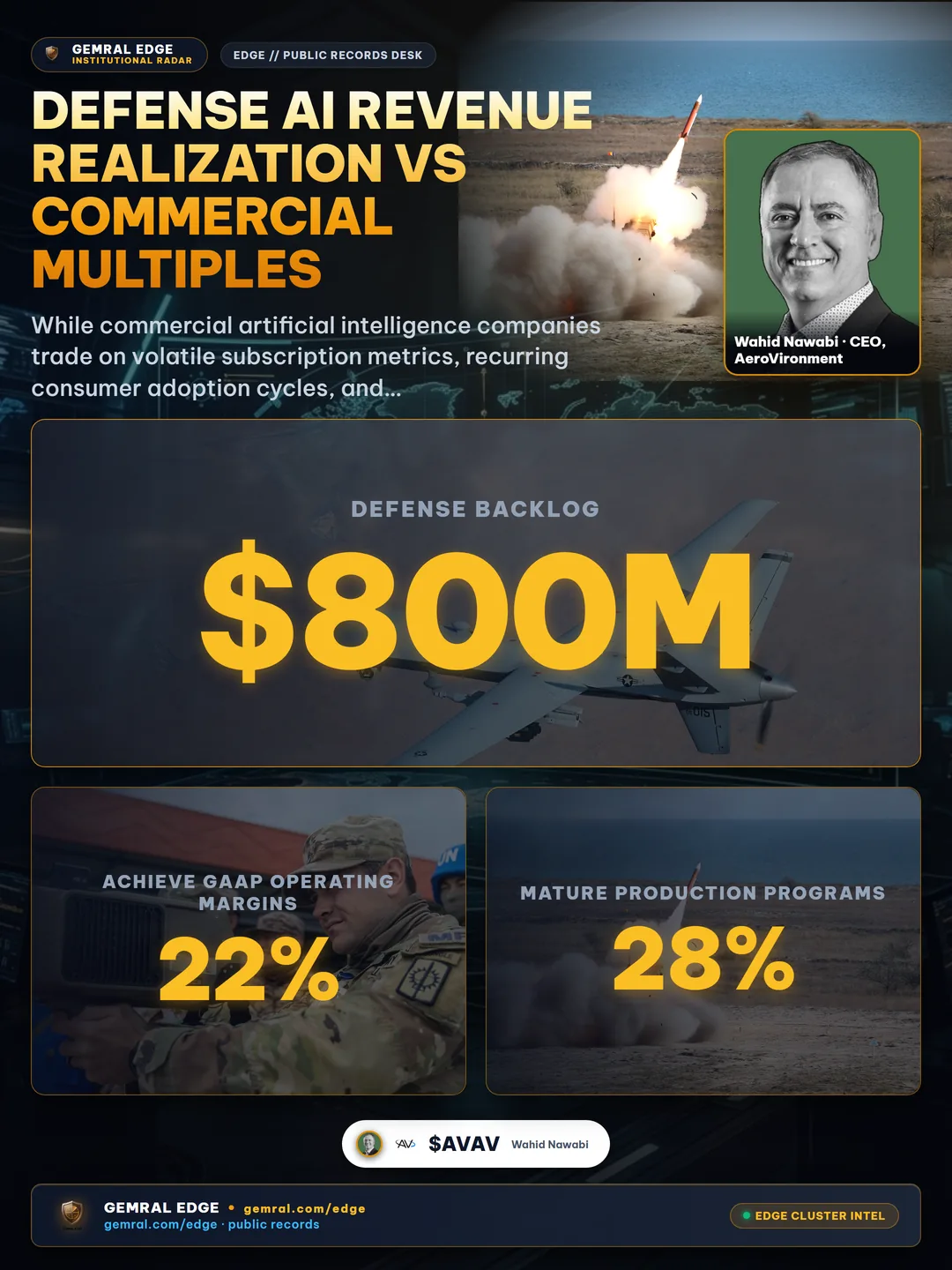
Revenue Visibility and Backlog Duration: Defense contracts are supported by statutory federal appropriations, generating funded backlogs that extend three to five years into the future. For example, AeroVironment (AVAV) reported a funded defense backlog exceeding $800 million in fiscal 2025, driven by global demand for autonomous loitering munitions equipped with visual tracking sensors.
Operating Margins and Development Absorption: Government cost-plus and firm-fixed-price incentive contracts reimburse research and development expenses under Government-Furnished Property (GFP) and non-dilutive federal grants. Consequently, defense software primes achieve GAAP operating margins between 22% and 28% on mature production programs, insulated from the aggressive consumer price wars prevalent in commercial SaaS markets.
Regulatory and Export Control Headwinds: Defense artificial intelligence models are strictly governed by the International Traffic in Arms Regulations (ITAR) and Export Administration Regulations (EAR). Foreign military sales (FMS) require extensive State Department approvals and bilateral congressional notifications, creating protracted 12-to-24-month sales cycles for international distribution.
Frequently asked questions
Which AI companies hold the largest US government contracts?
Major defense AI contract recipients include Palantir Technologies (tactical edge intelligence and targeting), Microsoft and Amazon AWS (enterprise cloud and classified infrastructure under the $9B JWCC program), and specialized autonomous defense hardware suppliers like AeroVironment and Kratos Defense.
How does the Pentagon award artificial intelligence contracts?
The Department of Defense awards AI contracts through competitive commercial solicitations, 10 U.S.C. 4022 Other Transaction Authorities (OTAs) for rapid prototyping, Small Business Innovation Research (SBIR) Phase III sole-source transitions, and enterprise multi-award delivery vehicles managed by the Chief Digital and Artificial Intelligence Office (CDAO).
What is the DoD budget allocation for artificial intelligence in FY2026?
The Department of Defense allocated over $1.8 billion directly to classified and unclassified artificial intelligence, autonomy, and machine learning initiatives, embedded within broader $13.4 billion command, control, communications, and tactical software line items.
What is the difference between a prototype OTA and a defense program of record for AI software?
A prototype Other Transaction Authority (OTA) allows rapid defense testing without traditional Federal Acquisition Regulation (FAR) friction; once validated, successful prototypes transition non-competitively under 10 U.S.C. 4022(f) into recurring, high-margin multi-year Programs of Record funded through baseline defense appropriations.