Industrial Edge Computing Architecture: Autonomous Deployments and Operational Technology Telemetry
The global manufacturing ecosystem is undergoing an aggressive structural migration as legacy centralized supervisory control architectures give way to distributed, on-premises autonomous intelligence. For decades, industrial automation operated under rigid, hierarchical Purdue Enterprise Reference Architectures, where physical programmable logic controllers (PLCs) fed operational data upward through supervisory control and data acquisition (SCADA) layers before finally reaching centralized enterprise resource planning (ERP) mainframes or remote cloud clusters. Today, as high-speed computer vision inspection, robotic manipulation, and closed-loop process automation demand sub-10-millisecond execution windows, modern enterprises are executing a widespread rollout of industrial edge computing infrastructure directly on factory floors.
Public regulatory filings, enterprise patent assignments, and technical consortium standards reveal that industrial operators can no longer afford the multi-hop network roundtrip latency or variable wide-area network (WAN) bandwidth costs inherent to centralized hyperscaler clouds. A single modern semiconductor assembly line or high-throughput automotive battery packaging plant generates upwards of 100,000 telemetry data points every second. Transferring this raw telemetry stream to external hyperscaler data centers incurs crippling cloud transit expenses while exposing critical physical operations to internet outages and external cyber threats. To achieve deterministic reliability, engineers are deploying localized compute appliances featuring hardened hardware architectures and containerized microservices, bridging legacy fieldbus protocols with modern artificial intelligence runtimes.
This deep dive examines the engineering mechanics, hardware specifications, determinism benchmarks, and capital allocation frameworks governing enterprise industrial edge computing deployments across discrete manufacturing, chemical processing, and robotic assembly facilities.
Industrial Edge Computing Architecture: Bridging OT Telemetry and Enterprise AI Compute
The foundational design principle of industrial edge computing is the unification of operational technology (OT) and information technology (IT) at the physical machine interface. In traditional facilities, OT engineering teams prioritize uninterrupted physical uptime and hard real-time determinism—where a delayed packet translates directly into a physical machine crash, tooling break, or safety hazard. Conversely, IT teams prioritize elastic scalability, continuous integration pipelines, and centralized access governance. Industrial edge gateways resolve this historical operational divide by functioning as protocol translation bridges and isolated runtime environments.
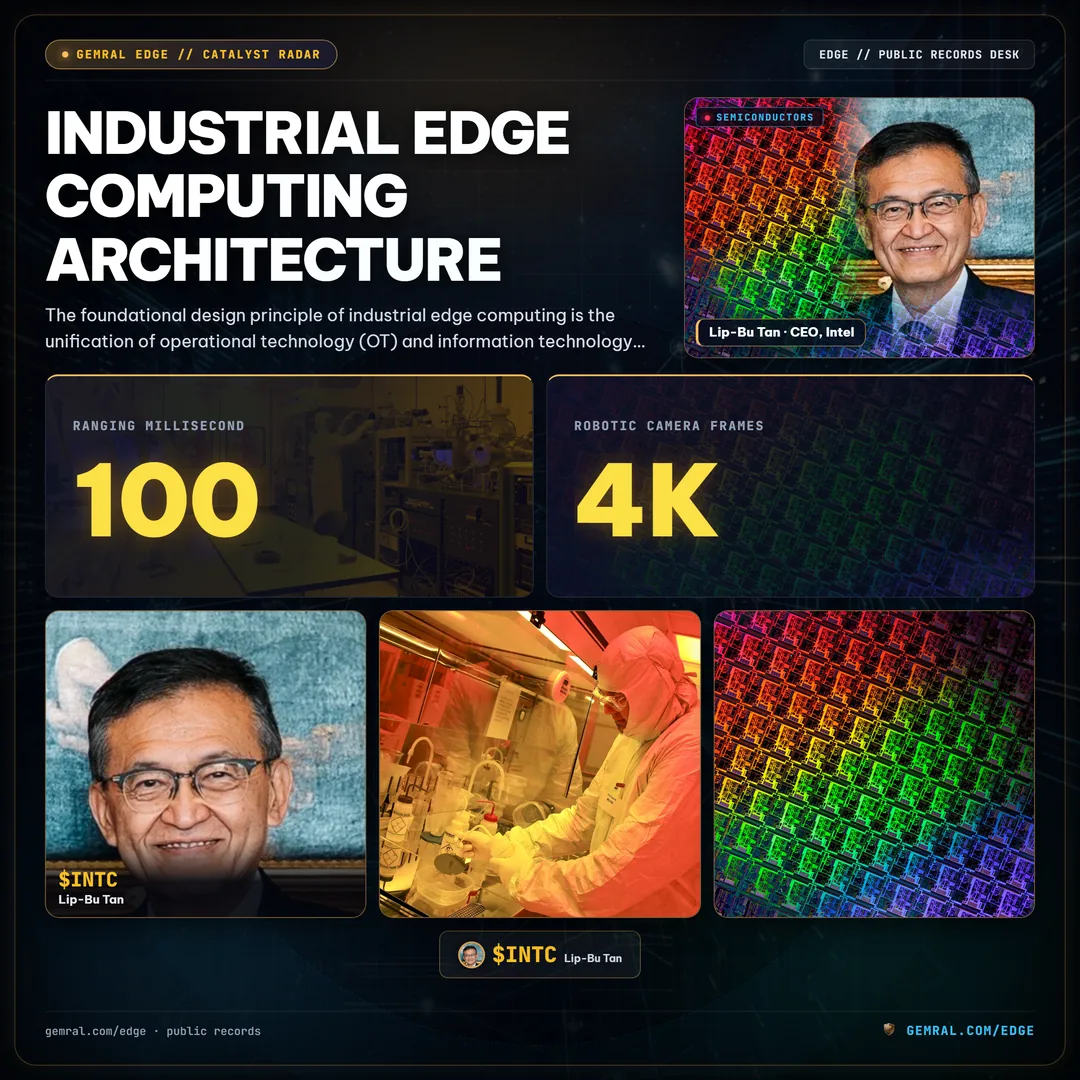
At the physical fieldbus layer, industrial edge appliances interface with machinery running heterogeneous legacy communication standards, including Modbus TCP, PROFINET, EtherNet/IP, EtherCAT, and serial RS-485 networks. Specialized protocol adapters ingest raw sensor registers, encoder counts, and actuator feedback signals at polling intervals ranging from 1 millisecond to 100 milliseconds. The edge software runtime normalizes these proprietary industrial data streams into standardized semantic models via the Open Platform Communications Unified Architecture (OPC UA) standard or publishes them onto lightweight localized Message Queuing Telemetry Transport (MQTT) event brokers with Sparkplug B payloads.
By transforming unstandardized machine vibration, temperature, acoustic, and positional sensor telemetry into unified semantic structures directly at the physical machine edge, facilities eliminate data serialization bottlenecks. Rather than routing high-frequency raw acoustic waves or 4K robotic camera frames over external networks, localized microservices execute edge data cleaning, anomaly thresholding, and fast Fourier transform (FFT) vibration analysis on-premises. High-speed signal processing on physical hardware relies heavily on advanced printed circuit board PCB high-speed interconnects designed to maintain signal integrity in electrically noisy plant environments, ensuring that sensory data flows into localized neural inference engines with near-zero transit distortion.
Hardware Acceleration and Embedded Inference: Edge Gateway Specs and Deterministic Workloads
Deploying artificial intelligence inside industrial operational environments requires specialized hardware engineering that diverges drastically from climate-controlled hyperscaler data center racks. Factory floors routinely expose compute appliances to ambient temperatures exceeding 60 degrees Celsius, continuous mechanical vibration, airborne particulate contamination, and severe electromagnetic interference (EMI) generated by high-voltage induction motors and arc welders. As a result, industrial edge compute appliances feature fanless, passively cooled aluminum fin chassis rated to IP65, IP66, or IP67 ingress protection standards, alongside dual-redundant 24V direct current (DC) industrial power inputs.
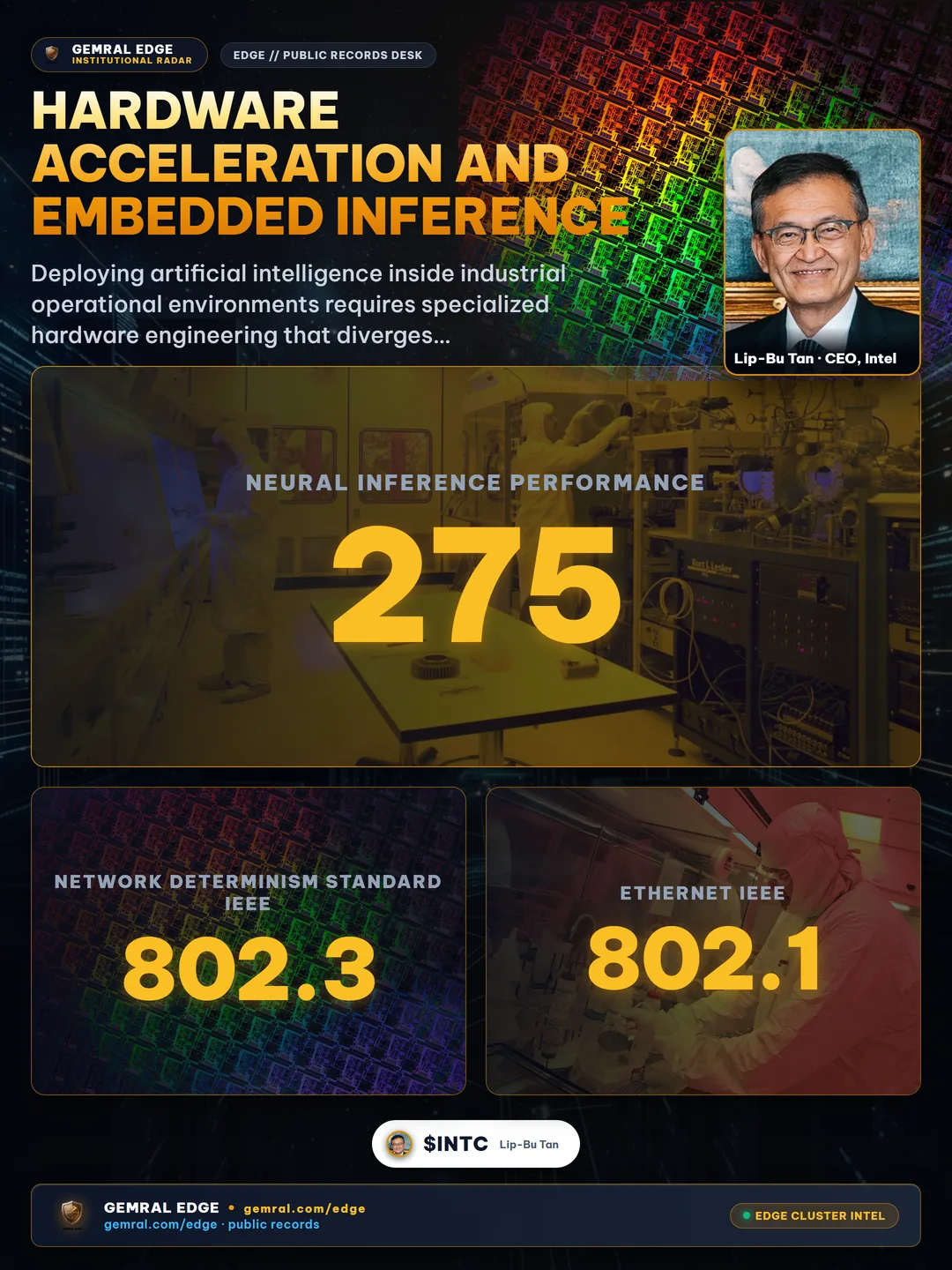
At the silicon level, enterprise industrial edge gateways combine multi-core real-time processors with dedicated neural processing units (NPUs) or low-power embedded graphics processing units (GPUs). Contemporary gateway platforms deliver between 30 TOPS and 275 TOPS of INT8 neural inference performance within a constrained thermal design envelope of 15W to 65W. System memory architectures utilize 32GB to 64GB of industrial-grade LPDDR5 memory equipped with in-band Error-Correcting Code (ECC) to eliminate soft bit-flip errors caused by electrical transients or background radiation.
| Component Domain | Legacy Industrial PC (IPC) | Modern AI Industrial Edge Gateway | Operational Advantage |
|---|---|---|---|
| Processor Architecture | Single-die x86 Dual-Core | Hybrid Heterogeneous x86/ARM + NPU | Concurrent real-time PLC logic & vision inference |
| AI Inference Throughput | 0.5 TOPS (CPU software emulation) | 30 to 275 TOPS (Dedicated NPU / Tensor Cores) | Sub-5ms multi-stream 4K defect classification |
| Thermal & Ingress Rating | Active fans, IP20 indoor cabinet only | Fanless passive conduction, IP66/IP67 rated | Zero maintenance, sealed against metal dust & coolant |
| Network Determinism | Standard IEEE 802.3 Ethernet | IEEE 802.1 TSN + Dual Gigabit Isolation | Deterministic microsecond packet delivery jitter |
| Power Supply Resilience | Single AC 110V/220V power supply | Dual-redundant 12-48V DC wide-input rail | Immunity to facility voltage sags & brownouts |
The integration of Time-Sensitive Networking (TSN) standards, specifically IEEE 802.1Qbv time-aware traffic shaping and IEEE 802.1AS precision time synchronization, enables these gateways to run deterministic motion control and heavy neural inference over a single physical Ethernet network. Control packets destined for robotic actuators receive mathematically bounded priority queues, ensuring that vision inference tasks processing 120 frames per second cannot saturate the bus or induce jitter in safety-critical robotic guidance loops. This embedded hardware acceleration mirrors the efficiency gains observed in wide-bandgap solid-state electronics, where transitioning to GaN vs SiC power semiconductors similarly optimizes thermal density and power delivery across mission-critical physical installations.
Capital Expenditures and Infrastructure ROI: Auditing Industrial Edge Appliance Deployments
While the technical merits of localized computing are well understood, enterprise adoption is fundamentally dictated by return on investment (ROI) metrics and total cost of ownership (TCO) comparisons against recurring cloud expenditures. A financial audit of representative automotive, aerospace, and precision electronics facilities reveals that industrial edge deployments generate predictable capital expenditure (CapEx) amortizations that replace volatile, compounding operational expenditures (OpEx) driven by cloud data ingestion tariffs.

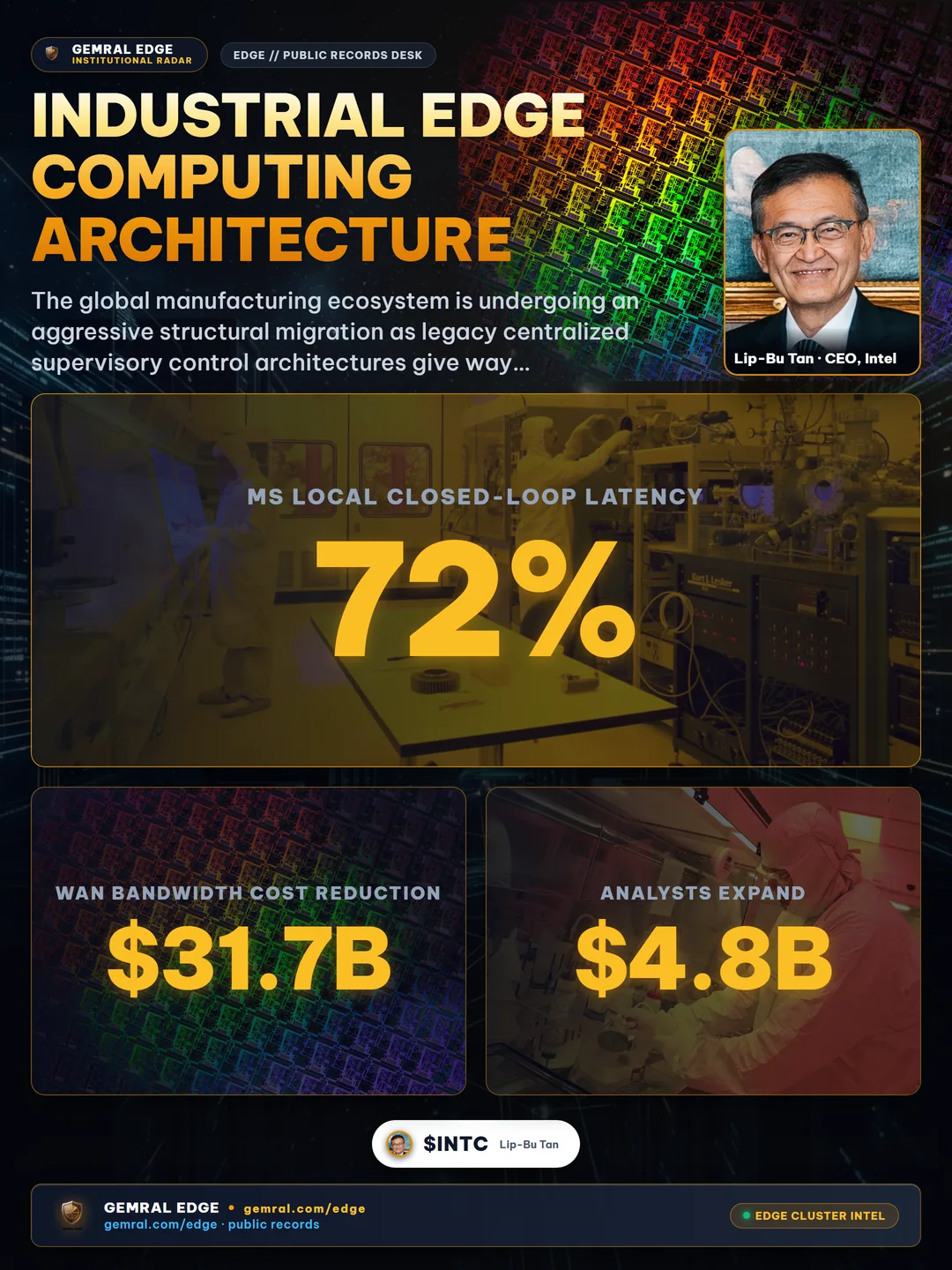
In a standard discrete manufacturing facility operating 12 automated production cells, continuous high-resolution optical inspection and multi-channel vibration monitoring generate approximately 4.2 terabytes of telemetry data per day. Transmitting this volume of data into commercial hyperscaler environments incurs continuous wide-area network bandwidth charges, ingress and egress data transfer fees, cloud storage fees, and recurring compute instance costs. Across a three-year operating lifecycle, recurring cloud expenses for a single plant frequently exceed $1,250,000. Conversely, deploying 12 ruggedized industrial edge appliances with a blended hardware, integration, and software licensing CapEx of $3,200 to $6,500 per node requires an initial outlay of approximately $78,000, reducing ongoing network operational costs by 72%.
Beyond network bandwidth rationalization, the primary financial catalyst for industrial edge computing lies in unplanned downtime mitigation. In automotive assembly and continuous chemical synthesis, line stoppages cost between $22,000 and $50,000 per minute. By executing localized predictive maintenance models on vibration and bearing temperature data with sub-second alerting, facilities consistently avert catastrophic spindle and gearbox failures, delivering full CapEx capital payback in less than 14 months.
Furthermore, local edge appliances eliminate dependencies on continuous external wide-area network availability. If a telecommunications fiber cut occurs or an internet service provider experiences an upstream DNS outage, factory lines equipped with autonomous edge nodes continue operating without interruption. Similar localized resilience dynamics are documented across defense forward bases adopting defense microgrid and military microreactor deployment architectures, where eliminating single-point external logistics vulnerabilities ensures mission continuity regardless of external network stability.
Industrial Edge vs Centralized Cloud Infrastructure: Latency, Bandwidth, and Air-Gapped Resiliency
To evaluate where compute workloads should physically reside, systems architects analyze the operational divergence between industrial edge platforms and centralized hyperscaler clouds across three critical operational pillars: deterministic latency, bandwidth consumption, and physical isolation.
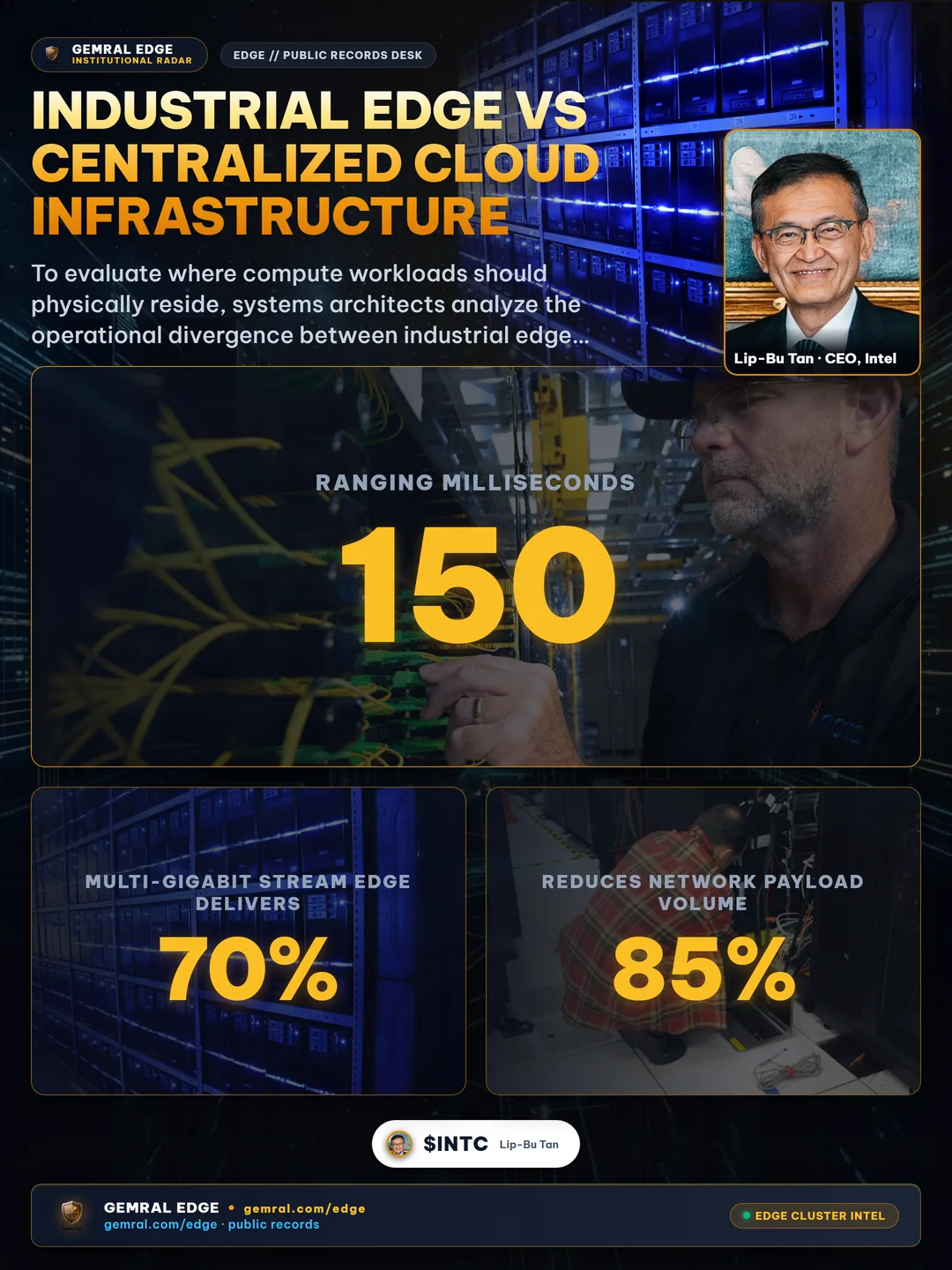
In closed-loop industrial automation, latency is not merely an average roundtrip duration; it is a rigid statistical bound defined by worst-case latency and packet jitter. When a robotic end-effector approaches a weld seam or a sorting arm diverts a defective component traversing a conveyor at 3 meters per second, the decision window is strictly bounded under 10 milliseconds. Centralized cloud data centers, even when connected via dedicated commercial fiber backbones, exhibit variable latency spikes ranging from 40 milliseconds to 150 milliseconds due to internet routing fluctuations, packet queuing, and firewall packet inspections. Attempting to control physical motion from a remote cloud inevitably results in mechanical overshoot, product damage, or emergency safety stops.
| Operational Metric | Industrial Edge Architecture | Centralized Hyperscaler Cloud | Engineering Assessment |
|---|---|---|---|
| Closed-Loop Latency | 1 to 8 milliseconds (Deterministic) | 45 to 180 milliseconds (Stochastic) | Edge is mandatory for real-time robotic actuation |
| Network Jitter | < 50 microseconds (via TSN) | 15 to 45 milliseconds | Cloud jitter causes unstable feedback loop oscillations |
| WAN Bandwidth Demand | Near-zero (Filtered summary egress only) | Continuous Multi-Gigabit stream | Edge delivers 70% to 85% bandwidth reduction |
| Offline Operational Resiliency | 100% operational during network blackout | Complete shutdown upon WAN loss | Edge maintains manufacturing operational continuity |
| Intellectual Property Exposure | Air-gapped on-premises data boundary | External multi-tenant public infrastructure | Edge maintains proprietary tooling and recipes in-house |
Bandwidth conservation presents an equally compelling operational imperative. By processing raw video streams and high-frequency analog telemetry on-site, edge inference engines discard baseline noise and transmit only summarized metadata, event timestamps, and defect markers upward to enterprise management dashboards. This reduces network payload volume by more than 85%, ensuring that corporate WAN connections remain unburdened while preserving rich historical telemetry locally on solid-state drives for comprehensive offline post-mortem audits.
Field Verification and Safety Standards: IEC 62443 Compliance and Deterministic Zero-Trust Controls
Deploying distributed compute nodes across industrial plant floors significantly expands physical and logical attack surfaces if not governed by rigorous cybersecurity architectures. Historically, OT environments relied on "air-gapping"—the assumption that operational machinery was physically isolated from public networks and therefore secure. However, modern industrial automation requires remote diagnostics, firmware updates, and analytics export, rendering legacy air-gaps obsolete and mandating strict adherence to the International Electrotechnical Commission (IEC) 62443 cybersecurity standard.
Industrial edge computing architectures implement Security Level 3 (SL-3) and Security Level 4 (SL-4) controls under IEC 62443-4-2 technical security requirements. Hardware appliances integrate hardware-based root of trust via dedicated Trusted Platform Module (TPM 2.0) chips or secure cryptoprocessors embedded directly within the system-on-chip (SoC). During system initialization, cryptographic measured boot verifies the integrity of the unified extensible firmware interface (UEFI), kernel binaries, and root filesystem before allowing operating system execution. If unauthorized firmware tampering or memory injection is detected, the gateway halts boot sequences and alerts administrative control consoles.
Application runtimes on the factory floor are strictly containerized using lightweight Open Container Initiative (OCI) compliant engines such as containerd or k3s Kubernetes distributions tailored for resource-constrained edge hardware. Each microservice executes within an immutable, read-only container sandbox with restricted Linux capabilities, strictly preventing a compromised vision inference service from probing underlying PLC communication ports. Zero-trust network access (ZTNA) is enforced at the device level: all ingress and egress network packets require mutual Transport Layer Security (mTLS 1.3) authentication backed by localized Public Key Infrastructure (PKI) certificates, ensuring that untrusted network nodes cannot forge telemetry data or inject malicious setpoint commands into operational machinery.
The Industrial Edge Ecosystem: Silicon Vendors, Gateways, and System Integrators
The enterprise acceleration of industrial edge computing has galvanized a collaborative, multi-tiered commercial ecosystem spanning silicon designers, industrial original equipment manufacturers (OEMs), operating system vendors, and global system integrators. The market is projected by industrial analysts to expand from $4.8 billion to $31.7 billion by 2030, reflecting a compound annual growth rate (CAGR) exceeding 24.6% as smart manufacturing mandates sweep North America, Europe, and the Asia-Pacific region.
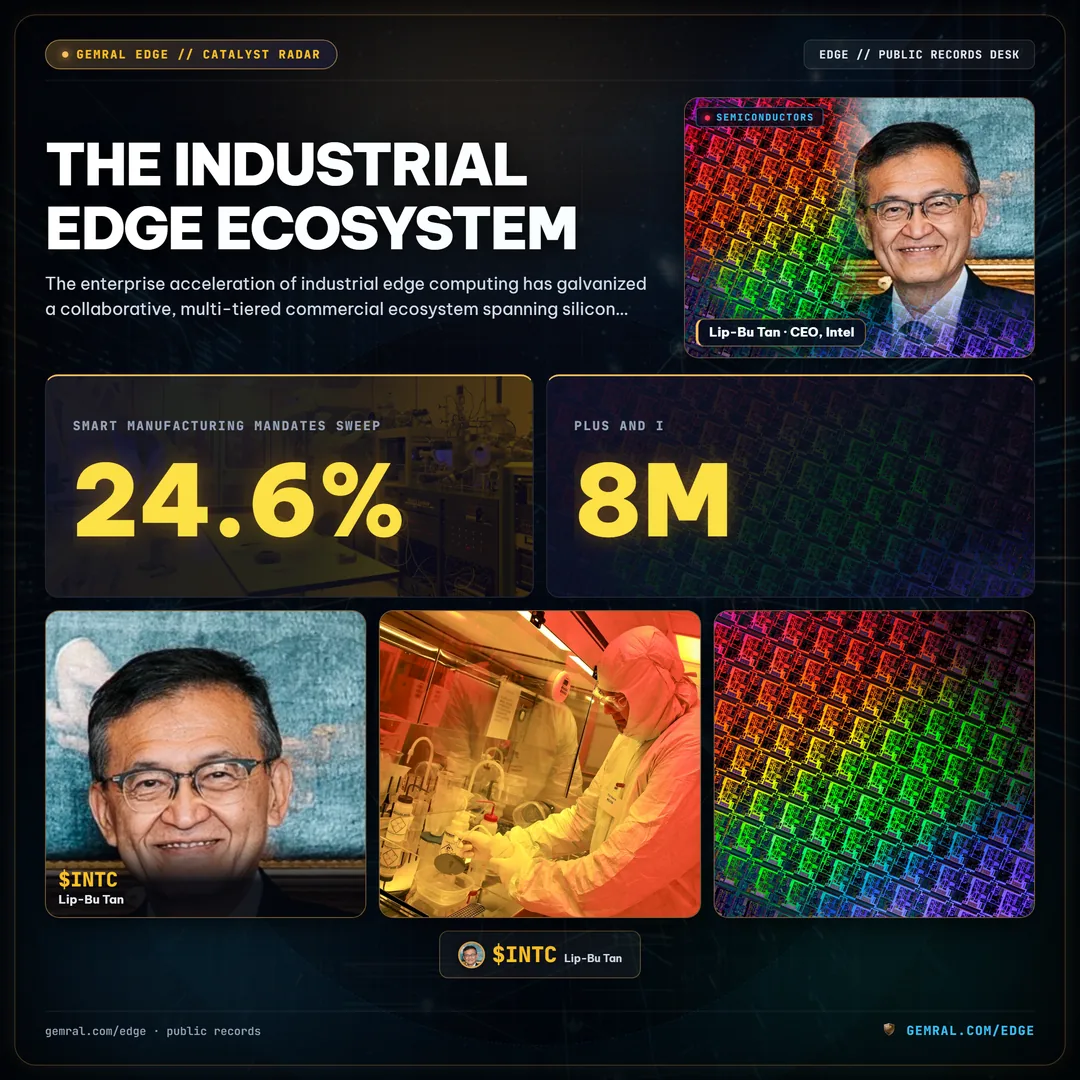
At the silicon tier, semiconductor leaders are introducing application-specific processors tailored for industrial environmental tolerances. Vendors such as NVIDIA (with its Jetson Orin and Thor industrial modules), Intel (with Atom x7000RE and Core Ultra embedded processors featuring integrated Arc GPUs), Qualcomm (with industrial IoT Snapdragon platforms), and NXP Semiconductors (with i.MX 8M Plus and i.MX 93 processors featuring microNPUs) provide the core compute engines. These chips integrate dedicated hardware timers, dual-channel CAN-FD interfaces, and wide-temperature silicon packaging specifically designed to operate reliably for 10-year continuous deployment lifecycles.
At the gateway and system integration tier, established automation giants including Siemens, Rockwell Automation, Schneider Electric, Advantech, and Beckhoff Automation engineer field-ready industrial controllers that combine ruggedized hardware with specialized software platforms. These platforms provide centralized fleet management consoles, allowing enterprise IT administrators to push containerized neural network weight updates, firmware patches, and security configurations to tens of thousands of globally distributed factory edge appliances via encrypted over-the-air (OTA) deployment pipelines.
As enterprise operators continue scaling autonomous robotics, automated optical inspection, and localized predictive telemetry, industrial edge computing stands as the foundational operational bridge—converting physical manufacturing floors from rigid, analog mechanical assemblies into dynamic, self-optimizing intelligent systems.
Disclaimer: Public data · not investment advice. All financial figures, corporate filings, technical benchmarks, and architectural disclosures cited in this report are sourced exclusively from public standards documentation, regulatory records, and enterprise technical disclosures. Gemral Edge provides institutional data intelligence and operational technology analysis for research and educational purposes only.
Frequently asked questions
What is industrial edge computing?
Industrial edge computing is the deployment of ruggedized computing hardware, real-time operating systems, and edge AI accelerators directly within manufacturing facilities to analyze sensor telemetry and control physical machinery locally.
How does industrial edge computing differ from traditional cloud computing?
Unlike centralized cloud infrastructure that introduces variable network latency and requires high-bandwidth internet connectivity, industrial edge computing delivers sub-10-millisecond deterministic response times, operates fully offline during network outages, and keeps sensitive intellectual property on-premises.
What communication protocols are standard in industrial edge deployments?
Standard protocols include OPC Unified Architecture (OPC UA), MQTT, Modbus TCP, PROFINET, and Time-Sensitive Networking (TSN), which bridge legacy programmable logic controllers (PLCs) with modern containerized microservices.
How do manufacturers secure industrial edge compute appliances?
Industrial edge security follows the IEC 62443 standard, utilizing hardware root of trust, cryptographic TPM 2.0 chips, mutual TLS (mTLS), strict air-gapped network segmentation, and zero-trust authentication across all gateway interfaces.