Military Microreactor: Project Pele Defense Microgrid Awards and 10 U.S.C. 4022 Contract Velocity
Military Microreactor Mechanics: Deconstructing Project Pele and Tactical Defense Microgrids
A tactical military microreactor represents a structural paradigm shift away from traditional gigawatt-scale commercial light-water reactors and bulky static diesel generators. Managed by the Pentagon's Strategic Capabilities Office (SCO) in close coordination with the Department of Energy (DOE) and the Idaho National Laboratory (INL), Project Pele is engineering a transportable, high-temperature gas-cooled reactor (HTGR) designed to operate as a self-sufficient energy island.

Unlike commercial nuclear reactors requiring extensive concrete containment structures and continuous cooling water intake from natural bodies of water, a military microreactor is factory-fabricated, sealed, and packaged into a modular footprint spanning just 3 to 4 standard 20-foot ISO containers. Each module complies with strict transportation limits: a maximum weight of 40.0 metric tons per container, enabling rapid global deployment via heavy transport trucks, rail, or standard U.S. Air Force C-17 Globemaster III strategic cargo aircraft.
Once delivered to an austere theater or forward operating base, the entire microgrid system is designed to achieve full power integration within 72 hours of touchdown. When strategic relocation is mandated, the reactor design permits safe shutdown, cooldown, and containerized packup within 7 days. This operational agility transforms tactical energy distribution from an ongoing logistical vulnerability into a deployable asset.
Procurement Obligations and OTA Contract Architecture: How the DoD Funds Mobile Nuclear Power
The acceleration of Project Pele relies on an agile acquisition framework codified under 10 U.S.C. 4022 (formerly Section 843 of the National Defense Authorization Act). By leveraging Other Transaction Authority (OTA) rather than standard Federal Acquisition Regulation (FAR) compliance channels, the Department of Defense bypassed bureaucratic procurement friction to award competitive prototype development task orders.
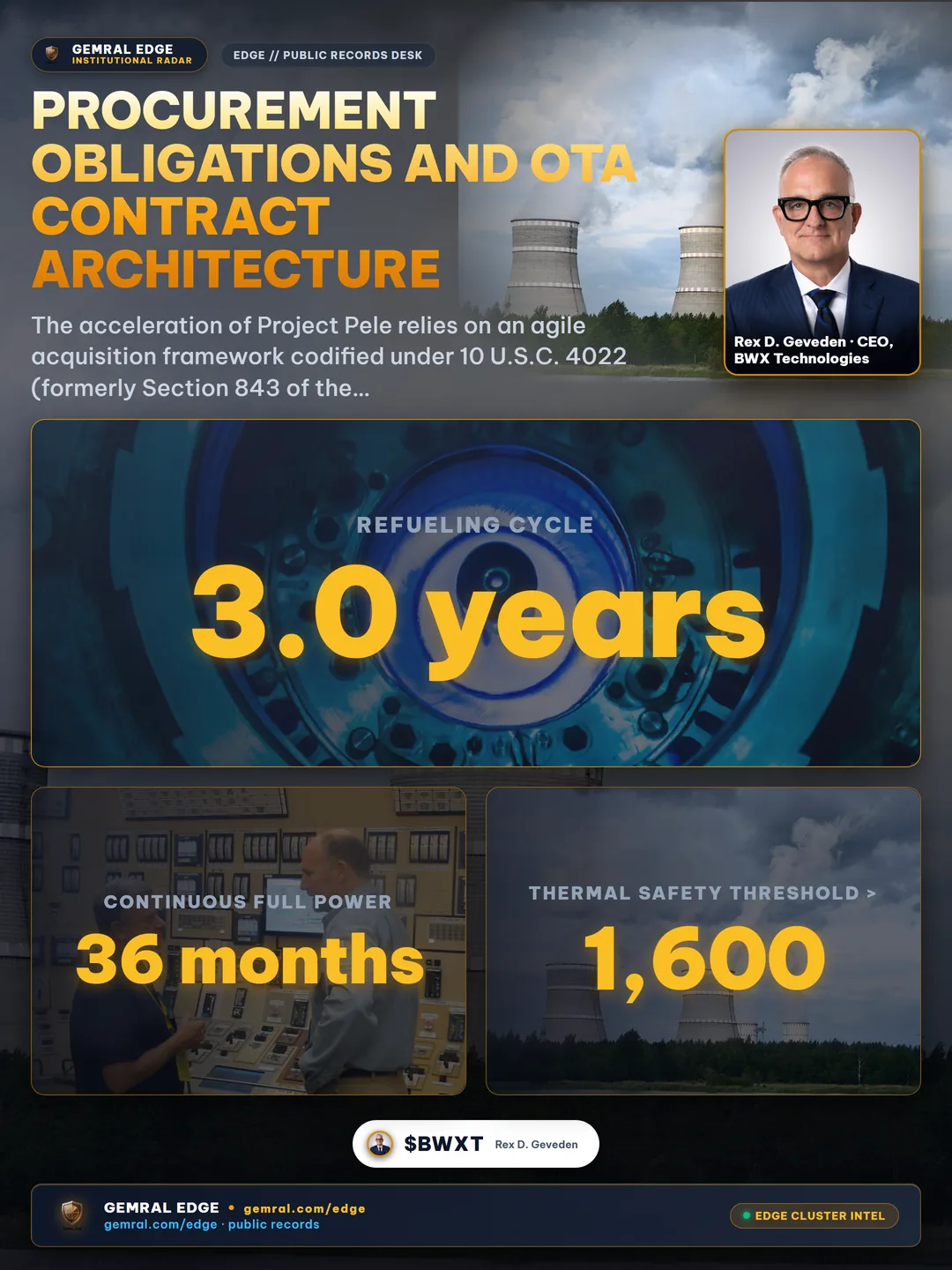
Initial competitive awards pitted commercial consortia against each other to deliver preliminary engineering designs. In final prototype fabrication selection, BWX Technologies ($BWXT, with a current enterprise valuation reflecting an established $10.8 billion market capitalization) secured the primary contract to manufacture the full-scale transportable microreactor prototype at its specialized facilities in Lynchburg, Virginia. Subsystem design partners and fuel fabrication consortia, including X-energy and Westinghouse, continue to advance complementary components across the federal supply chain.
| Metric / Specification | Project Pele Prototype | Legacy FOB Diesel Generator Farm |
|---|---|---|
| Electrical Capacity | 1.0 to 5.0 MWe continuous | 1.0 to 5.0 MWe (requires 4 to 8 diesel gensets) |
| Refueling Cycle | 3.0 years (36 months continuous full power) | Daily to weekly continuous tanker resupply |
| Thermal Safety Threshold | > 1,600°C (TRISO ceramic containment) | Flammable liquid fuel storage footprint |
| Enrichment Threshold | 19.75% HALEU (sub-20% non-proliferation) | Non-nuclear (commercial distillate diesel) |
| Mobility Framework | 3 to 4 ISO 20-foot containers (≤40.0 tons each) | Generators plus dedicated fuel bladder storage farms |
The total financial obligation of the Project Pele OTA prototype effort reached $300.0 million across its design, fabrication, and environmental evaluation phases. Under 10 U.S.C. 4022 authority, successful demonstration of the prototype at the Idaho National Laboratory provides the legal mechanism for direct follow-on production awards without undergoing a separate full-and-open competitive bidding cycle, providing substantial revenue visibility for winning prime contractors.
Tactical Microreactors vs Diesel Fuel Logistics: Supply Chain Resiliency and Forward Operating Base Metrics
The strategic imperative driving the Pentagon's adoption of the military microreactor is rooted in tactical survival. During historical military deployments across Iraq and Afghanistan, ground casualty data revealed that approximately 52.0% of all combat casualties occurred during ground logistics convoys transporting fuel and potable water. Supplying remote forward operating bases required hundreds of vulnerable fuel trucks navigating contested corridors.

In total, the Department of Defense consumes approximately 100.0 million gallons of diesel fuel annually across dispersed forward base generators. While wholesale bulk diesel purchases in peacetime appear modest, the fully burdened cost of delivering a single gallon of fuel into an austere, landlocked theater routinely escalates to $400.0 per gallon when factoring in armed escort convoys, aerial surveillance, dynamic route clearance, and battlefield risk premiums.
By contrast, a single 1.0 to 5.0 MWe military microreactor provides an unbroken baseload electricity supply for 3.0 continuous years without requiring a single resupply convoy. The reactor utilizes advanced Tri-structural Isotropic (TRISO) fuel particles, where microscopic uranium kernels are enveloped in triple layers of pyrolytic carbon and silicon carbide. These microscopic ceramic pressure vessels withstand temperatures exceeding 1,600°C without melting, ensuring complete passive cooling safety even in the event of catastrophic primary coolant breach or localized hostile kinetic impact.
The Defense Nuclear Microgrid Supply Chain: Key Contractors and Fuel Cycle Bottlenecks
The operational rollout of mobile defense microgrids creates a concentrated industrial supply chain involving specialty metallurgy, advanced gas turbine conversion, and high-assay nuclear fuel infrastructure. Investors and aerospace analysts track these developments in parallel with private datacenter energy contracts cataloged in our hyperscaler nuclear SMR power purchase agreements intelligence hub, alongside thematic coverage of GaN and SiC power semiconductors in electrification and commercial SMR power purchase agreements.
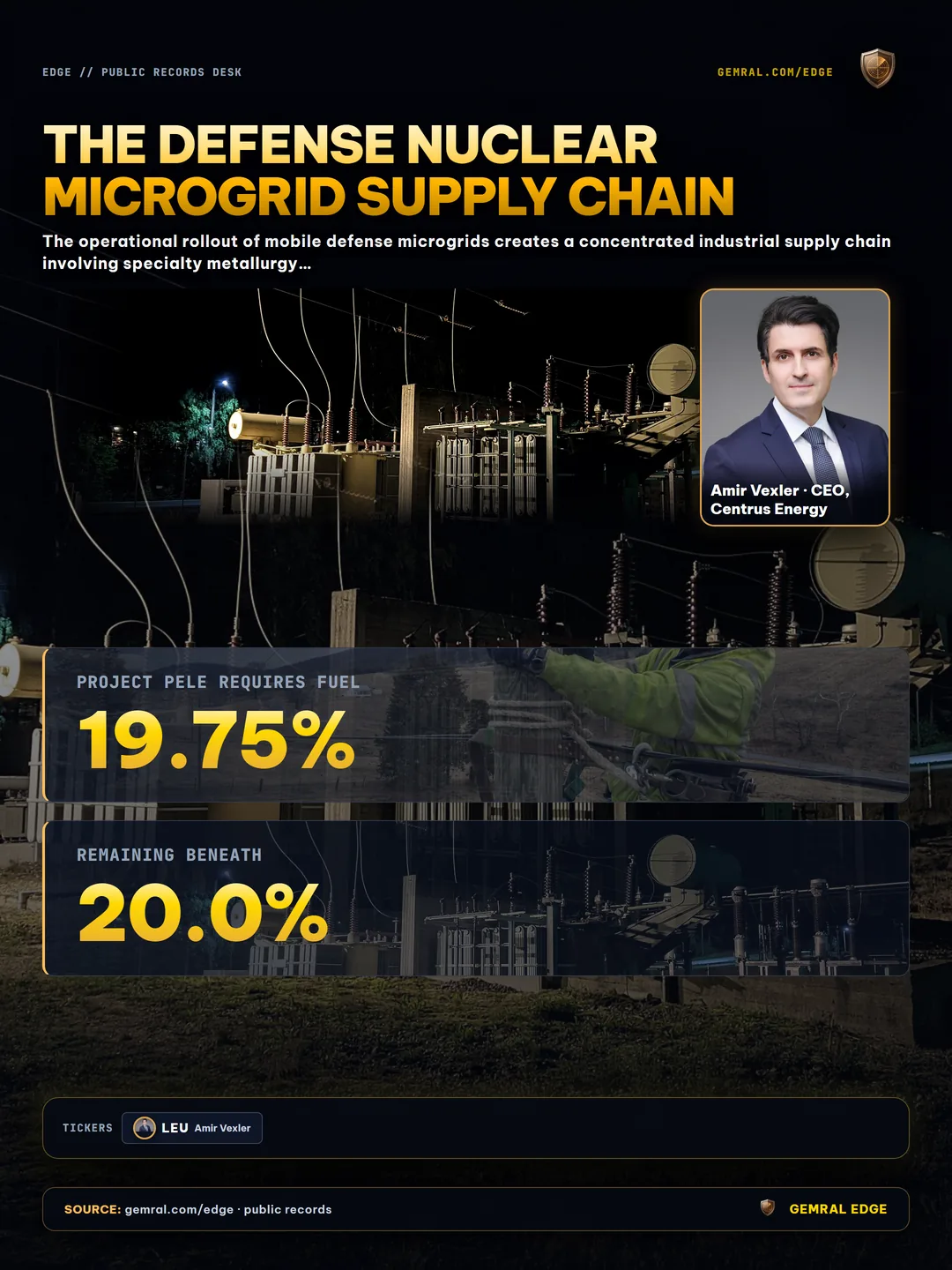
The primary supply chain bottleneck centers on High-Assay Low-Enriched Uranium (HALEU). Project Pele requires fuel enriched to precisely 19.75% U-235—maximizing operational energy density while remaining strictly beneath the 20.0% civilian non-proliferation ceiling. With commercial enrichment capacities historically constrained, federal investments under the Department of Energy are funding domestic commercial enrichment infrastructure, benefiting specialized providers like Centrus Energy ($LEU) and nuclear fuel fabricators.
Public contract award records, task order modifications, and testing milestone obligations under 10 U.S.C. 4022 can be tracked through public federal disclosure portals. Detailed milestone schedules and award tracking are cataloged via the Gemral Edge Tactical Military Microreactor Procurement Tracker.
As the Idaho National Laboratory advances testing protocols for the BWXT prototype, the convergence of Department of Defense forward operating energy security and civilian decentralized microgrid demand marks an inflection point in high-temperature nuclear deployment. By proving transportability, passive safety, and 72-hour operational capability, Project Pele establishes the operational blueprint for resilient military microgrids in contested multi-domain theaters.
Public data · not investment advice. All procurement data sourced from Department of Defense public contract disclosures and Idaho National Laboratory technical briefings.
Frequently asked questions
What is the primary objective of the US military Project Pele microreactor program?
The primary objective of Project Pele, directed by the Pentagon's Strategic Capabilities Office (SCO), is to design, fabricate, and test a mobile, high-temperature gas-cooled microreactor producing 1 to 5 MWe. It aims to provide resilient, carbon-free, decentralized electrical power to forward operating bases and critical military defense microgrids, dramatically reducing logistical vulnerability.
How transportable is a tactical military microreactor?
Project Pele microreactors are engineered to be modular and fit inside 3 to 4 standard 20-foot ISO shipping containers, each weighing under 40 metric tons. They can be transported via military heavy-haul trucks, rail, or standard U.S. Air Force C-17 Globemaster III cargo aircraft, and are designed to deploy and connect to a microgrid within 72 hours of arrival.
What type of nuclear fuel does Project Pele utilize to ensure passive safety?
Project Pele utilizes Tri-structural Isotropic (TRISO) fuel particles containing High-Assay Low-Enriched Uranium (HALEU) enriched to 19.75% U-235. Each TRISO particle is encapsulated in ceramic and carbon layers that withstand temperatures exceeding 1,600°C without melting, ensuring passive safety even under extreme operational or combat-induced coolant loss.
How does 10 U.S.C. 4022 Other Transaction Authority accelerate defense nuclear procurement?
Under 10 U.S.C. 4022, the Department of Defense leverages Other Transaction Authority (OTA) to bypass standard Federal Acquisition Regulation (FAR) friction. This enables rapid prototyping, cost-sharing, and direct task-order obligations with commercial consortia like BWX Technologies and X-energy, streamlining prototype development toward commercial fielding.