Hyperscaler Nuclear and SMR Clean Power Offtake Pledges: Baseload Power Purchase Agreements, Behind-the-Meter Co-Location, and NRC Licensing Realities
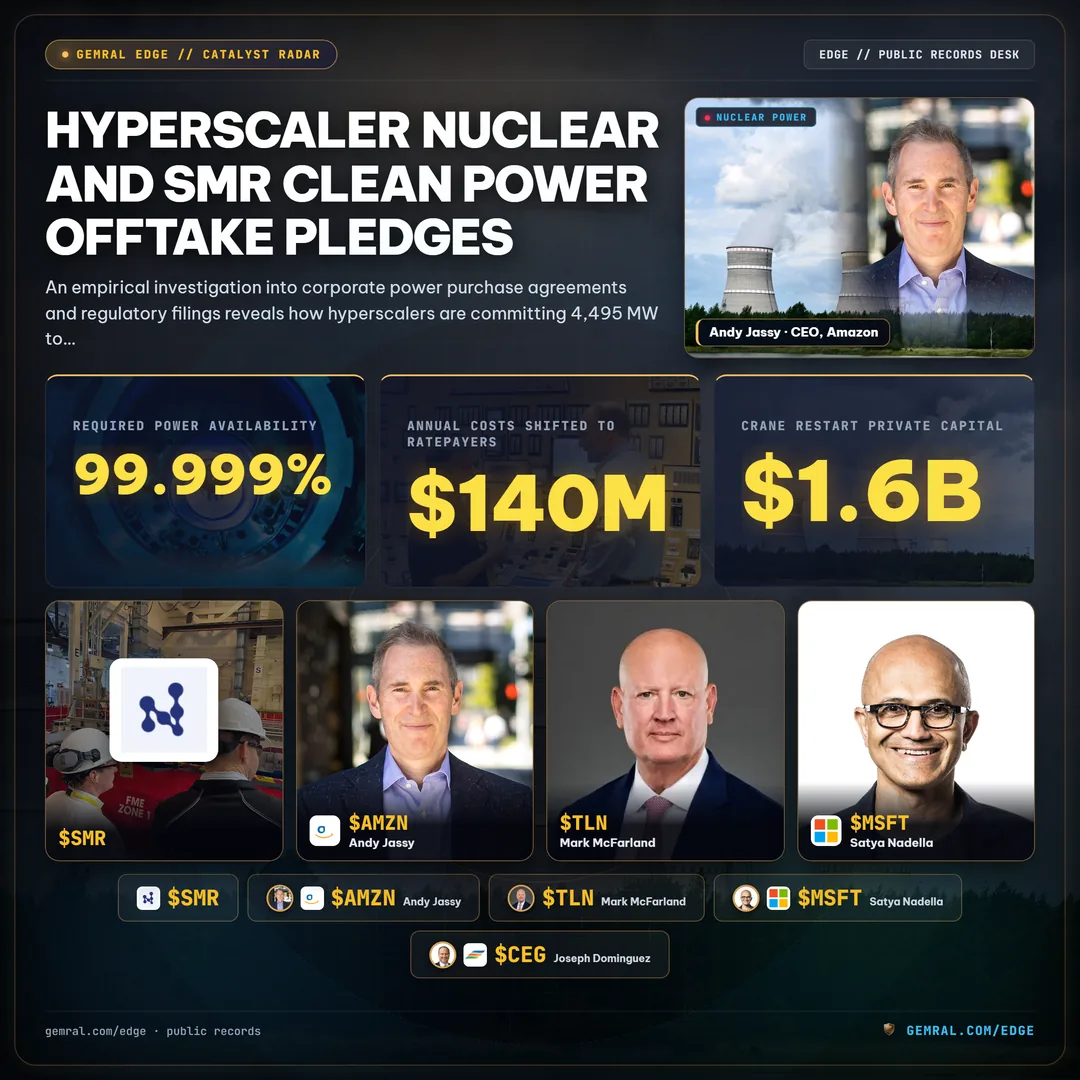
Across federal regulatory filings, corporate disclosures, and long-term power purchase agreements (tracked via the AI datacenter power and SMR contracts hub) (PPAs) audited in September 2026, the global technology sector has crossed an irreversible threshold in infrastructure capital allocation. Facing multi-year transmission interconnection delays across regional grids and confronting strict zero-carbon corporate mandates, hyperscale datacenter operators have committed to over 4,495 Megawatts of direct nuclear and clean baseload generation capacity. This unprecedented capital migration encompasses existing plant behind-the-meter co-locations, decommissioned reactor restarts, and first-of-a-kind Small Modular Reactor (SMR) development fleets.
The 24/7 Baseload Imperative: Why Intermittent Renewables Hit the AI Wall
For more than a decade, enterprise technology procurement relied heavily on annual volumetric matching of solar and wind generation via virtual power purchase agreements (vPPAs) and renewable energy certificates (RECs). Under this accounting convention, a datacenter operating in northern Virginia could consume fossil-heavy grid power during winter nights while claiming net-zero carbon operations based on solar credits generated in Texas during mid-summer afternoons.
The operational profile of artificial intelligence training and inference clusters has rendered volumetric renewable accounting technically unviable. Modern high-density compute facilities exhibit flat, continuous load curves requiring uninterrupted electric power with 99.999% availability. Unlike traditional cloud workloads that can tolerate latency throttling or flexible batch scheduling, multi-billion-dollar GPU clusters cannot be modulated according to local wind speeds or solar irradiance cycles without incurring severe capital inefficiency.
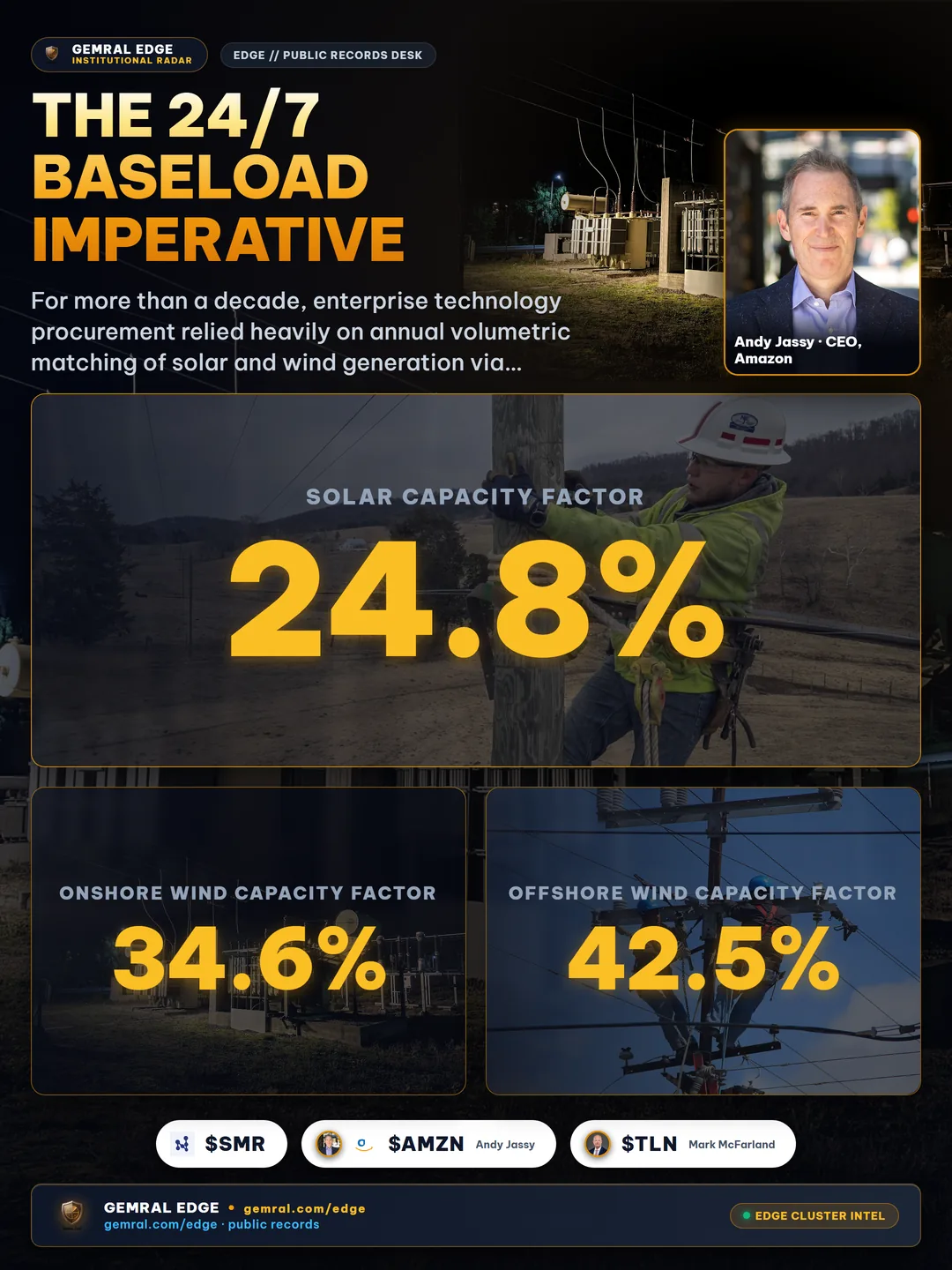
According to comprehensive electric power annual data compiled by federal agencies, utility-scale solar photovoltaic facilities achieve an average annual capacity factor of just 24.8%. Onshore wind generation achieves 34.6%, while offshore wind facilities average 42.5%. While lithium-ion battery energy storage systems (BESS) offer short-duration relief, standard four-hour battery installations fail to resolve multi-day solar and wind lulls (dunkelflaute events). In contrast, commercial nuclear generation delivers an annual capacity factor of 93.1%, operating continuously for 18 to 24 months between scheduled refueling outages.
To match a 1,000-Megawatt continuous datacenter load entirely through intermittent solar and battery assets would require over 4,000 Megawatts of nameplate solar capacity paired with more than 16,000 Megawatt-hours of battery storage, consuming vast geographic footprints and demanding billions of dollars in battery replacement capex every eight years. Consequently, hyperscalers seeking 24/7 carbon-free energy (CFE) have turned to the high power density and unmatched reliability of the commercial nuclear reactor fleet.
Behind-the-Meter Co-Location: The Susquehanna Precedent and Corporate PPA Economics
The initial corporate strategy to bypass grid interconnection backlogs materialized in the form of behind-the-meter (BTM) co-location. In this architectural configuration, a technology campus is constructed directly adjacent to an operating nuclear power plant, drawing physical electricity via private transmission lines without wheeling electrons across the broader regional transmission grid.

The landmark transaction establishing this model occurred when Amazon Web Services acquired Talen Energy's Cumulus datacenter campus, situated next to the 2,500-Megawatt Susquehanna nuclear power plant in Pennsylvania. Under the initial agreement, the facility secured an initial 480 Megawatts of continuous power with contractual provisions expanding up to 960 Megawatts over a decade. By contracting directly with the generator behind the transmission meter, the facility sought to eliminate years of waiting in the PJM regional interconnection queue.
The economic dynamics of these off-take contracts reflect a substantial premium over traditional wholesale wholesale power rates. While wholesale power on the PJM grid averaged approximately $48 per Megawatt-hour over the preceding year, behind-the-meter nuclear PPAs are executing at contract floors ranging between $96 and $112 per Megawatt-hour. Hyperscalers are willingly paying a premium of more than 100% over standard wholesale prices in exchange for three critical business advantages: verified zero-carbon pedigree, exemption from long transmission study queues, and operational price stability insulated from fossil fuel price volatility.
| Offtaker | Generation Partner | Facility Asset | Capacity (MW) | Contract Model |
|---|---|---|---|---|
| Amazon AWS | Talen Energy | Susquehanna Nuclear | 960 MW | Behind-the-Meter Co-Location PPA |
| Microsoft | Constellation Energy | Crane Clean Energy (TMI-1) | 835 MW | Front-of-Meter Restart PPA (20 Years) |
| Kairos Power | Advanced SMR Fleet | 500 MW | Multi-Unit Technology Development PPA | |
| Oracle | Vendor Undisclosed | Small Modular Reactors | 1,000 MW | 3-Reactor Dedicated Cluster Design |
| Meta | Utility / Independent | Baseload Clean Generation | 1,200 MW | Competitive Nuclear & Geothermal RFP |
Regulatory Crossfire: FERC Docket ER24-2172 and the Battle Over Transmission Cost-Shifting
The aggressive push by enterprise technology firms to monopolize existing nuclear output has triggered fierce resistance from incumbent electric utilities, consumer advocacy groups, and federal regulators. The central legal and economic battleground converged in Federal Energy Regulatory Commission (FERC) Docket ER24-2172, following an amended interconnection service agreement submitted by PJM Interconnection to facilitate an increase in co-located load at the Susquehanna facility from 300 Megawatts to 480 Megawatts.
Regional transmission owners, led by American Electric Power (AEP) and Exelon Corporation, filed formal protests opposing the interconnection amendment. Their core technical argument centers on transmission cost allocation and system reliability: if a 960-Megawatt industrial datacenter consumes electricity directly from a nuclear plant that previously delivered power to the regional grid, remaining commercial and residential ratepayers are forced to absorb hundreds of millions of dollars in network transmission charges while remaining exposed to reserve margin shortfalls.
Under standard PJM transmission network tariffs, commercial consumers pay approximately $14.20 per Kilowatt-month for transmission system maintenance and expansion. The disputed behind-the-meter exemption creates an estimated tariff avoidance of $9.80 per Kilowatt-month. Utility modeling demonstrated that exempting a single gigawatt-scale datacenter campus from network service charges transfers an estimated $140 million annually in transmission system costs onto regional residential and industrial ratepayers.
The Nuclear Restart Frontier: Three Mile Island, Duane Arnold, and 48-Month Engineering Cycles
Faced with regulatory roadblocks against cannibalizing operating grid resources, technology leaders shifted their capital toward an audacious alternative: resurrecting prematurely retired commercial nuclear reactors. By financing the capital restoration of dormant facilities, hyperscalers add net-new clean baseload capacity to the electrical system, neutralizing regulatory claims of capacity theft.
The defining milestone of this strategy was established by Microsoft through its landmark 20-year power purchase agreement with Constellation Energy to restart Unit 1 of the Three Mile Island nuclear station in Pennsylvania, rechristened the Crane Clean Energy Center. Unit 1—an 835-Megawatt pressurized water reactor that operated safely and independently of the damaged Unit 2 facility for decades before retiring in 2019 due to unfavorable merchant power economics—is slated to return to full commercial operation by 2028.
Executing a nuclear plant restart is an intensive engineering, regulatory, and financial undertaking. Constellation committed approximately $1.6 billion in private capital to restore the Crane facility. The 48-month engineering schedule involves extensive non-destructive testing of the reactor pressure vessel, replacement of main power transformers and steam generators, comprehensive digital modernization of turbine controls, and re-recruiting specialized licensed operating crews.
Crucially, the facility must navigate rigorous oversight from the Nuclear Regulatory Commission (NRC) under 10 CFR Part 50 regulations to restore an operating license from decommissioned status. Similar technical feasibility reviews are actively progressing across other retired nuclear facilities, including NextEra Energy's evaluation of the 615-Megawatt Duane Arnold Energy Center in Iowa and federal backing for the 800-Megawatt Palisades Nuclear Generating Station in Michigan. These restarts represent the fastest mechanism for adding hundreds of megawatts of zero-carbon baseload energy within a four-year horizon.
Small Modular Reactors (SMRs): Capital Intensity vs the 2030 Commercial Reality
While nuclear restarts provide near-term bridge capacity, the total inventory of economically retrievable retired reactors across North America is strictly finite, totaling fewer than 4 Gigawatts of potential generation. To support compute expansion into the 2030s, technology leaders have placed substantial bets on advanced Small Modular Reactors (SMRs).
In a historic corporate procurement announcement, Google committed to a multi-unit technology development agreement with Kairos Power to deploy up to 500 Megawatts of advanced SMR capacity across six to seven modular reactors, targeting initial commercial operation between 2030 and 2035. Concurrently, Oracle unveiled engineering designs for a dedicated datacenter campus engineered to be powered directly by three advanced modular reactors providing 1,000 Megawatts of autonomous baseload power.
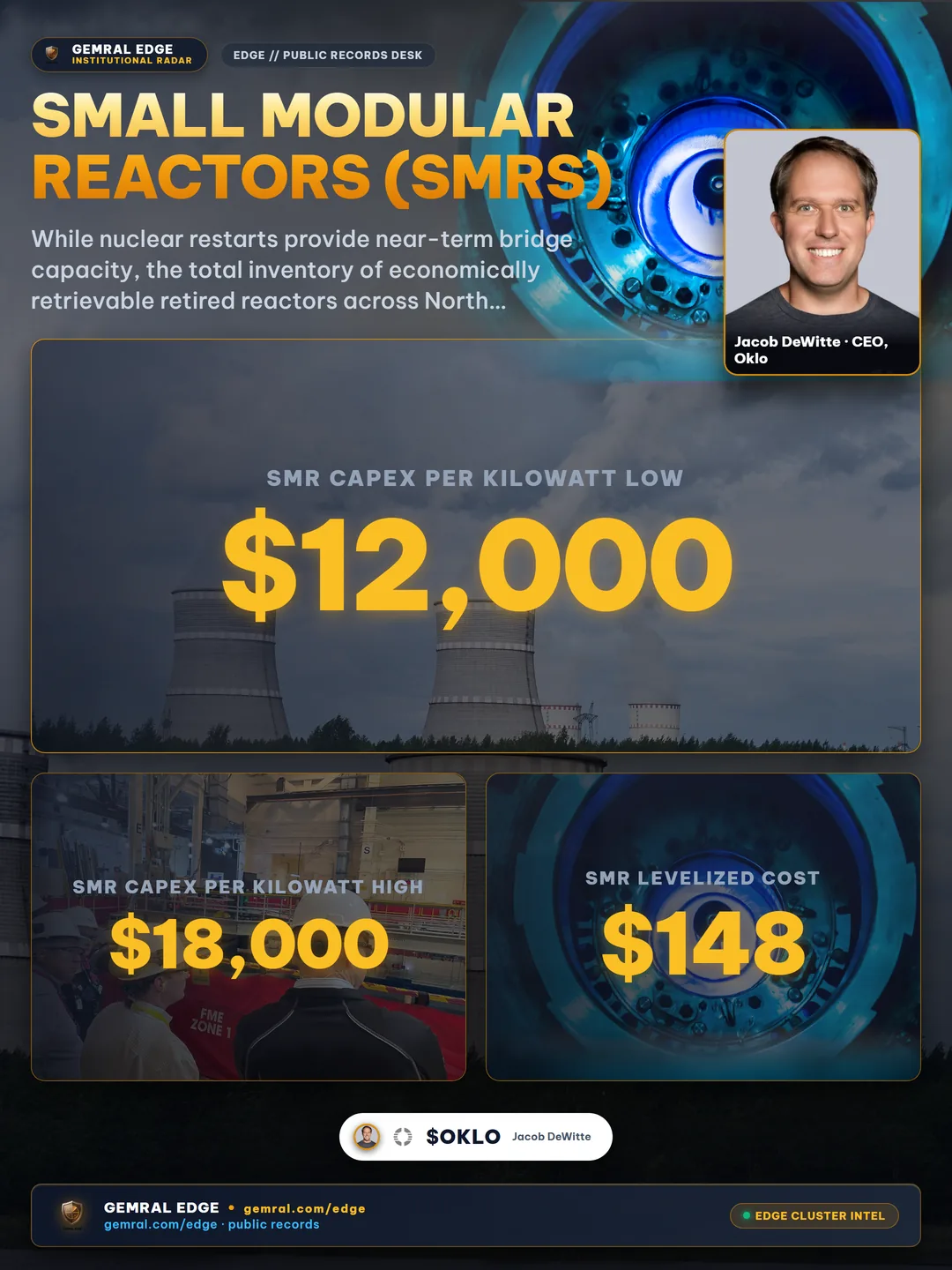
Despite enthusiastic capital market sentiment, public regulatory records demonstrate that SMR technology faces profound economic and licensing hurdles before reaching commercial scale. First-of-a-kind (FOAK) nuclear construction has historically suffered severe capital cost escalation. Recent engineering benchmark estimates indicate that early SMR installations carry capital expenditures between $12,000 and $18,000 per Kilowatt of capacity, resulting in a levelized cost of electricity exceeding $148 per Megawatt-hour.
| Reactor Archetype | Key Proponents | Cooling Medium | Estimated Lead Time | Regulatory Status |
|---|---|---|---|---|
| Light-Water SMR | NuScale Power (VOYGR) | Pressurized Water | 72–84 Months | NRC Standard Design Approval (50 MWe) |
| Fluoride Salt-Cooled High-Temp | Kairos Power (Hermes) | Liquid Molten Salt | 84–96 Months | Construction Permit Approved (Hermes Demo) |
| Fast Fission Micro-Reactor | Oklo Inc. (Aurora) | Liquid Metal (Sodium) | 60–72 Months | Pre-Application Review / Re-submission |
| High-Temperature Gas-Cooled | X-energy (Xe-100) | Helium Gas | 84–108 Months | ARDP Demonstration / Environmental Review |
Furthermore, novel reactor architectures require extensive testing under NRC 10 CFR Part 52 or the newly emerging Part 53 regulatory frameworks for advanced nuclear technology. The lead time required to progress from initial vendor design submission through environmental reviews, public hearings, construction permit issuance, and final commercial commissioning spans 84 to 108 months. Consequently, while SMR purchase agreements secure long-term manufacturing slots and fuel supply chains, they offer minimal operational power relief for compute infrastructure before 2030.
The 44-Gigawatt Carbon-Free Power Gap: Enterprise Compute Capital Versus Regulatory Physics
The collision between compute expansion and electrical generation physics is defining the geographic and strategic boundaries of enterprise technology deployment. Federal energy projections indicate that total electricity demand from artificial intelligence and enterprise datacenters will escalate from 18 Gigawatts in 2024 to 34 Gigawatts in 2026, reaching 58 Gigawatts by 2028 and exceeding 92 Gigawatts by 2030.
However, the total volume of firm, carbon-free baseload power contracted across all commercial nuclear, advanced geothermal, and clean energy agreements is projected to reach only 48 Gigawatts by 2030. This creates an acute, 44-Gigawatt clean power deficit across the global compute fleet.
Technology executives are learning that while software code and machine learning architectures can iterate on monthly release schedules, heavy nuclear engineering operates under immutable physical and regulatory laws. Fabricating forged reactor pressure vessels, securing high-assay low-enriched uranium (HALEU) enrichment services, and completing federal environmental impact statements require multi-year capital deployment cycles that cannot be compressed by software agility.
Empirical Intelligence & Catalyst Radars:
• Defense & Energy Procurement: Track newly obligated federal power contracts and prime contractor awards on the Federal Contracts & War Chest Radar.
• Datacenter Power Crisis Forecasts: Track nuclear SMR licensing odds and utility interconnect queues on the AI Datacenter Power Crisis & SMR Energy Radar.
• Grid Macro Telemetry: Inspect live central bank liquidity correlation with power infrastructure capex on the Global Macro & Federal Liquidity Radar.
• Monetary Catalyst Matrix: Review utility debt financing sensitivities and rate expectations on the FOMC Interest Rate Decision & Dot Plot Forecast.