AI Datacenter Power Grid Interconnection Bottlenecks: How Substation Queues and High-Voltage Lead Times Are Constraining Enterprise Compute Deployments
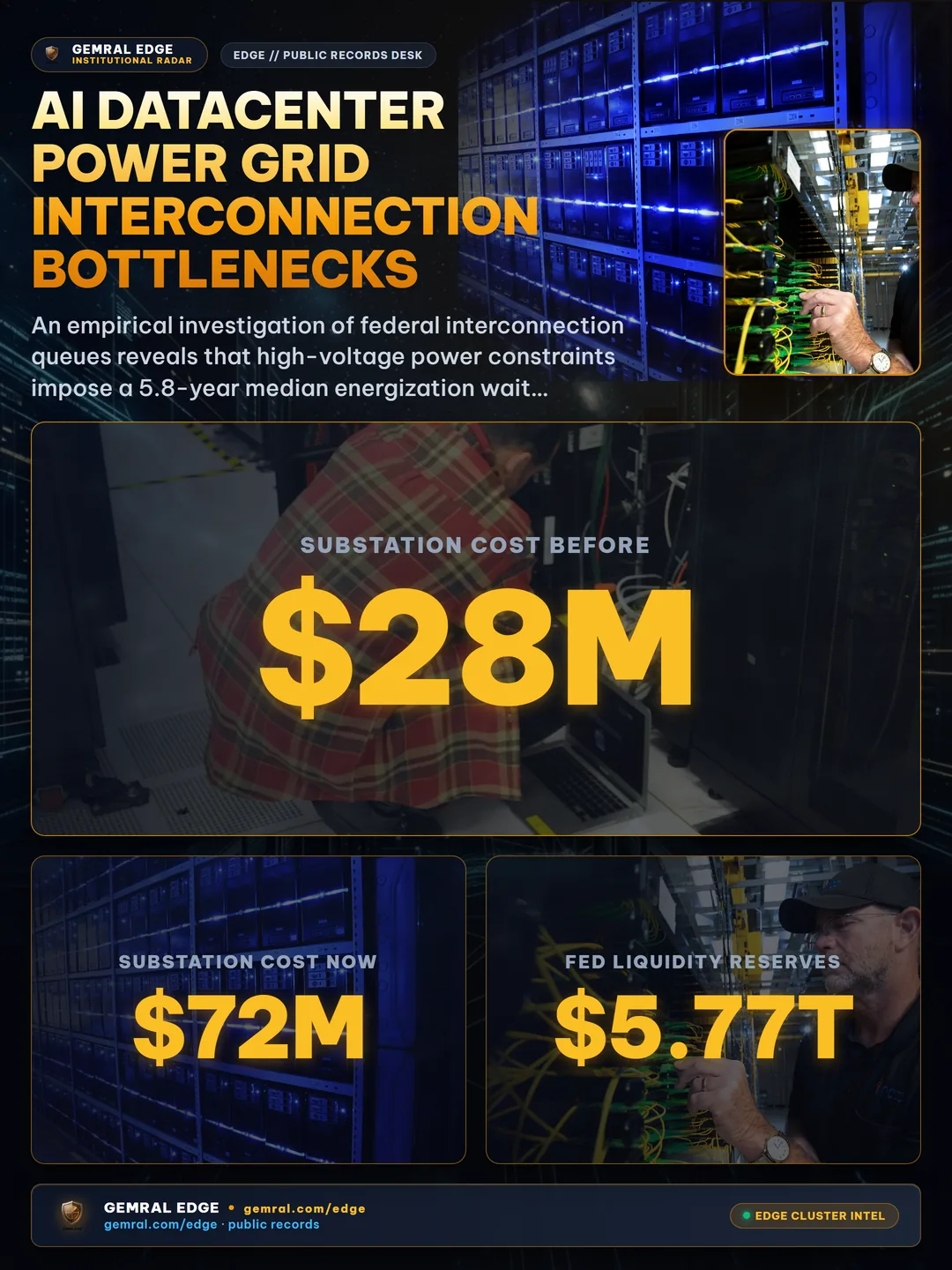
Across federal transmission filings, utility interconnection registries (tracked via the AI datacenter power infrastructure intelligence), and electrical equipment supply chain records audited in September 2026, the primary constraint on enterprise artificial intelligence deployment has shifted decisively from semiconductor fabrication yields to electrical transmission physics. Public transmission interconnection queues across the United States contain 3,140 Gigawatts of pending generation and storage projects, up 58% from 1,980 Gigawatts in 2022. For enterprise datacenter operators seeking utility power allocations exceeding 100 Megawatts, the median duration required to progress from initial system impact study to commercial energization has stretched to 5.8 years, compared to 2.4 years in 2020.
The Transmission Reality: 3,140 Gigawatts in Interconnection Limbo
Public regulatory records maintained by regional transmission organizations (RTOs) document a structural backlog in high-voltage grid access. In 2020, total capacity in active federal interconnection queues stood at 1,260 Gigawatts. That volume compounded steadily to 1,640 Gigawatts in 2021, reached 1,980 Gigawatts in 2022, climbed to 2,420 Gigawatts in 2023, reached 2,890 Gigawatts in 2024, and totals 3,140 Gigawatts in 2026.
While public financial market discourse focuses on software model benchmarks and quarterly semiconductor shipment guidance, physical high-voltage substations operate under fixed engineering and regulatory constraints. Before a utility connects a new high-density compute cluster requiring 200 Megawatts of continuous baseload power, engineers must perform a feasibility review, a system impact evaluation, and a comprehensive facilities study to prevent thermal overload on regional transmission backbones.
Historical transmission records indicate that 84% of all interconnection requests filed between 2012 and 2022 ultimately withdrew before reaching commercial operation. The primary catalyst for project withdrawal is not lack of commercial demand, but rather the allocation of unexpected network upgrade costs, where developers are assessed capital obligations for regional transmission upgrades located tens of miles away from their facility footprint.
Substation Backlogs: The 5.8-Year Energization Horizon
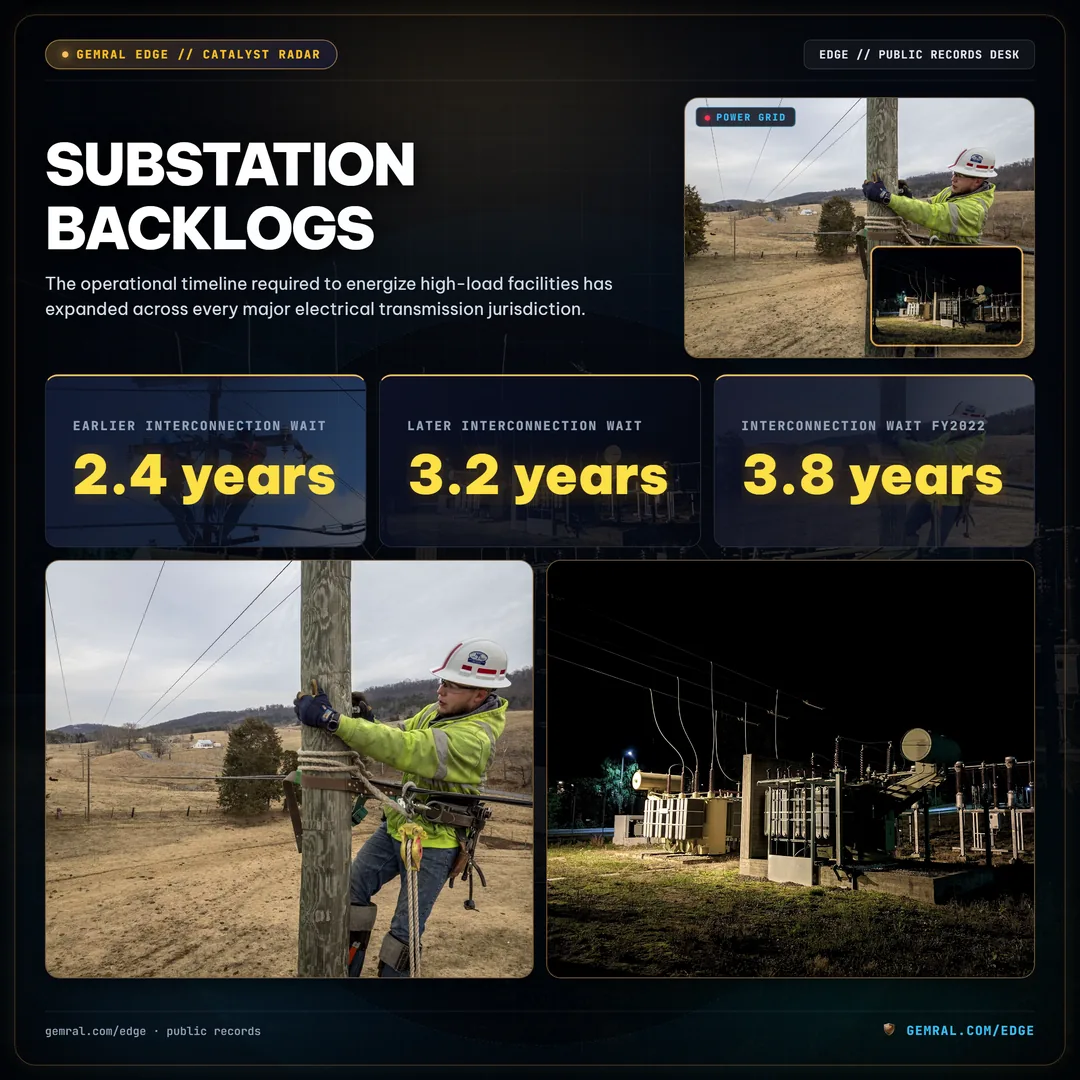
The operational timeline required to energize high-load facilities has expanded across every major electrical transmission jurisdiction. In 2020, the median wait time from application filing to commercial energization for facilities requiring over 100 Megawatts was 2.4 years. By 2021, this interval lengthened to 3.2 years, progressing to 3.8 years in 2022, 4.4 years in 2023, 5.1 years in 2024, and reaching 5.8 years in 2026.
This dynamic creates a structural divergence between enterprise software capital expenditure plans and physical site delivery. Technology leadership teams that approve multi-billion-dollar hardware allocations in 2026 confront an operational environment where local transmission interconnection agreements cannot deliver energized high-voltage substations until 2031 or 2032.
Because interconnection queues operate on sequential tariff rules, early filers hold legal transmission rights, forcing newer entrants to wait for engineering study cycles that can take up to 36 months to complete. As a consequence, enterprise operators are increasingly competing to acquire legacy industrial sites, decommissioned manufacturing plants, and retired power generation facilities specifically to inherit grandfathered transmission rights.
Hardware Supply Chain Bottlenecks: 148-Week Transformer Delays
Beneath the administrative delays of regulatory queues lies an acute physical supply chain bottleneck: high-voltage electrical distribution hardware. Manufacturer production disclosures and public procurement contracts demonstrate that procurement lead times for critical substation components have reached historic records.

High-voltage step-up transformers rated at 345 Kilovolts and 500 Kilovolts required an average manufacturing lead time of 46 weeks in 2021. By 2026, factory backlogs at major electrical equipment manufacturers extended that delivery horizon to 148 weeks, representing approximately 2.8 years of waiting time after contract signing before equipment arrives on a concrete substation pad.
| Substation Equipment Category | 2021 Baseline Lead Time | 2026 Current Lead Time | Lead Time Expansion | Primary Supply Chain Constraint |
|---|---|---|---|---|
| High-Voltage Step-Up Transformers (345kV–500kV) | 46 Weeks | 148 Weeks | +222% | Grain-Oriented Electrical Steel (GOES) |
| Medium-Voltage Switchgear Units | 28 Weeks | 82 Weeks | +193% | Specialized Copper Busbars & Precision Relays |
| High-Voltage Circuit Breakers (SF6 / Alternative) | 22 Weeks | 64 Weeks | +191% | Ceramic Bushings & Gas Handling Systems |
| Backup Fast-Start Aeroderivative Turbines | 20 Weeks | 54 Weeks | +170% | Precision Rotor Forgings & Control Electronics |
The manufacturing delay for high-voltage transformers stems from domestic industrial capacity constraints in grain-oriented electrical steel (GOES). Because transformer cores require specialized magnetic properties to minimize hysteresis losses under high-frequency electrical loads, global production is concentrated among a small number of precision metallurgical mills. As global utilities, electric vehicle charging networks, and hyperscale compute clusters compete for identical steel allocations, delivery dates have moved into multi-year backlogs.
Regional Queue Geography: ERCOT and PJM Interconnection Grids
Interconnection delays and power constraints are not distributed evenly across North American geography. An examination of regional transmission filings highlights severe geographic concentration across key power markets.
In the Electric Reliability Council of Texas (ERCOT), datacenter interconnection requests represent 42 Gigawatts of pending load commitments, operating with an average energization wait time of 4.5 years. Although Texas operates an independent, non-federally regulated grid that allows for comparatively rapid transmission approvals, local transmission lines between West Texas generation zones and metropolitan compute clusters face capacity congestion.
Within PJM Interconnection, which encompasses Northern Virginia—the largest datacenter concentration globally—total interconnection requests across all sectors stand at 260 Gigawatts, with dedicated datacenter load requests accounting for 38 Gigawatts. In this jurisdiction, average energization lead times now measure 6.2 years, driven by extensive transmission line rebuild requirements and local substation saturation across Loudoun and Prince William counties.
In the Midcontinent Independent System Operator (MISO), datacenter developers have submitted 24 Gigawatts of interconnection requests with a 5.6-year median wait time. The California Independent System Operator (CAISO) registers 18 Gigawatts of pending datacenter demand, characterized by the longest regulatory process in the nation at 6.8 years due to environmental review requirements under state environmental quality statutes. The Southwest Power Pool (SPP) accounts for 14 Gigawatts with a 5.1-year median queue duration.
Thermal and Electrical Escalation: The 120 kW Rack Density Shift
The underlying driver of this transmission grid congestion is the technical escalation of server rack thermal and electrical density. Standard enterprise enterprise IT architectures historically operated at 8 Kilowatts per standard 42U rack enclosure. Early hyperscale cloud virtualization clusters expanded that envelope to 15 Kilowatts per rack.
In contrast, production clusters engineered for large-scale artificial intelligence inference draw between 40 Kilowatts per rack, while dense accelerator training fabrics utilizing liquid-to-chip cooling architectures require up to 120 Kilowatts per rack enclosure.
This 8-fold to 15-fold increase in power density means that a newly constructed datacenter campus of identical physical building footprint now demands the electrical capacity of an entire medium-sized metropolitan city. A single campus housing 30,000 dense accelerators requires continuous delivery of 300 Megawatts to 500 Megawatts, necessitating dedicated high-voltage switchyards connected directly to 345 Kilovolt or 500 Kilovolt transmission lines.
Substation Infrastructure Capex: The 157% Cost Escalation
The combination of extended component lead times, specialized civil engineering requirements, and utility workforce shortages has driven substantial capital expenditure inflation for dedicated substation assets. Construction cost disclosures submitted to state public utility commissions reflect an accelerating cost baseline.
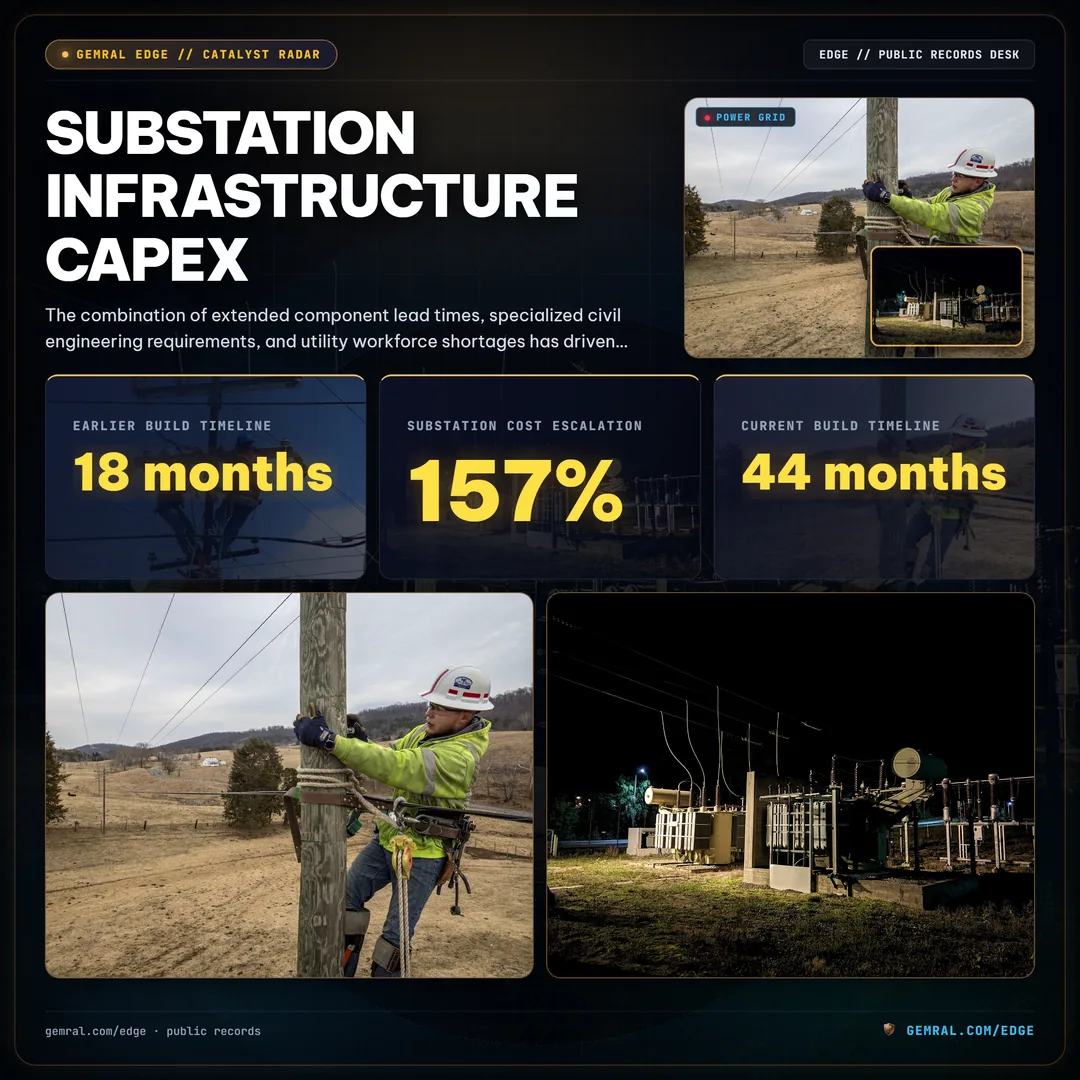
In 2021, constructing a dedicated 500 Kilovolt utility substation capable of stepping down transmission voltage for a large datacenter campus required a baseline capital cost of $28 million and took approximately 18 months from ground-breaking to energization. By 2026, identical engineering specifications demand $72 million in capital expenditure—a 157% cost escalation—while the turnkey completion timeline has extended to 44 months.
These capital requirements are transforming the financial structure of enterprise compute deployments. Datacenter development firms are increasingly structured as energy development companies, allocating more upfront capital toward electrical switchyards, on-site utility interconnections, and regional transmission upgrades than to the actual physical server hall shells.
Behind-the-Meter Offtake and Sovereign Deep Flow Allocations
Faced with a 5.8-year median queue horizon and severe component bottlenecks, enterprise operators are executing strategic adaptations. Utility filings indicate that 64% of major technology corporations are actively pursuing behind-the-meter co-location agreements, negotiating direct bilateral power purchase contracts with operating nuclear power stations, combined-cycle natural gas facilities, and dedicated solar-plus-storage microgrids to bypass regulated utility transmission queues entirely.
Within the analytical architecture of Gemral Edge, tracking these physical grid constraints provides an essential layer of institutional validation. When monitoring institutional capital flows and corporate asset accumulations, observing where hyperscalers secure physical high-voltage grid allocations establishes an empirical baseline for which infrastructure initiatives possess genuine operational viability.
Under Deep Flow tracking, public utility interconnection filings are correlated with corporate executive appointments, specialized industrial procurement filings, and congressional capital disclosures under the STOCK Act. In a macroeconomic regime where the Federal Reserve maintains systemic liquidity reserves above $5.77 trillion, examining capital allocations toward physical power transmission assets reveals the durable infrastructure foundations supporting enterprise compute.
Public Transmission Disclosures and Empirical Methodologies
All metrics, queue volumes, component lead times, and capital expenditure figures presented in this research are derived exclusively from public regulatory disclosures filed with regional transmission organizations, state public utility commissions, and federal energy regulatory authorities. By analyzing power interconnection queues as an empirical dataset, market analysts can evaluate infrastructure deployment velocity through physical engineering metrics rather than promotional corporate communications.
As enterprise compute demand compounds over the remainder of the decade, physical transmission interconnection queues, transformer manufacturing capacity, and high-voltage substation delivery schedules will remain the governing rate-limiters for global technology scaling. Monitoring these public energy datasets establishes an objective analytical foundation for understanding the physical reality of the artificial intelligence infrastructure transition.