Insider Buying This Week: 29 Disclosed Purchases, Berkshire's $192.6M Lennar Bet, and the 15-to-1 Sell Skew
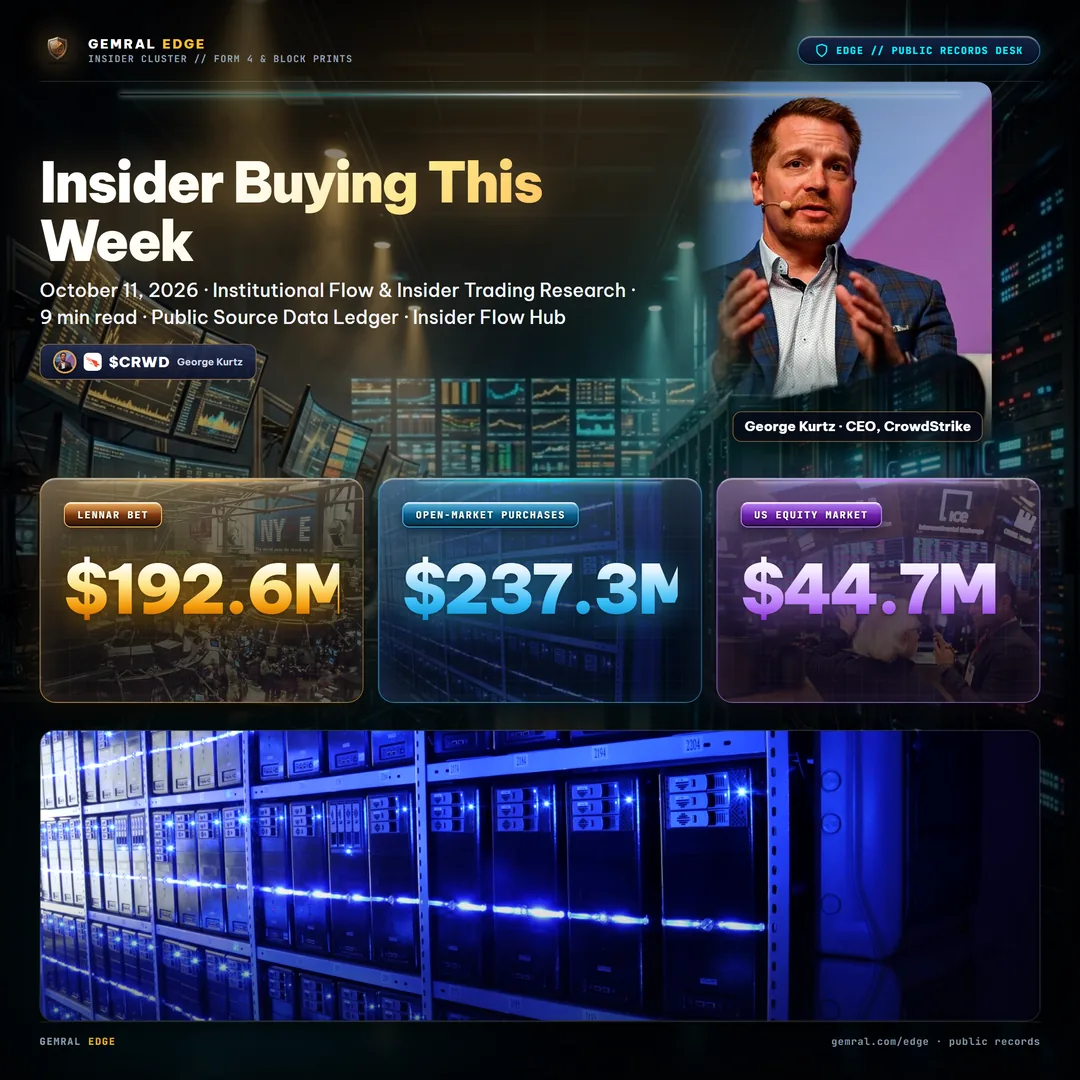
In the week ending October 10, 2026, corporate insiders filed 29 open-market purchases totaling $237.3M across 22 tickers. However, 81.2% of that capital originated from a single buyer: Berkshire Hathaway purchasing Lennar Corp (LEN). When stripping out that $192.6M stake, total insider buying across the remainder of the US equity market was $44.7M, overshadowed by $3.62B in disclosed insider sales across 135 transactions.
Market participants tracking insider buying this week confront a severe data distortion. At headline level, corporate ownership disclosures reflect $237.3M in total purchase volume, creating the appearance of robust corporate accumulation. Dissecting the underlying ledger on the Insider Flow Hub reveals that open-market corporate buying was concentrated in a single industrial bet, while baseline executive buying across corporate America remained subdued.
Analyzing insider transaction records requires examining both transaction classification and total capital dispersion. While automated scanners routinely aggregate raw filing dollars into generic sentiment gauges, granular auditing of disclosure footnotes separates secondary market execution from pre-priced initial public offering share distributions. Similar to our tracking of senator stock trades analysis and cross-asset allocations documented in semiconductor capital expenditure research, corporate disclosure filings reveal distinct institutional mechanics when evaluated in aggregate.
Insider Buying This Week: Dissecting the $237.3M Capital Deployment
During the seven-day period spanning October 3 to October 10, 2026, public corporate insiders across US exchanges filed 29 purchase transactions across 22 distinct tickers, involving 28 individual and institutional reporting owners. Aggregate buying totaled $237,323,342. The median transaction size across all 29 filings stood at $126,000, underscoring the divergence between a few multi-million-dollar institutional purchases and standard executive personal portfolio allocations.

Beyond the primary homebuilder transaction, several prominent corporate executives and investment funds disclosed open-market purchases. Ryan Israel, Chief Investment Officer of Pershing Square, executed a $9.6M acquisition of Pershing Square USA (PSUS), purchasing 256,613 shares on October 6, 2026. In the real estate operating sector, Bluerock Homes (BPRE) director Ramin Kamfar completed an $8.5M purchase of 651,063 shares on October 9, 2026. In the energy and resources space, institutional investment entity L1 Capital Pty Ltd disclosed two filings totaling $8.7M in AVR ($6,708,731 on October 5 and $1,957,950 on October 6).
| Ticker | Reporting Owner | Relationship | Shares | Transaction Value | Filing Date |
|---|---|---|---|---|---|
| LEN | Berkshire Hathaway Inc. | 10% Owner | 2,418,637 | $192,634,433 | October 6, 2026 |
| PSUS | Ryan Israel | Officer (CIO) | 256,613 | $9,615,216 | October 6, 2026 |
| AVR | L1 Capital Pty Ltd | 10% Owner | Multiple Tranches | $8,666,681 | October 6, 2026 |
| BPRE | Ramin Kamfar | Director | 651,063 | $8,501,527 | October 9, 2026 |
| AXIA3 | Pedro Batista de Lima Filho | Director | 489,900 | $5,295,819 | October 2, 2026 |
| SAH | Paul P. Rusnak | 10% Owner | 27,756 | $1,658,699 | October 5, 2026 |
Additional notable transactions included Pedro Batista de Lima Filho acquiring 489,900 shares of AXIA3 for $5.3M on October 2, 2026, and ten-percent owner Paul P. Rusnak purchasing 27,756 shares of automotive retailer Asbury Automotive Group (SAH) for $1.7M on October 5, 2026. Together, these five non-Berkshire transactions accounted for $33.7M of the $44.7M ex-Berkshire buying pool, leaving just $11.0M spread across the remaining 17 reporting entities.
The Berkshire Distortion: How One $192.6M Bet Accounts for 81% of Total Buying
The central driver of this week's insider statistics was Warren Buffett's Berkshire Hathaway Inc., which filed multiple ownership disclosures on October 6, 2026, detailing an accumulation of Lennar Corp (LEN) Class A common stock. Executed across October 1 and October 2, Berkshire purchased 2,418,637 shares at weighted average prices ranging from $77.12 to $81.90, deploying a total of $192,634,433.
This single allocation accounted for exactly 81.2% of all insider buying dollars documented across the entire US equity universe during the week. For quantitative screens that track insider accumulation as a proxy for macroeconomic sentiment, this single trade creates a substantial skew. Without Berkshire's capital, total insider buying across the United States would have registered at $44.7M, marking one of the quietest open-market buying windows of the second half of 2026.
Lennar's market positioning within the residential construction sector reflects macroeconomic crosscurrents in interest rates, housing supply shortages, and land acquisition strategies. Berkshire's regulatory disclosure demonstrates targeted capital allocation into homebuilding assets rather than a broad-based endorsement of consumer cyclicals. Investors evaluating headline insider buying trends must distinguish between conglomerate-level balance sheet positioning and widespread executive optimism.
Cluster Buying Audit: Separating Real Market Conviction From IPO Allocations
Quantitative insider trading strategies place heavy analytical weight on cluster buying, defined as multiple distinct insiders acquiring shares of the same company within a narrow calendar window. Conventional market theory posits that when three or more executives purchase shares simultaneously, the confluence of buying signals collective corporate confidence rather than isolated personal liquidity decisions.
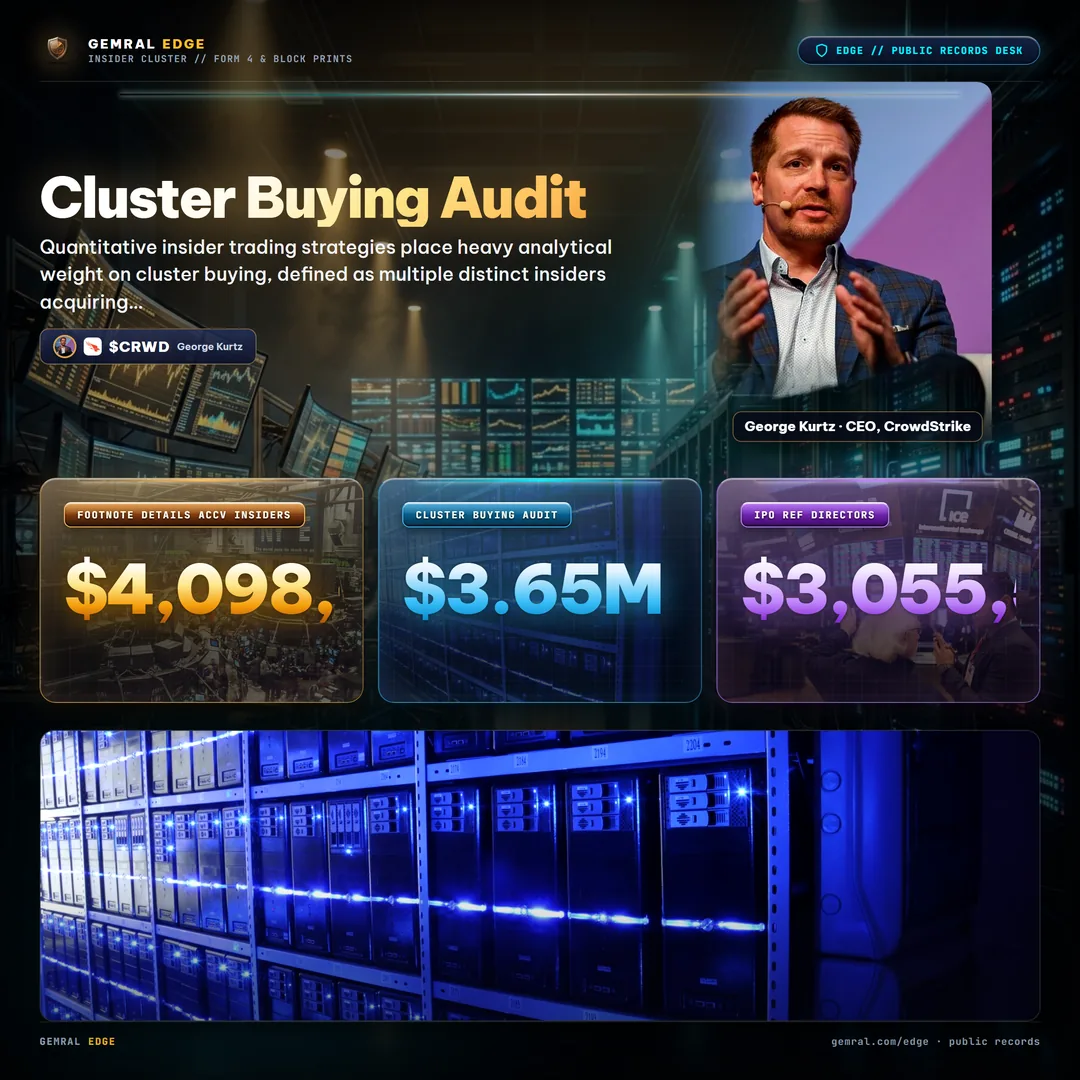
During the past seven days, automated screeners flagged two prominent multi-insider buying clusters: Accelevation Holdings Corp (ACCV) and Reformation Inc (REF). On surface evaluation, both tickers exhibited classic cluster accumulation signatures:
| Company | Cluster Size | Total Value | Key Insiders Involved | Disclosure Footnote Details |
|---|---|---|---|---|
| ACCV | 5 Insiders | $4,098,600 | CEO Rubiera ($3.65M), Jones ($180k), Donahue ($126k), Heckes ($90k), Jewell ($45k) | Note 1: Directed Share Program allocation in connection with IPO |
| REF | 3 Directors | $3,055,500 | Coyle ($3.0M), Allen ($52.5k), Kleine ($3k) | Note 1: Directed Share Program allocation in connection with IPO |
At Accelevation Holdings Corp (ACCV), five separate insiders filed disclosure documents reporting purchases totaling $4,098,600. The filings included CEO Michael Rubiera ($3.65M), Director Ginger Jones ($180,000), Director Paul Donahue ($126,000), Director Howard Heckes ($90,000), and COO Brent Jewell ($45,000). Similarly, Reformation Inc (REF) recorded filings from three directors totaling $3,055,500, led by John Joseph Coyle's $3.0M purchase alongside smaller allocations from Zipporah Allen ($52,500) and Brigitte Kleine ($3,000).
However, forensic auditing of Footnote 1 on each of these filings reveals that neither ACCV nor REF represented secondary open-market transactions. In both cases, the disclosures explicitly stated: "Purchased pursuant to a directed share program in connection with the Issuer's initial public offering." Insiders were purchasing shares at the predetermined public offering price under company-sponsored allotment programs. Classifying directed share program distributions as discretionary open-market accumulation misinterprets the economic incentive structure, as these transactions represent pre-planned foundational equity participation rather than spontaneous secondary market bids.
The 15-to-1 Sell Skew: Where C-Suite Executives Are Cashing Out
While insider purchases totaled $237.3M, corporate insider dispositions reached $3.62B ($3,620,755,363) across 135 transactions and 76 individual tickers. In dollar terms, corporate insiders sold $15.20 worth of equity for every single dollar of stock purchased, representing a 15.2 to 1 sell-to-buy ratio. Even when retaining Berkshire Hathaway's $192.6M Lennar purchase, net corporate insider cash flow was overwhelmingly negative.
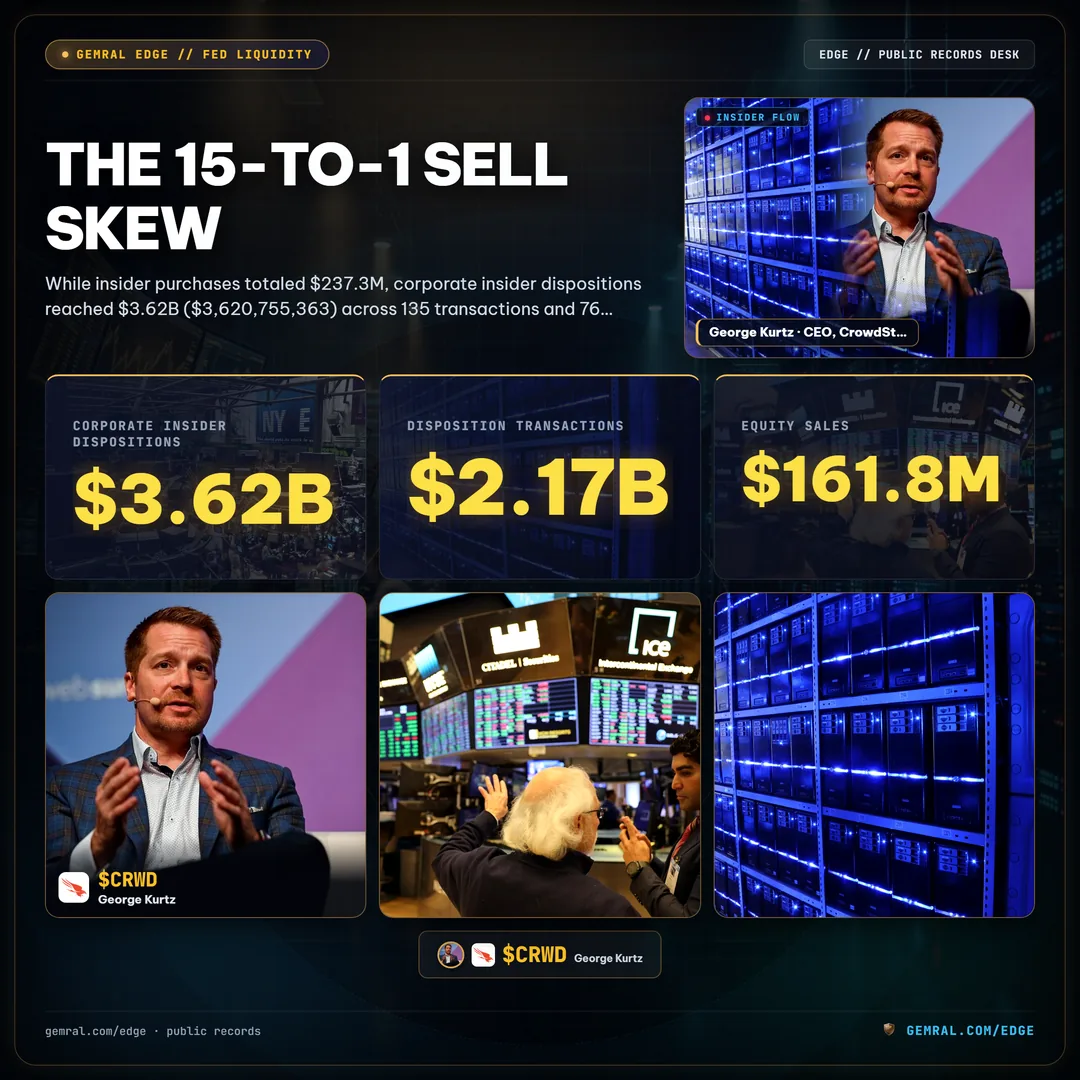
The largest disposition in the dataset occurred at InnSuites Hospitality Trust (IHT), where President and CEO James F. Wirth disclosed trust-related disposition transactions totaling $2.17B ($2,168,775,699). In the institutional healthcare distribution sector, sovereign entity GIC Private Ltd disclosed sales of Medline Industries (MDLN) stock totaling $721.6M.
Among high-multiple technology equities, corporate leadership utilized pre-scheduled Rule 10b5-1 trading plans to execute $161.8M in equity sales. Jayshree Ullal, CEO of networking equipment leader Arista Networks (ANET), disclosed $97.6M in share dispositions across October 2 to October 5. At cybersecurity firm CrowdStrike Holdings (CRWD), President Michael Sentonas completed share sales totaling $64.2M. While pre-established Rule 10b5-1 plans insulate executives from allegations of trading on material non-public information, the continuous conversion of equity compensation into cash liquidity remains a defining feature of executive capital flow.
Evaluating insider buying this week confirms that headline metrics require granular contextualization. When Berkshire's $192.6M single-name position and $7.1M in IPO directed share programs are appropriately cataloged, the remaining open-market insider buying landscape reflects selective, defensive deployment against an ongoing $3.62B backdrop of corporate executive liquidity realizations.
Frequently asked questions
What was the biggest insider stock purchase this week?
Berkshire Hathaway's acquisition of 2,418,637 shares of Lennar Corp (LEN) for $192.6M across October 1-2, disclosed in SEC Form 4 filings on October 6, 2026.
Did any stocks show cluster insider buying this week?
Accelevation Holdings (ACCV) recorded 5 insider filings totaling $4.1M, but SEC disclosures reveal these were IPO directed share program allocations rather than open-market secondary purchases.
What is the ratio of insider buying to selling this week?
Insiders sold $3.62B against $237.3M in purchases, resulting in a sell-to-buy ratio of 15.2x, driven by large liquidity sales in IHT ($2.17B) and MDLN ($721.6M).