Geothermal Data Center Interconnection Queues: Behind-the-Meter Power, FERC Reform, and the $42B Race for 24/7 Clean AI Baseload

Federal energy regulatory filings and corporate procurement disclosures confirm that the modern geothermal data center has shifted from an experimental clean tech niche into an urgent multi-billion-dollar infrastructure imperative. As artificial intelligence computing clusters expand from tens of megawatts toward gigawatt-scale campuses, hyperscale operators face an insurmountable bottleneck: regional electric transmission interconnection queues audited across the datacenter power intelligence radar now exceed 2,600 gigawatts nationwide, with average interconnection study delays stretching between 4 and 7 years.
Faced with gridlock that threatens to stall next-generation frontier model training clusters, technology leaders including Alphabet, Meta Platforms, and Amazon Web Services are orchestrating unprecedented clean power architectures. By pairing advanced Enhanced Geothermal Systems (EGS) with behind-the-meter colocation and long-term corporate power purchase agreements (PPAs), these tech titans are sidestepping regional transmission operators entirely. The resulting structural convergence between horizontal oilfield drilling technologies and continuous clean energy generation has triggered over $42 billion in projected private capital deployment, federal loan guarantees, and commercial off-take commitments through 2030.
1. The Baseload Bottleneck: Why AI Gigawatt Campuses Are Turning to Geothermal Data Center Power
The core catalyst accelerating the geothermal data center boom is the mathematical incompatibility between intermittent renewable energy and the electrical load profile of modern AI accelerator clusters. A single state-of-the-art AI training cluster housing 100,000 graphics processing units (GPUs) draws between 100 megawatts and 150 megawatts of continuous, non-fluctuating electric power. When engineering multi-cluster campuses designed for future computing architectures, hyperscale developers are planning facilities requiring 1,000 megawatts to 2,000 megawatts—equivalent to the electrical consumption of a major metropolitan area.

While tech companies spent the previous decade purchasing wholesale renewable energy credits from utility-scale solar photovoltaic (PV) and onshore wind farms, those intermittent resources cannot sustain an uninterrupted computing fabric. Solar facilities operate at average annual capacity factors of 22% to 28%, while onshore wind farms hover between 30% and 38%. Commercial utility battery energy storage systems (BESS), typically configured for 4-hour discharge durations, cannot bridge multi-day wind lulls or winter solar deficits without exponentially escalating capital expenditures.
In contrast, next-generation geothermal power plants operate as genuine 24/7 carbon-free energy (CFE) sources with capacity factors consistently surpassing 90% to 95%. Unlike traditional nuclear installations that require decade-long Nuclear Regulatory Commission (NRC) environmental reviews and capital budgets frequently exceeding $10 billion per gigawatt, advanced geothermal facilities can be drilled, stimulated, and brought online within 24 to 36 months when sited on accessible private or leased federal land.
2. Auditing the Queue: FERC Order 2023 Cluster Studies and the 2,600 GW Interconnection Gridlock
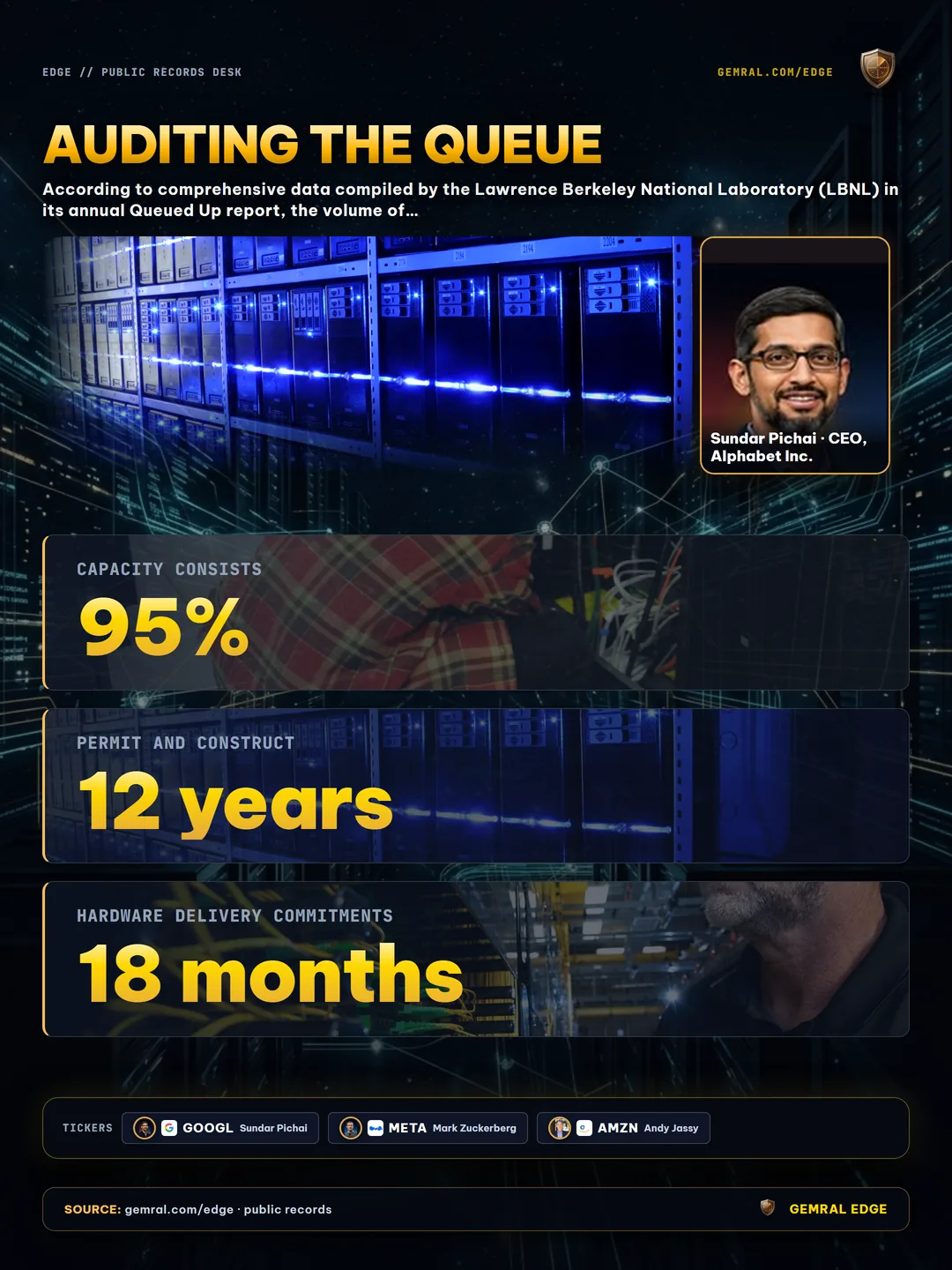
According to comprehensive data compiled by the Lawrence Berkeley National Laboratory (LBNL) in its annual Queued Up report, the volume of generation and storage capacity seeking transmission interconnection across regional transmission organizations (RTOs) surged to over 2,600 gigawatts at the beginning of 2026. Over 95% of this queued capacity consists of clean energy projects (solar, battery storage, and wind) struggling to secure physical grid access.
In major data center regions such as PJM Interconnection—which oversees electric grid operations for Northern Virginia's "Data Center Alley"—interconnection queues have ground to a near-total operational halt. PJM’s historical "first-come, first-served" review mechanism created speculative backlogs where developers submitted speculative requests for unviable projects, triggering cascading restudy delays for legitimate generators. Even under PJM's emergency transition to cluster-based reviews, projects entering the interconnection study process today are not scheduled for commercial energization decisions until 2029 or 2031.
The Federal Energy Regulatory Commission attempted to alleviate this crisis by issuing FERC Order 2023, mandating a transition to "first-ready, first-served" cluster studies, imposing escalating financial penalties for project withdrawals, and enforcing strict regulatory review deadlines on transmission providers. However, regulatory restructuring alone cannot resolve physical transmission line shortages. High-voltage alternating current (HVAC) and high-voltage direct current (HVDC) transmission lines take between 7 and 12 years to permit and construct across multi-state jurisdictions. For data center operators with hardware delivery commitments scheduled within 18 months, waiting for public grid expansion is an unacceptable operational failure.
3. Next-Generation EGS Engineering: Fracking Tech Adapted for 400°F Granite Reservoirs
The technological revolution enabling the deployment of the geothermal data center is Enhanced Geothermal Systems (EGS) and closed-loop Advanced Geothermal Systems (AGS). Conventional hydrothermal geothermal energy has existed for over a century at natural geological anomalies like The Geysers in Northern California or Salton Sea. However, hydrothermal projects require an exceedingly rare natural convergence of three elements: high subsurface heat, porous and permeable rock, and abundant underground water reservoirs. Because this trifecta occurs naturally across less than 2% of the Earth's landmass, geothermal power remained geographically constrained for decades.

Next-generation EGS dismantles this geographic boundary by manufacturing underground permeability where none previously existed. Utilizing horizontal directional drilling techniques, high-temperature measurement-while-drilling (MWD) tools, and multistage hydraulic stimulation adapted directly from unconventional shale oil and gas operations, EGS operators drill deep into impermeable crystalline basement granite at depths ranging between 8,000 and 14,000 feet, where temperatures routinely exceed 350°F to 450°F (175°C to 230°C).
The operational sequence follows a closed-loop or stimulated doublet pattern:
- Precision Directional Drilling: Operators drill an injection well down into basement rock, then steer horizontally for 4,000 to 8,000 feet through hot, dry granite formations.
- Zonal Hydraulic Stimulation: High-pressure water is injected in discrete stages along the horizontal lateral, opening millimeter-wide micro-fractures throughout the crystalline granite without chemical proppants.
- Production Well Intersection: A parallel production well is drilled horizontally several hundred feet above or adjacent to the injection lateral, precisely intercepting the stimulated micro-fracture network.
- Closed-Loop Circulation: Water is circulated down the injection well, heats as it migrates through the vast fractured rock heat exchanger, and returns up the production well at temperatures above 375°F under continuous pressure.
- Binary Organic Rankine Cycle (ORC) Generation: At the surface, the superheated geothermal brine passes through a heat exchanger to vaporize an organic working fluid (such as isobutane or isopentane) with a lower boiling point than water. The expanding vapor drives a high-efficiency binary turbine to generate clean electricity before being condensed and reinjected into the subsurface reservoir in a closed loop.
This closed thermodynamic cycle consumes minimal net water, generates zero particulate emissions, produces negligible surface acoustic signatures, and occupies a tiny land footprint compared to sprawling solar arrays or wind farms.
4. Hyperscaler PPA Architecture: Google, Meta, and the Multi-Hundred-Megawatt Offtake Agreements
Public corporate disclosures confirm that hyperscalers are no longer treating geothermal as an academic pilot program; they are signing multi-hundred-megawatt binding commercial agreements with dedicated EGS innovators.

| Corporate Buyer | Geothermal Developer | Contract Capacity | Commercial Structure | Projected COD | Regional Location |
|---|---|---|---|---|---|
| Google (Alphabet) | Fervo Energy | 115 MW | Clean Transition Tariff (NV Energy PPA) | 2026 – 2027 | Nevada (Basin & Range) |
| Meta Platforms | Sage Geosystems | 150 MW | Direct Behind-the-Meter Power Offtake | 2027 – 2028 | Western US Grid Region |
| Microsoft | Constellation / NextEra / EGS Consortium | 200+ MW (Evaluated) | Behind-the-Meter Multi-Resource Blend | 2027 – 2029 | Pacific Northwest / PJM |
| Amazon Web Services (AWS) | Confidential EGS Operators | 250 MW (Targeted) | Co-Located Private Wire Microgrid | 2028 – 2030 | Texas / Mountain West |
| Southern California Edison | Fervo Energy (Cape Station) | 400 MW | Multi-Phase Clean Baseload Utility PPA | 2026 – 2028 | Beaver County, Utah |
In November 2023, Google and Fervo Energy made history by synchronizing the world's first commercial EGS project serving a commercial hyperscale data center in Nevada, delivering a steady 3.5 megawatts directly into the local NV Energy grid. Following that successful validation, Google dramatically scaled its commitment in June 2024 by signing an agreement to purchase 115 megawatts of next-generation geothermal capacity from Fervo under a novel Clean Transition Tariff approved by the Nevada Public Utilities Commission.
Concurrently, in August 2024, Meta Platforms announced a landmark agreement with Sage Geosystems to develop up to 150 megawatts of advanced geothermal capacity. Sage Geosystems employs an innovative deep fractured mechanical heat harvesting architecture capable of generating electricity while simultaneously acting as a subsurface energy storage battery by pressurizing and depressurizing underground rock formations. The first 150 MW phase is slated to begin commercial deliveries to Meta's data center footprint by 2027.
5. Federal Financing Catalysts: DOE Loan Programs Office Title 17 and IRA Tax Credit Stacking
While hyperscaler balance sheets are driving commercial demand, federal clean energy industrial policy has provided the non-dilutive low-cost capital required to de-risk subsurface exploration and commercial wellfield scaling. The U.S. Department of Energy (DOE) Loan Programs Office (LPO), revitalized under the Inflation Reduction Act (IRA), controls over $72 billion in active clean energy financing authority under its Title 17 Clean Energy Financing Program.

Geothermal developers qualify for Title 17 Section 1703 financing, which provides federal loan guarantees covering up to 80% of eligible project capital expenditures at U.S. Treasury interest rates plus a modest spread. This low-cost federal debt structure dramatically lowers the weighted average cost of capital (WACC) for multi-well geothermal projects, transforming previously marginal drilling economics into lucrative commercial infrastructure assets.
Furthermore, developers can stack multiple investment tax credits under Section 48 and Section 45Y of the Internal Revenue Code:
- Base Clean Energy Investment Tax Credit (ITC): A baseline 30% tax credit on all qualified geothermal property, drilling equipment, and surface binary power plant hardware, provided prevailing wage and apprenticeship requirements are satisfied.
- Energy Community Bonus: An additional 10% tax credit adder for facilities located in brownfield sites or historical fossil fuel communities characterized by coal plant retirements or elevated oil and gas employment. Because advanced EGS heavily utilizes existing oilfield labor and drilling equipment, many projects naturally qualify.
- Domestic Content Bonus: An additional 10% credit adder for projects that verify minimum thresholds of U.S.-manufactured iron, steel, and manufactured components.
Under optimal tax planning, an advanced geothermal facility can achieve an effective 40% to 50% capital subsidy from federal tax incentives alone. Coupled with the Section 6418 tax credit transferability provisions established by the IRA, early-stage geothermal operators can monetize these credits directly to corporations and institutional financial institutions without constructing complex tax-equity partnership structures.
6. Behind-the-Meter Colocation vs. Virtual PPAs: Regulatory Battles Over Grid Cost-Shifting
As data center developers accelerate clean power procurement, a critical regulatory battleground has emerged over the physical interconnection topology: Virtual Power Purchase Agreements (vPPAs) versus Behind-the-Meter (BTM) Colocation.
Historically, hyperscalers favored virtual PPAs, wherein a remote renewable generator injects electricity into the wholesale grid at one regional node, while the data center draws grid electricity at a separate consumption node, financially settling the price difference and retiring the associated Renewable Energy Certificates (RECs). While vPPAs require zero physical modification to the data center's electrical interconnection, they do nothing to solve local transmission congestion. If the local utility substation lacks capacity, the data center cannot expand, regardless of how many virtual clean energy contracts it holds across distant states.
This reality has triggered a decisive pivot toward Behind-the-Meter (BTM) Colocation. In a BTM configuration, the geothermal power plant is constructed directly adjacent to the data center campus. Electricity flows across dedicated private infrastructure directly into the server halls, bypassing the public transmission grid during normal operating hours.
However, BTM colocation has ignited fierce opposition from incumbent regulated electric utilities. In recent high-profile filings before the Federal Energy Regulatory Commission—most notably surrounding the landmark Talen Energy / Amazon AWS Susquehanna nuclear colocation docket—utilities such as American Electric Power (AEP) and Exelon formally challenged BTM interconnects. The utilities argued that allowing large 900+ megawatt loads to tap generation behind-the-meter while remaining connected to the broader grid for backup and standby power creates unfair "transmission cost-shifting," forcing residential and small business ratepayers to shoulder the fixed costs of maintaining grid stability.
Geothermal power developers enjoy a strategic structural advantage in this regulatory struggle. Unlike single-site gigawatt nuclear stations with decades of integrated utility rate-base history, geothermal wellfields can be developed on private land in Western states (such as Nevada, Utah, and Idaho) under state-level regulatory jurisdictions that explicitly permit private microgrids and direct bilateral power sales. By engineering geothermal data center campuses with on-site synthetic inertia, battery buffers, and localized black-start capabilities, operators can sever dependence on regional transmission grids entirely.
7. Strategic Energy Map: Capital Flows, Infrastructure REITs, and the Public Market Ripple Effects
The acceleration of geothermal data center infrastructure is sending profound economic ripple effects across public equity markets, specialized real estate investment trusts (REITs), and the energy services supply chain. As capital markets recognize that computational throughput is fundamentally constrained by electricity availability, market valuations are re-rating companies positioned to supply continuous clean firm power.
Key public market beneficiaries and strategic market vectors include:
- Pure-Play Geothermal Equipment Manufacturers: Ormat Technologies (NYSE: ORA), the global leader in binary Organic Rankine Cycle turbines and geothermal project development, is experiencing surging commercial interest. With over 1.2 gigawatts of operating geothermal assets and integrated turbine manufacturing facilities, Ormat is uniquely positioned to supply both equipment and turnkey generation solutions to hyperscale developers.
- Oilfield Service Primes Transitioning to Geothermal: Global energy service conglomerates including SLB (NYSE: SLB) and Baker Hughes (NASDAQ: BKR) are repurposing their elite rotary steerable drilling systems, high-temperature downhole sensors, and reservoir characterization software toward geothermal exploration. For oilfield service giants, geothermal represents a multi-decade revenue growth runway that decouples their high-margin drilling technology from volatile crude oil and natural gas price cycles.
- High-Temperature Subsea and Casing Metallurgy: The extreme corrosive and high-temperature environments of 400°F geothermal wells require specialized corrosion-resistant alloy (CRA) casing, premium connections, and high-performance valves supplied by specialized manufacturers such as Tenaris (NYSE: TS) and Vallourec.
- Data Center Infrastructure REITs: Leading wholesale data center operators such as Equinix (NASDAQ: EQIX) and Digital Realty (NYSE: DLR), alongside specialized private developers like CyrusOne and Stack Infrastructure, are actively securing long-term land options adjacent to proven geothermal thermal gradients across the Great Basin and the desert Southwest.
Official federal regulatory filings, DOE Title 17 capital deployments, and commercial hyperscaler offtake commitments Audited across corporate disclosures confirm that the geothermal data center has evolved into an essential pillar of 21st-century technological sovereignty. For ongoing intelligence on AI infrastructure power procurement, examine our related analyses on Nuclear Power for Data Centers: SMR Deployments and Baseload Energy, the clean energy infrastructure developments analyzed in AI Datacenter Power Infrastructure Radar, and the evolving procurement structures audited in Data Center PPA Structures: Hyperscaler Offtake Agreements.
Frequently asked questions
What is a geothermal data center?
A geothermal data center is a high-density computing facility powered directly or through dedicated power purchase agreements (PPAs) by geothermal energy. Unlike intermittent solar and wind, next-generation Enhanced Geothermal Systems (EGS) deliver continuous 24/7 carbon-free baseload electricity with capacity factors exceeding 90%.
Why are tech giants like Google and Meta investing in geothermal energy for AI?
Hyperscale AI workloads require continuous, non-fluctuating electric power that traditional renewables cannot sustain without prohibitive battery costs. Additionally, regional transmission interconnection queues take 4 to 7 years to clear, prompting tech companies to sign multi-hundred-megawatt geothermal PPAs with developers like Fervo Energy and Sage Geosystems.
What are the advantages of behind-the-meter geothermal power for data centers?
Behind-the-meter (BTM) geothermal colocation enables data centers to draw power directly from on-site geothermal wells and binary organic Rankine cycle turbines. This circumvents regional transmission interconnection queues (FERC Order 2023 gridlock), avoids costly utility grid tariffs, and guarantees dedicated power delivery.
How does Enhanced Geothermal Systems (EGS) technology work for data center power?
EGS utilizes advanced horizontal directional drilling and hydraulic stimulation adapted from oil and gas engineering to create permeable fluid pathways through deep, hot crystalline granite (350°F to 500°F). Water circulated through these artificial reservoirs returns to the surface at high temperatures to spin organic Rankine cycle turbines.