Stratospheric Balloon Defense Procurement Clusters: $184M in Military High-Altitude Surveillance Contracts

Breaking procurement filings reveal that the Department of Defense has accelerated capital commitments into military stratospheric balloon architectures, surpassing $184 million in cumulative task order awards across high-altitude surveillance specialists. As regional contested theaters challenge orbital satellite survivability and conventional aerial reconnaissance, federal procurement records audited via the federal contract radar track an unmistakable cluster of funding directed toward near-space persistence.
Operating between 60,000 and 90,000 feet—an atmospheric domain positioned safely above commercial air traffic and weather patterns, yet far below the predictable orbits of Low Earth Orbit (LEO) reconnaissance satellites—the modern stratospheric balloon has transformed into an indispensable intelligence asset. Far from passive weather balloons of previous decades, today's tactical high-altitude platforms utilize autonomous solar-electric navigation, zero-pressure balloon envelopes, and synthetic aperture radar (SAR) payloads to maintain persistent theater oversight for months at a time.
1. The Near-Space Asymmetry: Why Military Stratospheric Balloon Architecture Surpasses Satellites
The strategic resurgence of military stratospheric balloon technology is grounded in severe economic and operational asymmetry. Traditional orbital reconnaissance relies on LEO satellites that travel at 17,500 miles per hour, crossing a designated operational zone in roughly 10 to 15 minutes before disappearing over the horizon. Re-establishing visual contact requires either waiting for subsequent orbital passes or deploying multi-billion-dollar constellations of dozens of synchronized spacecraft.
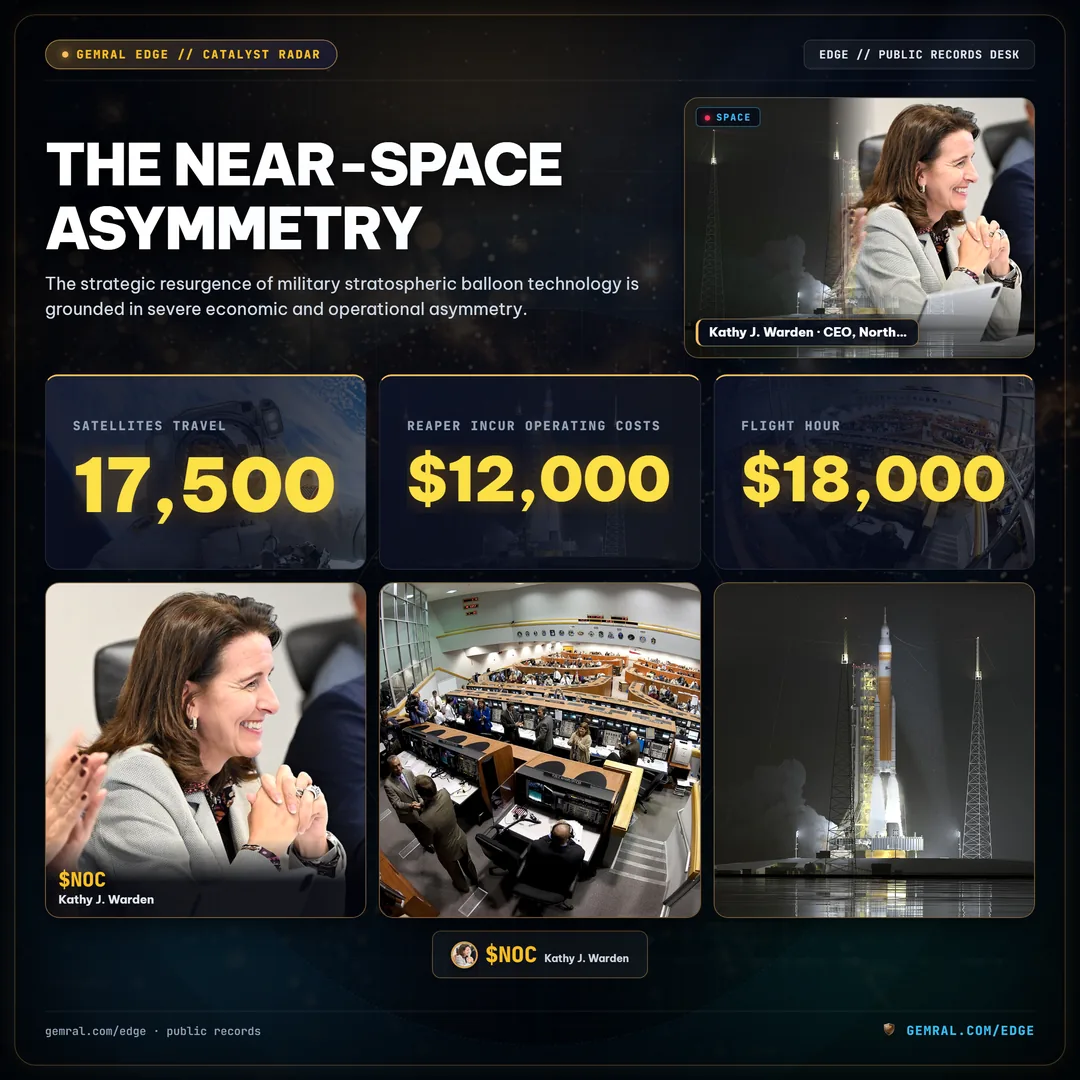
Conversely, medium-altitude unmanned aerial vehicles (UAVs) such as the MQ-9 Reaper incur operating costs exceeding $12,000 to $18,000 per flight hour, demanding extensive tanker refueling infrastructure, forward operating base logistical tails, and vulnerable ground control communication links. A superpressure stratospheric balloon operating at 70,000 feet flips this economic equation entirely. With daily operating expenditures modeled below $2,000 per platform, a cluster of steerable balloons delivers uninterrupted persistence over critical maritime choke points and disputed borders for 45 to 60 consecutive days.
Furthermore, near-space altitudes present formidable targeting dilemmas for hostile air defense networks. Surface-to-air missile systems (SAMs) optimized for aircraft operating between 20,000 and 45,000 feet must expend multi-million-dollar kinetic interceptors designed for ballistic missiles to reach targets floating at 85,000 feet. The radar cross-section of a composite polymer balloon envelope is negligible, creating a stealth footprint that complicates engagement telemetry for adversary sensors.
2. Contract Clustering: Auditing $184M in Transaction-Level Defense Task Orders
Dissecting official defense procurement filings reveals that high-altitude balloon procurement is no longer confined to isolated research and development science projects. Across the U.S. Army Space and Missile Defense Command (SMDC), the Defense Innovation Unit (DIU), and the U.S. Air Force Life Cycle Management Center, funding streams have consolidated around a core cadre of specialized aerospace vendors.

| Prime Contractor / Awardee | Contracting Agency | Obligated Scope | Operational Altitude |
|---|---|---|---|
| Aerostar International (Raven Aerostar) | U.S. Army SMDC / DIU | Thunderhead Superpressure Balloon ISR Payloads | 65,000 – 85,000 ft |
| TCOM, L.P. | U.S. Air Force / Combatant Commands | Persistent High-Altitude Sensor Integration | 60,000 – 75,000 ft |
| World View Enterprises | Defense Innovation Unit (DIU) | Stratollite Steerable Long-Duration Remote Sensing | 70,000 – 90,000 ft |
| Northrop Grumman Mission Systems | U.S. Navy / Naval Air Systems Command | Stratospheric Multi-Node Tactical Radio Relays | 65,000 – 80,000 ft |
| Sierra Nevada Corporation (SNC) | U.S. Special Operations Command (USSOCOM) | High-Altitude Attritable Mesh Communications | 70,000 – 85,000 ft |
Recent contract modifications demonstrate that Aerostar International has secured cumulative delivery orders exceeding $64.2 million for its Thunderhead Superpressure Balloon systems. These awards prioritize modular sensor bays capable of hot-swapping electro-optical/infrared (EO/Infrared) gimbals, radio frequency (RF) direction-finding antennas, and electronic intelligence (ELINT) packages. Concurrently, TCOM has captured $48.5 million in high-altitude aerostat and balloon sensor modernization awards, underscoring joint-service coordination to field layered near-space networks.
3. Steerable Superpressure Technology: Navigation Algorithms at 70,000 Feet
The primary technological breakthrough driving military adoption of stratospheric balloon platforms is the development of autonomous directional navigation within variable stratospheric wind currents. Historically, high-altitude balloons were regarded as unsteerable adrift platforms, captive to prevailing jet streams and discarded after short transits.
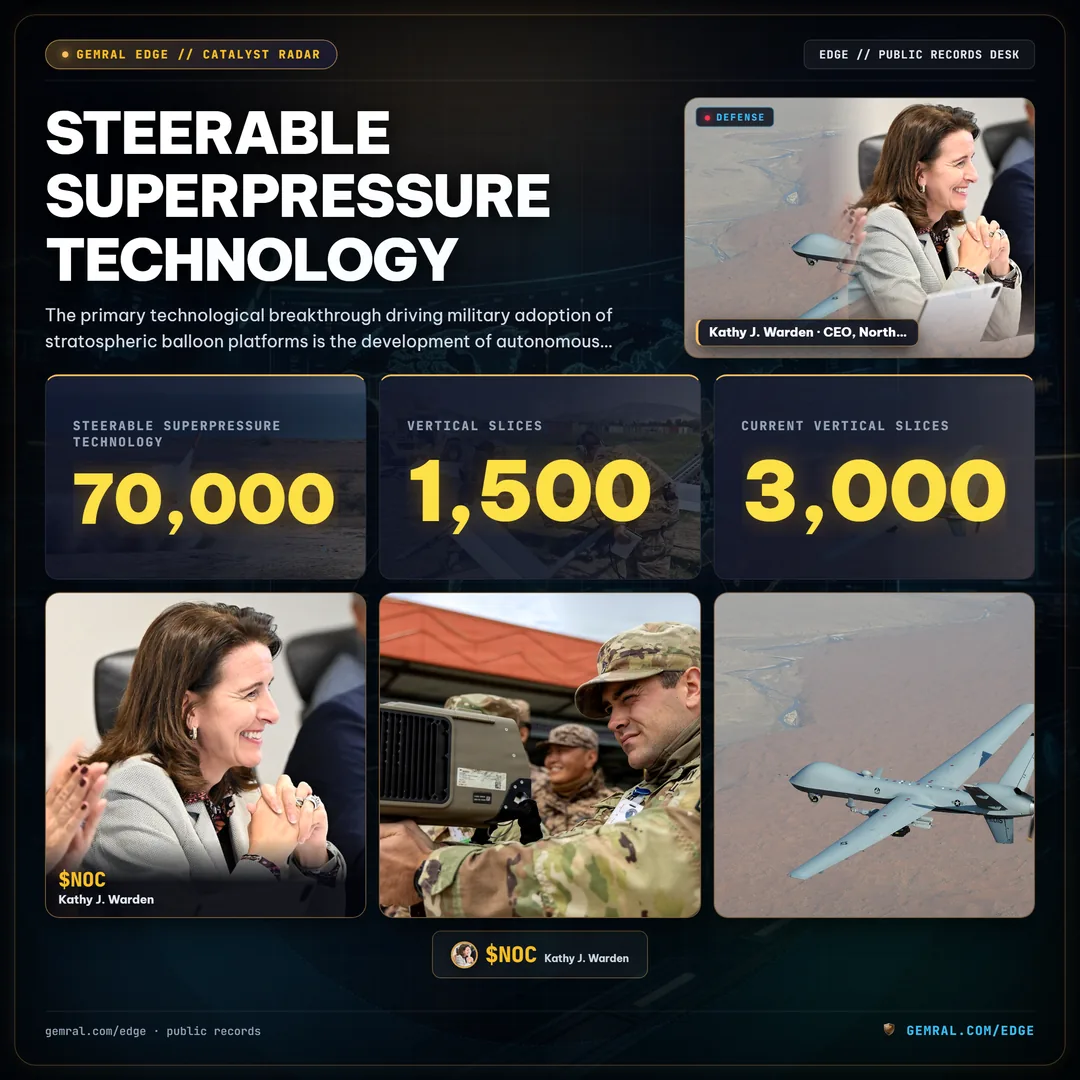
Modern superpressure platforms circumvent this limitation through sophisticated variable-buoyancy control systems. By pumping ambient air into an internal air ballast chamber (ballonet) using high-efficiency solar-powered electric compressors, the balloon increases its overall density and descends. Releasing the ballast air causes the balloon to ascend. Because stratospheric wind vectors vary drastically across vertical slices of just 1,500 to 3,000 feet, onboard flight control algorithms continuously profile real-time wind shear data.
When tactical commanders require a stratospheric balloon to station-keep over a specific maritime corridor, the platform executes automated vertical altitude adjustments: riding an eastward wind current at 68,000 feet for twelve hours, then climbing to 73,000 feet to catch a counter-directional westward current. This closed-loop navigational maneuvering allows the platform to loiter within a narrow 50-kilometer radius for weeks, delivering continuous reconnaissance without expending liquid hydrocarbon propellants.
4. Multi-Domain Mesh Relays: Connecting Tactical Communications Across Disputed Theaters
While imaging and sensor surveillance represent primary defense use cases, the most consequential military stratospheric balloon procurement vector centers on tactical communications mesh relays. In Anti-Access/Area Denial (A2/AD) operational environments where hostile jamming or anti-satellite (ASAT) weapons degrade space-based connectivity, stratospheric balloons serve as survivable high-bandwidth bridge nodes.
From an altitude of 75,000 feet, a single stratospheric balloon commands a direct line-of-sight visual horizon spanning more than 600 kilometers in diameter. When equipped with tactical data links such as Link 16, Common Data Link (CDL), and software-defined UHF/VHF transceivers, a formation of three to five interconnected balloons forms an airborne communications umbrella exceeding 1,200 kilometers across theater boundaries.
Procurement documents from the Defense Innovation Unit highlight joint demonstrations where stratospheric balloons successfully bridged communications between submerged naval unmanned undersea vehicles (UUVs), surface combatants, and fourth-generation strike fighters lacking satellite access. By establishing resilient, low-latency line-of-sight relays that bypass vulnerable satellite up-links, defense planners are cementing near-space balloons as a fundamental layer of Joint All-Domain Command and Control (JADC2) architectures.
5. Strategic Market Implications: The Near-Space Procurement Horizon
The consolidation of $184 million in stratospheric balloon procurement reflects an enduring shift in aerospace defense contracting. Rather than relying exclusively on exquisite, high-cost orbital assets with decade-long development cycles, procurement authorities are establishing a high-volume, rapid-fielding pipeline for attritable near-space systems.
For defense industrial base participants and aerospace investors, this spending momentum highlights three primary inflection points:
- Payload Miniaturization: Ongoing contract awards demand high-resolution Synthetic Aperture Radar (SAR) and passive RF receivers weighing under 75 kilograms, accelerating margin expansion for precision defense sensor fabricators.
- Solar-Electric Propulsion and Battery Density: Prolonging loiter endurance beyond 90 days requires advanced solid-state energy storage and lightweight gallium arsenide solar cells capable of surviving sub-zero stratospheric temperature swings (-60°C).
- Autonomous Fleet Orchestration: As multi-balloon constellations replace single-vehicle trials, defense software awards are prioritizing automated multi-agent coordination systems capable of managing dozens of drifting and loitering nodes simultaneously.
Official federal contract records confirm that near-space is no longer a neglected transition zone between aviation and spaceflight. As capital commitments continue to cluster across public procurement filings, the stratospheric balloon has secured its role as a permanent, cost-effective linchpin of modern multi-domain military intelligence. To examine related defense procurement supply chains, review our analysis on the Defense Logistics Agency Strategic Material Stockpile Audit and the critical supply vulnerabilities analyzed in Antimony Trioxide Export Controls on Defense Ammunition.
Frequently asked questions
What is a military stratospheric balloon and how does it operate?
A military stratospheric balloon is a high-altitude, zero-pressure or superpressure balloon operating between 60,000 and 90,000 feet in near-space. Equipped with solar-electric power systems, autonomous steerable propulsion, and modular payload bays, it provides persistent surveillance and communication relays over targeted operational theaters for 30 to 60+ consecutive days.
Why is the Department of Defense obligating millions to stratospheric balloon platforms instead of satellites?
Stratospheric balloons offer significant cost asymmetry and operational persistence. Unlike Low Earth Orbit (LEO) satellites that pass over a target area in minutes or medium-altitude drones requiring continuous refueling, stratospheric balloons can hover or maneuver within regional wind currents for weeks at operating costs under $2,000 per day, compared to tens of thousands per flight hour for manned aircraft.
Which defense contractors and suppliers build military stratospheric balloons?
Primary defense contractors active in military stratospheric balloon procurement include Aerostar International (Raven Aerostar), TCOM, L.P., World View Enterprises, and prime integrators such as Northrop Grumman and Sierra Nevada Corporation (SNC).