Sovereign AI: Hyperscaler Capex, Domestic Compute Compacts, and Physical Infrastructure
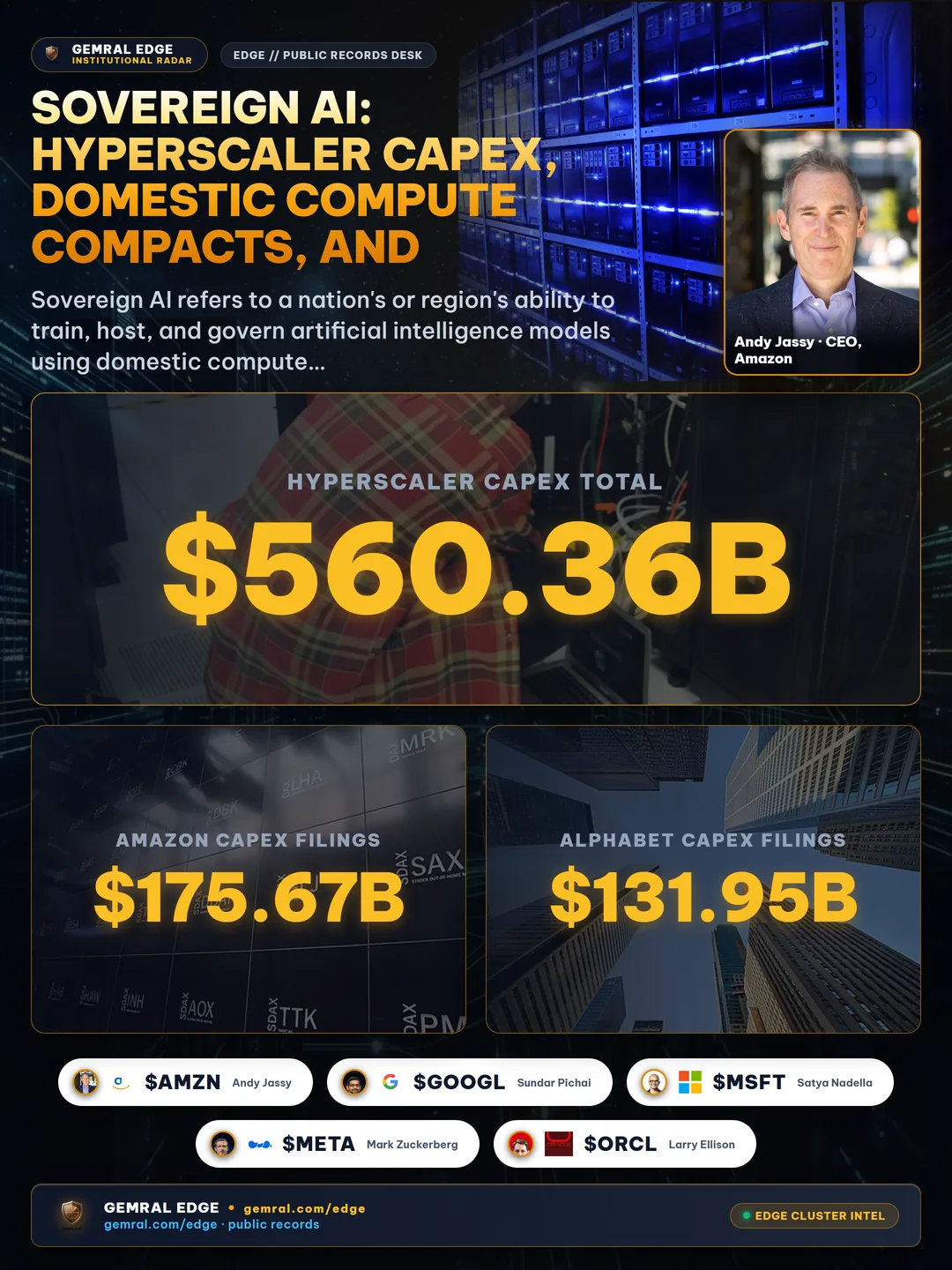
Sovereign AI refers to a nation's or region's ability to train, host, and govern artificial intelligence models using domestic compute infrastructure, local data residency, and dedicated power capacity. In 2026 through Q3, five major hyperscalers (AMZN, GOOGL, MSFT, META, ORCL) reported $560.36B in combined quarterly capital expenditures supporting global and domestic compute expansion.
What Sovereign AI Means in 2026: Domestic Compute, Data Residency, and $560.36B in Hyperscaler Capex
$560.36B in three quarters. When policy analysts and institutional investors examine sovereign AI deployments in 2026, the conversation often centers on foundation-model weights or diplomatic announcements. Yet the physical reality of sovereign AI is governed by concrete, substations, backup-generator air permits, and quarterly capital expenditure filings.
Sovereign AI means a government or regional bloc controls the full computing stack—data residency, training clusters, grid interconnection, and model governance—within its own legal jurisdiction rather than relying exclusively on cross-border cloud regions. In practice, national governments rarely build hyperscale campuses alone. Instead, ministries sign bilateral compute compacts and cloud-region agreements with US-listed hyperscalers, semiconductor designers, and colocation operators, driving unprecedented capital deployment across both domestic and allied power grids.
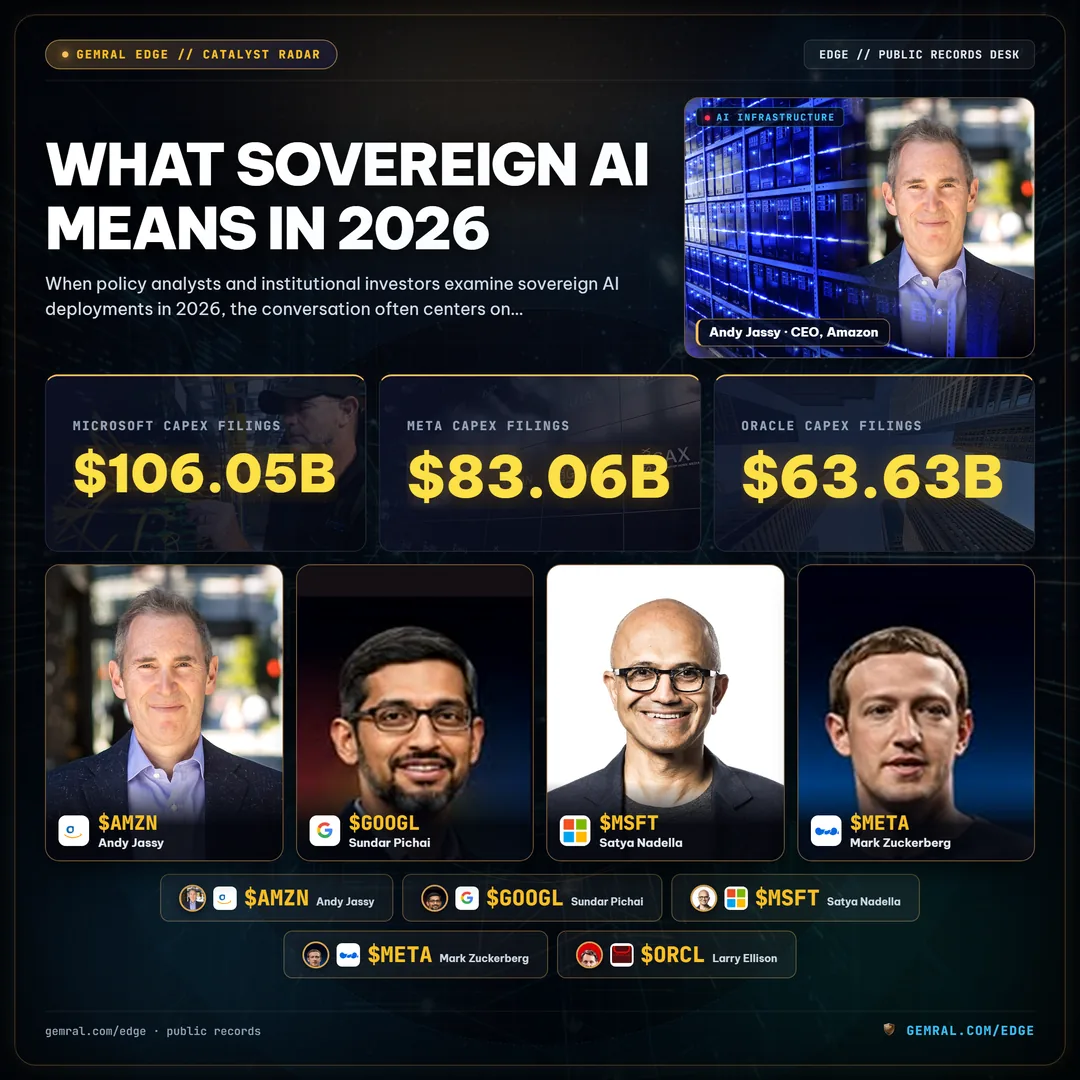
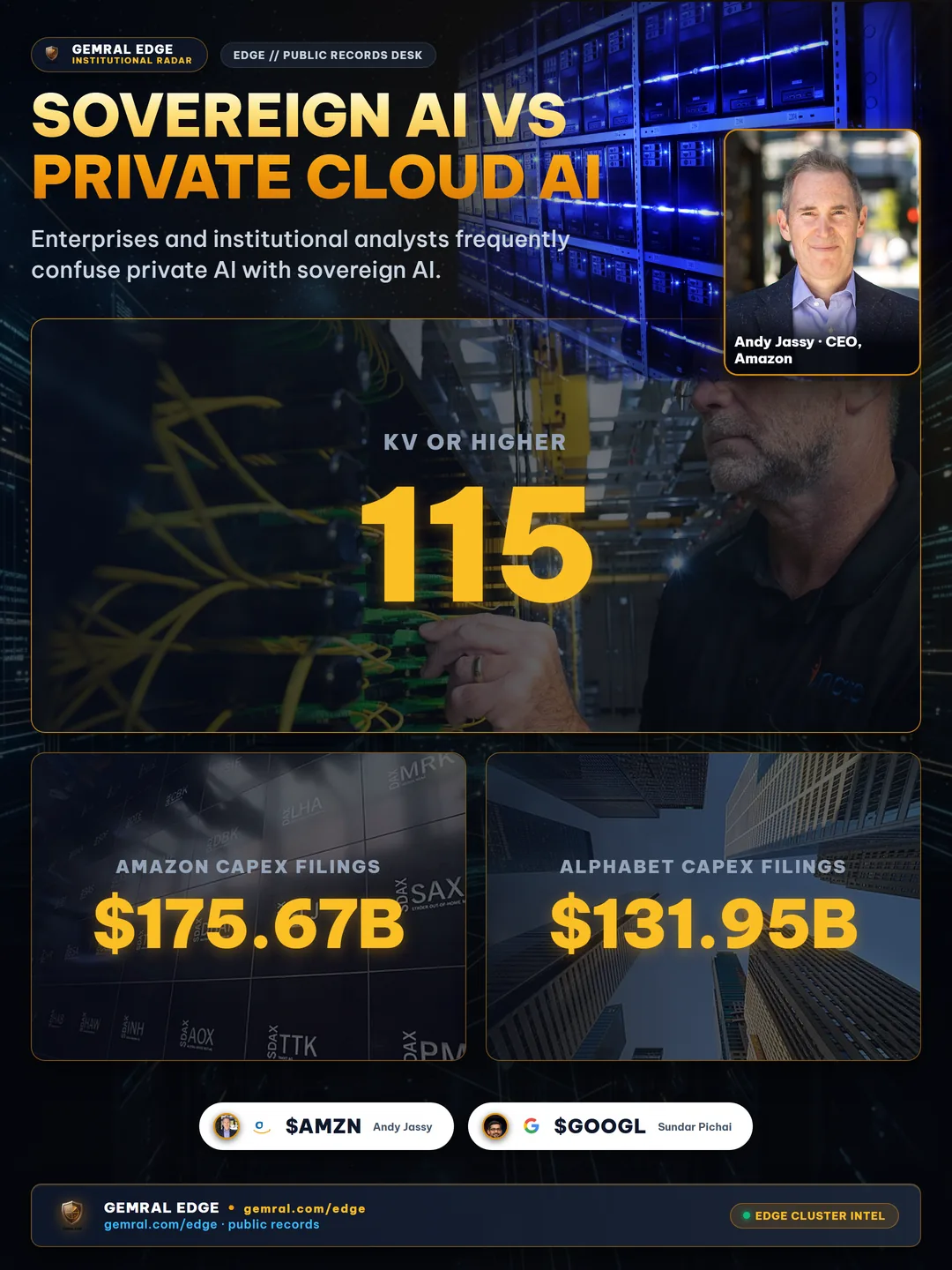
Across the first three quarters of 2026 alone, quarterly company filings show Amazon (AMZN) deploying $175.67B in capital expenditures (latest period ended September 30, 2026, filed October 30, 2026), Alphabet (GOOGL) deploying $131.95B (filed October 29, 2026), Microsoft (MSFT) deploying $106.05B (filed October 28, 2026), Meta Platforms (META) deploying $83.06B (filed October 22, 2026), and Oracle (ORCL) deploying $63.63B (latest period ended August 31, 2026, filed September 11, 2026). That $560.36B five-company total dwarfs the annual capital budgets of most G20 industrial sectors.
Why Sovereign AI Infrastructure Matters: Power Grids, Substations, and 1,725 Physical Sites
Software weights can cross borders in milliseconds; gigawatts of firm electrical capacity cannot. That physical bottleneck explains why sovereign AI initiatives immediately collide with substation proximity, regional grid demand, and environmental permitting timelines.
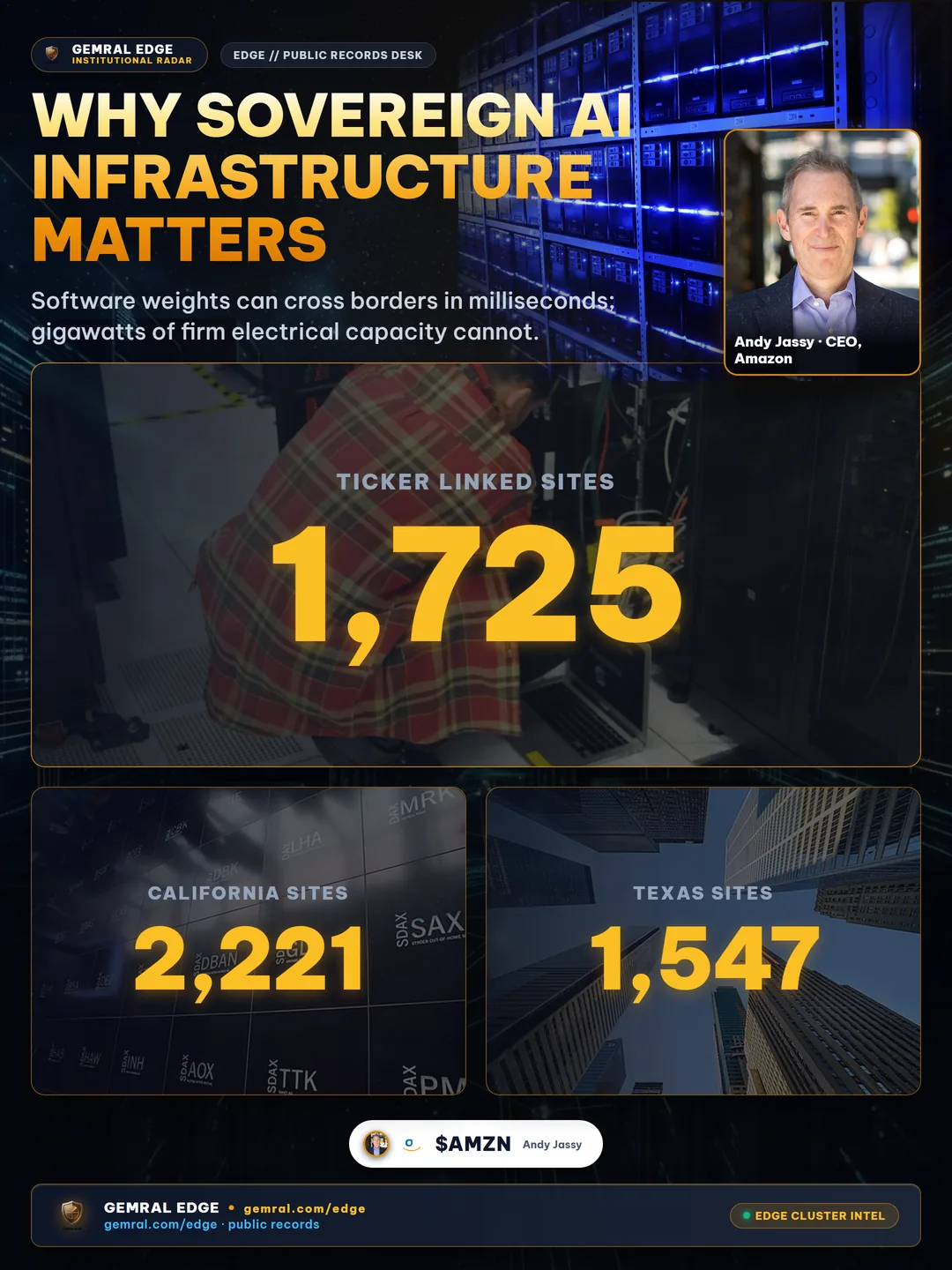
In our physical infrastructure database tracking data-center campuses and power plants across the United States, 1,725 physical sites resolve directly to 76 publicly traded tickers across 47 states. Looking at total tracked sites by state highlights how concentrated physical compute and generation assets remain: California leads with 2,221 tracked sites, followed by Texas with 1,547 sites, New York with 1,345 sites, North Carolina with 1,015 sites, Illinois with 894 sites, Minnesota with 885 sites, Massachusetts with 739 sites, and Virginia with 674 sites.
| US State | Tracked Physical Sites | Primary Infrastructure Role |
|---|---|---|
| California (CA) | 2,221 | Cloud hubs, power generation, edge colocation |
| Texas (TX) | 1,547 | ERCOT load growth, hyperscale campuses, thermal & wind |
| New York (NY) | 1,345 | Financial low-latency compute & grid substations |
| North Carolina (NC) | 1,015 | Southeast cloud corridor & utility generation |
| Illinois (IL) | 894 | Midwest nuclear baseload & Chicago interconnect |
| Virginia (VA) | 674 | Northern Virginia hyperscale & federal cloud cluster |
As examined in our AI data center power case study and substation interconnection analysis, proximity to ≥115 kV high-voltage substations dictates how rapidly a sovereign or commercial cluster can energize. For example, Amazon's 132 ticker-linked physical sites across 11 states sit at an average distance of just 1.05 km from their nearest ≥115 kV substation.
Sovereign AI Examples: How Hyperscalers and Utilities Build Dedicated Regional Compute
Every sovereign AI deployment pairs compute operators with regulated electric utilities and independent power producers. Without firm baseload generation and transmission capacity, sovereign cloud regions remain theoretical announcements rather than energized racks.
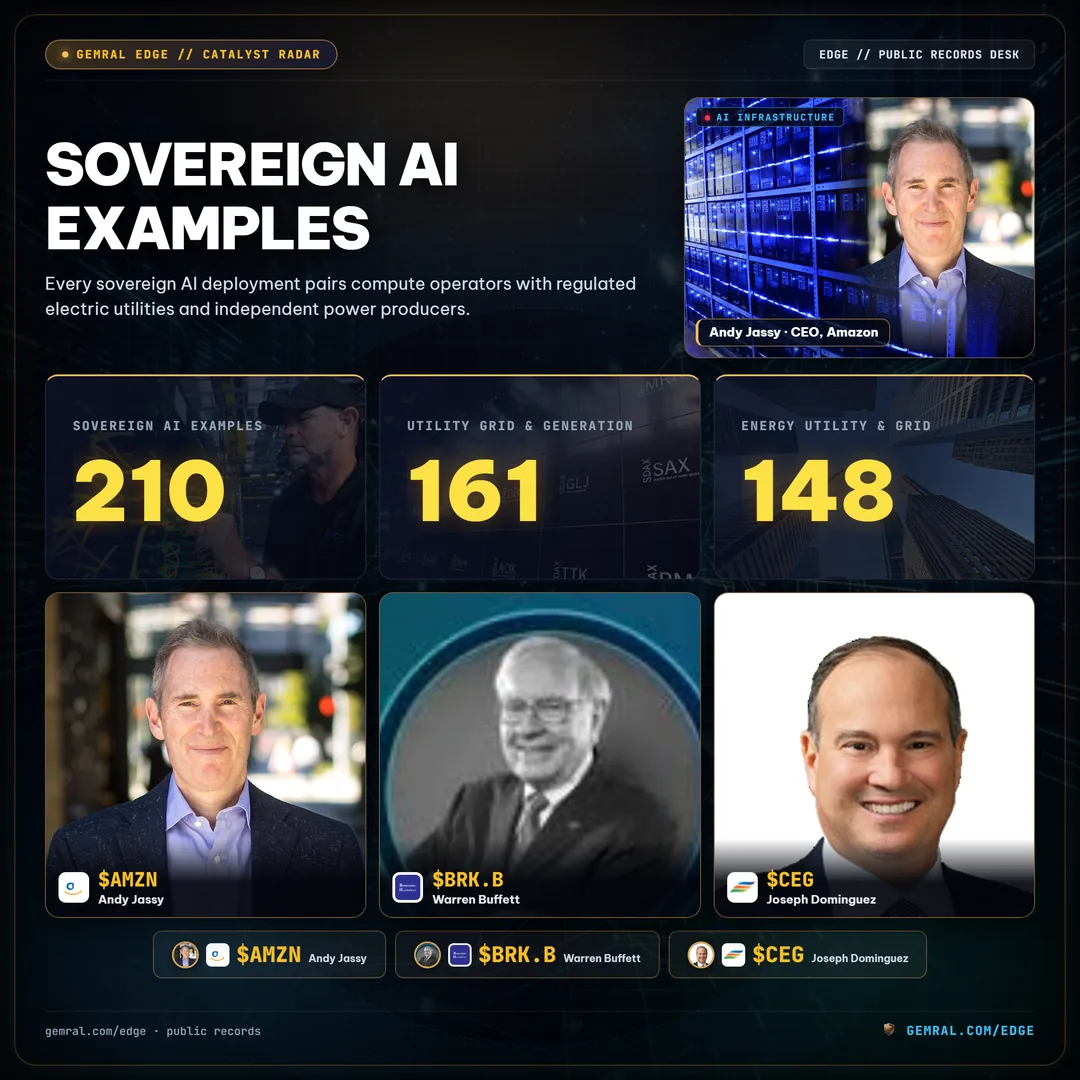
In our physical site registry, the largest ticker-linked footprints belong overwhelmingly to power producers and utilities alongside Amazon: NextEra Energy (NEE) accounts for 210 sites across 16 states, Duke Energy (DUK) operates 161 sites across 6 states, Berkshire Hathaway Energy (BRK-B) holds 148 sites across 10 states, Southern Company (SO) operates 138 sites across 16 states, Dominion Energy (D) operates 132 sites across 8 states, Amazon (AMZN) holds 132 sites across 11 states, and Constellation Energy (CEG) operates 131 sites across 22 states.
| Listed Company (Ticker) | Tracked Physical Sites | States Covered | Infrastructure Layer |
|---|---|---|---|
| NextEra Energy (NEE) | 210 | 16 | Power generation & transmission |
| Duke Energy (DUK) | 161 | 6 | Regulated utility grid & generation |
| Berkshire Hathaway (BRK-B) | 148 | 10 | Energy utility & grid infrastructure |
| Southern Company (SO) | 138 | 16 | Southeast baseload & nuclear |
| Amazon (AMZN) | 132 | 11 | Hyperscale data-center campuses |
| Dominion Energy (D) | 132 | 8 | Virginia data-center corridor utility |
| Constellation Energy (CEG) | 131 | 22 | Zero-carbon nuclear baseload |
Alongside utilities, Xcel Energy (XEL) operates 99 sites across 8 states, Entergy (ETR) operates 70 sites across 4 states, and American Electric Power (AEP) operates 66 sites across 12 states. Understanding sovereign AI examples requires pairing those utility footprints with air-permit filings, backup-generator capacity, and monthly satellite built-up measurements per campus.
Sovereign AI Capital Expenditure: AMZN, GOOGL, MSFT, META, and ORCL Filings
While utilities supply megawatts, hyperscalers and data-center REITs supply the balance-sheet capital required to procure GPUs, liquid-cooling manifolds, and dedicated regional clusters. Tracking quarterly capital expenditures with exact filing dates separates reported investment commitments from forward-looking press releases.
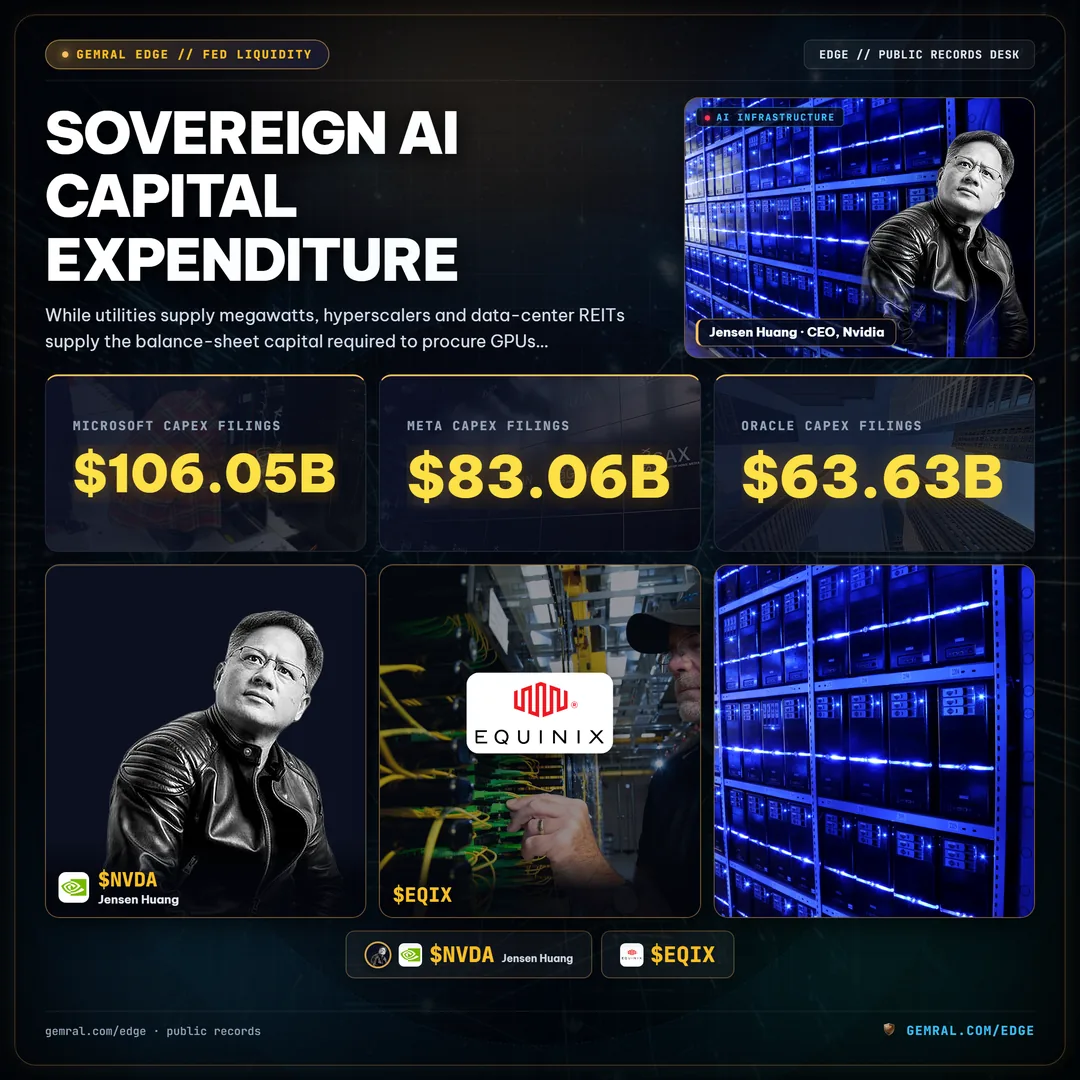
| Ticker | 2026 Capex (3 Quarters) | Latest Period End | Latest Filing Date |
|---|---|---|---|
| AMZN | $175.67B | 2026-09-30 | 2026-10-30 |
| GOOGL | $131.95B | 2026-09-30 | 2026-10-29 |
| MSFT | $106.05B | 2026-09-30 | 2026-10-28 |
| META | $83.06B | 2026-09-30 | 2026-10-22 |
| ORCL | $63.63B | 2026-08-31 | 2026-09-11 |
| NVDA | $5.72B | 2026-07-26 | 2026-08-26 |
| EQIX | $4.39B | 2026-09-30 | 2026-10-28 |
| DLR | $3.17B | 2026-09-30 | 2026-10-30 |
Notice the contrast between asset-light chip designers and capital-intensive cloud builders: Nvidia (NVDA) reported $5.72B in 3-quarter capital expenditures through July 26, 2026, while Equinix (EQIX) and Digital Realty (DLR) reported $4.39B and $3.17B, respectively, through September 30, 2026. Meanwhile, the five hyperscalers alone deployed $560.36B across those same three quarters.
This capital divergence illustrates why sovereign AI programs rely on multi-tier vendor ecosystems rather than single-company contracts. Hyperscalers finance the land, shell construction, cooling distribution units, and multi-year utility power purchase agreements, while colocation specialists like Equinix and Digital Realty provide carrier-neutral interconnection hubs where sovereign workloads peer with financial, telecommunications, and public-sector networks. Without tracking both the $560.36B hyperscaler balance-sheet commitments and the physical substation constraints on the ground, analysts miss the multi-quarter lag between capital authorization and energized megawatts.
Sovereign AI vs Private Cloud AI: Jurisdiction, Hardware Imports, and Supply Chains
Enterprises and institutional analysts frequently confuse private AI with sovereign AI. Private AI isolates a single company's proprietary weights and retrieval indexes inside a virtual private cloud or on-premises rack. Sovereign AI goes further: it enforces national legal jurisdiction over data residency, physical facility ownership, model auditing, and domestic energy supply.
Because domestic compute buildouts depend on specialized transformers, switchgear, servers, and optical transceivers, physical infrastructure tracking pairs quarterly capex with monthly US equipment import volumes by product code and origin country. Note that import series provide industry context by product code and origin country rather than company-level shipments. Likewise, permitted backup-generator megawatts on air permits represent an upper bound on emergency backup capacity rather than actual data-center IT load.
Distinguishing between sovereign AI and private enterprise AI also clarifies why public permitting and utility filings serve as leading indicators of sovereign cloud expansion. A private enterprise deploying a virtual private cloud inside an existing commercial region rarely triggers new high-voltage transmission upgrades or county-level land-use amendments. By contrast, a sovereign AI initiative demanding dedicated domestic compute clusters, air-gapped government compliance zones, and multi-hundred-megawatt redundancy frequently requires new state air-quality permit filings, multi-year substation interconnections at 115 kV or higher, and dedicated utility baseload allocations. Pairing environmental permit dates with quarterly capex filings across all 57 US-listed AI-infrastructure companies exposes where physical capacity is actually breaking ground versus where policy announcements remain aspirational.
In addition, regional sovereign AI strategies in Europe, Asia, and North America increasingly hinge on supply-chain resilience for high-voltage electrical components and thermal management hardware. When hyperscalers commit $175.67B (AMZN) or $131.95B (GOOGL) in three-quarter capital expenditures, a substantial share flows into long-lead power distribution equipment, liquid-cooling manifolds, and backup diesel or natural-gas generator sets. Tracking monthly equipment import flows alongside state-level air permits and substation proximity gives institutional research desks an empirical lens into hardware bottlenecks before those delays surface in quarterly earnings commentary.
Tracking Sovereign AI Buildouts Across 57 US-Listed Companies Without Look-Ahead Bias
For institutional research teams covering the 57 US-listed AI-infrastructure companies—spanning hyperscalers, semiconductors, cooling, power equipment, and utilities—temporal alignment is essential. Across 1,725 ticker-linked physical sites in 47 states, quarterly capex filings carry exact filing dates, daily regional grid demand runs from 2019 forward, power-plant generator changes run from 2021 forward, and monthly satellite surface measurements per site run from 2023 forward.
Every dataset ships only after passing a minimum 95% sampled accuracy audit against original public documents, delivered as Parquet files with SHA-256 manifests, a read-only REST API, and an MCP server. Separating execution or permit issue dates from public availability timestamps ensures that sovereign AI infrastructure models never suffer from look-ahead bias when evaluating how physical capacity translates into corporate capital deployment. By combining entity-resolved site records, utility interconnection proximity, quarterly capital expenditure filings, and monthly satellite surface observations on a single timeline, research teams can evaluate domestic compute buildouts using verifiable public disclosures rather than promotional announcements. Explore physical AI-infrastructure signals at gemral.com/edge/tech or inspect live sample records in the Gemral Edge data preview portal.
Public data · not investment advice. Data comes only from public sources and contains no material non-public information.
Frequently asked questions
What is sovereign AI?
Sovereign AI is artificial intelligence infrastructure—encompassing data centers, semiconductors, power generation, and foundation models—owned, hosted, and governed within a specific national jurisdiction to preserve data residency and strategic autonomy.
How much capital expenditure are hyperscalers deploying in 2026?
Through Q3 2026 filings, Amazon reported $175.67B in capital expenditures, Alphabet $131.95B, Microsoft $106.05B, Meta Platforms $83.06B, and Oracle $63.63B—totaling $560.36B across five hyperscalers.
How does sovereign AI differ from private enterprise AI?
Private enterprise AI focuses on isolating a single corporation's proprietary data inside a virtual private cloud, whereas sovereign AI enforces national-level legal jurisdiction, domestic physical siting, and grid-level energy security.