Government Contracts Database: Point-in-Time Entity Resolution for Federal Awards
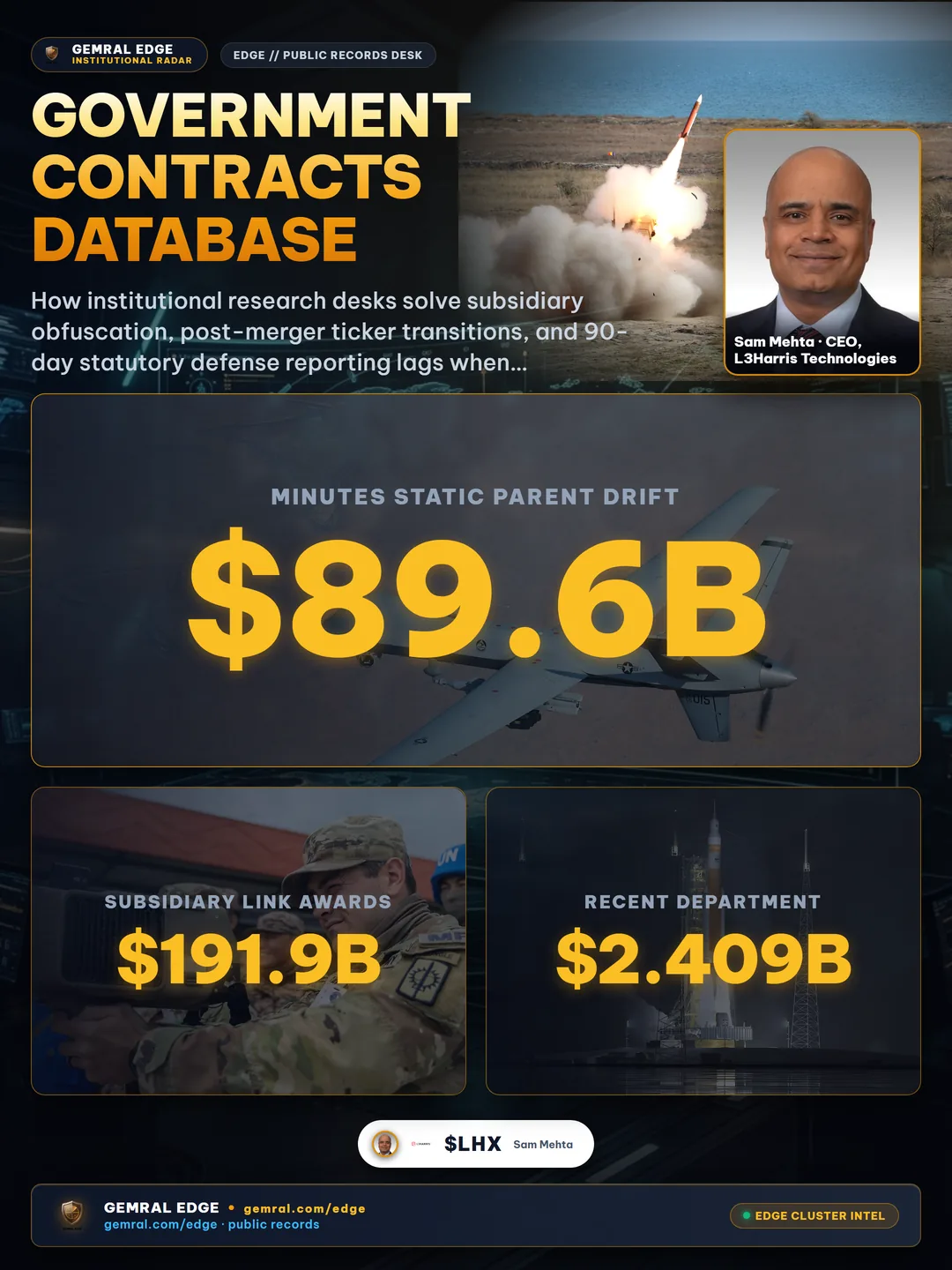
How institutional research desks solve subsidiary obfuscation, post-merger ticker transitions, and 90-day statutory defense reporting lags when mapping US federal procurement obligations to publicly traded equities.
The Entity Resolution Trap in Raw Government Contracts Databases
Quantitative funds evaluating federal revenue exposure frequently start with a straightforward question: how much capital does the United States government obligate to a specific publicly traded company each quarter? Querying a raw government contracts database by exact corporate name immediately breaks down. Federal contracting officers record awards against legal operating entities, regional divisions, joint ventures, and legacy vendor identifiers rather than consolidated parent stock tickers.
Across 650,000+ federal contract transactions and 850,000+ resolved disclosure events (measured October 19, 2026), exact string matching against parent company names captures only a fraction of real procurement demand. Without an effective-dated corporate hierarchy, a contract awarded to a wholly owned subsidiary in 2021 appears invisible to a ticker-level screener, while a contract signed by an acquired defense supplier in 2019 gets retroactively credited to its 2026 parent company—introducing severe look-ahead bias into historical research models.
Every record in an institutional-grade procurement dataset must answer two strict requirements: which legal entity signed the award, and which publicly traded parent ticker was valid on the exact day that award became public knowledge. Maintaining that temporal boundary separates auditable point-in-time data from contaminated retrospective tables.
Static Parent Tables vs Point-in-Time Ownership: Why $89.6 Billion Shifts Tickers
The most pervasive flaw in commercial alternative datasets is joining historical federal procurement logs through a static, present-day parent company lookup table. When a mega-cap defense prime or industrial conglomerate acquires a mid-cap contractor in 2024, a static lookup table rewrites the entire historical database from 2018 onward, attributing pre-acquisition contract awards to the buyer's ticker years before the merger was ever announced.
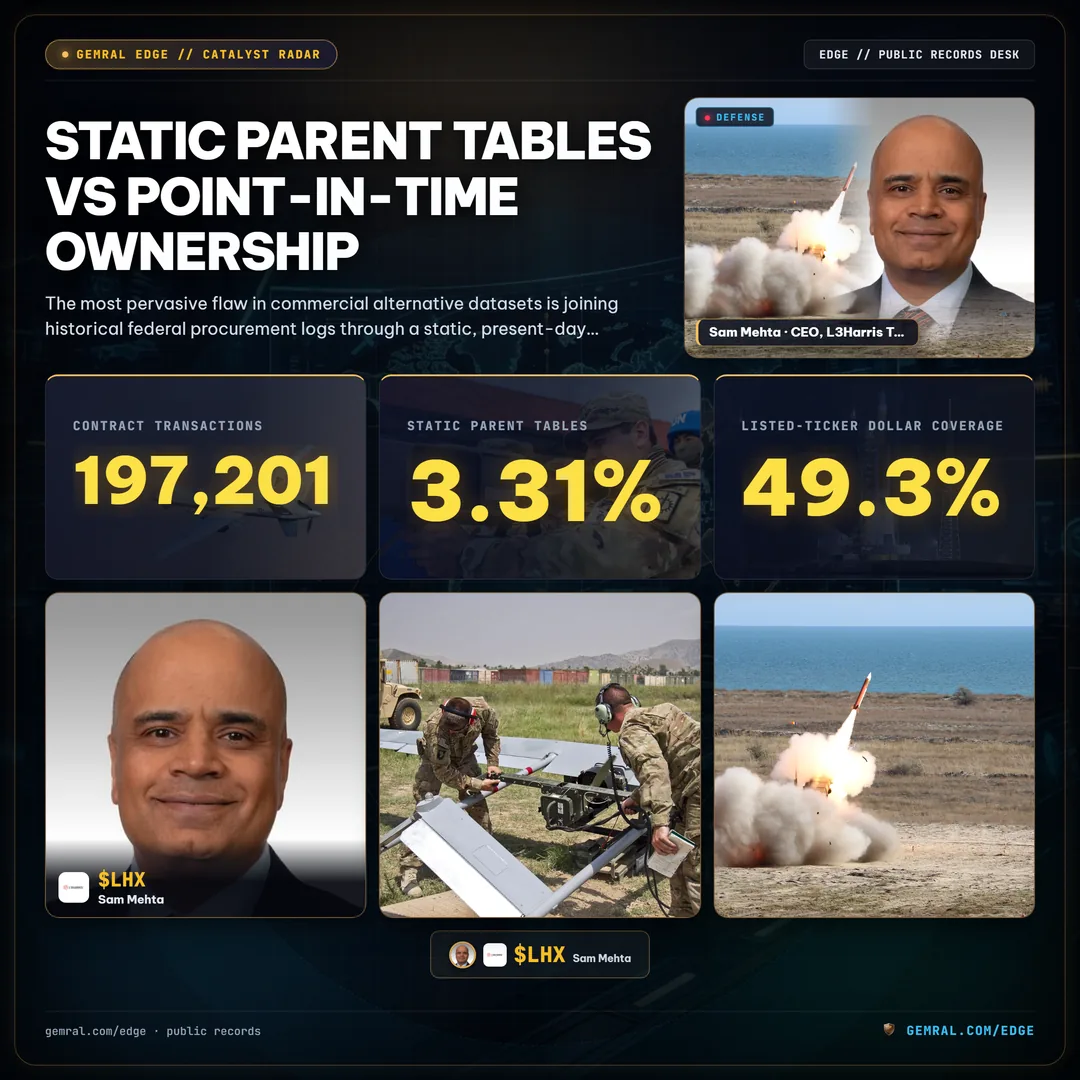
Measured on October 24, 2026 across 197,201 resolved contract transactions totaling $2.706 trillion, mapping federal contract transactions through today's parent table instead of the parent valid on the publication date would credit $89.6 billion (3.31% of total dollars across 8,568 transactions) to a different stock ticker. For quantitative strategies evaluating sector concentration or federal backlog momentum, a $89.6 billion attribution error corrupts historical cross-sectional rankings.
| Attribution Metric | Measured Scale | Share of Resolved Pool | Measurement Date |
|---|---|---|---|
| Static Parent Misattribution | $89.6 Billion | 3.31% (8,568 transactions) | October 24, 2026 |
| Dated Subsidiary Link Awards | $191.9 Billion | 7.1% (13,465 transactions) | October 24, 2026 |
| Listed-Ticker Dollar Coverage | 49.3% of FY2018+ | 98.5% precision (193/196) | October 23, 2026 |
| Historical Ticker Universe | 4,745 Tickers | Includes delisted & merged | October 23, 2026 |
Subsidiary Hop Resolution: Tracing $191.9 Billion Behind Operating Divisions
Even when an analyst avoids static parent tables, direct name matching misses billions in federal obligations awarded to operating subsidiaries. Federal agencies routinely issue multi-year awards to specific business units, research laboratories, and regional engineering subsidiaries whose legal names bear no lexical resemblance to their publicly traded parent corporation.
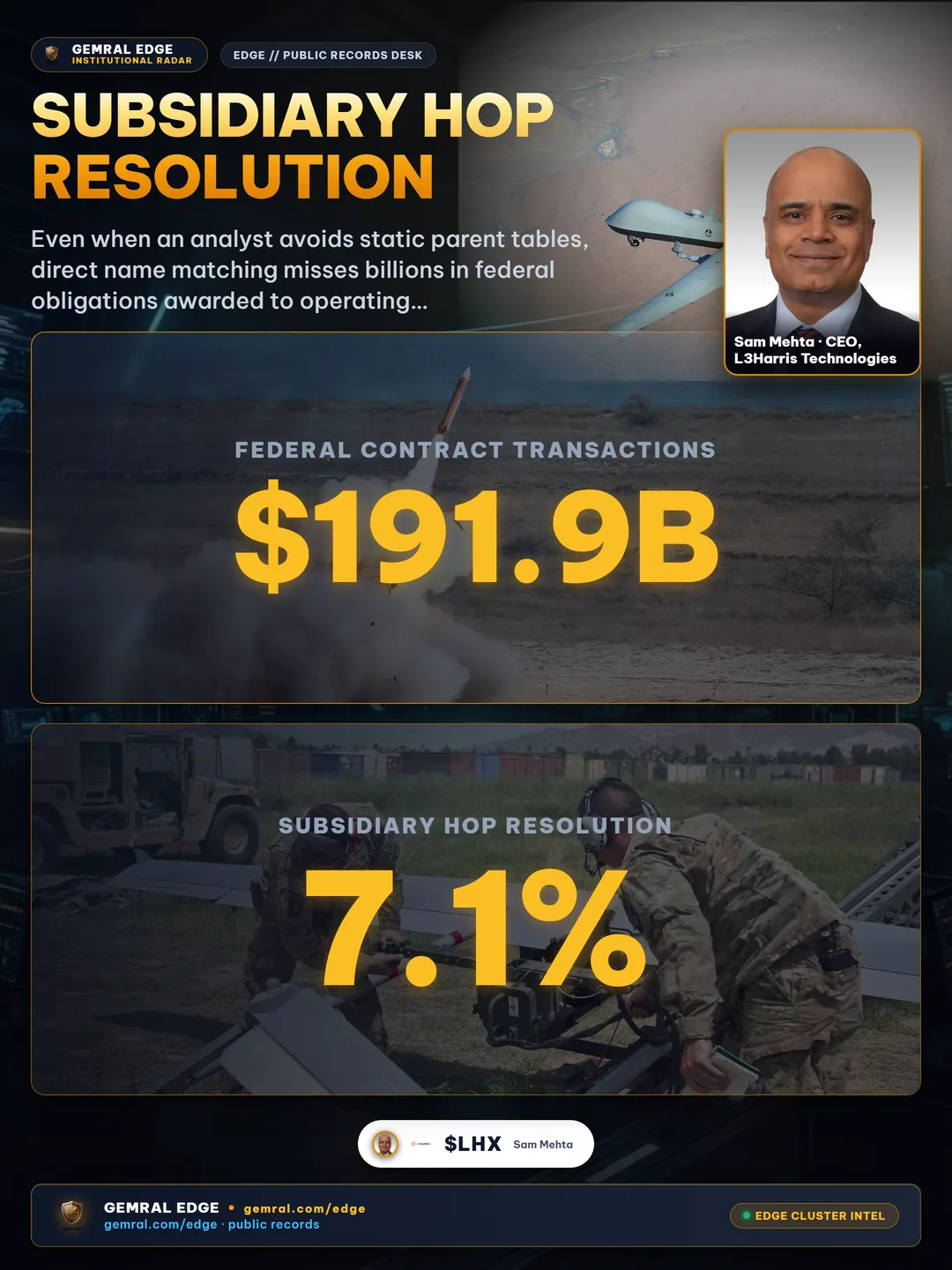
As measured on October 24, 2026, $191.9 billion of ticker-linked federal contract transactions—representing 7.1% of all linked dollars across 13,465 transactions—reach a listed parent company only through an effective-dated subsidiary relationship link. In every one of those 13,465 cases, the legal recipient name printed on the government contract award is not a publicly traded company. Only by chaining corporate ownership records with explicit effective start and end dates can a government contracts database surface these obligations accurately.
This multi-hop architecture is equally critical when mapping prime-to-subcontractor supply chains. Large defense systems awards flow down from prime contractors to specialized aerospace, optics, and semiconductor suppliers via dated subcontracting disclosures, allowing institutional researchers to trace second-order federal demand across mid-cap suppliers.
Acquisitions and Ticker Transitions: Resolving Pre-Close Contracts Without Survivorship Bias
Corporate mergers and ticker renames create subtle edge cases between the day a federal contract is signed and the day it becomes public record. Because Department of Defense contract transactions carry a 90-day statutory publication lag, a contract can be signed by an independent target company before an acquisition closes, yet appear in public federal transaction files weeks after the merger completes.
An audit conducted on October 24, 2026 identified 659 federal contract actions signed before an acquisition closed but published afterward: 651 of those transactions roll cleanly to the publicly traded acquirer valid on the publication date (including 361 under RTX, 124 under LHX, 49 under UTX, 49 under GD, 43 under NOC, and 25 under SAIC), while 8 belong to non-listed buyers and remain unattributed. Similarly, 254 contract actions involved issuers that changed ticker symbols between signing and publication—such as UTX transitioning to RTX (121 actions), HRS to LHX (68 actions), JEC to J (44 actions), and ASGN to EFOR (17 actions).
Across the full resolved event history (measured October 23, 2026), 4,745 distinct tickers appear, explicitly preserving delisted, merged, and renamed historical issuers under the symbols active at the time of publication. Retaining delisted entities prevents upward survivorship bias when evaluating historical contractor activity.
Coverage Boundaries and Precision: Accounting for the 49.3% Listed-Ticker Ceiling
Transparency regarding coverage limits is mandatory for institutional due diligence. Not every dollar obligated by the federal government flows to a publicly traded stock. Measured on October 23, 2026 across FY2018+ contract transactions of $1 million or more, approximately 49.3% of federal contract transaction dollars are linked to a listed ticker.

- 01. Private & Unlisted Contractors: The remaining 50.7% of contract dollars flows primarily to privately held defense and logistics firms, foreign entities, nonprofit research institutions, national laboratories, and municipal entities—or remains unattributed where ownership documents are inconclusive.
- 02. Sampled Document Precision: Across the latest graded verification batch (October 23, 2026), federal contract linkage achieved 98.5% precision (193/196 verifiable sampled records), while pre-award notices reached 97.0% (192/198), lobbying filings reached 96.0% (192/200), and insider trades reached 100% (200/200).
- 03. Cumulative vs Current Resolver Accuracy: Cumulative precision across all historical grading batches sits lower for contracts (91.2%), pre-award notices (76.4%), subcontractor links (94.0%), and bid protests (92.5%) because early validation batches were scored prior to the October 2026 entity resolver upgrade.
Publication Lags in Defense Procurement: Daily Announcements vs 90-Day Transaction Delays
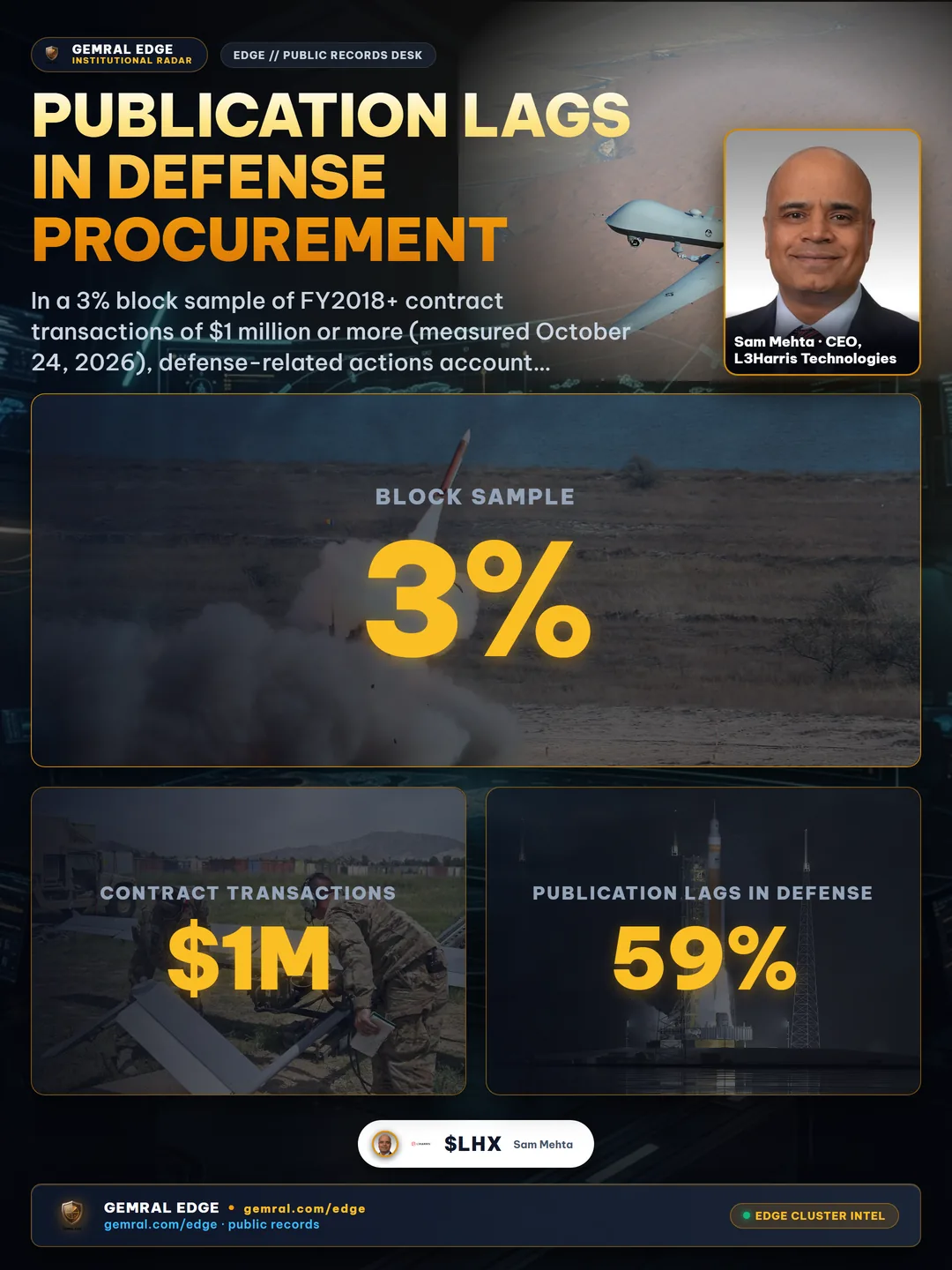
In a 3% block sample of FY2018+ contract transactions of $1 million or more (measured October 24, 2026), defense-related actions account for roughly 59% of rows and 65% of total dollars. Because Department of Defense procurement records undergo a mandatory 90-day statutory delay before entering federal transaction archives, relying solely on transaction tables creates an artificial 3-month blind spot on Pentagon spending.
However, daily defense contract announcements provide an earlier public signal. Across 9,158 matched defense contracts (measured October 24, 2026) appearing in both daily contract announcements and final transaction archives—representing $1.07 trillion in announced awards—the daily announcement precedes the transaction record in 93.5% of cases by a median of 90 days (interquartile range 90 to 90 days). Aligning both feeds by publication timestamp allows models to capture daily announcements immediately without contaminating historical transaction evaluations with future dates.
Understanding this 90-day publication window is equally critical when analyzing congressional disclosures, corporate lobbying reports, and insider transactions alongside federal awards. As measured on October 24, 2026, dating disclosures by activity date rather than public filing date shifts information artificially early by 90 days for defense contract actions, a median 27 days (90th percentile 63 days across 63,122 trades since 2018) for congressional trades, 1 day (4 days at the 90th percentile across 35,226 trades since 2018) for corporate insider filings, and 20 days (21 days at the 90th percentile across 8,975 filings since 2018) after quarter-end for quarterly lobbying disclosures. Point-in-time joins require aligning every dataset strictly on its public release timestamp.
Empirical Record Verification: Real-World Federal Contract Actions and Agency Flows
Inspecting live resolved records demonstrates how point-in-time contract tracking operates across civilian and defense agencies. On November 16, 2026, Fluor Corporation (FLR) recorded $2.409 billion in recent Department of Defense contract awards, while L3Harris Technologies (LHX) logged $918 million in Department of Transportation awards and Granite Construction (GVA) posted $515 million from the Department of Homeland Security.

Similarly, infrastructure and energy contractors depend on multi-year federal funding cycles alongside private utility commitments. Cross-referencing defense and civilian agency obligations with our analysis of nuclear SMR power infrastructure contracts and corporate lobbying spending velocity reveals how legislative appropriations translate into auditable contractor revenue pipelines.
Furthermore, contract modification streams and bid protests frequently alter initial award ceilings over multi-year performance periods. Across 13,850 tracked bid protests (measured October 19, 2026), only 25.3% (3,505 records) link cleanly to a specific federal contract transaction and awardee identifier, and the statutory 100-day protest decision deadline aligns exactly in 61.7% of cases (with remaining decisions extending around 143 to 145 days due to weekends, holidays, or procedural extensions). Disclosing these structural linkage limits prevents analysts from over-interpreting incomplete protest linkages in procurement workflows.
Institutional Integration: Joining Procurement Records With Policy and Capital Telemetry
When every federal contract, bid protest, pre-award notice, and lobbying disclosure shares a unified point-in-time ticker spine, institutional desks can evaluate government demand alongside macro risk indicators such as the VIX term structure and Treasury funding conditions. Standardized Parquet distributions, REST API endpoints, and audit-ready revision logs ensure that historical research models reflect strictly what was visible to market participants on every trading day.
Finally, preserving amendment history without silent overwrites ensures reproducibility for compliance teams and model validators. Starting in October 2026, contract modifications and amended disclosure records write to an append-only revision log rather than overwriting prior states, ensuring that any historical snapshot reconstructed from Parquet archives or REST API queries matches the exact public record visible on that calendar date.
Frequently asked questions
Why do static parent tables fail in a government contracts database?
Static parent mappings assign historical federal awards using today's corporate ownership tree rather than the corporate hierarchy valid on the publication date. Measured across resolved federal contract transactions on October 24, 2026, using today's parent table would misattribute $89.6 billion (3.31% of $2.7 trillion across 8,568 transactions) to the wrong stock ticker.
How much federal contract value flows through corporate subsidiaries?
Federal procurement records frequently name an operating subsidiary or regional division rather than the publicly traded parent holding company. As measured on October 24, 2026, $191.9 billion of ticker-linked contract transactions (7.1% of dollars across 13,465 transactions) reach a listed company only through a dated subsidiary ownership link.
What percentage of federal contract dollars belong to publicly traded companies?
Measured on October 23, 2026 across FY2018+ contract transactions, approximately 49.3% of federal contract transaction dollars are linked to a publicly traded ticker (with 98.5% precision on sampled records). The remaining 50.7% flows to private firms, unlisted foreign entities, nonprofits, or unattributed recipients.
How do statutory defense reporting lags impact point-in-time procurement research?
Department of Defense contract actions are subject to a statutory 90-day publication delay in official federal transaction databases, whereas daily defense contract announcements are published on the award date in 93.5% of matched cases. Separating activity dates from publication dates prevents look-ahead leakage in historical research.