Liquid Cooling Stocks for Data Centers: Direct-to-Chip CDUs and Thermal Management
An empirical deep dive into the thermal bottleneck of generative AI compute, examining direct-to-chip microfluidics, coolant distribution unit (CDU) deployment, power usage effectiveness (PUE) compression, and the publicly traded industrial supply chain.

The Thermal Crisis in AI Compute: Why Air Cooling Breaks Down Above 40kW per Rack
The architectural transition from conventional enterprise computing to large-scale artificial intelligence clusters has catalyzed a fundamental physical crisis in data center thermal management. In legacy enterprise server environments, standard compute racks operated at power densities between 6kW and 12kW. Even dense cloud virtualization clusters rarely exceeded 24kW per rack. Under these power envelopes, forced-air convection—utilizing computer room air handlers (CRAH) and hot-aisle/cold-aisle containment—efficiently evacuated thermal loads away from silicon dies.
However, modern AI training clusters have shattered these physical boundaries. Next-generation accelerator architectures consume between 700W and 1200W per individual GPU. When aggregated into high-density rack form factors such as the NVL72 architecture, a single cabinet consumes upwards of 120kW to 132kW of continuous electrical power. At these extreme thermal gradients, the thermodynamic properties of air fail. The maximum practical heat dissipation threshold for forced-air cooling tops out between 35kW and 40kW per rack.
Attempting to cool a 120kW server rack with air requires moving colossal volumes of air at velocities that induce severe acoustic vibration, excessive fan parasitics, and prohibitive static pressure drops. As a consequence, liquid cooling is no longer an optional performance optimization; it is a non-negotiable thermodynamic mandate for modern AI infrastructure. Institutional allocators tracking our data center infrastructure sector tracker monitor this physical inflection point as a primary driver of industrial supplier revenues.
Physics of Fluid Thermal Transport: Volumetric Heat Capacity and Conduction Dynamics
The technical superiority of liquid cooling over forced air stems from the fundamental transport properties of fluids. Water possesses a thermal conductivity approximately 24 times greater than ambient air, allowing heat to conduct across metallic cold-plate interfaces with minimal thermal resistance. More critically, water exhibits a volumetric heat capacity nearly 3000 times higher than that of air at standard atmospheric pressure.
This volumetric advantage fundamentally alters cooling mechanics:
Thermodynamic Volume Disparity
To remove 1 kilowatt of heat with a 10°C temperature delta, an air-based system must circulate roughly 3000 times the volumetric displacement required by a treated water-glycol loop.
Air handlers require large-scale air ducts, elevated ceilings, and raised floors, consuming up to 60% of total data center square footage purely for airflow management.
Die-to-Fluid Thermal Delta
Direct fluid contact via micro-channel cold plates maintains silicon junction temperatures below 75°C under continuous 1000W sustained compute loads.
Preventing thermal throttling protects chip longevity and eliminates clock-frequency degradation across thousands of interconnected nodes.
By substituting pneumatic cooling loops with closed-circuit hydraulic infrastructure, data center operators achieve tight thermal boundaries while reclaiming floor space for compute density.
Direct-to-Chip Architectures: Cold Plates, Manifolds, and Quick-Disconnect Couplings
Within the modern liquid-cooled data center, the dominant mechanical implementation is Direct-to-Chip (D2C) cooling. Rather than altering the underlying server chassis format, D2C retrofits metallic cooling blocks directly on top of the primary heat-generating silicon dies. A comprehensive D2C sub-system consists of three mission-critical mechanical layers:

- Micro-Channel Cold Plates: Precision-machined copper or aluminum plates containing sub-millimeter internal fins that maximize surface contact area and induce micro-turbulent coolant flow directly above the GPU heat spreader.
- Vertical and Horizontal Rack Manifolds: Stainless steel distribution pipes mounted along the server rack exterior that equalize fluid pressure across 18 to 72 individual server sleds.
- Blind-Mate Quick-Disconnect Couplings (QDC): Precision fluid connectors that allow hot-swappable server blade insertion without risking fluid leakage or requiring loop depressurization.
Micro-channel cold plate designs reduce die junction temperatures by 45%, while precision quick-disconnect couplings deliver 24x higher thermal conduction than forced-air convection. Manufacturing these components requires aerospace-grade tolerances. Under standard direct-to-chip manifold specifications, distribution loops maintain hydraulic operating pressures of 45 psi pressure across 72 server sleds, requiring precision flow balancing to sustain heat dissipation above 1000W compute load. A single droplet of dielectric fluid or treated water escaping at 45 psi fluid pressure can short out millions of dollars of compute hardware. Consequently, component suppliers with proven validation histories command defensible industrial moats.
The Coolant Distribution Unit (CDU): The Central Nervous System of Liquid Loops
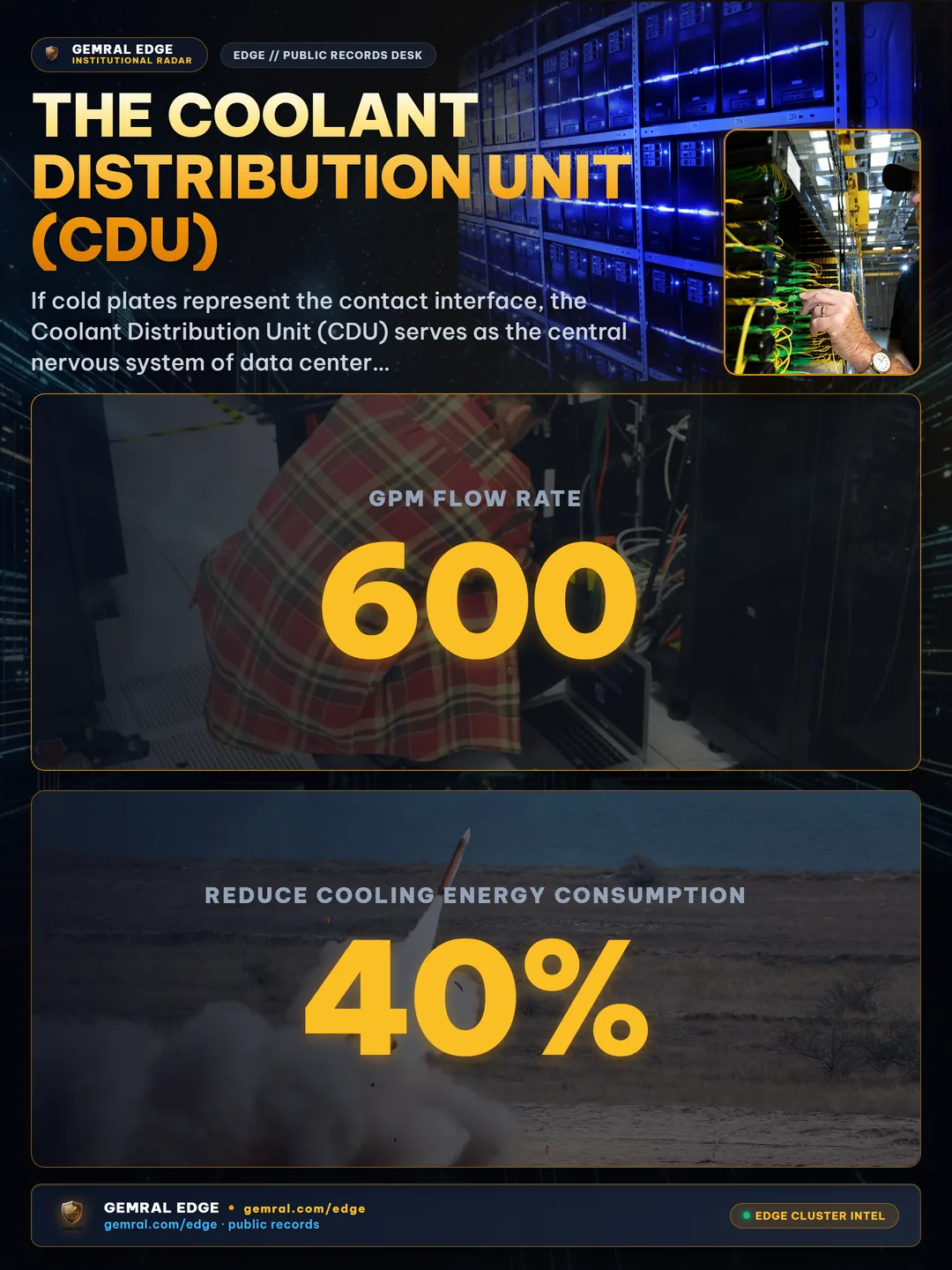
If cold plates represent the contact interface, the Coolant Distribution Unit (CDU) serves as the central nervous system of data center liquid cooling architectures. A CDU is a specialized mechanical assembly that decouples the primary Facility Water System (FWS) from the secondary Technology Cooling System (TCS) circulating through compute racks.
| CDU Form Factor | Thermal Capacity | Typical Placement | Primary Application |
|---|---|---|---|
| In-Rack CDU | 60kW - 300kW | Internal to 42U/48U Cabinet | Isolated high-power density training racks |
| Row-Based CDU | 300kW - 750kW | End of Server Row | Multi-cabinet shared cluster deployment |
| Facility Floor CDU | 750kW - 1500kW | Mechanical Perimeter Room | Campus-scale hyperscale AI infrastructure |
Modern facility-level CDUs deliver 1500kW capacity in continuous thermal exchange rating, featuring redundant dual-pump architectures that circulate up to 600 gpm flow rate while maintaining secondary loop operating thresholds of 300kW minimum to prevent condensation. Modern facility-level CDUs scale up to 1.5 MW thermal capacity, circulating coolant continuously to reduce cooling energy consumption by 40% across hyperscale facilities. The CDU regulates critical loop variables: maintaining secondary loop water temperatures above dew point to prevent condensation, filtering particulate contaminants, and modulating variable-speed pumps to match real-time compute workloads. CDUs feature redundant N+1 pump configurations to ensure zero downtime during pump maintenance.
Evaluating the Supply Chain: Pure-Play Thermal Providers vs Industrial Conglomerates
The rapid proliferation of liquid cooling has created distinct investment dynamics across publicly traded industrial and electrical equipment suppliers. Equities operating across this thermal value chain fall into two primary corporate archetypes:
Pure-Play & Dedicated Infrastructure Providers
Suppliers such as Vertiv Holdings and Modine Manufacturing maintain high revenue exposure to data center cooling systems. These companies engineer complete thermal architectures, from row-level CDUs to outdoor dry coolers. Their specialized focus enables rapid design iterations tailored directly to the reference architectures of leading chip manufacturers.
Diversified Electrical & Chiller Conglomerates
Industrial giants including nVent Electric, Carrier Global, and Johnson Controls provide mission-critical subsystems. nVent dominates high-tolerance quick-disconnect couplings, manifolds, and liquid-tight enclosures, while Carrier and Johnson Controls supply the campus-level water chillers and facility heat exchangers required to evacuate heat into the external atmosphere.
Investors must balance the high operational leverage of dedicated thermal providers against the diversified balance sheets of broad industrial conglomerates. To monitor legislative capital allocations overlapping with commercial tech hardware, consult our politician stock tracker portfolio telemetry.
Direct-to-Chip vs Immersion Cooling: Capital Outlay and Operational Tradeoffs
While Direct-to-Chip cooling commands over 68% of new AI cluster retrofits, immersion cooling represents an alternative thermodynamic architecture that captures growing industry attention. Evaluating both methods requires analyzing key operational tradeoffs:

- Direct-to-Chip (D2C): Retains traditional vertical rack architecture. Technicians can service RAM, storage drives, and network cards using standard hot-swap protocols. However, secondary air cooling is still required for peripheral components that generate modest heat.
- Single-Phase Immersion: Servers are submerged horizontally in tanks filled with dielectric hydrocarbon or synthetic fluids. Fluid convection removes 100% of heat from all components, completely eliminating facility fans. However, server servicing requires robotic cranes to lift dripping chassis into maintenance bays.
- Two-Phase Immersion: Uses engineered fluorochemical fluids that boil at low temperatures (around 50°C), vaporizing to carry heat to condenser coils. While thermodynamically superior, high fluid costs, vapor containment challenges, and emerging environmental PFAS restrictions have limited commercial scale.
Because hyper-scalers prioritize rapid deployment and maintain existing standard rack service contracts, D2C remains the definitive choice for near-term AI cluster rollouts.
Power Usage Effectiveness (PUE) Economics: Calculating Energy Savings and ROI
Beyond physical feasibility, the commercial adoption of liquid cooling is propelled by compelling economic returns. The standard efficiency benchmark in the data center industry is Power Usage Effectiveness (PUE), defined as total facility power divided by total IT equipment power:

Thermodynamic PUE Compression
Legacy air-cooled facilities operate at an average PUE of 1.50, meaning that for every 100 megawatts allocated to compute servers, an additional 50 megawatts are consumed by facility chillers, air compressors, and ventilation fans (noting that total facility-level power envelopes serve as an upper bound rather than IT load alone).
This operational reduction of 38 megawatts of parasitic power translates into tens of millions of dollars in annual utility savings per campus. More importantly, in power-constrained utility jurisdictions where substation interconnect capacity is capped, reducing cooling overhead frees up raw electrical capacity to power additional revenue-generating GPU clusters. For an analysis of grid interconnection delays, examine our study on data center substation power grid infrastructure.
Institutional Capital Allocation Framework for AI Thermal Infrastructure
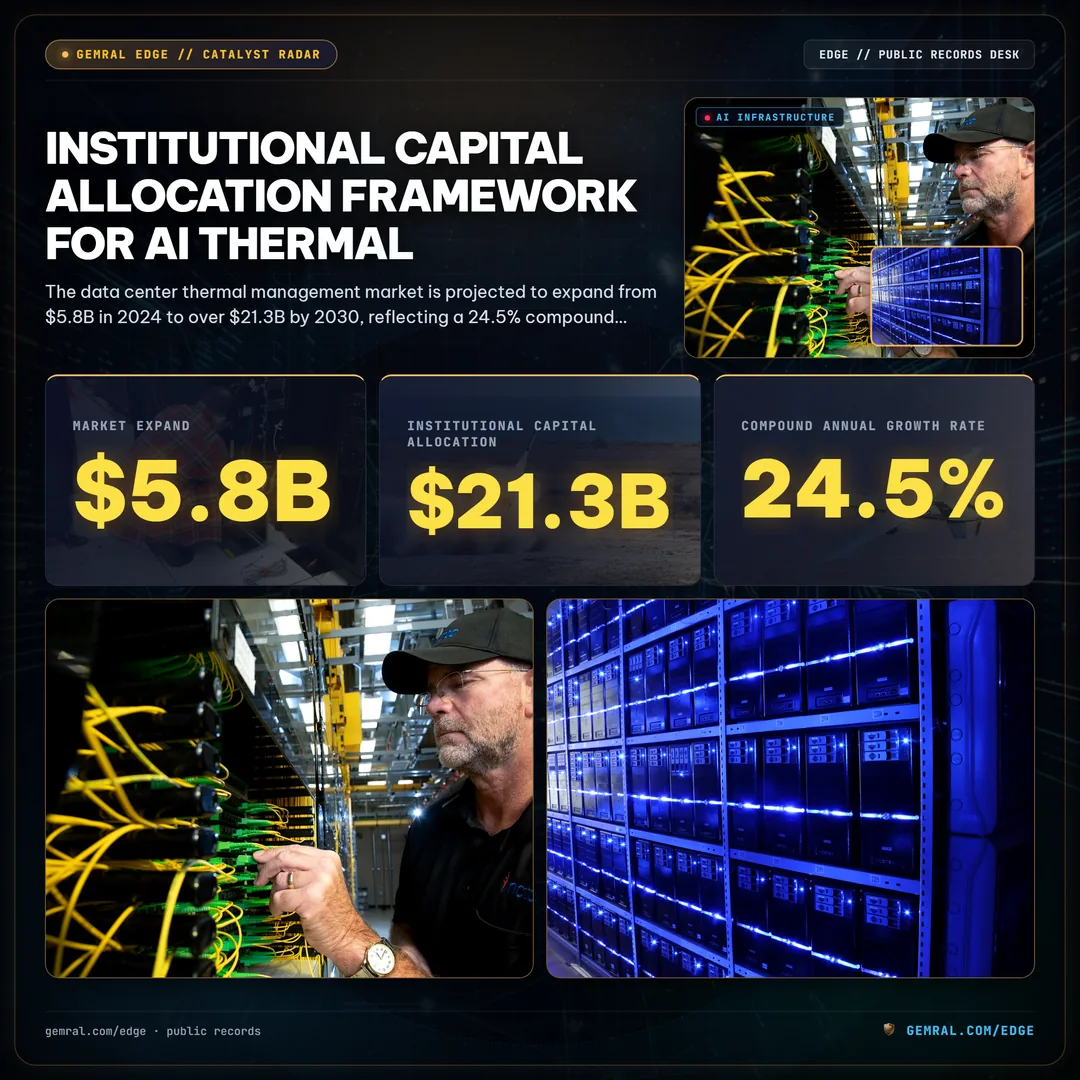
The data center thermal management market is projected to expand from $5.8B in 2024 to over $21.3B by 2030, reflecting a 24.5% compound annual growth rate. For institutional portfolio managers, evaluating equity exposure within this secular theme requires a disciplined four-pillar framework:
Institutional Evaluation Pillars for Thermal Equities
- Reference Architecture Alignment: Identifying equipment vendors officially qualified within major GPU reference designs and Open Compute Project (OCP) standards.
- Manufacturing Capacity and Lead Times: Monitoring order backlogs for high-capacity 1500kW CDUs and precision manifold tooling, where industry lead times frequently stretch past 30 to 40 weeks.
- Services and Maintenance Attachment: Prioritizing suppliers with extensive field-service engineering networks capable of servicing closed-loop hydraulic systems under strict SLA guarantees.
- Valuation Discipline vs Backlog Visibility: Benchmarking enterprise multiples against multi-year hyper-scaler capital expenditure commitments.
Quantitative allocators track these secular infrastructure trends through our institutional data preview telemetry feeds to detect multi-quarter capital expenditure acceleration across the global computing stack.
Frequently asked questions
What are the primary liquid cooling stocks benefiting from AI data center buildouts?
Primary liquid cooling stocks include thermal infrastructure providers such as Vertiv Holdings (VRT), heat transfer specialist Modine Manufacturing (MOD), electrical and liquid manifold provider nVent Electric (NVT), and industrial chiller manufacturer Johnson Controls (JCI).
Why is liquid cooling required for next-generation AI data centers?
Liquid cooling is technically required because advanced AI clusters such as NVIDIA GB200 NVL72 generate rack power densities exceeding 100kW to 132kW, surpassing the 35kW physical thermal dissipation ceiling of traditional forced-air ventilation.
What is the difference between Direct-to-Chip (D2C) and Immersion cooling?
Direct-to-Chip (D2C) circulates liquid coolant through cold plates mounted directly on GPU/CPU dies while keeping standard server chassis accessible. Immersion cooling submerges entire servers in dielectric fluid, providing extreme thermal capture but requiring specialized facility retrofits.
How does liquid cooling improve data center Power Usage Effectiveness (PUE)?
By eliminating high-power chiller fans and optimizing heat exchange efficiency, liquid cooling lowers data center PUE from historical air-cooled averages of 1.50 to between 1.10 and 1.15, reducing facility cooling electricity consumption by up to 40%.