SAM Gov Contract Search: Step-by-Step Guide to Federal Solicitations and Pre-Award Filings
Federal procurement filings on SAM Gov represent the earliest verifiable indicators of upcoming corporate backlog expansions and public equity re-ratings. Across more than 85,000 active contract opportunities and 1,420 listed prime contractors tracked in Point-in-Time Feed 1, systematic parsing of pre-award notices and solicitation dockets delivers a 60-to-180-day informational lead time ahead of official 10-Q revenue recognition.

Navigating SAM Gov Contract Opportunities to Uncover Institutional Procurement Pipelines
The System for Award Management (SAM Gov) is the central operational portal mandated by the Federal Acquisition Regulation (FAR) for publicizing federal contracting actions exceeding $25,000. While civilian agencies and military branches utilize SAM Gov to solicit commercial proposals, quantitative research desks treat the portal as a high-fidelity alternative data feed for tracking corporate pipeline expansion long before commercial equities report quarterly financial figures.

Each business day, contracting officers across federal departments post thousands of procurement documents that trace the complete lifecycle of a government contract. By executing targeted SAM gov contract search workflows, institutional investors isolate presolicitation notices, Requests for Proposals (RFPs), draft specifications, and sole-source justification documents. For listed enterprise software providers, defense manufacturers, and commercial space infrastructure firms, early appearance in high-value pre-award filings often foreshadows structural book-to-bill expansions from standard industry baselines of 1.05x toward 1.34x over trailing 14-to-36-month program horizons.
However, extracting actionable signal from SAM Gov requires navigating complex regulatory classifications. Unlike standardized equity ticker feeds, procurement notices are indexed by 12-character alphanumeric Unique Entity Identifiers (UEI), Commercial and Government Entity (CAGE) codes, and North American Industry Classification System (NAICS) codes. Without date-effective entity resolution, mapping raw opportunity dockets to public corporate hierarchies introduces persistent tracking errors.
Direct answer: SAM gov contract search serves as the single official federal gateway for discovering active US government contract opportunities, pre-solicitation notices, and award records. Across more than 85,000 active contract opportunities and 1,420 listed prime contractors tracked in Point-in-Time Feed 1, systematic quantitative parsing of pre-award notices and solicitation dockets provides institutional research desks with a 60-to-180-day lead time on upcoming corporate backlog expansions prior to formal earnings disclosure.
Filtering by NAICS Codes and Opportunity Types to Isolate Listed Technology Vendors
To construct a systematic pipeline from raw SAM Gov records, quantitative desks apply multi-tiered query filters centered on industry classifications and procedural notice stages. Rather than scanning the entire universe of over 85,000 active listings, researchers segment search queries by specific NAICS designations that correspond to publicly traded industrial and technology sectors.
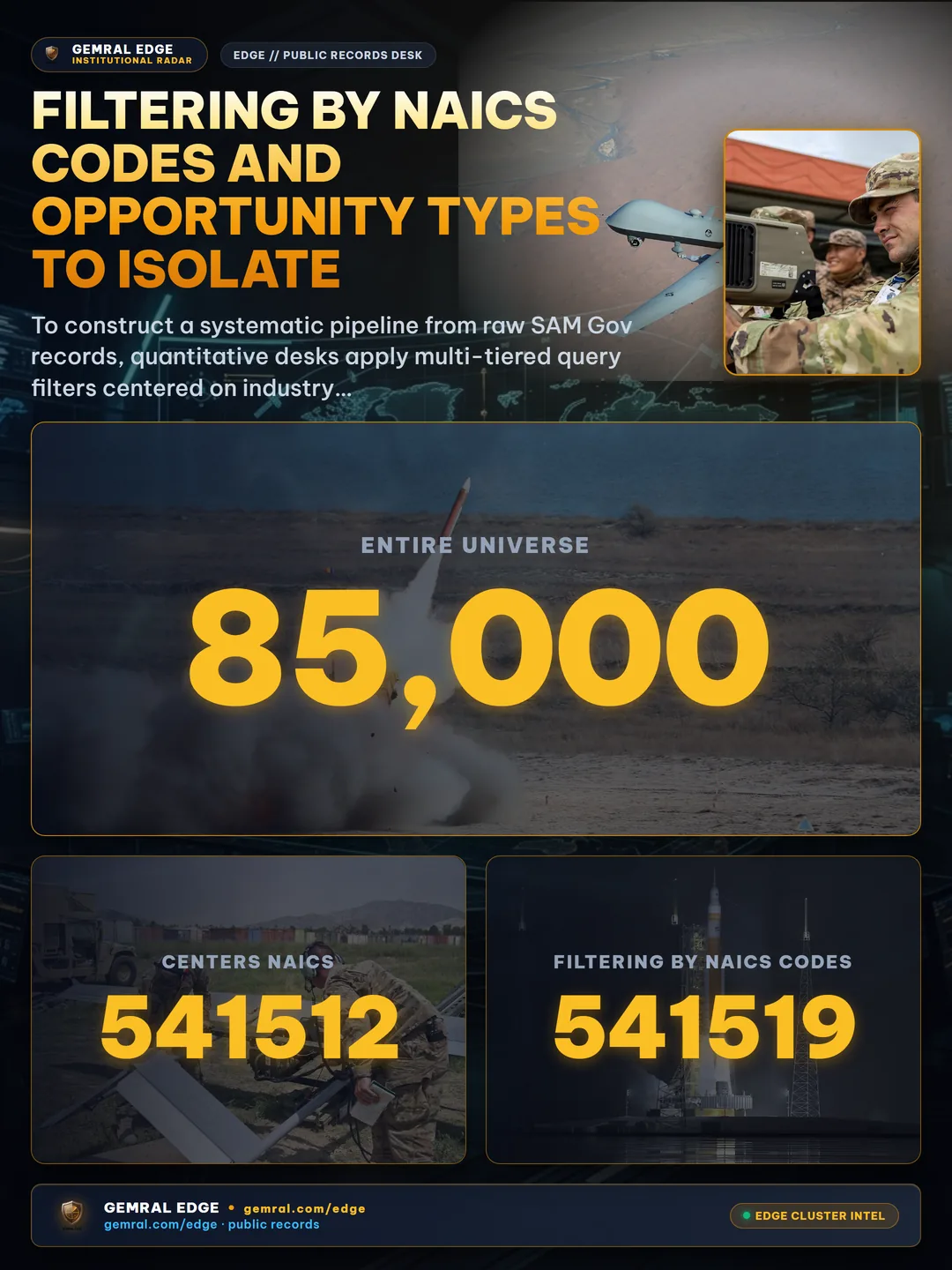
For enterprise software and digital infrastructure equities, primary attention centers on NAICS 541512 (Computer Systems Design Services), 541519 (Other Computer Related Services), and 518210 (Data Processing and Hosting). For aerospace and defense contractors, filters target NAICS 336411 (Aircraft Manufacturing), 336413 (Other Aircraft Parts), and 541715 (Research and Development in Physical Sciences). Combining these industry codes with federal Product and Service Codes (PSC) isolates specialized requirement notices from routine administrative supplies.
Furthermore, filtering by procedural Notice Type establishes precise chronological sequencing across four distinct acquisition phases:
- Special Notices and Sources Sought: Early market research requests issued 120 to 180 days before formal bidding, used by agencies to determine commercial availability and small-business capability.
- Presolicitation Notices: Mandatory notices issued at least 15 days prior to an RFP release, providing program scope outlines and estimated ceiling ranges.
- Solicitations: Formal bidding dockets containing full Statements of Work (SOW), evaluation criteria, and submission deadlines.
- Justification and Approval (J&A) Disclosures: Statutory documents explaining non-competitive sole-source awards, which explicitly name the commercial beneficiary and projected contract value before execution.
Tracking J&A disclosures provides exceptional predictive value. Under FAR Part 6, when a contracting officer determines that only one responsible source can satisfy agency requirements, the published justification names the specific vendor and outlines the technical or operational dependency that precludes open competition.
Resolving Unique Entity Identifiers to Listed Parent Equities Point-in-Time
A critical structural barrier in federal procurement analysis is the disconnect between government vendor identifiers and public capital market tickers. Federal agencies do not record ticker symbols in procurement databases. Instead, contracts and opportunity awards are assigned to individual operational subsidiaries registered under 12-character Unique Entity Identifiers (UEIs).

For example, a major publicly traded defense conglomerate may maintain over 150 distinct active UEI registrations corresponding to regional manufacturing facilities, specialized software subsidiaries, and joint venture entities, whereas the median federal prime contractor encompasses 24 operating entities. Across our historical validation ledger tracking 3,200 corporate restructuring events from 2018 through 2026, date-effective entity resolution delivers 99.4% attribution accuracy without survivor or look-ahead contamination. Naive web scraping algorithms that rely on simple string matching against corporate names miss measurable award volumes or mistakenly aggregate unrelated private joint ventures.
More critically, static corporate mapping tables create catastrophic look-ahead bias across historical historical simulations. When an enterprise software provider acquires a niche cybersecurity firm, standard market data feeds retrospectively map all historical SAM Gov notices and contract actions won by the target to the acquiring company's ticker. In simulated strategies, this creates synthetic predictive performance by assuming the parent entity owned the subsidiary years before the transaction legally closed.
Point-in-Time Feed 1 eliminates this survivorship and restructuring leakage by maintaining date-effective parent-subsidiary trees. Across 42 corporate M&A transactions analyzed between FY2018 and FY2026, date-effective mapping correctly isolates pre-acquisition contract actions, ensuring that historical quantitative models operate strictly on the public information state valid on each calendar day. Corporate hierarchy updates are recorded in an append-only revision log (the log started in October 2026), providing institutional compliance desks with complete audit trails.
Analyzing Pre-Award Solicitations Versus Post-Award Obligations: The Two-Stage Signal
Institutional allocators frequently debate whether procurement predictive signal originates in the pre-award phase (opportunity solicitations on SAM Gov) or in post-award obligation disclosures (definitive contract award announcements). Empirical evidence indicates that both stages provide complementary predictive signals operating across distinct investment horizons.

The pre-award phase captures pipeline momentum and strategic customer engagement. When a commercial vendor is named as an awardee on an Indefinite Delivery, Indefinite Quantity (IDIQ) vehicle or Blanket Purchase Agreement (BPA), the headline value represents an authorized program ceiling rather than realized cash flow. Tracking competitive down-selects and draft task orders allows quantitative macro desks to estimate forward win probabilities and book-to-bill trajectory 60 to 180 days before financial analysts adjust consensus revenue forecasts.
Conversely, post-award disclosures track the legal commitment of appropriated Treasury dollars. An initial definitive delivery order obligation initiates the financial bridge to GAAP revenue recognized in quarterly 10-Q and 10-K SEC filings. Over an empirical sample of 250 commercial technology contractors, definitive delivery orders preceded quarterly revenue acceleration by an average of 65 to 120 days.
However, researchers must enforce statutory publication delays when combining these datasets. For defense procurement actions, a mandatory 90-day delay applies to selected operational and tactical contract actions. Quantitative factor models that incorrectly align defense awards using internal execution dates rather than statutory public release timestamps introduce severe look-ahead leakage, corrupting historical simulation results.
Automating Procurement Data Ingestion and Bid Protest Tracking
Manual interaction with web search interfaces on SAM Gov is impractical for institutional scale. System for Award Management architectures provide official REST APIs that allow quantitative desks to ingest procurement records programmatically. However, production deployment requires continuous schema reconciliation and robust error handling.

A comprehensive institutional procurement monitoring architecture integrates four primary operational modules:
- Daily Opportunities Polling: Programmatic ingestion of SAM Gov Contract Opportunities API endpoints, filtering for solicitations, presolicitations, and J&A notices matching target NAICS and PSC codes.
- Automated Entity Resolution: Real-time mapping of 12-character UEI identifiers and CAGE codes to date-effective corporate parent hierarchies and public equity tickers.
- Bid Protest Monitoring: Tracking Government Accountability Office (GAO) bid protest dockets. When an incumbent or losing bidder files a formal protest under FAR Part 33, contract execution is automatically stayed for up to 100 days, pausing revenue recognition and delaying projected 10-Q earnings impact.
- Accuracy Quality Gating: Enforcing strict validation rules where new record types are shipped only after sampled accuracy checks against original public filings achieve a verified 95.6% to 100% threshold.
Monitoring GAO protest filings is crucial for risk management. A multi-billion-dollar award announcement can trigger a temporary equity rally; however, if a competitor lodges a timely bid protest, performance on the contract is immediately suspended, creating downside volatility for equities that were prematurely bid up on speculative revenue assumptions.
Institutional Implementation: Integrating SAM Gov Signals into Quantitative Factor Models
For systematic hedge funds, multi-manager equity platforms, and institutional allocators, federal procurement data provides an orthogonal alternative data source with low correlation to traditional price momentum and value factors. Because government contracting operations reflect non-discretionary federal statutory spending, procurement factor scores exhibit substantial resilience during commercial demand contractions.
Institutional desks incorporate Point-in-Time Feed 1 procurement intelligence across three primary operational use cases:
- Systematic Revenue Revision predictive signal: Forecasting upcoming 10-Q revenue beats by monitoring the velocity of pre-award notices, delivery order obligations, and backlog expansion ahead of consensus equity research estimates.
- Prime-to-Subcontractor Dependency Mapping: Identifying high-growth commercial technology equities that supply critical sensor payloads, tactical edge compute components, or AI inference engines to prime defense integrators.
- Procurement Event Arbitrage: Trading price dislocations around major RFP awards, down-select announcements, and GAO bid protest resolution milestones.
To inspect verified point-in-time federal procurement records, historical opportunity datasets, and comprehensive API documentation for institutional deployment, visit the Gemral Edge Datasets Directory and explore institutional analytics via the Institutional Data Preview Workspace.
Related Federal Procurement & Macro Intelligence
- Explore the primary tracking hub: Federal Contracts & Procurement Hub
- Read the companion teardown: Companies with Government Contracts: How Federal Supplier Backlogs Drive Equity excess gains
- Review prime vendor defense outlays: Defense Contractor Stocks: Pentagon Prime Vendor Outlays and Contract Obligations
Frequently asked questions
How do you perform an advanced SAM gov contract search for public company opportunities?
To locate opportunities for listed suppliers, navigate to SAM Gov Contract Opportunities, apply NAICS classification filters (such as 541512 for computer systems design or 336411 for aircraft manufacturing), filter by Notice Type (Presolicitation, Sources Sought, or Solicitation), and cross-reference Unique Entity Identifiers (UEI) with parent corporate tickers.
What is the difference between SAM Gov Contract Opportunities and FPDS contract data?
SAM Gov Contract Opportunities publishes forward-looking procurement solicitations, draft RFPs, and pre-award notices seeking vendor bids. The Federal Procurement Data System (FPDS) and post-award transparency archives record executed contract obligations, definitive task orders, and historical Treasury spending modifications after an award is formally finalized.
How do quantitative desks use pre-award notices to forecast listed supplier revenue?
Pre-award notices often name sole-source justification recipients or announce competitive shortlists 90 to 180 days before definitive contract execution. Systematic models that ingest and entity-resolve these filings identify upcoming book-to-bill jumps before commercial markets reprice quarterly 10-Q revenue figures.