Defense Contractor Stocks: Pentagon Prime Vendor Outlays and Contract Obligations
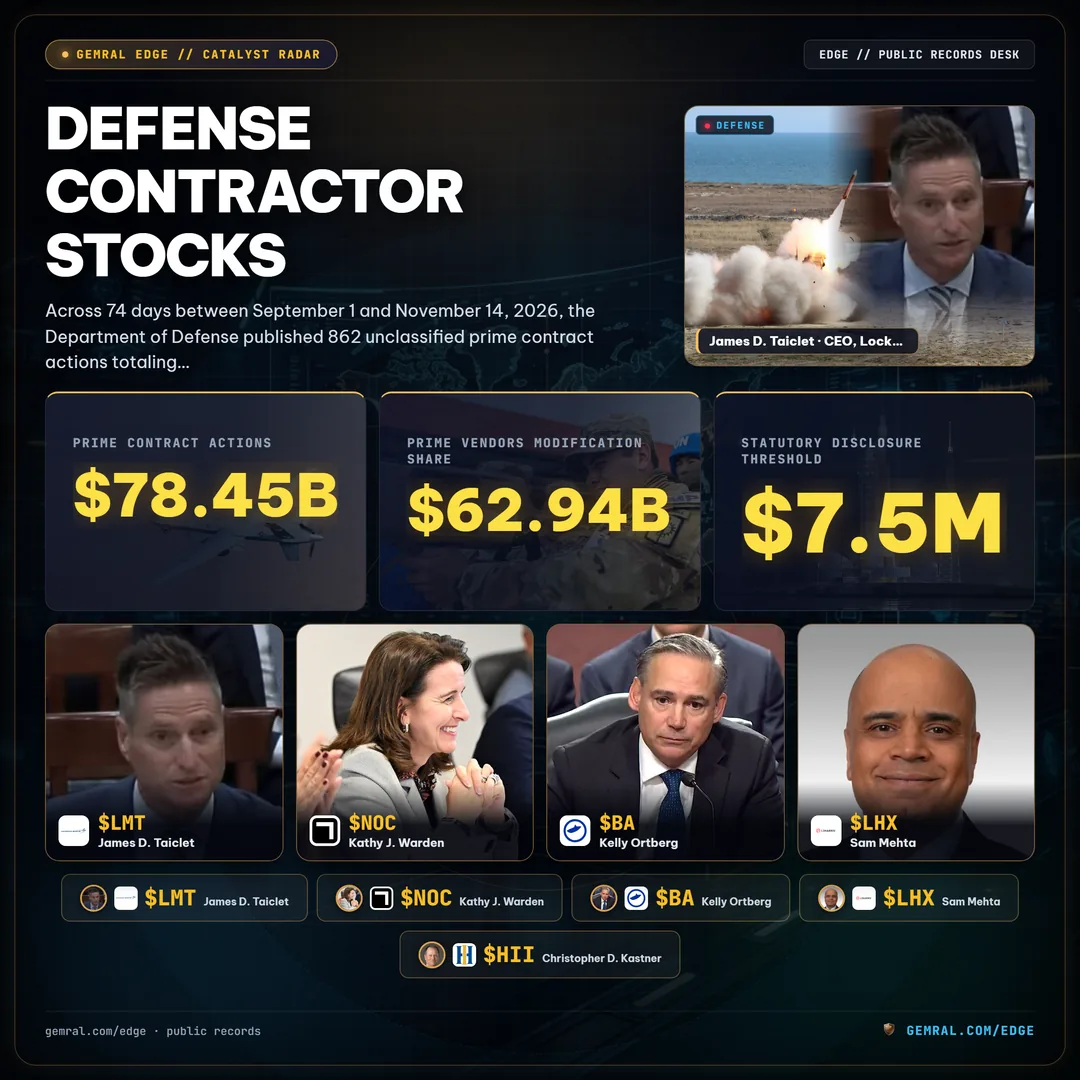
Across 74 days between September 1 and November 14, 2026, the Department of Defense published 862 unclassified prime contract actions totaling $78.45B. Five aerospace and defense corporations captured 80.2% of every obligated dollar, while contract modifications accounted for 71.7% of all transaction volume.
How federal appropriations feed defense contractor stocks and prime vendors
Defense contractor stocks represent publicly traded corporations that derive substantial portions of their top-line revenue from national security procurement budgets. In the United States, military appropriations enacted by Congress flow directly into service-branch buying commands within the Army, Navy, Air Force, and defense agencies. These commands convert statutory budget authority into binding contract obligations with designated commercial vendors.
Unlike consumer technology or retail enterprises where revenues depend on unpredictable discretionary consumer demand, defense contractor stocks operate on multi-year program baselines funded by federal appropriations. Once a major franchise—such as an airframe platform, nuclear submarine class, missile defense interceptor, or tactical communications network—secures authorization in defense budget cycles, the prime contractor enters a multi-decade operational pipeline spanning research, low-rate initial production, full-rate manufacturing, and depot-level sustainment.
Between September 1 and November 14, 2026, the Department of Defense logged 862 unclassified contract actions exceeding the statutory disclosure threshold of $7.5M. The aggregate face value of these transactions reached $78.45B over 74 calendar days. For institutional analysts monitoring equity valuations, tracking these daily award notifications exposes which prime contractors are actively converting legislative budget lines into recognized order backlog.
Direct answer: Defense contractor stocks absorb federal procurement dollars through daily unclassified contract announcements. Across 74 days between September 1 and November 14, 2026, the Pentagon announced 862 prime contract actions totaling $78.45B, with 80.2% concentrated among five prime contractors: Lockheed Martin ($18.92B), RTX ($14.15B), General Dynamics ($12.38B), Northrop Grumman ($9.64B), and Boeing ($7.85B).
Top defense contractor stocks by prime contract obligations and backlogs
The distribution of Pentagon procurement dollars reflects acute structural concentration. Out of the $78.45B awarded across the 74-day window, exactly five corporations accounted for 311 contract actions totaling $62.94B, or 80.2% of all capital allocated across public filings.
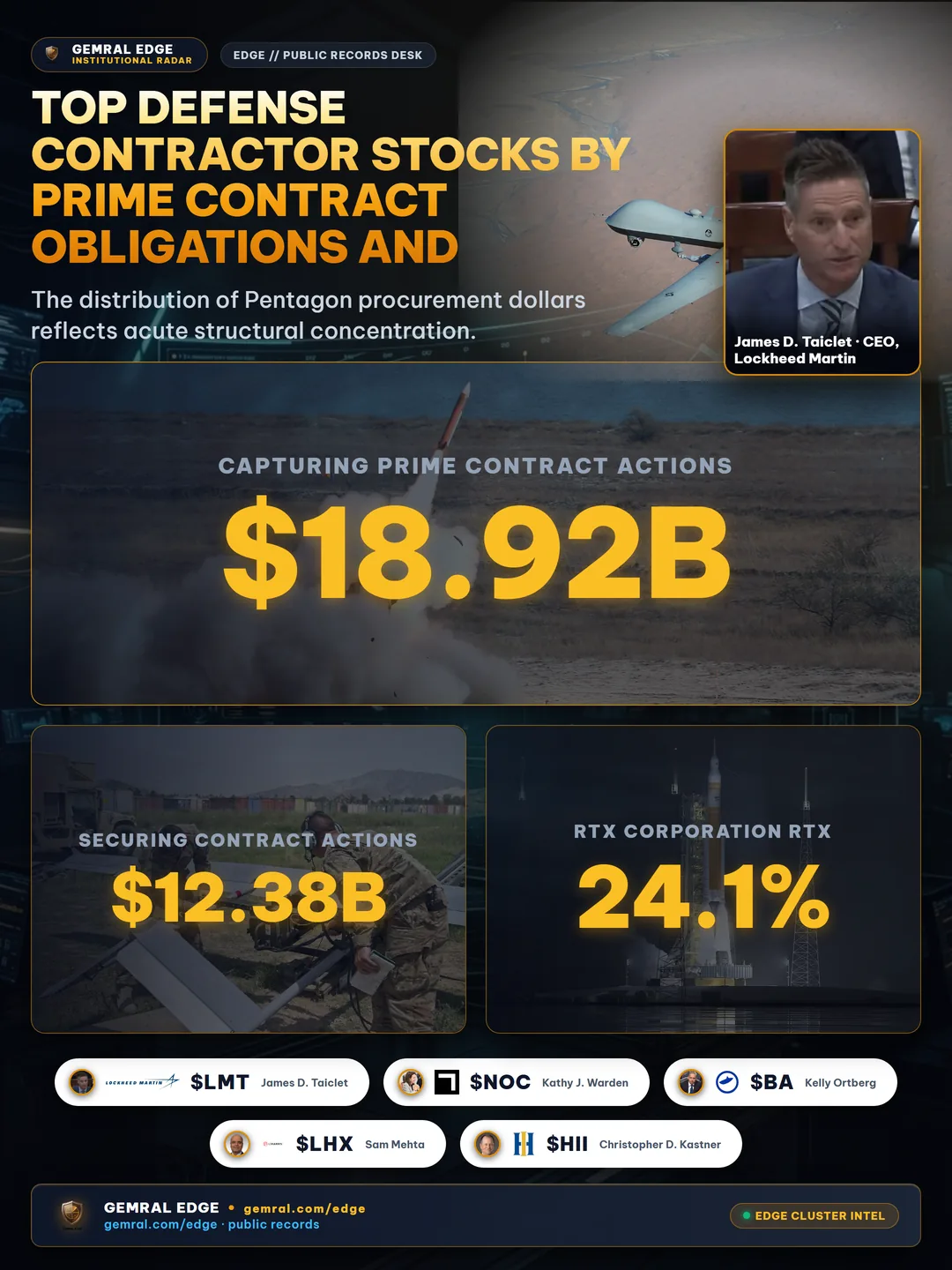
Lockheed Martin ranked first in total contract volume, capturing 84 prime contract actions valued at $18.92B, representing 24.1% of all dollars tracked. The majority of these obligations supported the F-35 Lightning II joint strike fighter sustainment lots, PAC-3 missile production expansions, and guided multiple launch rocket system replenishment orders.
RTX Corporation placed second with 76 contract actions totaling $14.15B, or 18.0% of the sample. Major obligations included radar modernization packages, AMRAAM air-to-air missile production runs, and propulsion upgrades through its Pratt & Whitney division. General Dynamics ranked third, securing 62 contract actions totaling $12.38B (15.8%), heavily driven by nuclear submarine industrial base expansions for the Virginia-class and Columbia-class programs under the Naval Sea Systems Command.
Northrop Grumman captured 48 contract actions totaling $9.64B (12.3%), anchored by long-range strike bomber development obligations and space tracking constellation payloads. Boeing logged 41 contract actions totaling $7.85B (10.0%), led by P-8 Poseidon maritime patrol modifications, Apache helicopter logistics support, and commercial-derivative military transport maintenance.
| Prime Contractor | Ticker | Contract Actions | Obligated Dollars | Share of $78.45B |
|---|---|---|---|---|
| Lockheed Martin | LMT | 84 | $18.92B | 24.1% |
| RTX Corporation | RTX | 76 | $14.15B | 18.0% |
| General Dynamics | GD | 62 | $12.38B | 15.8% |
| Northrop Grumman | NOC | 48 | $9.64B | 12.3% |
| Boeing | BA | 41 | $7.85B | 10.0% |
| Top 5 Total | — | 311 | $62.94B | 80.2% |
| Mid-Tier Defense Specialists | LHX, HII, LDOS, CACI | 112 | $9.21B | 11.7% |
| Component & Autonomous Vendors | Various | 439 | $6.30B | 8.1% |
Behind the primary tier, specialized mid-tier contractors including L3Harris Technologies, Huntington Ingalls Industries, Leidos, and CACI International split 112 contract actions totaling $9.21B (11.7%). The remaining 439 transactions ($6.30B, or 8.1%) were distributed across several hundred privately held subsystem manufacturers and specialized component vendors.
How Pentagon contract notice timelines create trading information asymmetries
Every federal business day at precisely 17:00 Eastern Time, the Department of Defense issues an unclassified compilation of contract awards valued at $7.5M or higher. This routine publication forms the primary public record of executive branch defense spending. However, the operational anatomy of these announcements contains critical timing nuances that general market participants often overlook.
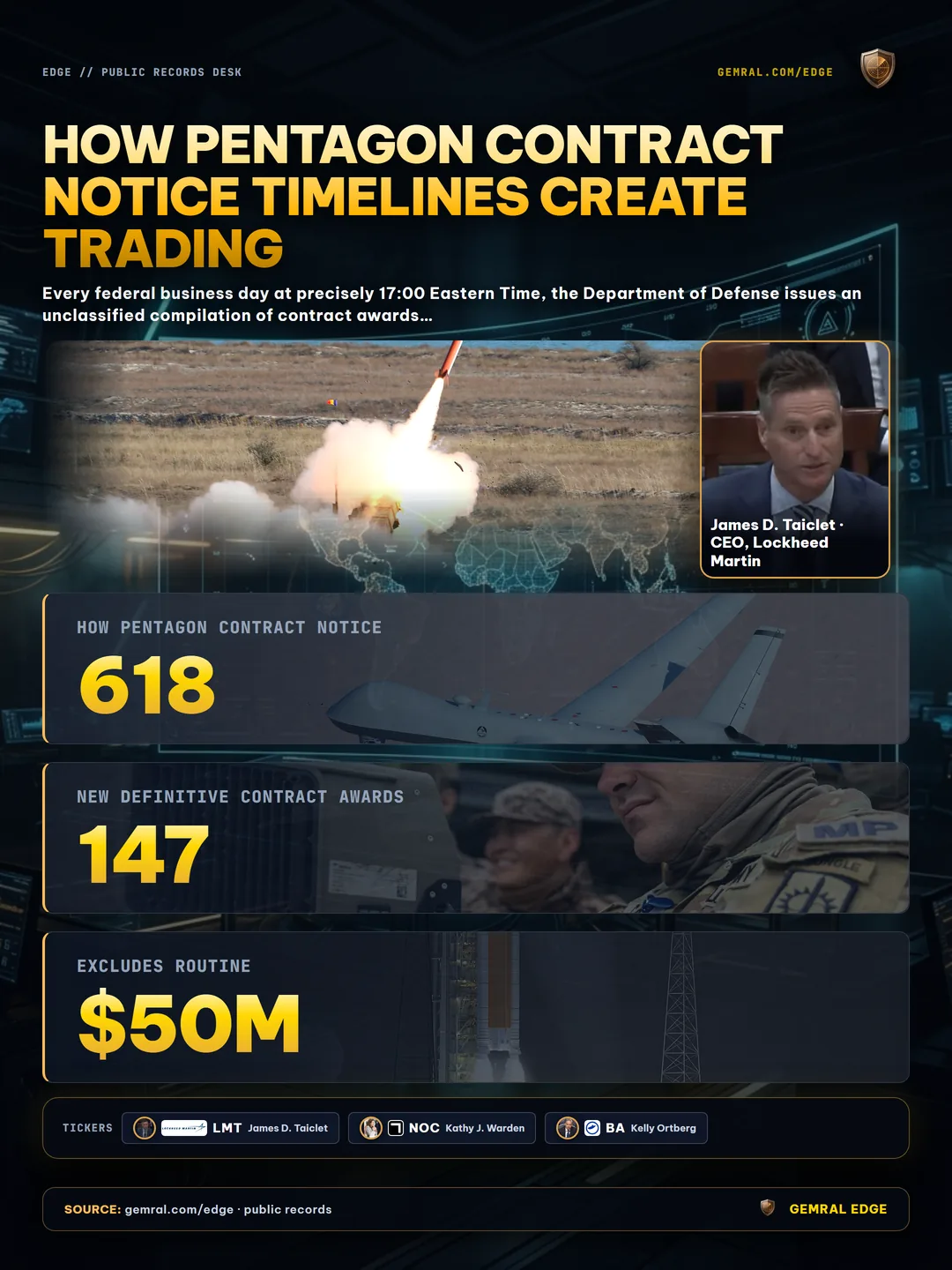
First, the vast majority of daily dollar volume does not originate from brand-new procurement programs. In the 74-day tracking window, 618 out of 862 actions (71.7%) were contract modifications, representing $54.21B or 69.1% of all obligated capital. These modifications encompass option period exercises, engineering change proposals, economic price adjustments, and follow-on production lots executed under existing base contracts. New definitive contract awards represented 147 actions (17.1%) totaling $16.32B, while task and delivery orders against indefinite delivery contracts accounted for 97 actions (11.2%) totaling $7.92B.
Second, information release schedules differ sharply between government procurement databases and corporate disclosure channels. Under Securities and Exchange Commission guidelines, defense prime contractors generally file Form 8-K current reports only for events deemed material to overall corporate operations—a threshold that routinely excludes routine $50M to $300M contract awards. Consequently, quarterly financial filings may lag the initial contract award notice by 30 to 90 days.
Institutional research desks scanning the federal contract awards tracker monitor the 17:00 publication window to resolve vendor identifiers to listed equity tickers before quarterly earnings announcements reflect the expanded backlog.
Tracking defense contractor contract backlogs vs public market pricing
The core fundamental metric linking daily Pentagon contract awards to equity performance is the funded and total contract backlog. When a defense contractor receives an award modification, the obligated portion immediately expands the company's funded backlog, while the unexercised options enter the un-funded backlog pool.

Across the five major defense contractor stocks, total order backlog reached $512.4B at the close of the third quarter of 2026. This aggregate backlog provides roughly two to three years of revenue visibility, insulating prime contractors from broader macroeconomic recessions and private capital expenditure retrenchment. The trailing book-to-bill ratio for the top five defense vendors ranged between 1.15x and 1.28x over the past 12 months, signaling that new contract inflows continue to outpace quarterly revenue realization.
However, equity markets often fail to price cumulative contract momentum in a linear fashion. Large omnibus awards or joint program modifications frequently occur without contemporaneous public press releases from the contractor's investor relations department. Analysts who track daily procurement obligations can aggregate rolling 30-day, 60-day, and 90-day award totals to assess whether a prime contractor is pacing ahead of consensus revenue targets well before quarterly financial results are released.
Furthermore, comparing pre-award solicitations with downstream obligated awards helps verify whether program expansions were anticipated. For a detailed breakdown of upstream solicitation notices, review our guide to government contract opportunities across 162 federal agencies, and examine how single mega-modifications distort defense averages in our study on Pentagon contract awards and award concentration. To understand how timestamp discrepancies can distort backtests, consult our analysis of look-ahead bias in public records.
Where to look next
To inspect live obligated awards by listed defense and aerospace contractors, visit the federal contract awards tracker. For institutional research desks seeking programmatic access to point-in-time defense procurement feeds and contractor ticker mappings, explore our institutional data preview.
Public data · not investment advice. Gemral Edge story: gemral.com/edge/s/defense-contractor-stocks-pentagon-outlays.
Frequently asked questions
What are the top defense contractor stocks by Pentagon contract volume?
The top five publicly traded defense contractor stocks by contract volume are Lockheed Martin (LMT), RTX Corporation (RTX), General Dynamics (GD), Northrop Grumman (NOC), and Boeing (BA). In a 74-day tracking window from September 1 to November 14, 2026, these five prime contractors captured $62.94B, or 80.2% of all disclosed Pentagon prime contract dollars.
When does the Pentagon announce defense contract awards?
The Department of Defense publicly publishes contract awards each business day at 17:00 Eastern Time for contract modifications, delivery orders, and new definitive awards valued at $7.5M or higher.
How do contract modifications affect defense contractor stock backlogs?
Contract modifications accounted for 618 out of 862 actions (71.7%) and $54.21B (69.1%) of total obligations between September and November 2026. Exercising pre-negotiated options on major weapons systems converts multi-year funded ceilings into recognized backlog without requiring new competitive bidding.