Data Center Air Permits: 169 Environmental Filings and Site Ownership Look-Ahead Bias
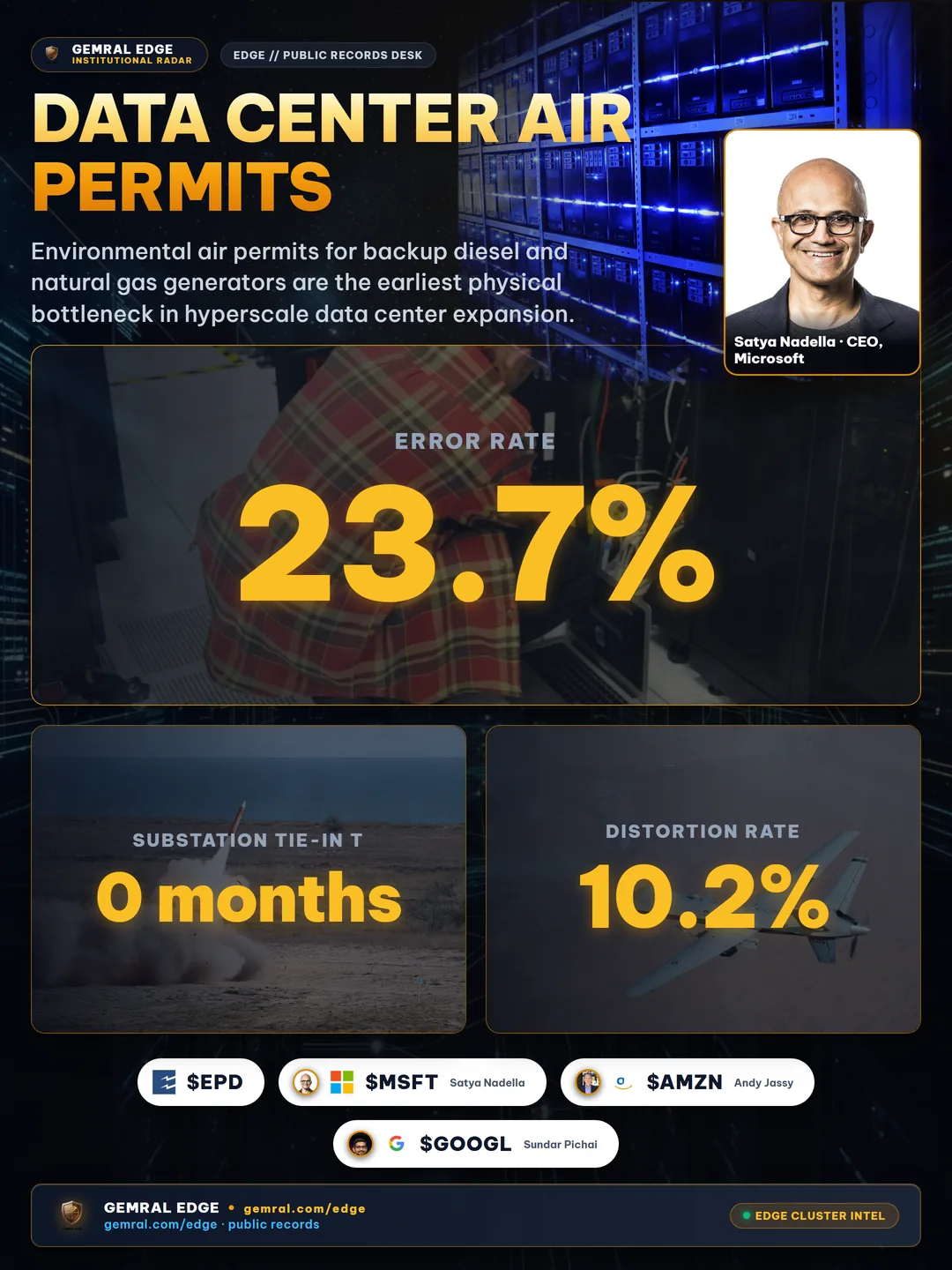
Environmental air permits for backup diesel and natural gas generators are the earliest physical bottleneck in hyperscale data center expansion. Across 169 permit events and 687 power plant status records tracked in Feed 2, joining site records through today's corporate owners introduces look-ahead bias in 40 permit filings and 70 power records.
Why data center air permits are the earliest physical bottleneck in hyperscale buildouts
In quantitative modeling of digital infrastructure, capital expenditure guidance from major hyperscalers provides an aggregate financial ceiling, but it fails to answer where and when physical compute capacity will actually come online. Long before structural steel rises or utility substations energize high-voltage transmission lines, operators must secure stationary source air permits for their on-site emergency generation arrays.
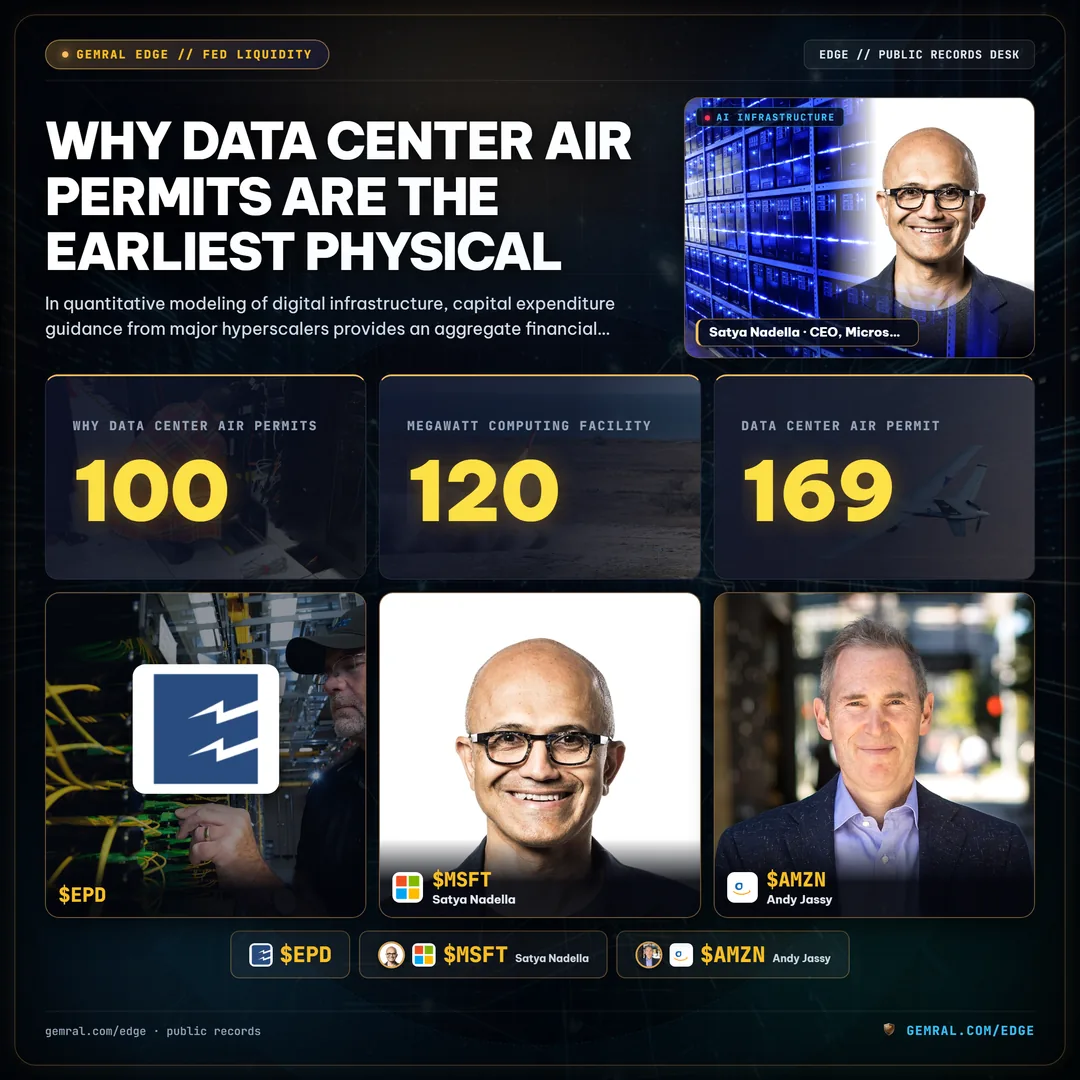
Modern artificial intelligence campuses require unprecedented power densities, often exceeding 100 megawatts per building and scaling toward multi-gigawatt regional clusters. To guarantee Tier III or Tier IV operational reliability under standard commercial service-level agreements, hyperscale facilities install rows of high-capacity diesel or dual-fuel backup generators. A single 120-megawatt computing facility commonly specifies between 30 and 48 individual 3.0-megawatt generator units. Because diesel engine exhaust discharges large volumes of nitrogen oxides, particulate matter, and carbon monoxide, state environmental regulators classify these backup installations as stationary pollution sources under the Clean Air Act.
Consequently, environmental air permit applications precede building completions by 14 to 36 months. Filing dockets disclose the exact number of planned generator units, fuel storage capacity, thermal output, and scheduled installation milestones years before a commercial server rack consumes a single kilowatt of power. For quantitative research desks, tracking state Department of Environmental Quality dockets transforms what was once opaque private capex into a verifiable, point-in-time physical pipeline.
However, extracting actionable signal from these public records requires rigorous point-in-time discipline. When raw environmental filings are improperly ingested or joined against current corporate hierarchies, systematic data leakage contaminates historical simulations and distorts machine learning models.
Direct answer: Across 169 data center air permit filings and 687 power plant status events tracked in Feed 2, joining environmental records through current corporate owners creates look-ahead bias in 40 permit events and 70 power records. Point-in-time entity resolution preserves exact historical ownership dates, preventing predictive model distortions across hyperscale buildouts.
How Virginia and Georgia DEQ air permit filings trace megawatt generator capacity
State environmental agencies maintain public dockets where every proposed stationary engine installation must be registered, evaluated, and formally approved. In Northern Virginia—the largest data center market in the world spanning Prince William and Fairfax counties—the Virginia Department of Environmental Quality (VDEQ) oversees permit applications under 9 VAC 5-80. Similarly, in Georgia's rapidly growing Metro Atlanta corridor, the Environmental Protection Division (EPD) registers emissions sources under the Georgia Air Quality Act.
Each docket entry captures four critical operational dimensions that financial disclosures never provide at the facility level:
- Nameplate generator ratings: The exact mechanical output of each engine in brake horsepower and electrical capacity in megawatts, providing an unalterable upper bound on site emergency power.
- Total facility fuel throughput: On-site storage volumes for ultra-low sulfur diesel or pipeline natural gas, indicating run-time endurance under utility grid disconnection scenarios.
- Emissions threshold classifications: Whether the site operates under a Minor New Source Review (NSR), a synthetic minor operating limit, or a full Title V operating permit requiring continuous monitoring.
- Engineering review timelines: Exact dates for initial application submission, public comment period announcements, draft permit issuance, and final operating approval.
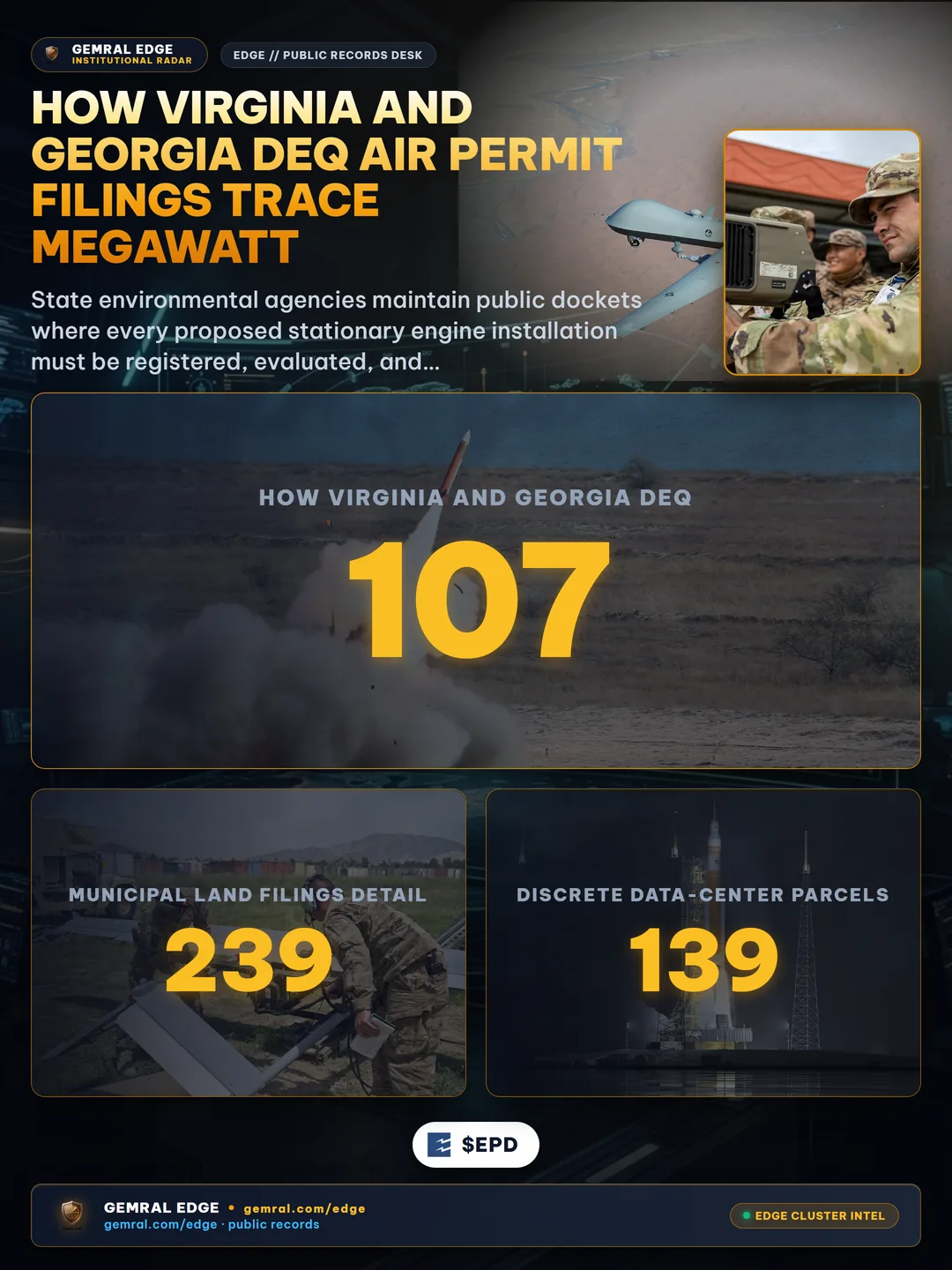
In Feed 2, 107 distinct data-center campuses carry five simultaneous public-record layers: documented legal owner entity, nearest electrical substation connection, regional transmission grid zone, dated environmental air permit or registration, and recurring satellite verification. Of these 107 integrated campuses, 92 reside within the hyper-dense corridors of Virginia. Across this physical inventory in one county, municipal land filings detail 239 permitted buildings, 139 discrete data-center parcels, and 85 planned project expansion areas.
169 permit events across key hubs: what state environmental dockets disclose
To quantify the development trajectory of critical computing clusters, Feed 2 catalogs 169 discrete air permit lifecycle events across major Mid-Atlantic and Southeastern infrastructure hubs. Each event represents a concrete administrative transition: an initial registration filing, a request for public comment, a permit modification to expand engine counts, or a formal permit issuance.

A systematic audit of these 169 filings demonstrates why tracking administrative state transitions provides substantial lead time over traditional equity analyst estimates. Consider a typical timeline observed across major regional campus buildouts:
| Timeline Milestone | Typical Horizon | Public Docket Disclosure | Quantitative Value |
|---|---|---|---|
| T - 30 months | Site Acquisition & Initial Filing | Initial Minor NSR Air Permit Application | Confirms generator count and maximum electrical capacity |
| T - 22 months | Engineering Review | VDEQ Technical Evaluation Memo & Public Notice | Reveals fuel storage layout and emission modeling metrics |
| T - 18 months | Permit Approval | Final Operating Permit Issued | Fixes construction start window and foundation engineering |
| T - 10 months | Equipment Delivery | Generator Installation Notice & Satellite Confirmation | Confirms physical equipment arrival and substation tie-in |
| T - 0 months | Commercial COD | Commercial Operation Date / Revenue Commissioning | First public disclosure in quarterly financial capex filings |
Tracking this administrative sequence across 169 individual permit events provides institutional researchers with an empirical, verified calendar of capacity additions. However, this analytical advantage evaporates if research teams make the critical error of joining historical site permits directly to the corporate parent that owns the campus today.
Ownership look-ahead bias: why static ticker mapping breaks in 40 of 169 air permit events
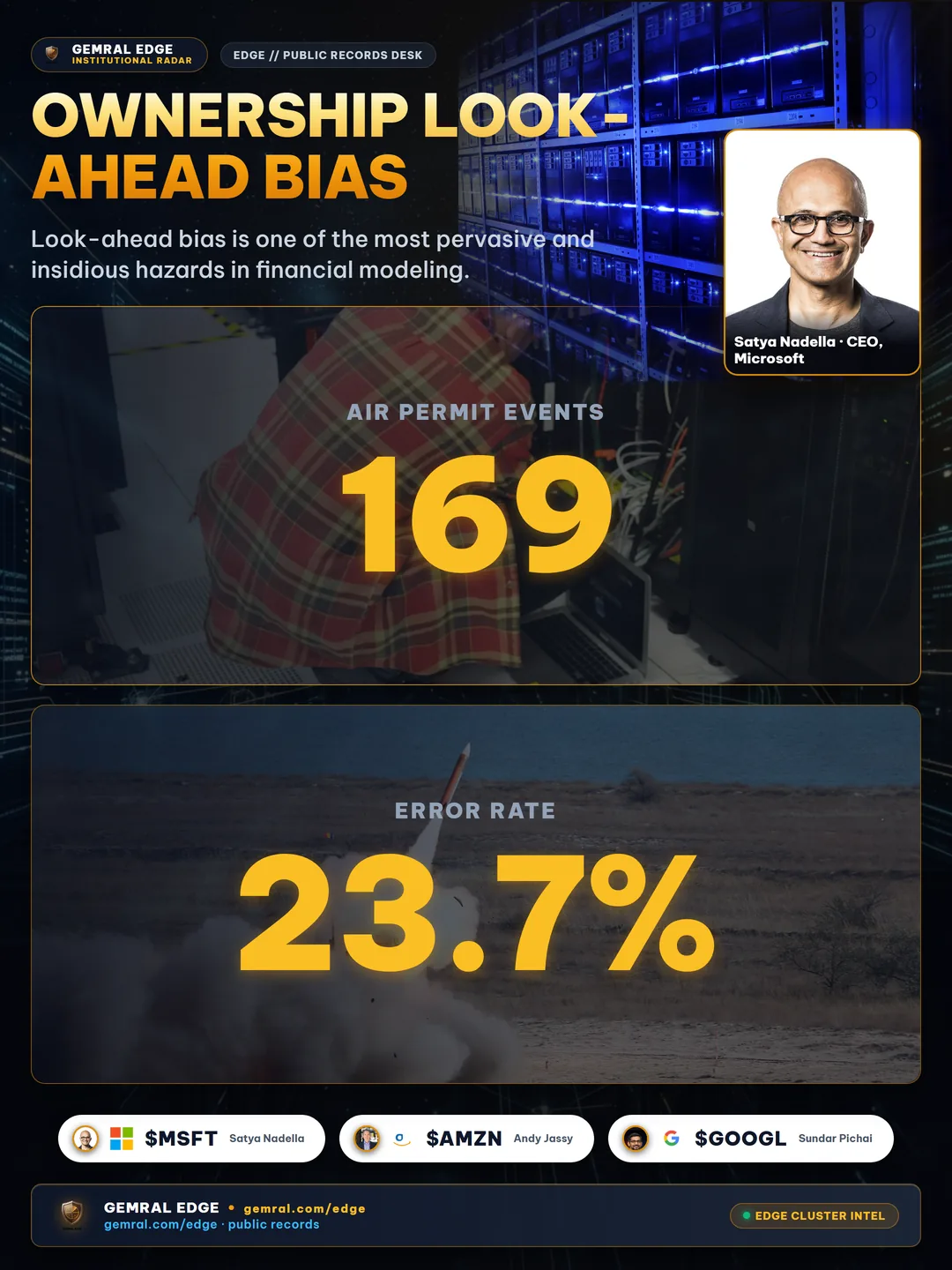
Look-ahead bias is one of the most pervasive and insidious hazards in financial modeling. In alternative data workflows, it occurs when information that was not available at a historical timestamp is inadvertently introduced into historical simulations. When dealing with physical assets like data centers, look-ahead bias manifests primarily through static entity resolution.
Hyperscale infrastructure development follows a complex multi-year lifecycle involving specialized land developers, shell holding companies, and joint ventures before assets are acquired by public real estate investment trusts or hyperscale technology companies. An environmental air permit is virtually never filed under the corporate name of a major listed entity like Microsoft, Amazon, Alphabet, or Equinix. Instead, early permit filings are submitted by local development entities such as 'Silver Fox LLC', 'Compass Creek Land Holdings', or specialized private developers.
When an alternative data vendor maps assets using a static database, they typically associate the entire historical lifecycle of the parcel with its current parent owner. If a listed REIT acquires a development campus in March 2025, a static database joins all historical air permits filed in 2023 and 2024 to that listed ticker retrospectively.
The Measurement on 24 October 2026: 40 Distorted Filings
In a direct measurement conducted across Feed 2 records on 24 October 2026, joining site events through current parent owners attached a public ticker prematurely or incorrectly for 40 of 169 air permit events. That represents a 23.7% error rate in historical asset attribution.
In every one of those 40 instances, a quantitative model using static mapping would have credited a publicly traded entity with hundreds of megawatts of planned backup capacity years before the company acquired legal ownership or assumed capital commitments for the site.
To eliminate this failure mode, Feed 2 enforces strict Point-in-Time (PIT) entity resolution. Each permit event is permanently stamped with the exact legal entity appearing on the state agency docket on the publication date. Separate transaction tables record entity acquisitions and corporate restructuring events along with their legal effective dates. When researchers simulate historically models using Feed 2, site capacity transitions into a ticker's portfolio only on the verified date of legal closing, maintaining pure informational causality.
Power plant status joins: extending point-in-time rigor across 687 grid events
The danger of static ownership mapping is not limited to data center backup generator dockets; it extends directly to the regional utility generation assets supplying the electric grid. As hyperscale power requirements surge, computing campuses increasingly negotiate large-scale power purchase agreements directly with merchant solar, battery storage, and natural gas peaking plants.
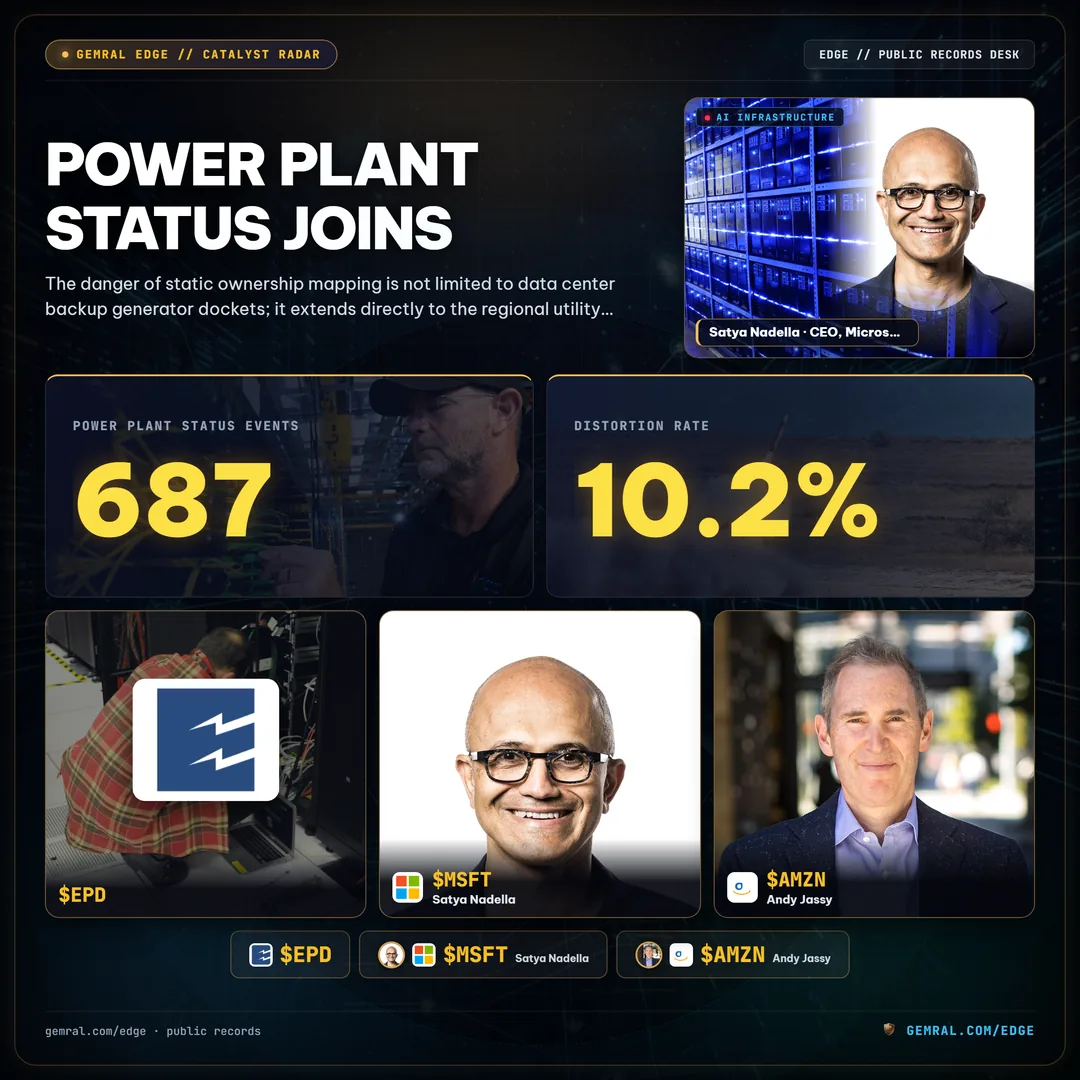
Feed 2 extends its point-in-time verification architecture to 687 power plant status events across key regional transmission organizations, including PJM Interconnection, ERCOT, and the Midcontinent Independent System Operator. These events track generator interconnection queue progression, capacity testing approvals, environmental compliance certifications, and operational status transitions.
When evaluated under the same audit criteria on 24 October 2026, static owner joins misattributed 70 of 687 power-plant status events (a 10.2% distortion rate). Merchant generation assets frequently change hands during development: an independent developer advances an interconnection study and environmental permit through state dockets, then sells the shovel-ready project to an independent power producer or utility holding company prior to commercial energization.
By preserving true historical ownership records across both data centers and the 687 grid power events, Feed 2 ensures that researchers can model the structural intersection of AI electricity demand and regional generation capacity without introducing forward-looking contamination.
Quantitative model architecture: building survival and capacity curves without future data
For quantitative researchers and asset managers, the objective of tracking physical permits is to build predictive survival models and capacity forecasting curves. Knowing how long a permit takes to progress from application to commercial operation allows analysts to estimate future compute supply curves across individual metropolitan statistical areas.
When data leakage enters these models through static joins, survival models become heavily biased:
- Survivorship distortion: Failed or abandoned permit applications submitted by private developers that were never acquired by a listed entity are filtered out of public ticker views, creating an artificially elevated completion rate for historical projects.
- Premature capex attribution: Historical simulations attribute capital deployment to public sponsors years ahead of time, artificially smoothing out capex volatility and distorting return-on-invested-capital calculations.
- Corrupted lead-time estimates: Because the acquisition date is conflated with the original environmental application date, machine learning models estimate distorted regulatory approval timelines.
Feed 2 eliminates these distortions by supplying immutable, timestamped snapshots. Every record provides three discrete timestamps: the regulatory publication date, the administrative legal effective date, and the ingestion timestamp when the record entered the production pipeline. By utilizing these dual-timestamp structures, modelers can construct exact historical views of the AI physical infrastructure landscape as it existed on any historical trading day.
Importantly, Feed 2 does not offer price predictions, asset return forecasts, or directional trading advice. Instead, it provides the clean, granular, point-in-time foundational infrastructure data that quantitative research teams require to construct their own proprietary valuation and supply-demand models.
Where to inspect the records: institutional feeds and verification
To inspect the technical methodology behind the point-in-time spatial datasets and review data dictionary specifications, institutional researchers can examine the Due Diligence Questionnaire (DDQ). Qualified research desks and quantitative funds evaluating commercial licensing can request access via the institutional data preview. To inspect related defense and agency procurement telemetry, explore the federal contract awards tracker.
For related research on alternative data structuring and pipeline risk, explore the breakdown of look-ahead bias in public records, review our analysis of government contract opportunities, or inspect the broader data catalog at gemral.com/edge.
Public data · not investment advice. Gemral Edge story: gemral.com/edge/s/data-center-air-permits-ownership-look-ahead-bias.
Frequently asked questions
Why do data centers require state environmental air permits?
Hyperscale data centers install dozens of multi-megawatt backup diesel or natural gas generators to maintain continuous uptime. State environmental agencies such as Virginia DEQ and Georgia EPD regulate these generators as stationary emission sources, requiring Title V or minor source air permits before installation.
What is ownership look-ahead bias in data center infrastructure data?
Ownership look-ahead bias occurs when historical permitting or grid filings are joined using current parent company ownership rather than point-in-time records. In Feed 2, static owner joins misattribute 40 of 169 air permit filings and 70 of 687 power plant status events to current owners before acquisitions occurred.
How many data center sites maintain multi-layer public records in Feed 2?
Feed 2 tracks 107 data-center sites carrying five public-record layers simultaneously—dated owner entity, nearest substation, grid zone, dated air permit or registration, and satellite measurements—with 92 sites concentrated in Virginia.