Government Contract Opportunities: 12,388 Pre-Award Filings Across 162 Agencies in 71 Days
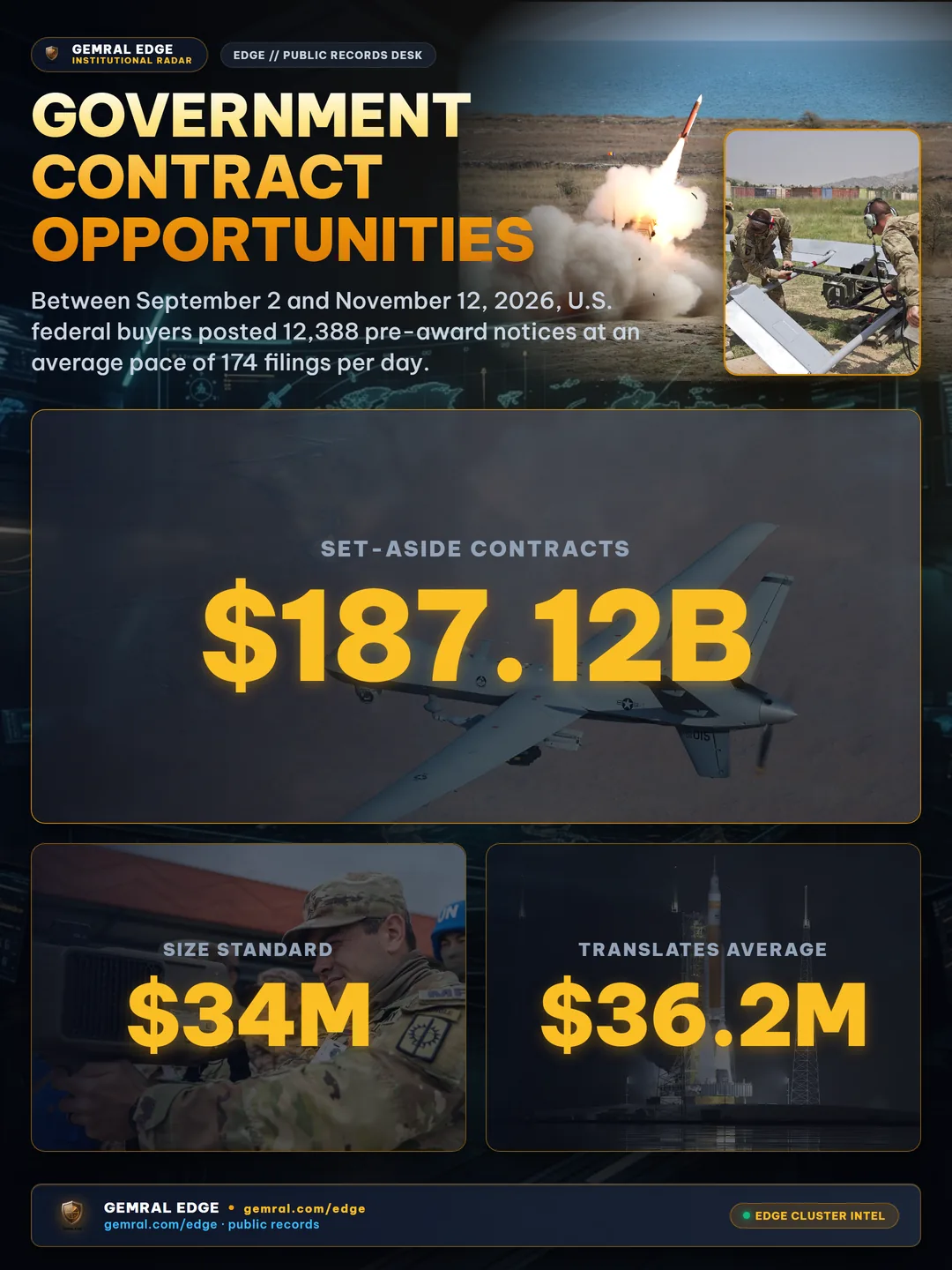
Between September 2 and November 12, 2026, U.S. federal buyers posted 12,388 pre-award notices at an average pace of 174 filings per day. Just five agencies generated 70.8% of the entire pipeline, and 80.7% of notices carried no small-business set-aside.
12,388 government contract opportunities in 71 days: where the pipeline concentrates
Most market observers only see federal spending after the award is signed and the obligation hits the federal contract awards tracker. By then, the solicitation cycle has already run for weeks or months. Tracking pre-award government contract opportunities captures the demand signal while agencies are still defining requirements, polling industry capabilities, and announcing sole-source intentions.
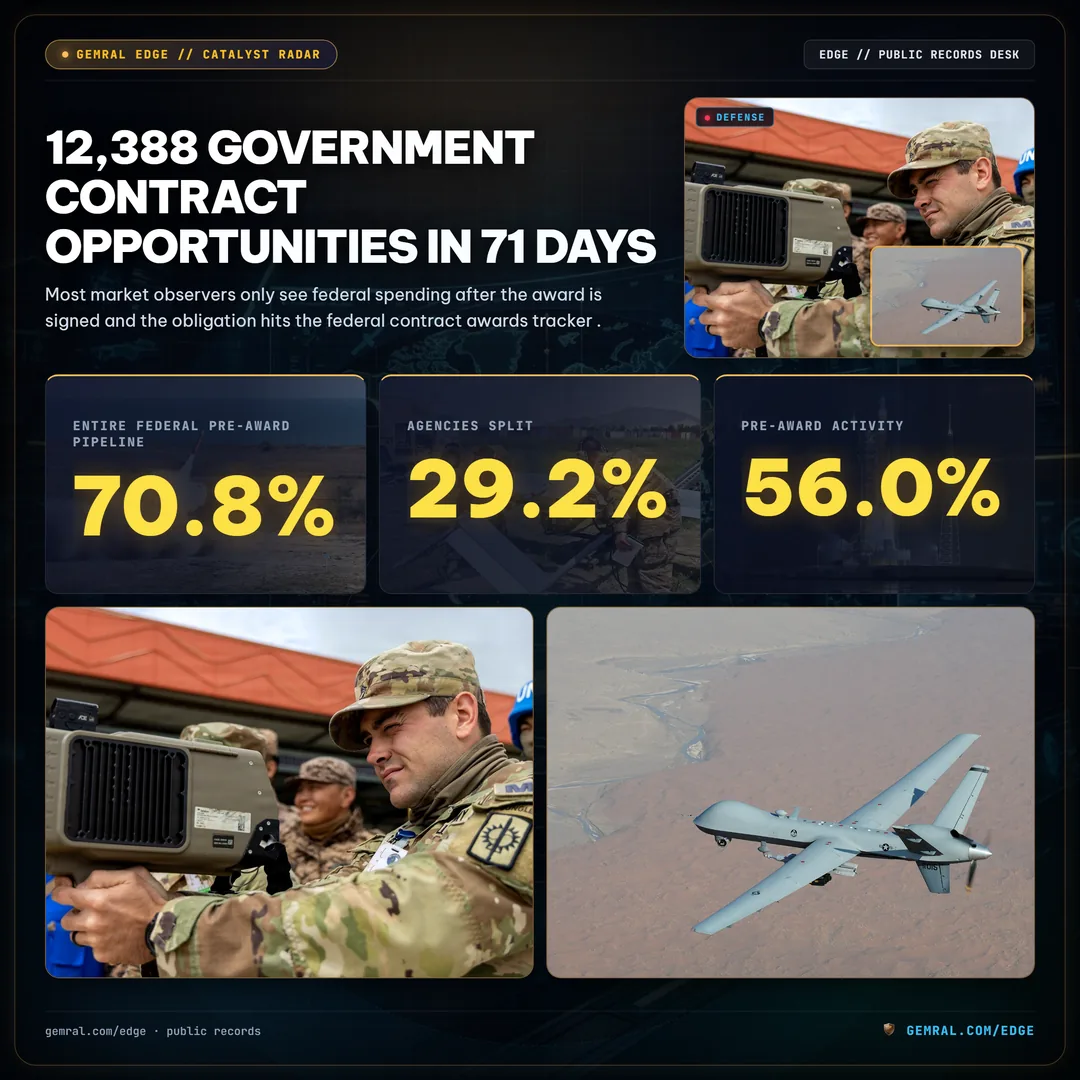
Across 71 calendar days from September 2 through November 12, 2026, federal contracting offices published 12,388 pre-award notices spanning 162 distinct agencies. That works out to 174 notices every day, including weekends. Yet the distribution is heavily skewed: the five most active buyers posted 8,776 notices, or 70.8% of the entire federal pre-award pipeline, leaving the remaining 157 agencies to split 29.2%.
Defense commands dominate the top of the table. Four Department of Defense components alone—the Navy, Army, Defense Logistics Agency, and Air Force—accounted for 6,943 notices, or 56.0% of all pre-award activity. The Department of Veterans Affairs was the only civilian buyer inside the top five, ranking third overall with 1,833 filings (14.8%). Outside the top five, NASA posted 340 notices (2.7%), the National Institutes of Health posted 221 (1.8%), the Public Buildings Service posted 204 (1.6%), the U.S. Coast Guard posted 177 (1.4%), and the State Department posted 156 (1.3%).
| Agency / Component | Pre-Award Notices | Share of 12,388 |
|---|---|---|
| Department of the Navy | 2,304 | 18.6% |
| Department of the Army | 1,939 | 15.7% |
| Department of Veterans Affairs | 1,833 | 14.8% |
| Defense Logistics Agency | 1,505 | 12.1% |
| Department of the Air Force | 1,195 | 9.6% |
| NASA | 340 | 2.7% |
| National Institutes of Health | 221 | 1.8% |
| GSA Public Buildings Service | 204 | 1.6% |
| U.S. Coast Guard | 177 | 1.4% |
| Department of State | 156 | 1.3% |
Direct answer: Between September 2 and November 12, 2026, U.S. agencies posted 12,388 pre-award government contract opportunities across 162 buyers, with 70.8% concentrated in the Navy, Army, Veterans Affairs, Defense Logistics Agency, and Air Force.
How to find government contract opportunities across RFIs, presolicitations, and special notices
Every pre-award filing sits in one of three operational stages before a formal Request for Proposal (RFP) is awarded. Separating those three buckets is essential for anyone scanning federal procurement pipelines, because each notice type signals a different level of commitment and competition.
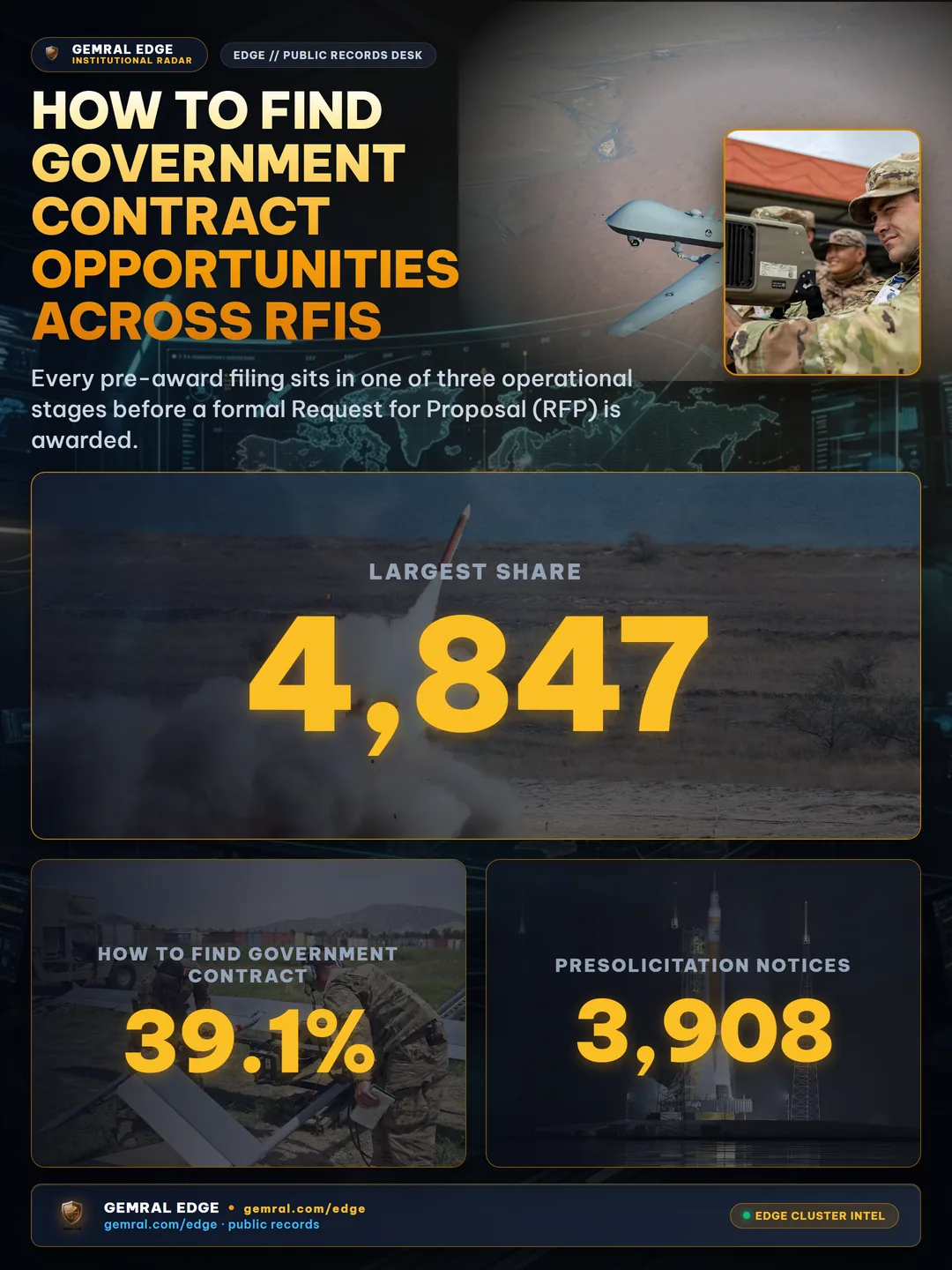
First, Sources Sought notices and Requests for Information (RFIs) represent the largest share at 4,847 filings, or 39.1% of the 71-day total. Agencies issue RFIs during market research to test whether qualified vendors exist before locking in a contracting strategy or deciding whether to reserve the work for small businesses. Responding at this stage shapes the final technical requirements.
Second, Presolicitation notices accounted for 3,908 filings, or 31.5% of the sample. Under Federal Acquisition Regulation (FAR) Part 5, contracting officers publish presolicitation synopses to alert industry that a formal solicitation is imminent. For corporate capture teams and institutional analysts, presolicitations mark the transition from exploratory budgeting to an active procurement calendar.
Third, Special Notices made up 3,633 filings, or 29.3% of the total. Special Notices include industry days, draft solicitation briefings, and Notices of Intent to Award Sole Source. For example, on November 12, 2026, the Air Force Research Laboratory Systems Technology Office posted a special notice under NAICS code 541519 ($34M size standard) announcing its intent to issue a 12-month, 365-day firm-fixed-price renewal to Altair for HyperWorks software on or about November 19, 2026, giving other vendors 5 days to submit capability statements. On the same day, the Defense Health Agency published an update to its seventh-generation TRICARE Dental Program (TDP-7) industry one-on-one Q&A under NAICS 524114.
A practical workflow monitors all three tracks by NAICS industry code, agency hierarchy, and response deadline rather than waiting for signed contract awards. Filtering by notice type prevents analysts from mistaking an early RFI market check for an immediate revenue event.
80.7% unrestricted vs 13.0% small business: who actually competes for these notices
A persistent misconception about federal contract opportunities is that most pre-award notices are locked behind small-business set-asides. The 71-day filing record shows the opposite. Out of 12,388 notices, 9,995 (80.7%) carried no set-aside restriction—split between 6,452 filings with no set-aside code listed and 3,543 explicitly marked as no set-aside used.
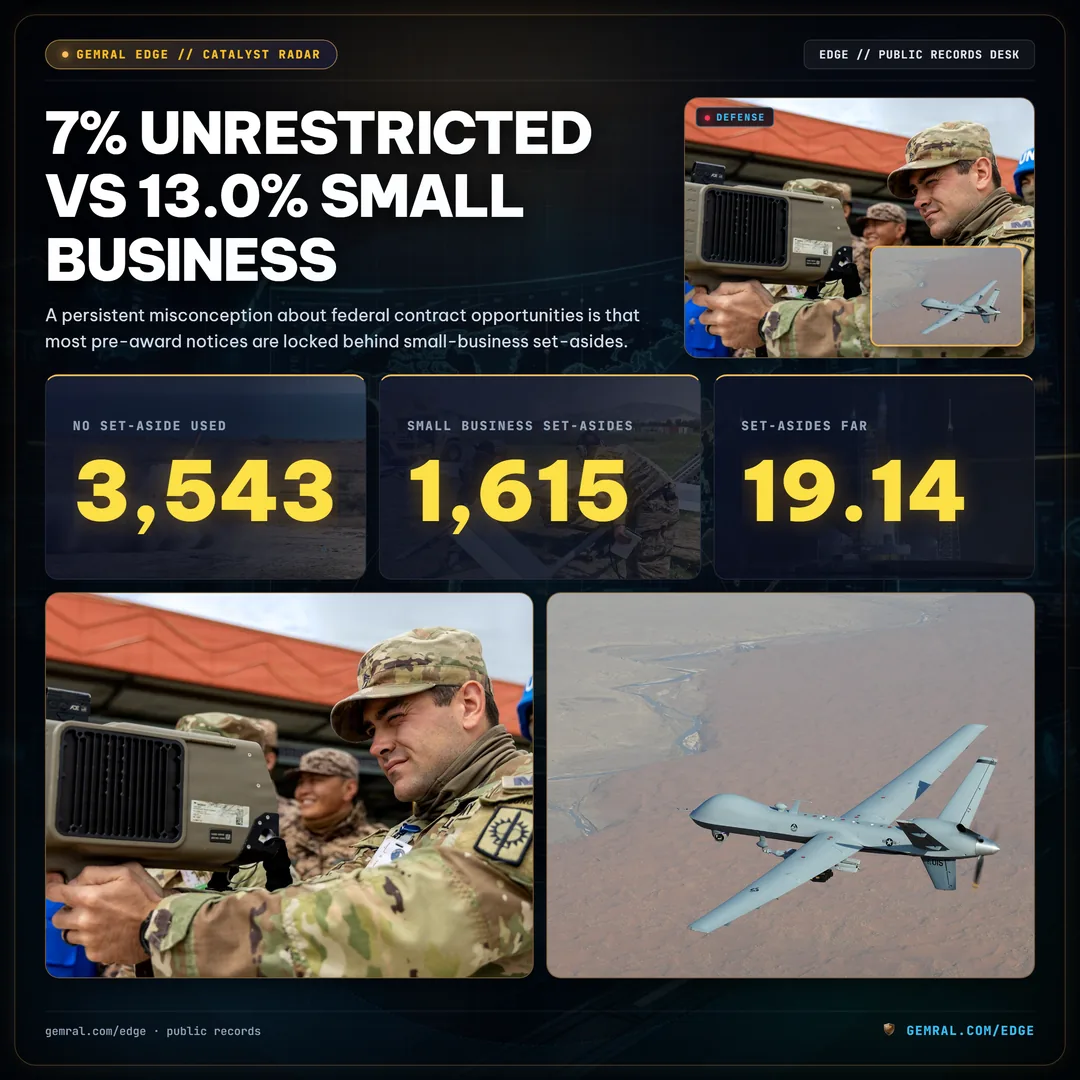
The remaining 19.3% of the pipeline is divided across targeted socioeconomic programs mandated under FAR Part 19. Total Small Business Set-Asides accounted for 1,615 notices, or 13.0% of the sample. Service-Disabled Veteran-Owned Small Business (SDVOSB) Set-Asides under FAR 19.14 represented 438 notices (3.5%), driven heavily by Veterans Affairs medical and facility procurement.
Smaller targeted tracks include 82 competitive 8(a) Set-Asides (0.7%) and 69 8(a) Sole Source actions (0.6%) under FAR 19.8, totaling 151 notices (1.2%). Partial Small Business Set-Asides accounted for 36 filings (0.3%), and SBA Certified Women-Owned Small Business (WOSB) Set-Asides under FAR 19.15 accounted for 33 filings (0.3%).
For public-market investors and institutional research desks, unrestricted notices and sole-source special notices are where listed prime contractors and specialized software suppliers appear first. Across the 12,388 pre-award notices in this window, 288 filings (2.3%) already resolve directly to 68 publicly traded equity tickers—often through named sole-source renewals, incumbent system upgrades, or multi-year program recompetes long before a dollar is obligated.
From pre-award notice to $187.12B in obligated contracts: why timing matters
Pre-award filings are an upstream lead indicator for obligated spending, not a substitute for it. Over roughly the same period—from September 1 through November 12, 2026—federal agencies logged 5,170 awarded contract actions totaling $187.12B in obligated funds. That translates to an average of $36.2M per action, though single mega-awards frequently skew weekly totals.
Connecting the 12,388 pre-award notices to the 5,170 obligated awards solves a recurring timing problem in procurement analysis. An RFI or presolicitation notice does not guarantee that funds will be obligated in the current quarter, nor does it disclose the final contract ceiling. What it does provide is an exact, timestamped record of agency demand, technical scope, and competition rules weeks or months before the signed award hits public ledgers.
When a notice carries a named incumbent or sole-source justification, analysts can verify the historical relationship against past contract awards and lobbying disclosures while keeping publication dates strictly separated. Applying point-in-time discipline—logging both the agency's posted date and the ingestion timestamp—ensures that backtests never treat an early solicitation as a post-award revenue certainty.
Where to look next
To inspect live obligated awards by listed defense and technology contractors, open the federal contract awards tracker. For a breakdown of how single mega-awards skew weekly defense totals, read Pentagon contract awards: one award was 37% of the dollars. For procurement software benchmarks and open-data alternatives, see our GovWin pricing guide, and for how we separate notice dates from ingestion timestamps, read look-ahead bias in public records. Institutional research teams evaluating point-in-time solicitation and contract feeds can request access via the institutional data preview.
Public data · not investment advice. Gemral Edge story: gemral.com/edge/s/government-contract-opportunities.
Frequently asked questions
What are the main types of pre-award government contract opportunities?
Across 12,388 federal pre-award notices tracked from September 2 to November 12, 2026, 4,847 (39.1%) were Sources Sought or Requests for Information, 3,908 (31.5%) were presolicitation notices, and 3,633 (29.3%) were special notices such as sole-source intent filings.
Which federal agencies post the most contract opportunities?
Five agencies generated 8,776 of the 12,388 notices (70.8%): the Department of the Navy (2,304), Department of the Army (1,939), Department of Veterans Affairs (1,833), Defense Logistics Agency (1,505), and Department of the Air Force (1,195).
How many government contract opportunities are reserved for small businesses?
In the 71-day sample, 1,615 notices (13.0%) were total small-business set-asides, 438 (3.5%) were SDVOSB set-asides, and 151 (1.2%) were 8(a) set-asides or sole-source awards, while 9,995 notices (80.7%) had no set-aside restriction.