GovWin Pricing Guide: Deltek Costs and Open Data Alternatives
An empirical evaluation of Deltek GovWin IQ subscription tiers, per-seat licensing expense models, proprietary pre-RFP pipeline intelligence, and institutional open data strategies across federal and defense procurement.

In the federal contracting ecosystem, evaluating govwin pricing and procurement intelligence software is a critical capital decision for emerging suppliers, mid-tier defense specialists, and institutional quantitative research desks. Each fiscal year, the United States federal government obligates over $750B across civilian agency procurements, defense hardware acquisitions, and commercial information technology task orders. For decades, Deltek GovWin IQ has operated as the legacy commercial benchmark for tracking government solicitations, pre-award pipeline forecasts, and competitor incumbent award capture ratios.
However, with baseline annual seat licenses frequently demanding between $5,000 and $18,000+ per user, government contracting firms (GovCon) and institutional market analysts face substantial cost friction. Navigating complex multi-year contract renewals, opaque pricing structures, and locked geographic modules has driven a broader market transition toward automated public data pipelines. Modern market participants increasingly integrate raw federal feeds into dedicated research architectures via our federal procurement intelligence platform to monitor multi-agency spending without paying recurring enterprise software surcharges.
How Deltek GovWin IQ Dominates Federal Procurement Intelligence
Understanding the value proposition behind GovWin requires analyzing how Deltek structures its procurement data assets. While official public databases record contract actions after formal obligation, GovWin deploys dedicated analyst networks to identify opportunities 18 to 36 months before a formal Request for Proposals (RFP) is published. In the federal market, where over 65% of prime awards are effectively shaped during pre-solicitation discussions, early intelligence provides decisive strategic capture advantage.

The platform organizes federal market intelligence across several core dimensions:
- Pre-RFP Opportunity Tracking: GovWin tracks early-stage agency budget justifications, draft solicitations, and industry day notices across more than 80 federal departments and executive agencies. Analysts conduct direct outreach to agency procurement officers, assigning estimated award timelines, expected total contract values, and anticipated acquisition vehicles (such as OASIS+, Alliant 3, or CIO-SP4).
- Incumbent Contract Profiling: For contracts approaching recompete windows, GovWin profiles the current prime awardee, historical Task Order spending burn rates, and initial versus realized contract values. Contractors utilize this data to identify recompete vulnerabilities where incumbents suffer performance demerits or cost overruns.
- Agency Budget and Organization Charts: The platform cross-references Congressional appropriations with executive branch program offices, identifying key Contracting Officers (COs) and Program Managers (PMs) across multi-billion-dollar discretionary spending pools.
For prime contractors competing for multi-hundred-million-dollar defense programs, access to this intelligence often justifies six-figure enterprise IT investments. However, for specialized subcontractors, boutique consulting teams, and quantitative equity analysts tracking corporate contract backlogs, the structural cost model of GovWin introduces severe capital inefficiencies.
GovWin Pricing Tiers and Annual Licensing Breakdown
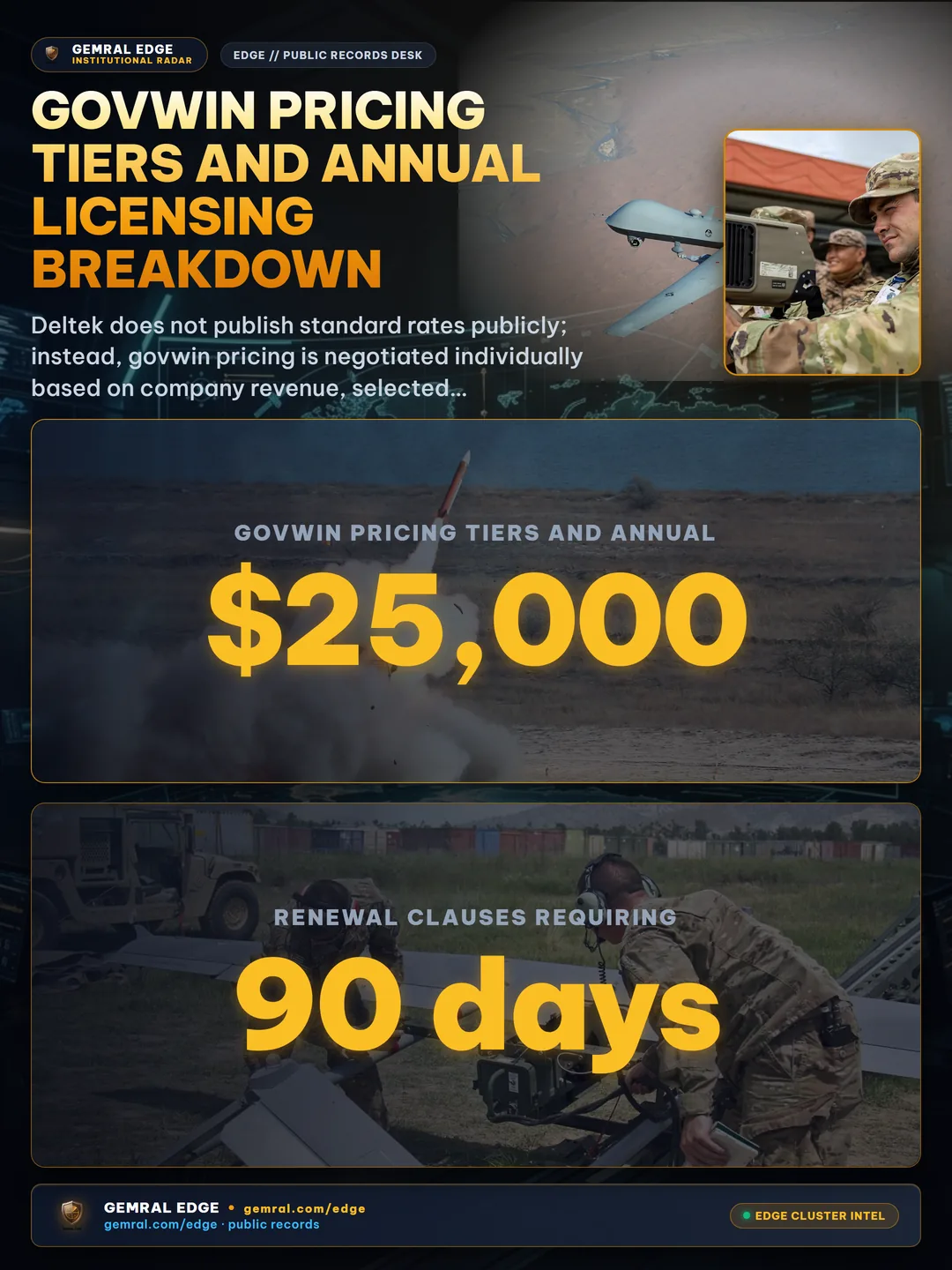
Deltek does not publish standard rates publicly; instead, govwin pricing is negotiated individually based on company revenue, selected jurisdictional databases, and the total count of named user seats. Based on market procurement audits, industry survey benchmarks, and contractor disclosures, the prevailing annual pricing tiers reflect the following capital commitments:
- Entry-Level Single-Seat Access ($5,000 – $8,000/year): Typically limited to a single user license with basic federal opportunity search. These packages frequently restrict access to high-value intelligence assets, omitting detailed program organization charts, labor rate databases, or state and local procurement files.
- Standard Federal Core Package ($9,500 – $13,500/year): Provides access to federal civilian and defense agency opportunities, historical award archives, and standard teaming partner directories for 2 to 3 concurrent user seats. Additional seats require steep incremental add-on charges.
- Comprehensive Enterprise & SLED Suites ($15,000 – $25,000+/year): Designed for prime defense integrators requiring comprehensive coverage across all 50 state governments, local municipalities, higher education (SLED), and Canadian procurement. Includes advanced labor rate benchmarking, federal organizational charts, and executive contact directories.
Beyond the baseline subscription fee, contractors frequently encounter hidden friction points. Contracts typically mandate strict 12-month or multi-year lock-in terms with automated renewal clauses requiring 60 to 90 days advance written cancellation notice. Furthermore, rigid per-seat licensing models prevent research teams from distributing raw data feeds programmatically across internal CRM systems, business intelligence dashboards, or algorithmic trading pipelines.
Deltek GovWin vs Free Open Federal Data: Public Award Registries and Spending Ledgers
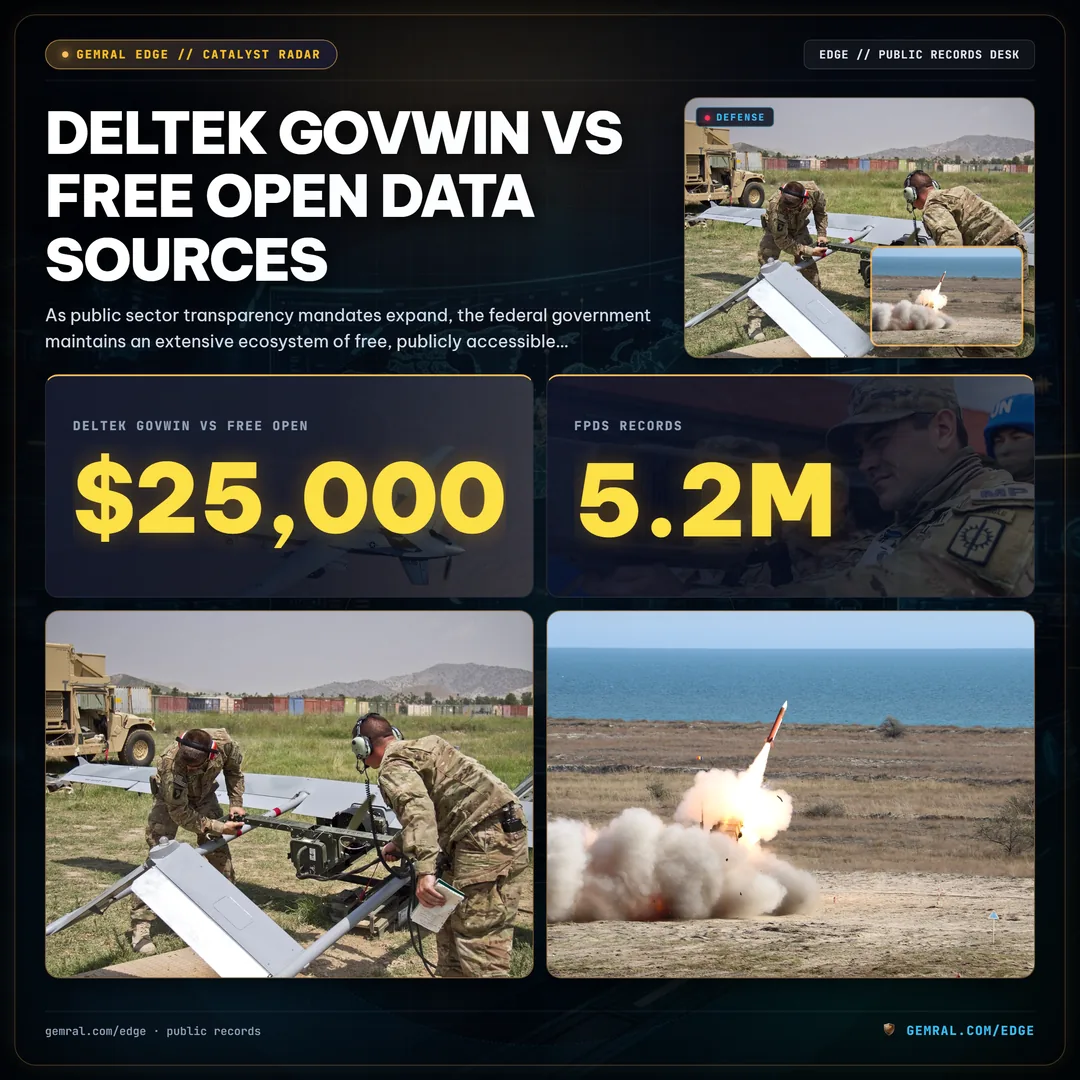
As public sector transparency mandates expand, the federal government maintains an extensive ecosystem of free, publicly accessible procurement repositories. By understanding the structural architecture of official reporting databases, contractors can duplicate substantial portions of proprietary intelligence without recurring subscription overhead:
- Federal Solicitations Directory (Public Awards Registry): The authoritative statutory portal where federal agencies are legally mandated to publish all active solicitations, pre-solicitation notices, Sources Sought announcements, and Requests for Information (RFIs) exceeding $25,000. While the public system lacks proprietary analyst commentary, its native public search engine and automated email alert system provide primary source solicitation documents directly from Contracting Officers. For an operational walkthrough of navigating live agency solicitations, consult our comprehensive guide to federal contract opportunities.
- Federal Procurement Data System - Next Generation (FPDS-NG): The definitive public ledger for federal contract actions. FPDS records over 5.2M contract modifications, base awards, delivery orders, and de-obligations each fiscal year, capturing precise NAICS codes, Product Service Codes (PSCs), primary place of performance, and competitive bidding status.
- Federal Outlays and Budgetary Repository (DATA Act System): Operating under federal transparency mandates, official public spending databases link Congressional budgetary appropriations directly to prime contract outlays and sub-award transactions. Programmatic REST endpoints enable researchers to track prime-to-subcontractor capital flows and federal grant distributions.
The primary operational tradeoff between proprietary platforms and public repositories centers on data curation versus raw access. GovWin delivers curated opportunity timelines with analyst estimates, whereas public sources provide legally binding, uncurated transactional truths. For market research desks tracking corporate revenue exposure across major publicly traded defense suppliers, analyzing historical award concentration via our breakdown of the top defense contractors by revenue illustrates how raw obligation data reveals definitive market share trends.
How Institutional Contractors Build Multi-Agency Procurement Pipelines
Rather than relying exclusively on costly legacy software licenses or navigating fragmented government websites manually, modern quantitative firms and agile contractors construct proprietary procurement intelligence pipelines. By combining open public APIs with institutional data platforms, organizations establish programmatic monitoring architectures that track opportunity lifecycles from early budget requests to final contract closeout.
A systematic procurement pipeline incorporates three distinct operational layers:
- Layer 1: Automated Ingestion of Agency Forecasts: Federal departments publish annual procurement forecasts detailing upcoming requirements, planned acquisition strategies, and Small Business set-aside allocations (such as 8(a), HUBZone, and SDVOSB programs designed to fulfill the federal 23% small business utilization mandate). Scripts ingest these forecast spreadsheets directly, indexing opportunities by agency code and anticipated solicitation quarter.
- Layer 2: Real-Time Solicitation Webhooks: Programmatic ingestion pipelines poll public solicitation feeds to capture newly posted Sources Sought and Presolicitation notices within 15 minutes of release. Automated keyword matching filters opportunities by specialized technical criteria, such as autonomous systems, cyber defense zero-trust mandates, or cloud compute infrastructure.
- Layer 3: Incumbent Expiration and Subaward Mapping: Using nightly transaction dumps, quantitative models identify major multi-year Indefinite Delivery/Indefinite Quantity (IDIQ) contracts and Blanket Purchase Agreements (BPAs) entering their final 12 months. Cross-referencing prime awardee historical capture rates reveals potential teaming and sub-contracting opportunities long before formal recompete notices appear on public boards.
Institutional researchers seeking to audit historical defense obligations, identify corporate contract catalysts, and integrate normalized federal data feeds can explore our institutional data preview or review extensive coverage metrics across our alternative datasets.
The platform standardizes official public records into structured intelligence across accessible subscription tiers: the Pro Tier ($39/month) for individual GovCon executives tracking targeted agency pipelines, the B2B Intelligence Tier ($299/month) for growing government contracting teams requiring multi-user access to normalized award records, and the Institutional API Tier ($2,000/month) for quantitative investment funds, research desks, and corporate development groups integrating automated federal contract telemetry directly into proprietary analytical systems.
Frequently asked questions
What is the typical GovWin pricing range for federal contractors?
GovWin IQ subscription costs generally start around $5,000 to $8,000 annually for a single-seat entry-level package, scaling to between $12,000 and $18,000+ per year for comprehensive federal, defense, and state procurement coverage with advanced teaming intelligence.
What modules determine Deltek GovWin pricing tiers?
GovWin pricing is tiered based on jurisdictional scope (U.S. Federal Government, SLED, or Canadian public sector), agency depth (DoD, Civilian, Intelligence Community), and functional add-ons such as organizational charts, labor rate benchmarking, and competitor market share analysis.
What are the best free alternatives to Deltek GovWin IQ?
Primary free alternatives include SAM.gov (the official federal contract opportunities repository), the Federal Procurement Data System (FPDS) for historical award data, and USASpending.gov for multi-agency budgetary obligations and prime-to-subaward transaction data.
How can contractors track federal procurement opportunities without high GovWin costs?
Contractors and quantitative analysts combine automated SAM.gov API webhooks, FPDS nightly contract archives, and institutional telemetry platforms like Gemral Edge to monitor prime awards, teaming partner networks, and agency spending cycles with zero per-seat friction.