Congressional Stock Trading: Tracker Data, Disclosure Lags, and the ETHICS Act Ban
An empirical analysis of Capitol Hill capital allocation, evaluating disclosure requirements under the STOCK Act, structural reporting delays, proposed divestment bans under the ETHICS Act, and multi-member committee cluster trade dynamics.
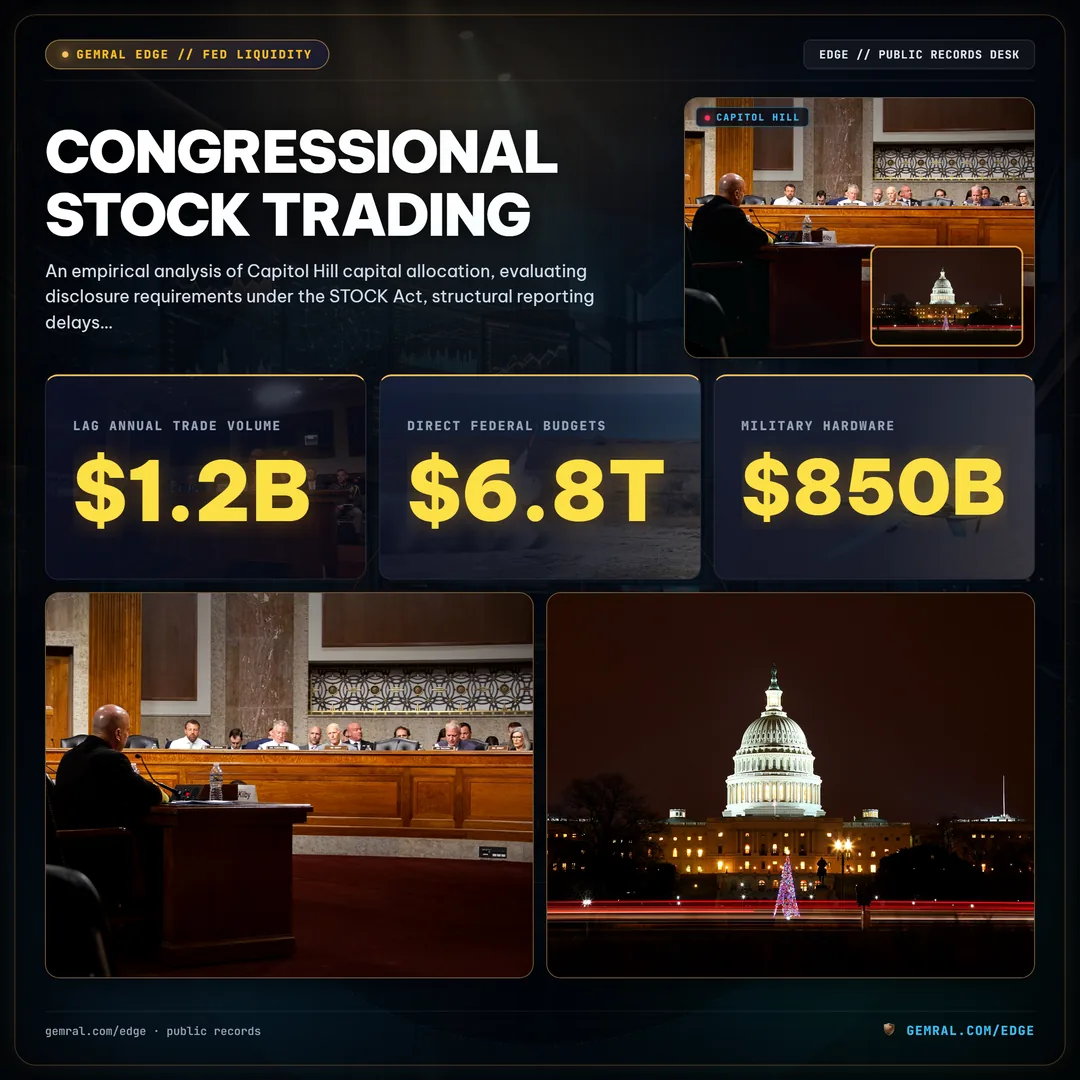
In institutional capital markets, congressional stock trading represents one of the most scrutinized intersections between federal legislative authority and private wealth accumulation. The 535 voting members of the United States Congress—comprising 100 Senators and 435 Representatives—direct federal budgets exceeding $6.8T, draft industrial policy subsidies, approve defense authorizations, and conduct regulatory oversight across public corporations. Simultaneously, lawmakers maintain the legal right to purchase, sell, and hold individual common equities, debt securities, and derivative contracts.
Over the past legislative sessions, cumulative annual transaction volume reported across Capitol Hill has consistently surpassed $1.2B. For quantitative researchers and systematic market analysts, tracking these transactions is not merely a matter of political transparency; it provides empirical visibility into legislative incentives, committee jurisdictional priorities, and corporate sector allocations. Rather than relying on sporadic media coverage, institutional desks continuously monitor structured filings via our congressional stock trading tracker to transform raw legislative disclosures into actionable intelligence.
How Congressional Stock Trading Operates Under the STOCK Act
The legal architecture governing Capitol Hill transactions is rooted in the Stop Trading on Congressional Knowledge (STOCK) Act of 2012 (Public Law 112-105). Enacted to address persistent public concerns regarding insider access, the legislation affirmed that members of Congress, congressional staffers, and judicial officers are not exempt from federal insider trading prohibitions under the Securities Exchange Act of 1934.
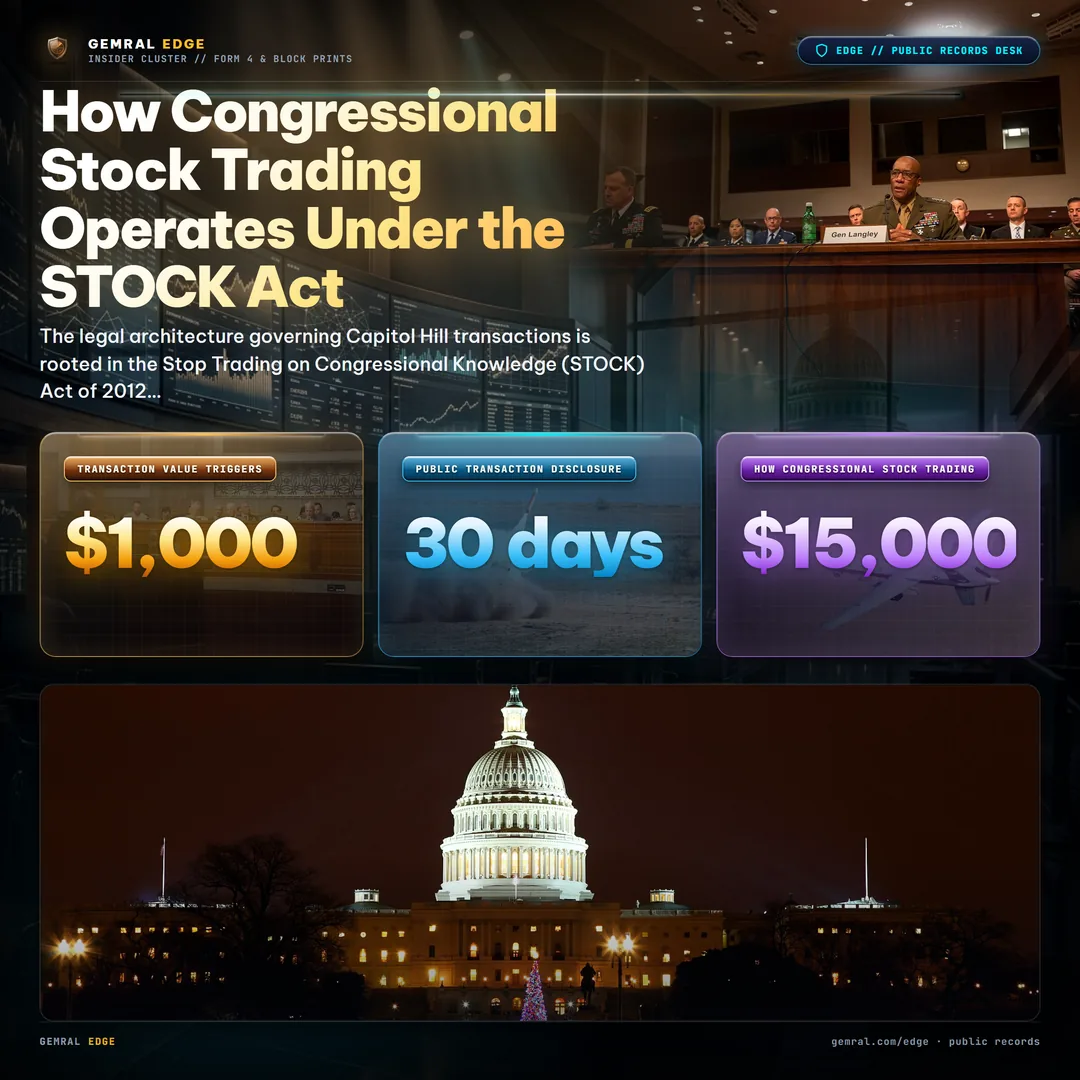
Under the operational provisions of the STOCK Act, lawmakers must adhere to specific compliance criteria whenever they, their spouses, or their dependent children engage in financial transactions:
- Mandatory Disclosure Threshold: Any acquisition, sale, or exchange of common equities, corporate bonds, commodity futures, or exchange-traded derivatives exceeding $1,000 in transaction value triggers a statutory reporting requirement. Broad-based index mutual funds and diversified exchange-traded funds (ETFs) are generally exempt from periodic reporting, focusing regulatory scrutiny squarely on single-company securities.
- Dual-Deadline Notification Protocol: Lawmakers must submit a public transaction disclosure within 30 days of receiving official notice or monthly trade confirmation from their custodial broker, and in no event later than 45 calendar days after the execution date of the trade.
- Statutory Reporting Brackets: Unlike corporate executive filings that record exact share counts and execution prices down to the cent, congressional disclosures are submitted within predefined statutory dollar ranges: $1,001–$15,000, $15,001–$50,000, $50,001–$100,000, $100,001–$250,000, $250,001–$500,000, $500,001–$1,000,000, and larger intervals extending beyond $5,000,000.
- Compliance Penalties: Historically, failure to submit timely disclosures has carried a nominal $200 administrative penalty fee, which can be waived by chamber ethics officials upon administrative review. Critics have long argued that this negligible fine creates insufficient deterrence against chronic reporting delays.
While the STOCK Act formalized periodic disclosures, it left intact the fundamental ability of elected officials to trade shares in individual corporations—even those directly impacted by bills pending before their assigned congressional committees.
The STOCK Act vs. The ETHICS Act: Tracking Proposed Trading Bans and Legislative Timelines
The structural limitations of the 2012 framework have sparked sustained bipartisan pressure to overhaul Capitol Hill ethics rules. The most prominent reform proposal is the Ending Trading and Holdings in Congressional Stocks (ETHICS) Act. Introduced with cross-party sponsorship across both chambers, the ETHICS Act represents a structural shift from post-trade disclosure to outright asset divestment.

| Legislative Dimension | Current Framework (STOCK Act 2012) | Proposed Reform (ETHICS Act) |
|---|---|---|
| Permitted Holdings | Individual equities, corporate bonds, commodities, sector derivatives | Divestment required; only diversified mutual funds, ETFs, & Treasury debt permitted |
| Trust Mechanisms | Optional qualified blind trusts; rarely utilized due to high setup fees | Mandatory certified qualified blind trusts for pre-existing individual assets |
| Family Coverage | Member, legal spouse, and dependent children | Member, legal spouse, and dependent children with enhanced enforcement |
| Late Filing Penalty | Standard $200 fine; frequently waived by ethics committees | Steep fines equal to monthly congressional salary or 10% of trade value (up to $50,000) |
| Transition Window | Immediate periodic reporting upon taking oath of office | Structured 90-to-180 day divestiture window following legislative enactment |
The legislative momentum behind the ETHICS Act centers on eliminating the inherent conflict between public duty and private capital. While earlier proposals languished in procedural subcommittees, committee markups and floor discharge petitions have kept the divestment mandate active in public debate. For quantitative desks, tracking legislative calendars and markup votes provides critical forward-looking context regarding whether congressional disclosures will remain a continuous data feed or transition into historical divestiture archives.
Analyzing the Disclosure Gap: Why 45-Day Reporting Lags Shape Public Signal Interpretation
A common misconception in retail trading circles is that congressional disclosures can be mirrored in real time for short-term trading momentum. In practice, the structural reporting lag embedded in federal statutes creates a substantial temporal buffer between trade execution and public visibility.
The statutory framework permits up to 45 calendar days from trade execution to formal public document filing. Empirical audits across multi-year congressional datasets reveal the following operational realities:
- Median Disclosure Latency: Across historical filings, the median elapsed duration between order execution at the brokerage custodian and public clerk availability spans 28 to 34 days. Approximately 12% of filings are submitted on days 44 or 45, right at the statutory ceiling.
- Information Diffusion and Market Absorption: By the time a transaction appears on official disclosure portals, corporate quarterly earnings reports, macro policy updates, and institutional trading flows have often already re-priced the underlying security. Attempting to execute intraday breakout trades based on month-old filings frequently incurs negative selection bias.
- Long-Horizon Accumulation Telemetry: Because individual trades arrive with a built-in lag, sophisticated research desks treat congressional data as structural capital positioning rather than tactical execution triggers. When lawmakers accumulate corporate positions over multiple quarters, the data reveals institutional commitment to multi-year policy themes, such as domestic semiconductor reshoring or aerospace defense modernization. For an in-depth review of specific equity acquisitions, see our empirical breakdown of what stocks did congress buy.
Consequently, institutional analysts do not evaluate raw filings in isolation. Instead, disclosures are systematically normalized and aggregated to identify multi-party accumulation patterns across distinct legislative subcommittees.
Committee Alignment and Cluster Trading: High-Volume Technology and Defense Disclosures
The primary predictive utility of congressional transaction data emerges at the intersection of legislative jurisdiction and multi-member cluster trading. Under congressional committee rules, seated members possess expansive powers to direct federal spending, authorize non-competitive defense contracts, and conduct sensitive closed-door oversight hearings.
When evaluating capital flows across Capitol Hill, quantitative researchers focus on two primary structural dimensions:
1. Committee Jurisdictional Purview: Lawmakers assigned to specific legislative committees frequently concentrate personal investments in corporate sectors overseen by their respective panels:
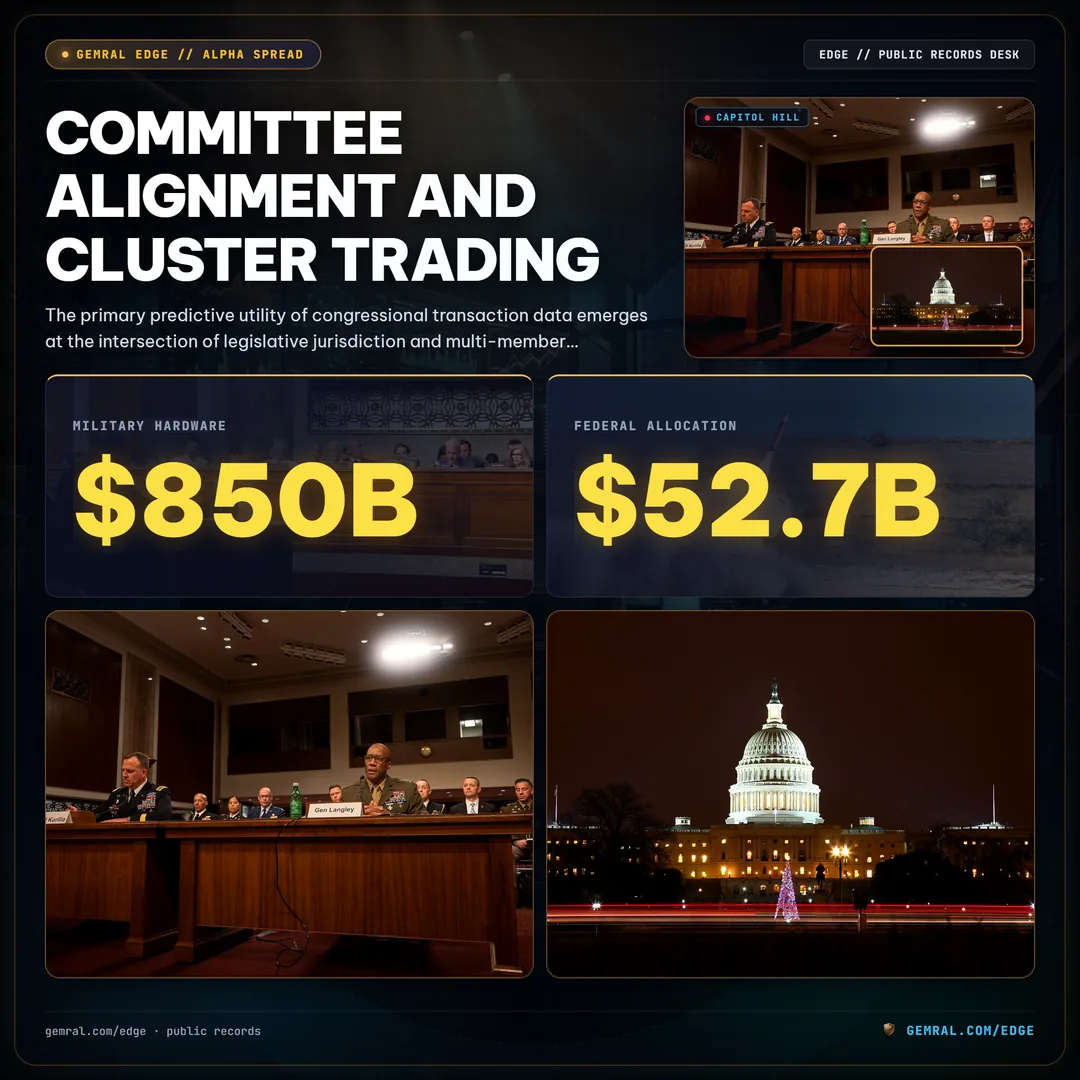
- Armed Services and Defense Appropriations: Seated members on the House Armed Services Committee (HASC) and Senate Armed Services Committee (SASC) participate directly in shaping the annual National Defense Authorization Act (NDAA), which allocates over $850B across military hardware, autonomous defense systems, and aerospace procurement. Disclosed personal equity accumulation in prime defense contractors and specialized communications suppliers by members of these committees frequently coincides with multi-year budget expansion authorizations.
- Energy, Commerce, and Technology Oversight: Committees directing energy grid policy, telecommunications standards, and microchip fabrication initiatives—such as the federal allocation of $52.7B under landmark domestic semiconductor funding—frequently feature high-volume transactions in high-performance computing hardware, cloud enterprise software, and optical networking infrastructure.
- Financial Services and Banking Panels: Lawmakers overseeing banking supervision, federal liquidity backstops, and capital requirements maintain concentrated allocations across major diversified financial institutions, payments technology providers, and regional commercial banks.
2. Multi-Member Cluster Accumulation: A transaction executed by a single representative may reflect personal liquidity management, inheritance planning, or independent wealth manager discretion. However, when three or more lawmakers across opposing political parties execute purchase transactions in the same underlying corporate ticker within a 30-day window, the transaction cluster provides empirical confirmation of cross-legislative alignment.
Systematic platforms isolate these cluster events by normalizing disparate document formats, matching ticker symbols, tracking member committee assignments, and calculating aggregate net buying volume across rolling 30-day, 60-day, and 90-day timeframes. For additional analysis on monitoring legislative disclosures and custodian reports, consult our guide on how to track congress stock trades. Desks seeking low-latency structured feeds can explore our institutional data preview or integrate comprehensive alternative data packages directly into proprietary quantitative models.
The Gemral Edge platform standardizes official public filings into structured, institutional-grade datasets across accessible subscription tiers: the Pro Tier ($39/month) for professional individual researchers tracking customizable lawmaker portfolios, the B2B Intelligence Tier ($299/month) for multi-analyst equity research teams, and the Institutional API Tier ($2,000/month) for algorithmic funds and quantitative desks requiring programmatic access to historical disclosures, committee taxonomies, and multi-asset corporate linkages.
Frequently asked questions
What is congressional stock trading?
Congressional stock trading is the practice of U.S. senators and representatives buying and selling public financial assets while holding federal legislative power, committee leadership roles, and regulatory oversight.
How does the STOCK Act regulate congressional stock trading?
The STOCK Act of 2012 explicitly prohibits lawmakers from using nonpublic legislative information for private profit and requires periodic transaction disclosures within 30 days of receiving brokerage trade notification and no later than 45 days after the trade execution date.
What is the proposed ETHICS Act and how does it affect lawmakers?
The Ending Trading and Holdings in Congressional Stocks (ETHICS) Act is bipartisan reform legislation designed to prohibit members of Congress, their spouses, and dependent children from owning or trading individual stocks, requiring divestiture or transition to diversified qualified blind trusts.
Why is the 45-day disclosure lag critical in congressional trade tracking?
The 45-day statutory filing lag means that congressional transaction reports function as delayed institutional accumulation records rather than immediate intraday signals, allowing quantitative desks to analyze multi-member cluster buying patterns across overlapping legislative committees.