Track Congress Stock Trades: Real-Time STOCK Act Disclosure Pipeline and Portfolio Tracking
An institutional analysis of congressional financial disclosure architecture, detailing statutory Periodic Transaction Report pipelines, committee jurisdiction overlaps, and quantitative latency modeling.
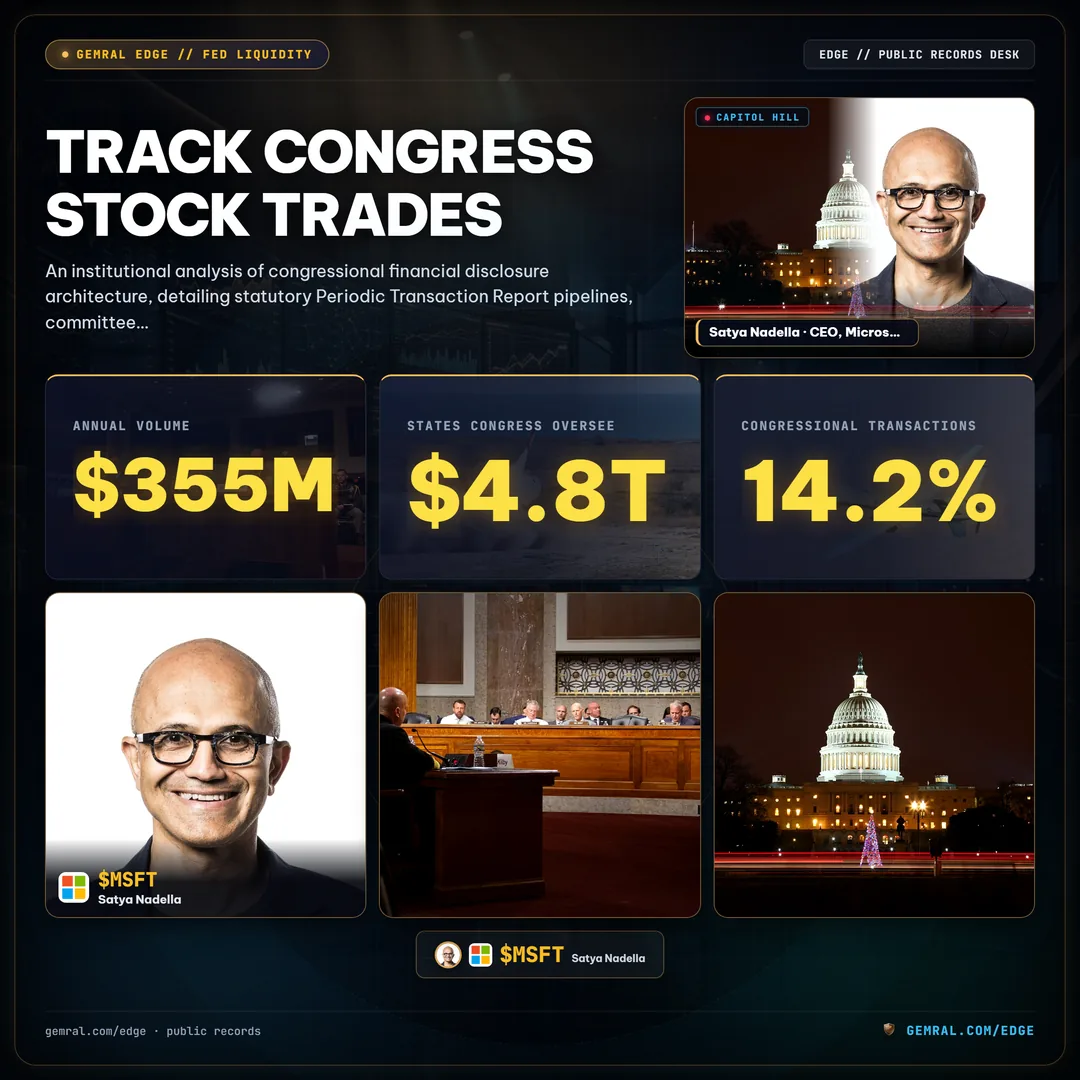
Across global equity markets, the ability to track congress stock trades with precision has transitioned from an informal retail curiosity into a disciplined quantitative domain. In any given legislative session, members of the United States Congress oversee more than $4.8 trillion in discretionary and mandatory federal budget allocations, craft corporate tax structures, and direct billions in national defense and energy procurement authorizations. Concurrently, dozens of senators and representatives maintain active personal brokerage portfolios, deploying millions of dollars into publicly traded equities and derivative contracts directly tied to industries under their active legislative jurisdiction.
Investors who systematically track congress stock trades utilizing dedicated data pipelines uncover capital allocation patterns across both chambers of Capitol Hill. Rather than relying on sporadic social media screenshots, institutional market observers monitor transaction telemetry directly through the Congressional Trading Intelligence Hub. Evaluating tool capabilities in our congress stock trades website analysis highlights the operational difference between delayed retail aggregators and low-latency statutory ingestion. Over $355 million in personal securities transactions are disclosed across Capitol Hill annually, spanning over 1,420 unique tickers. Understanding the statutory disclosure architecture, measuring historical reporting latency, and isolating cross-committee jurisdiction signals provides an objective framework for evaluating legislative capital flows.
The Regulatory Architecture: How the STOCK Act Governs Congressional Stock Disclosures
The statutory cornerstone of modern congressional transparency is the Stop Trading on Congressional Knowledge (STOCK) Act of 2012 (Public Law 112-105). Prior to its passage, members of Congress were only required to submit an annual financial disclosure statement once every calendar year. That legacy framework allowed trades executed in January to remain concealed from public view for up to sixteen months, completely severing any timely correlation between legislative votes and personal financial enrichment.

The STOCK Act fundamentally altered this regulatory framework by establishing the Periodic Transaction Report (PTR) requirement. Under current statutory rules codified in Title 5 of the United States Code:
- Awareness Notification Window: Lawmakers must submit a formal disclosure within 30 days of receiving notification of any securities transaction executed on their behalf.
- Absolute Statutory Backstop: Regardless of when notification is received from a financial broker or trustee, the filing must be completed no later than 45 days following the trade execution date.
- Transaction Value Threshold: The disclosure mandate applies to any purchase, sale, or exchange of common stock, corporate bonds, commodity futures, or options contracts exceeding an individual transaction value of $1,000.
- Covered Family Entities: The statutory reporting obligation explicitly extends to transactions conducted by a lawmaker's spouse and dependent children, capturing private holdings and joint family trusts.
While the statutory framework establishes clear disclosure thresholds, the enforcement mechanism remains notoriously porous. The statutory penalty for failing to file a Periodic Transaction Report within the mandatory 45-day window is a nominal fine of just $200. Furthermore, the House Committee on Ethics and the Senate Select Committee on Ethics retain statutory discretion to waive this penalty under loosely defined administrative circumstances, creating a persistent structural incentive for delayed reporting during volatile market windows.
Decoding Periodic Transaction Reports: Transaction Tiers, Asset Types, and Latency Windows
When quantitative researchers ingest raw congressional filings, they encounter specialized reporting conventions that diverge markedly from standard corporate executive insider disclosures. While corporate executives report the exact share count and precise execution price down to the cent, congressional disclosures report capital allocations in broad, non-linear categorical valuation bands:
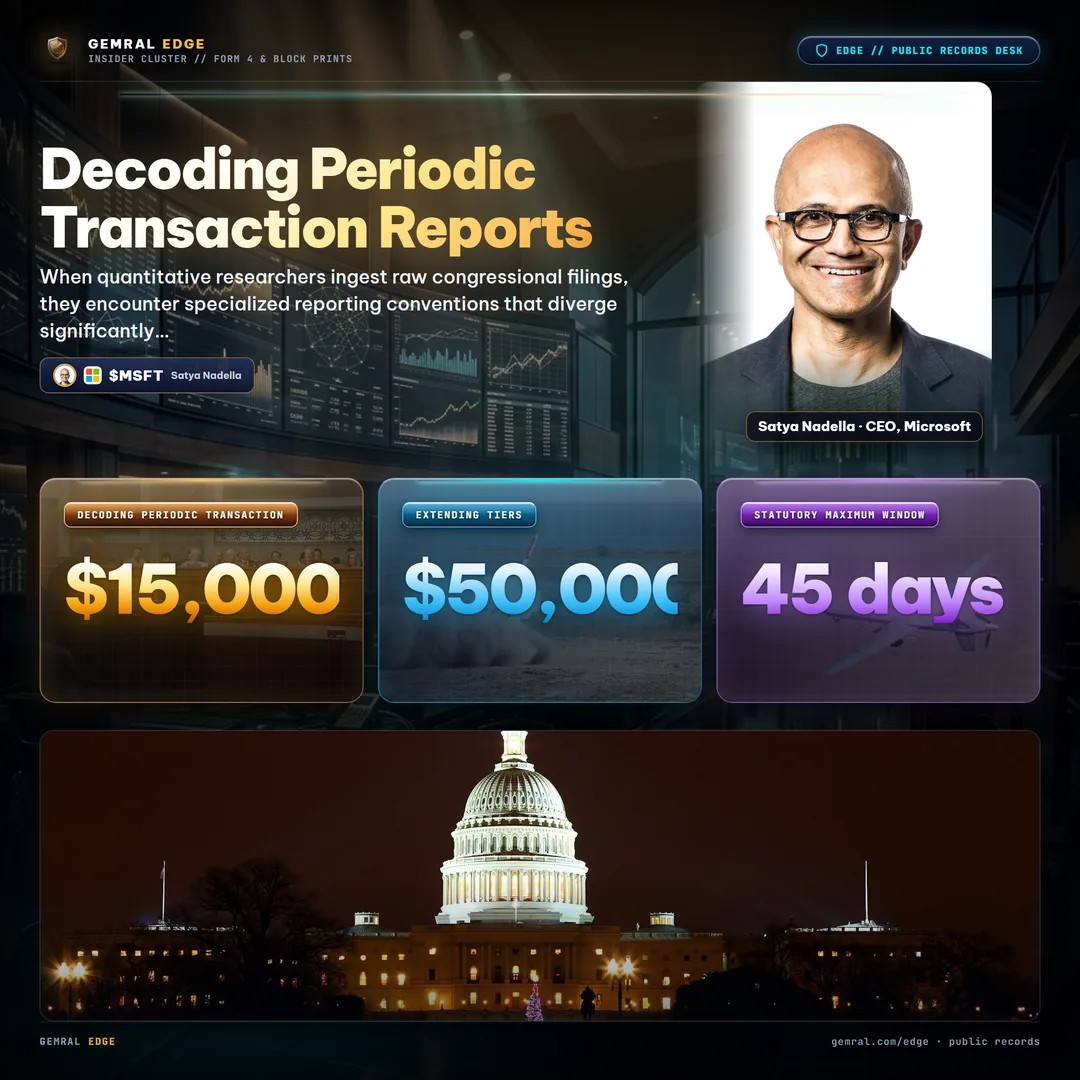
This bracketed reporting structure introduces mathematical variance into quantitative portfolio modeling. For example, a lawmaker disclosing a purchase of a major semiconductor manufacturer in the $100,001–$250,000 tier may have deployed $100,002 or $249,999. Sophisticated data pipelines normalize this categorical data by tracking both midpoint estimates ($175,000) and lower-bound conservative baselines across rolling quarterly periods.
Equally critical is the empirical reporting latency distribution. Although the statutory maximum window is 45 days, historical transaction analysis reveals measurable dispersion across 4 distinct latency tiers:
- Top-Decile Fast Filers (1 to 7 Days): Approximately 14.2% of congressional transactions are disclosed within one week of execution, typically reflecting automated reporting feeds established by institutional wealth managers.
- Median Operational Window (21 to 35 Days): Over 58.7% of all filings cluster between the third and fifth weeks post-execution, aligning with standard monthly brokerage statement cycles.
- Statutory Edge Filers (40 to 45 Days): Nearly 18.5% of disclosures are submitted in the final 72 hours before the statutory fine triggers, maximizing private informational advantages while remaining technically compliant.
- Delinquent Filers (46+ Days): Between 8.6% and 11.2% of disclosures breach statutory deadlines, occasionally arriving 90 to 240 days after execution, often accompanied by retrospective amendments.
Because of this temporal lag, congressional disclosures cannot be treated as real-time momentum triggers. Instead, they provide high-fidelity intelligence regarding institutional positioning, sector rotation, and medium-term regulatory risk posture.
Mapping Committee Jurisdiction to Traded Equities: The Conflict of Interest Signal
The true informational signal in congressional trading does not emerge from aggregate transaction volume alone, but rather from the intersection of personal trading activity and legislative committee jurisdiction. The congressional committee system concentrates immense legislative, budgetary, and investigatory authority within specialized subcommittees. When lawmakers trade securities operating directly within their regulatory purview, the informational asymmetry reaches its apex.
Consider the systemic operational overlaps across key congressional committees:
- Armed Services & Defense Appropriations: Members of the House and Senate Armed Services Committees receive classified briefings on foreign military threats, weapons modernization programs, and proprietary defense prototype competitions. When committee members accumulate shares of aerospace prime contractors, tactical communication providers, or defense electronics manufacturers ahead of National Defense Authorization Act (NDAA) markups, the legislative overlap is profound.
- Energy and Commerce & Science Committees: Lawmakers overseeing clean energy subsidies, semiconductor packaging initiatives, and power grid modernization routinely manage legislative language that distributes billions in federal grants and tax incentives.
- Finance & Banking Committees: Members of the Senate Committee on Banking, Housing, and Urban Affairs and the House Committee on Financial Services review monetary policy actions, financial institution stress tests, and private equity regulatory structures before legislative proposals are made public.
- Health, Education, Labor, and Pensions (HELP): Lawmakers evaluating clinical trial frameworks, drug pricing negotiations, and Medicare reimbursement formulas frequently manage personal capital allocations in biotechnology and pharmaceutical equities.
Systematic congressional tracking engines calculate an Oversight Relevance Coefficient for every disclosed transaction. If a representative on the Armed Services Committee executes a $250,000 purchase of a defense subcontractor three weeks before an unannounced multi-year contract award is authorized in committee markup, the signal carries dramatically higher institutional significance than an identical trade executed by an unaffiliated member.
Systematic Tracking Infrastructure: Ingesting and Normalizing Disclosures from Official Clerks
Building an enterprise-grade infrastructure to monitor congressional trades requires overcoming substantial public record fragmentation. There is no unified, API-driven government database that consolidates House and Senate financial filings into a clean JSON stream. Instead, disclosures are bifurcated across two separate administrative bodies:
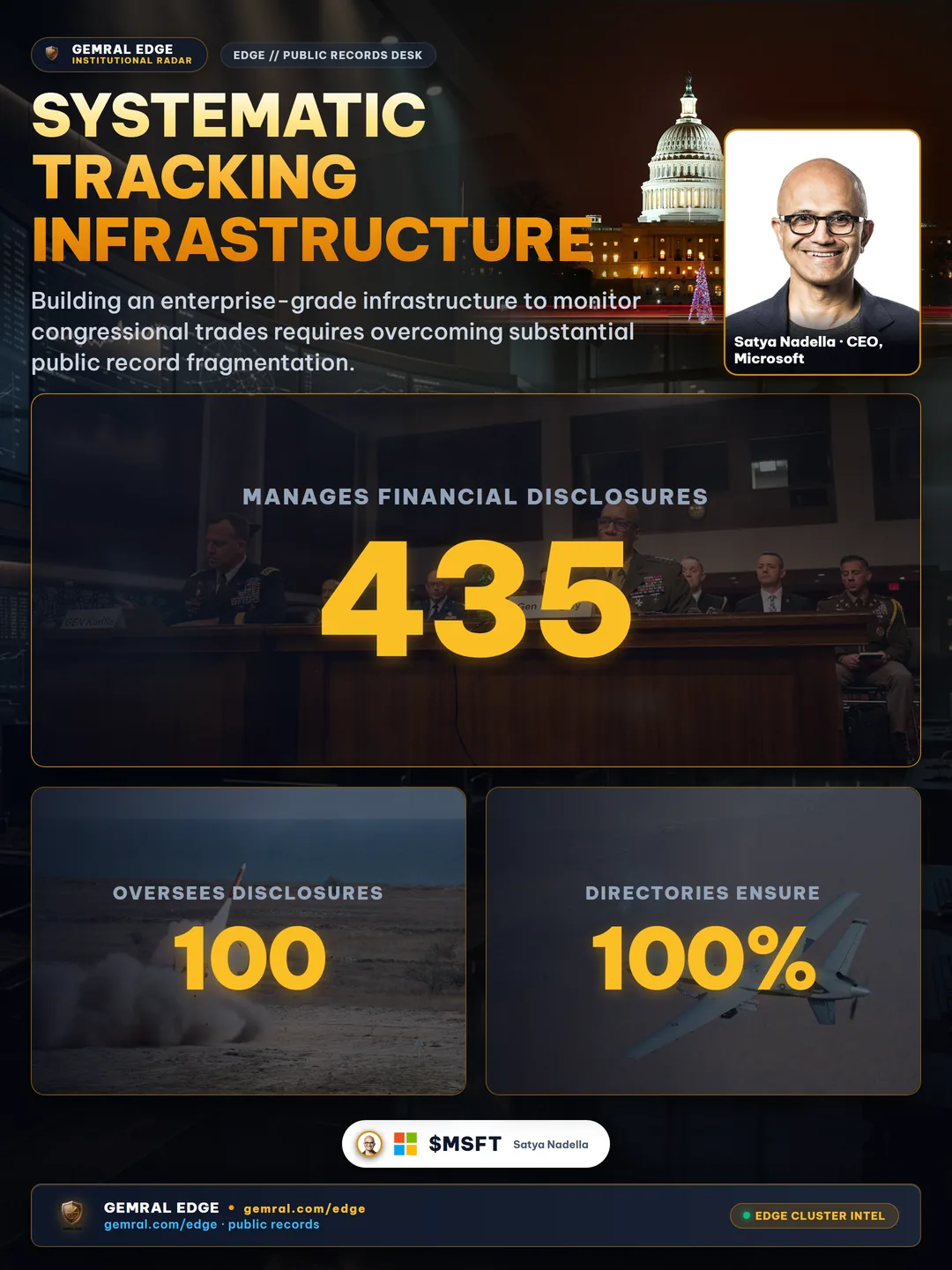
- U.S. House Office of the Clerk: Manages financial disclosures for all 435 voting representatives, 5 non-voting delegates, and the Resident Commissioner of Puerto Rico. Disclosures are published via an electronic portal that provides basic tabular indexing and scanned PDF documents.
- Secretary of the Senate Office of Public Records: Oversees disclosures for all 100 U.S. senators. Filings include both modern web-based electronic form entries and legacy handwritten scanned PDFs that require Optical Character Recognition (OCR) ingestion.
An automated ingestion pipeline must execute four distinct data processing stages to convert raw public filings into quantitative signals:
- Document Extraction & OCR Normalization: Raw electronic filings and rasterized PDF scans must be parsed, extracting critical metadata fields: lawmaker identifier, filer chamber, transaction date, disclosure filing date, asset description, ticker symbol, transaction type (Purchase, Sale, Exchange), and value bracket.
- Ticker Entity Resolution: Lawmakers frequently record asset names ambiguously in public filings—for example, writing "Microsoft Corporation - Common Stock" without specifying the ticker symbol, or recording debt notes with non-standard identifiers. Ingestion engines must resolve ambiguous corporate names against global exchange security master directories to ensure 100% accurate ticker mapping.
- Deduplication and Amendment Reconciliations: Congressional filers frequently submit amended filings to correct clerical errors, adjust transaction amounts, or disclose omitted trades. A robust pipeline must detect amendment supersedence, updating historical trade ledgers while preserving complete audit trails for empirical research.
- Cross-Signal Synthesis: Once normalized, congressional trading records can be programmatically linked to external data vectors, including corporate lobbying expenditures, federal procurement contracts, and executive insider transactions available through the institutional data preview. Furthermore, incorporating research from our point-in-time data framework ensures that historical backtests eliminate look-ahead and survivorship distortions when modeling legislative committee alpha.
Institutional Alpha vs Retail Copy-Trading: Managing the Latency Asymmetry
The surge of retail interest in congressional stock trackers has popularized the concept of direct "copy-trading"—the practice of immediately purchasing whatever stock a prominent lawmaker discloses. However, rigorous quantitative backtesting demonstrates that naive retail copy-trading strategies frequently suffer from severe performance drag due to the statutory 45-day reporting lag.
When a lawmaker executes a trade on Day 1 and files the mandatory disclosure on Day 42, the underlying market dynamics have often absorbed the initial catalyst. If the trade was motivated by impending macroeconomic shifts, regulatory reviews, or corporate milestone announcements, the equity may have already experienced substantial multiple expansion by the time retail market participants observe the disclosure.
In contrast, institutional quantitative funds and forensic market researchers utilize congressional trading telemetry through a fundamentally different lens:
By isolating bipartisan accumulation clusters—where multiple lawmakers across opposing political parties concurrently establish long positions in the same specialized technology or infrastructure subsector—researchers can detect legislative tailwinds months before major policy overhauls or appropriations bills reach the floor of Congress.
Frequently asked questions
What is the legal deadline for members of Congress to report stock trades?
Under the Stop Trading on Congressional Knowledge (STOCK) Act of 2012, members of the U.S. House of Representatives and Senate must file a Periodic Transaction Report (PTR) within 30 days of becoming aware of a transaction, and no later than 45 days after the trade execution date.
How can you track congress stock trades by specific stock ticker?
You can track congress stock trades by specific ticker using dedicated tools like the Gemral Edge Congressional Ticker Explorer (/edge/tools/congress-ticker) or the House and Senate official disclosure portals, aggregating all buys, sells, and option contracts disclosed across lawmakers for any individual company.
Why is disclosure lag critical when tracking congressional stock portfolios?
Because lawmakers have up to 45 days to disclose their trades, public disclosures represent point-in-time historical records rather than live execution signals. Understanding this 45-day latency window is essential for assessing whether a trade occurred prior to committee legislative hearings, contract awards, or regulatory votes.
What penalties exist for late or non-compliant congressional stock filings?
The statutory penalty for filing a late Periodic Transaction Report under the STOCK Act is a nominal $200 fine, which House or Senate ethics committees frequently waive. This lenient penalty structure has historically contributed to recurring disclosure delays across both chambers.