Congress Stock Trades Website: Comparing Official Portals, Disclosure Lags, and Real-Time Trackers
A systematic analysis of legislative stock disclosure mechanics under the STOCK Act of 2012, contrasting raw federal filing repositories against modern quantitative intelligence engines.
Over the past several market cycles, public interest in legislative trading disclosures has expanded from academic curiosity into a major alternative data discipline. Retail investors, investigative journalists, and quantitative equity research desks increasingly search for a dedicated congress stock trades website to monitor the personal portfolio transactions of lawmakers serving in the United States Senate and the House of Representatives.
While federal statute mandates public disclosure of all equity, option, and debt transactions executed by federal legislators, the raw government infrastructure was never engineered for real-time market analysis. Investors who consult official government databases face fragmented document stores, scanned PDF forms, and wide valuation brackets. Understanding the difference between raw government document repositories and quantitative intelligence engines is critical for anyone seeking actionable insights from congressional trading data.
Where to Track Congressional Stock Trades: Official Portals vs Real-Time Platforms
The official primary sources for congressional stock transaction disclosures reside across two distinct legislative branch portals. For members of the House of Representatives, transactions are filed with the Office of the Clerk of the House through its public financial disclosure portal. For members of the Senate, filings are submitted to the Senate Select Committee on Ethics through its public disclosure system.
Both repositories satisfy statutory transparency mandates, but both suffer from fundamental architectural constraints that hinder systematic research:
- Fragmented Document Architecture: House and Senate portals operate on entirely separate software stacks. A market participant looking to track cross-chamber consensus in semiconductor or defense equities must query two disconnected databases with distinct search schemas.
- Unstructured PDF Formats: A substantial portion of public disclosures are filed as static PDF documents or scanned image files rather than structured data feeds. Many filings contain handwritten descriptions that evade standard optical character recognition (OCR) engines.
- Absence of Aggregate Analytics: Official government portals offer no historical performance attribution, no committee-level trade clustering metrics, and no automated correlation against federal procurement contract awards.
- Manual Query Workflows: Government repositories lack automated webhook notifications, programmatic REST endpoints, or real-time ticker-level alerts, forcing researchers to run manual keyword queries each day.
To resolve these friction points, independent quantitative tracking platforms ingest raw public filings, extract transaction records into structured databases, and cross-reference them against corporate tickers and committee assignments.
The STOCK Act Disclosure Mechanism: How Periodic Transaction Reports Work
The statutory backbone of all congressional stock reporting is the Stop Trading on Congressional Knowledge Act of 2012, commonly known as the STOCK Act (Public Law 112-105). Prior to 2012, lawmakers were only required to report personal asset holdings once per year in an annual financial disclosure statement. The STOCK Act introduced the Periodic Transaction Report (PTR), mandating timely public disclosures of individual transactions throughout the calendar year.
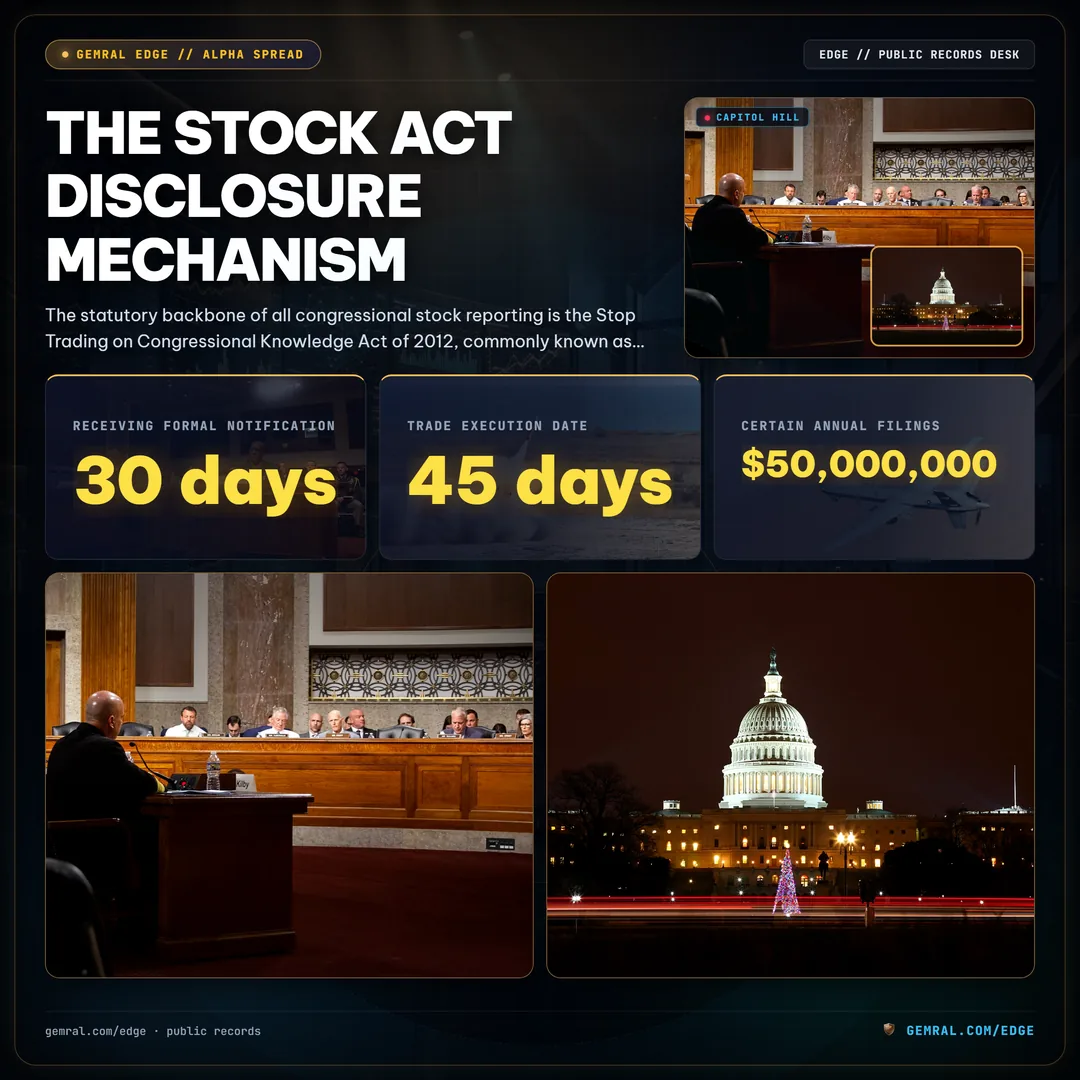
Under Section 6 of the STOCK Act, lawmakers must publicly disclose any purchase, sale, or exchange of stocks, bonds, commodities futures, or other securities exceeding $1,000 in value. The law establishes a dual-tier reporting deadline:
- 30-Day Notification Deadline: Lawmakers must submit a disclosure within 30 days of receiving formal notification of a transaction from their broker or investment manager.
- 45-Day Statutory Cutoff: In no circumstance may a filing be submitted later than 45 days after the trade execution date, regardless of when broker notification was received.
Unlike executive branch disclosures or corporate insider filings that specify exact transaction prices and share counts, congressional PTRs only disclose broad valuation brackets. The primary disclosure bands include:
- $1,001 to $15,000
- $15,001 to $50,000
- $50,001 to $100,000
- $100,001 to $250,000
- $250,001 to $500,000
- $500,001 to $1,000,000
- Over $1,000,000 (with specialized higher tiers up to $50,000,000 in certain annual filings)
Furthermore, lawmakers must indicate the owner of the asset: self, spouse (SP), dependent child (DC), or joint holding (JT). This reporting structure means that when a lawmaker reports a purchase of a tech equity, the public record reveals only a valuation range rather than an exact dollar allocation.
Platform Comparison: Official Government Portals vs Automated Quantitative Trackers
Evaluating the competitive landscape of congressional stock tracking websites reveals structural differences in data latency, entity normalization, and analytical depth:
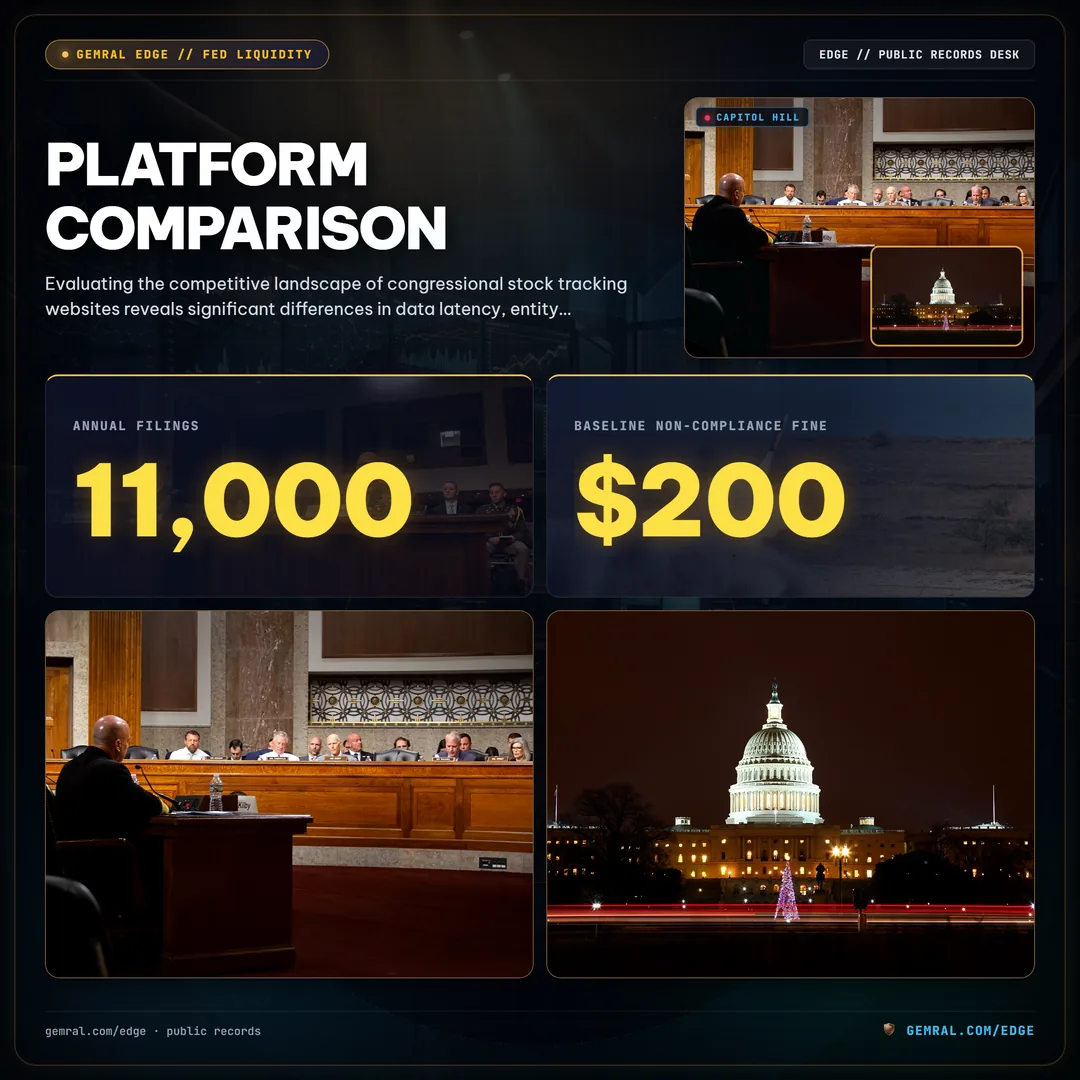
- 35-Day Median Disclosure Delay: Automated trackers quantify reporting latency across chambers, identifying lawmakers with average filing delays ranging from 28 to 35 calendar days.
- 11,000 Annual Filings Ingested: Scalable parsers continuously ingest more than 11,000 Periodic Transaction Reports each year across House and Senate repositories.
- $200 Baseline Non-Compliance Fine: Professional platforms track compliance enforcement across members, auditing instances where the statutory $200 late filing penalty was assessed or waived.
| Feature Dimension | Official Government Portals | Basic Free Trackers | Quantitative Edge Engines |
|---|---|---|---|
| Data Structure | Raw PDFs & TIFF scans | Scraped HTML tables | Clean normalized SQL / JSON APIs |
| Ticker Resolution | Manual text fields (unstandardized) | Basic string regex matching | Point-in-time CUSIP & parent equity mapping |
| Reporting Lag Tracking | Filing date only | Static days calculation | Statistical lag distributions & compliance scoring |
| Legislative Telemetry | None | Basic party label (D/R) | Committee jurisdictions, markups & contract links |
| Delivery Mechanism | Browser search box | Social media bots & web feeds | Real-time webhooks, feeds & institutional dashboards |
While basic consumer websites cater to social media virality, institutional researchers require robust data engineering that handles revisions, amendments, and complex trust structures without introducing survivorship or look-ahead biases.
Data Integrity and Auditability: Overcoming Handwritten Scans and Reporting Lags
The greatest operational obstacle facing any congress stock trades website is data integrity. Under current congressional filing rules, members of the House are permitted to submit handwritten disclosure forms by hand or mail. These forms are frequently scanned at low resolutions, leading to frequent transcription errors in amateur databases.
Quantitative data pipelines address these challenges through a multi-stage validation process:
- Bitemporal Point-in-Time Indexing: Every transaction record must maintain two distinct timestamps: the trade execution date (when the lawmaker or broker executed the order) and the publication filing timestamp (when the document became available to the public). Evaluating past performance using trade execution dates rather than public filing dates introduces severe look-ahead bias, as market participants could not have acted upon the trade during the intervening lag window.
- Filing Lag Dispersion: Across more than 11,000 annual PTR filings, the median reporting lag hovers between 28 and 35 calendar days. However, late filings are common. The statutory penalty for submitting a PTR beyond the 45-day deadline is a modest $200 fine, which ethics committees frequently waive under administrative discretion.
- Amendment Reconciliations: Lawmakers routinely file amended disclosures months after the initial transaction to correct ticker symbols, modify valuation brackets, or add previously omitted trades. Professional data feeds continuously reconcile amended records against initial prints.
- Corporate Spin-Off and Ticker Drift: Disclosures frequently record legacy company names or unlisted corporate bond identifiers. Automated entity resolution algorithms resolve these records to actively traded common equity tickers.
Institutional Signal Extraction: Committee Clusters, Defense Markups, and Quantitative Modeling
For institutional quantitative researchers and equity macro analysts, the core value of congressional trade telemetry lies not in blindly mirroring individual trades, but in evaluating systemic capital clustering across key legislative committees.
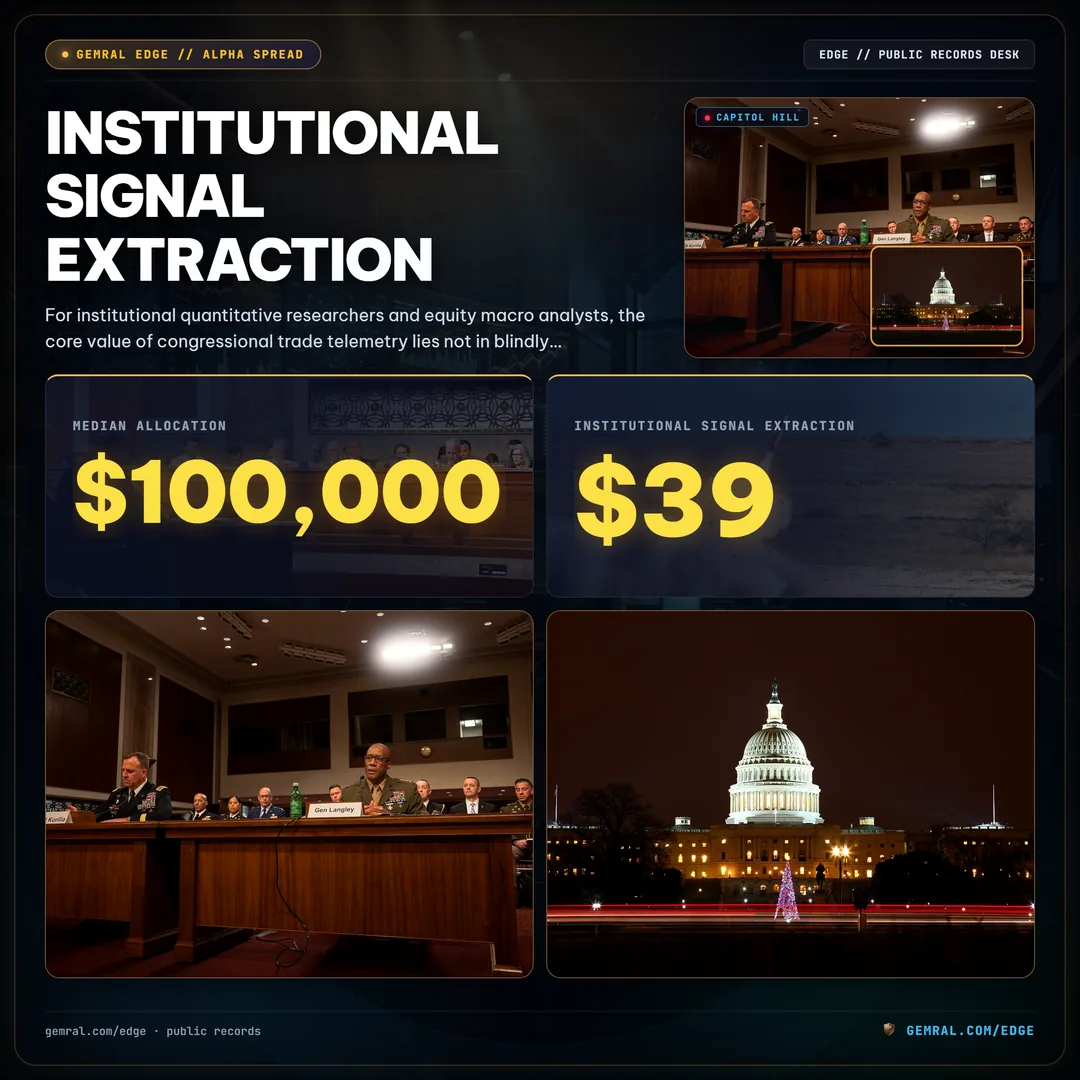
Congressional committees exercise direct oversight and funding authority over major commercial sectors:
- 14-Day Cluster Horizon: Quantitative engines identify capital clustering when 3 or more committee members execute purchases in the same industry sector within a concentrated 14-day window.
- 45-Day Statutory Latency: Because lawmakers have up to 45 calendar days to disclose trades, institutional models treat congressional filings as structural position indicators rather than real-time trading catalysts.
- $5 Million Volume Filter: Advanced pipelines apply a $5 million minimum aggregate transaction filter across committee disclosures to separate discretionary retail trades from large-scale institutional shifts.
- $100,000 Median Allocation: Committee-level transaction sizes cluster around the $100,000 valuation bracket during active legislative markup cycles.
When multiple members of an oversight committee execute purchases in the same industry sector within a concentrated 14-day window, quantitative engines flag this phenomenon as a committee trade cluster. Researchers correlate these cluster signals against upcoming legislative markups, agency contract awards, and committee hearing calendars to evaluate public policy momentum.
However, institutional researchers maintain strict risk management guardrails. The structural 30-to-45-day reporting lag means that short-term price reactions often precede the public filing date. Therefore, sophisticated desks utilize congressional trading data as a medium-to-long-term thematic indicator rather than a high-frequency trading trigger, cross-referencing disclosures with broader public procurement datasets to construct durable macro perspectives.
Regulatory Disclaimer & Public Transparency Notice
Public data · not investment advice. All congressional transaction filings, disclosure timelines, and statutory reporting frameworks cited in this report are sourced from official public records maintained by the Office of the Clerk of the U.S. House of Representatives and the U.S. Senate Select Committee on Ethics under the STOCK Act of 2012. Gemral Edge provides systematic public record aggregation, entity resolution, and policy telemetry for quantitative research desks. Institutional data feeds and API access are available through our Edge Data Plans ($39 Pro, $299 B2B, $2000 API).
Frequently asked questions
Where can the public officially look up congressional stock trades?
Official primary filings are hosted on the U.S. House Clerk Financial Disclosure portal (disclosures-clerk.house.gov) for Representatives and the Senate Electronic Financial Disclosure system for Senators. However, raw filings are stored largely as unindexed PDF scans without aggregate portfolio metrics.
Is it legal for members of Congress to buy and sell individual stocks?
Yes. Members of Congress and their immediate family members are permitted to trade individual equities, options, and municipal bonds under federal law, provided they report transactions over $1,000 within 30 to 45 days pursuant to the Stop Trading on Congressional Knowledge (STOCK) Act of 2012.
What is the reporting deadline for congressional stock transactions?
Under the STOCK Act, lawmakers must submit a Periodic Transaction Report no later than 30 days after receiving notification of a transaction, and in no event later than 45 days after the trade execution date.
Why do institutional investors track congressional stock trading websites?
Institutional researchers evaluate congressional disclosures as an alternative data stream to detect capital clustering around committee jurisdictions—such as Armed Services, Energy and Commerce, and Appropriations—where legislative markups and procurement awards create structural market tailwinds.