Government Contracts Database: How Point-in-Time Contract Records Drive Quantitative Defense Research
An institutional examination of federal procurement telemetry, mapping raw obligation modifications and subsidiary awards point-in-time to publicly traded parent tickers while eliminating statutory look-ahead distortion.
In institutional quantitative finance and equity research, a dedicated government contracts database serves as an indispensable foundation for analyzing sovereign capital allocation. The United States federal government represents the single largest procurement counterparty on earth, obligating upwards of $750 billion annually across defense hardware, aerospace engineering, cybersecurity infrastructure, and cloud systems. However, transforming unstructured procurement notices into an investment-grade, quantitative data feed requires solving fundamental data engineering bottlenecks that raw government repositories systematically ignore.
While fundamental equity analysts frequently review headline announcements, systematic funds require programmatic access to point-in-time federal award data where every transaction is mapped to the exact public equity ticker active on the date of public disclosure. Quantitative researchers seeking to evaluate contractor backlogs and procurement velocity can explore our institutional coverage portal at Federal Government Contracts. For deeper exploration of how sovereign demand interacts with corporate equity valuation, review our analysis on Defense Contractors by Market Cap and our technical teardown on Hedge Fund Database Architecture.
The Architecture of a Quantitative Government Contracts Database
A production-grade government contracts database differs dramatically from generic government search web portals. Federal procurement data is inherently event-driven, asynchronous, and subject to continuous retroactive revisions. When a federal agency issues an award, the transaction represents a legally binding obligation of funds under the Federal Acquisition Regulation (FAR). Each individual record carries dozens of technical attributes, ranging from the Procurement Instrument Identifier (PIID) and transaction modification index to North American Industry Classification System (NAICS) codes and Product Service Codes (PSC).
To build a reliable data ingestion pipeline for quantitative asset managers, the architecture must maintain an immutable, append-only log of every contract action. Standard relational databases that execute in-place updates when an agency modifies funding levels corrupt historical backtests. If an initial $50 million award issued in January is revised downward to $35 million in October due to a partial de-obligation, a model evaluating performance in March must see only the $50 million figure that was legally known at that point in time. Overwriting the original record retroactively introduces severe look-ahead bias into mathematical simulations.
Furthermore, an institutional procurement database isolates individual transaction rows rather than aggregating contracts prematurely. Each contract vehicle consists of a base award followed by dozens—often hundreds—of subsequent administrative actions, including option exercises, incremental funding injections, scope changes, and period-of-performance extensions. Preserving this granularity ensures that quantitative research desks can measure obligation velocity, contract burn rates, and agency disbursement patterns without losing critical microstructural information.
Point-in-Time Entity Resolution: Mapping Subsidiaries to Listed Parent Tickers
The primary obstacle that causes off-the-shelf procurement scrapers to fail in institutional environments is entity resolution. Federal agencies do not award contracts to stock tickers; they award contracts to commercial operating entities identified by Unique Entity Identifiers (UEI) and Commercial and Government Entity (CAGE) codes. In fact, over 70% of federal prime contracts awarded to publicly traded defense and technology corporations are legally issued to wholly-owned operating subsidiaries, specialized joint ventures, or recently acquired business units whose corporate names bear no textual resemblance to the parent company.

Consider recent contract transactions recorded across federal civilian and defense agencies:
- Leidos Biomedical Research, Inc.: On September 30, 2026, the National Institutes of Health awarded an operational task order carrying an action obligation of $342.19 million ($342.19M). An unassisted keyword search for the parent ticker would miss this award entirely. A point-in-time entity resolution engine immediately maps this operating unit to its publicly traded parent, Leidos Holdings, Inc. (NYSE: LDOS).
- General Dynamics One Source LLC and General Dynamics Information Technology, Inc.: Multiple delivery orders and incremental funding modifications—including a $10.43 million ($10.43M) action from the Department of Homeland Security and a $15.00 million ($15.00M) action from the General Services Administration—were executed on September 30, 2026. Both entities resolve systematically to General Dynamics Corporation (NYSE: GD).
- Maximus Federal Services, Inc.: On September 30, 2026, the Centers for Medicare and Medicaid Services executed a contact center operations contract action obligating $401.56 million ($401.56M). This subsidiary rolls up directly to Maximus Inc. (NYSE: MMS).
- Perimeter Solutions LP: Awarded a full-service fire retardant contract action valued at $67.62 million ($67.62M) by the U.S. Forest Service on September 30, 2026, resolving directly to Perimeter Solutions, SA (NYSE: PRM).
Crucially, corporate entity hierarchies are not static. Mergers, acquisitions, spin-offs, and bankruptcies continuously reshape the corporate genealogy of defense contractors. When L3 Technologies merged with Harris Corporation in June 2019 to form L3Harris Technologies (NYSE: LHX), historical contracts previously awarded to legacy entities required date-bounded parent links. An institutional government contracts database maintains an effective-dated parent mapping ledger. Contracts published prior to the merger effective date remain linked to legacy tickers, while awards published post-merger roll up to the unified parent entity, guaranteeing survivorship-bias-free historical datasets.
Tracking Federal Obligation Modifications, De-obligations, and Statutory Publication Lags
A common misconception among quantitative analysts new to alternative procurement data is that contract signing dates coincide with public visibility. In statutory federal procurement, contractual execution and public availability are separated by measurable multi-day lags. Most critically, Department of Defense transactions are governed by statutory operational security embargoes that enforce a mandatory 90-day reporting delay before individual procurement transactions can be uploaded to public contract registries.
| Awarding Agency Category | Contract Action Date | Median Public Publication Delay | Statutory & Administrative Drivers |
|---|---|---|---|
| Department of Defense (DoD) | Date Signed | 90 Days (Statutory) | Mandatory 90-day operational security embargo on defense transactions |
| Federal Civilian Agencies (HHS, DHS, NASA) | Date Signed | 3 to 14 Business Days | Routine agency batch transmission and registry ingestion cycles |
| Defense Daily Press Bulletins | Date Announced | Same Day (17:00 ET) | High-level contract summaries for prime awards valued at $7.5M+ |
| Federal Bid Protests | Filing Date | 1 to 2 Business Days | Government Accountability Office docket publication schedule |
If a quantitative factor model tests the hypothesis that major defense contract awards generate abnormal equity drift, using the contract signing date creates catastrophic forward-looking bias. The simulation executes trades 90 days before any market participant had access to the data. An institutional database explicitly tracks publication timestamps alongside contract signing dates, ensuring that event studies only evaluate returns after information reaches public dissemination channels.
In addition to positive obligations, federal contracting involves frequent downward revisions, administrative closeouts, and contract de-obligations. When an agency terminates a task order for convenience or rescinds unspent funds at the conclusion of a fiscal year, the transaction appears as a negative dollar obligation. A robust procurement engine handles negative cash flow modifications with equal precision, preventing artificial inflation of contractor backlog estimates.
Comparing Public Procurement Search Portals to Institutional Point-in-Time Feeds
Institutional asset allocators frequently ask why internal data engineering teams cannot simply query publicly available government search portals using automated scripts. While public interfaces provide valuable transparency for civic accountability, their technical infrastructure is fundamentally unsuited for systematic financial engineering.
| Feature Dimension | Public Search Web Portals | Institutional Point-in-Time Data Feeds |
|---|---|---|
| Entity Mapping | Immediate vendor name and UEI only | Point-in-time parent equity ticker and corporate hierarchy |
| Revision Handling | In-place updates overwrite historical states | Immutable append-only revision logs with effective timestamps |
| Temporal Integrity | Action date only; publication latency hidden | Dual bitemporal indexing (valid event time vs publication time) |
| Delivery Mechanisms | Rate-limited web APIs and bulk CSV dumps | Columnar Parquet bundles, normalized schemas, and REST APIs |
| Survivorship Bias | Acquired entities retroactively reassigned | Delisted and acquired firms retained under historical identifiers |
Public portals frequently apply current parent entity structures retroactively to historical awards. When an investor queries a five-year procurement history for an aerospace conglomerate, the public portal displays past awards under the current corporate brand, completely erasing the independent historical track records of acquired mid-tier defense firms. In systematic backtesting, this creates survivorship bias by retroactively populating winning prime contractors with historical revenues that were actually earned by entities traded under different capital structures.
Auditing Contract Records Against Daily Defense Announcements and Disclosures
Maintaining institutional data integrity requires multi-layered verification gates. In production data pipelines, raw procurement feeds must be validated against independent public disclosure streams to detect discrepancies, missing modifications, and clerical errors before records enter quantitative research pipelines.
A rigorous data pipeline enforces a dual-stream audit:
- Daily Defense Contract Announcements Matching: Every business day at 17:00 Eastern Time, the Department of Defense publishes official summaries of prime contract awards exceeding $7.5 million. These announcements provide immediate textual confirmation of major weapon system awards, identifying the prime recipient, contract ceiling, work locations, and contracting service branch. Pairing daily announcements with subsequent federal registry transactions enables quantitative desks to detect contract awards well before the full 90-day statutory delay expires.
- Sampled Ground-Truth Accuracy Audits: High-reliability feeds require automated and manual audit gates where randomly sampled transaction records are checked against source PDF award notices and agency contract documentation. Under our institutional data standard, a procurement record type is approved for institutional consumption only after passing a minimum 95.0% accuracy verification threshold across sampled public documents.
- Bid Protest Cross-Referencing: Awarded contracts often face legal challenges before the Government Accountability Office (GAO). When a competitor files a formal bid protest, the agency frequently issues a stop-work order while the protest is adjudicated. Tracking bid protest filings alongside contract awards prevents research models from assuming smooth revenue recognition on contested awards.
By correlating prime contract awards with subcontractor links, corporate lobbying reports, and congressional committee oversight filings, quantitative researchers obtain a comprehensive 360-degree view of sovereign capital allocation.
Integrating Government Contract Data into Institutional Quantitative Backtests
For quantitative portfolio managers and risk analysts, integrating a point-in-time government contracts database unlocks empirical orthogonal factor signals and fundamental risk factors. Federal procurement data provides direct, empirical measurement of sovereign demand that operates largely independently of commercial macroeconomic cycles.
Key institutional use cases include:
- Leidos Biomedical Research, Inc.: On September 30, 2026, the National Institutes of Health awarded an operational task order carrying an action obligation of $342.19 million ($342.19M). An unassisted keyword search for the parent ticker would miss this award entirely. A point-in-time entity resolution engine immediately maps this operating unit to its publicly traded parent, Leidos Holdings, Inc. (NYSE: LDOS).
- General Dynamics One Source LLC and General Dynamics Information Technology, Inc.: Multiple delivery orders and incremental funding modifications—including a $10.43 million ($10.43M) action from the Department of Homeland Security and a $15.00 million ($15.00M) action from the General Services Administration—were executed on September 30, 2026. Both entities resolve systematically to General Dynamics Corporation (NYSE: GD).
- Maximus Federal Services, Inc.: On September 30, 2026, the Centers for Medicare and Medicaid Services executed a contact center operations contract action obligating $401.56 million ($401.56M). This subsidiary rolls up directly to Maximus Inc. (NYSE: MMS).
- Perimeter Solutions LP: Awarded a full-service fire retardant contract action valued at $67.62 million ($67.62M) by the U.S. Forest Service on September 30, 2026, resolving directly to Perimeter Solutions, SA (NYSE: PRM).
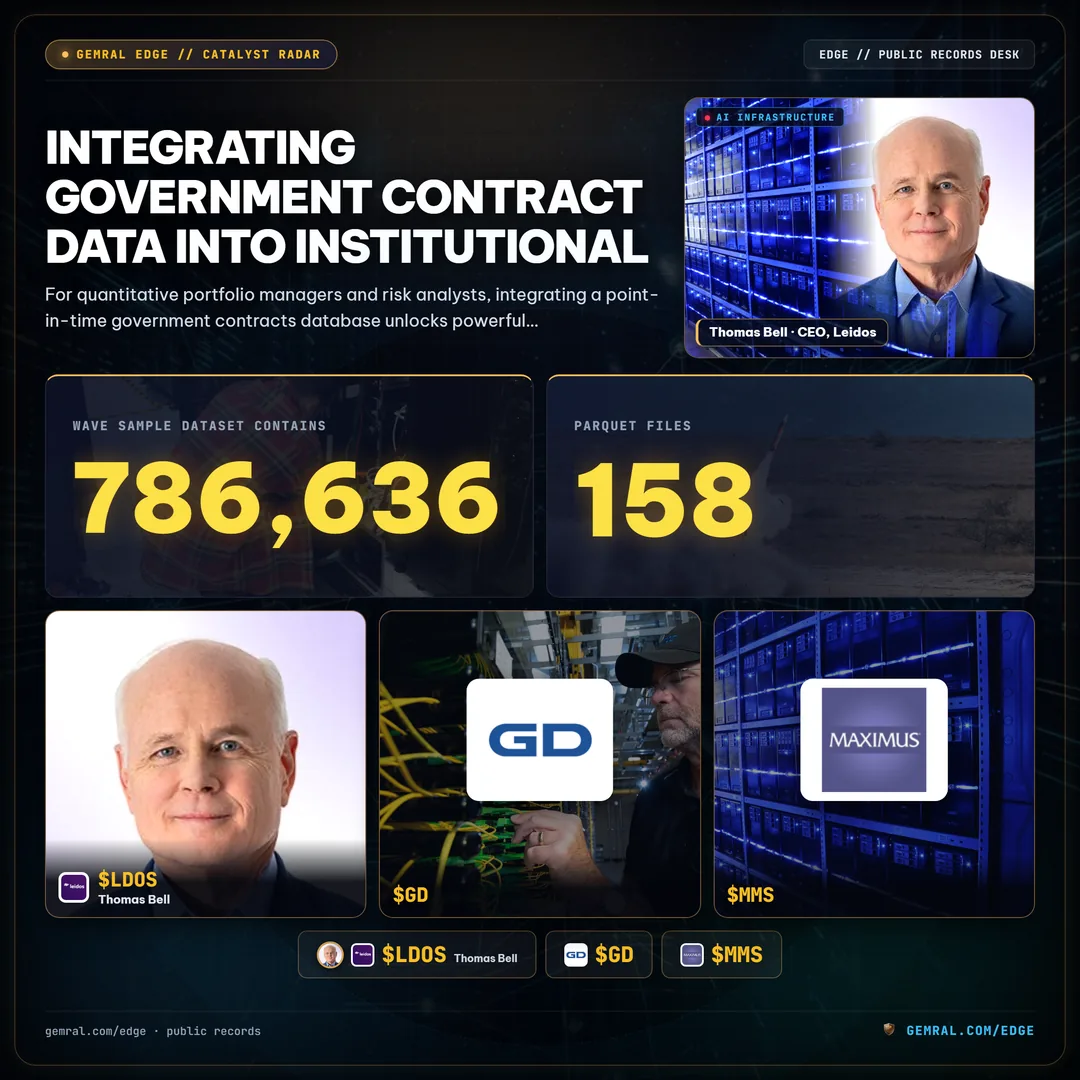
To evaluate how point-in-time procurement telemetry enhances institutional investment frameworks, research teams can review our full history sample pack. The Wave 1 sample dataset contains 786,636 verified transaction rows across 24 normalized tables and 158 Parquet files, complete with point-in-time parent entity resolution, statutory publication delay controls, and zero look-ahead bias.
Institutional Research & Evaluation
Edge delivers point-in-time federal procurement records, defense award telemetry, and entity-resolved public disclosures for quantitative research teams, hedge funds, and institutional risk desks. Internal-use fund licenses provide complete historical access via columnar Parquet files, normalized REST APIs, and comprehensive data dictionaries.
Disclaimer: Public data · not investment advice. All figures, contract identifiers, and entity mappings reflect verified historical government procurement records. Past performance and historical procurement allocations do not guarantee future equity market returns.
Frequently asked questions
What is the difference between raw government procurement portals and a quantitative government contracts database?
Raw government procurement portals record awards by agency tracking IDs and immediate recipient business names without linking subsidiaries to publicly traded parent tickers or preserving historical entity structures. A quantitative government contracts database maps every award modification, de-obligation, and task order point-in-time to the listed parent entity valid on that date, incorporating statutory reporting delays to prevent look-ahead bias in backtests.
How does statutory publication lag affect defense contract data?
Federal statutes impose an operational security delay, typically a 90-day lag on Department of Defense contract transactions, before public disclosure. Backtesting models that use the contractual signing date rather than the actual publication date introduce look-ahead bias, as the market could not legally observe the contract during the embargo period.
How does point-in-time entity resolution handle mergers and corporate name changes in government contracting?
Point-in-time entity resolution maps awards based on the corporate genealogy and ticker active on the date of public disclosure. If Company A is acquired by Company B, pre-acquisition contracts remain tied to Company A's historical ticker, while post-acquisition contract actions roll up to Company B, preventing survivorship and look-ahead distortions.
What data fields are critical for tracking federal contract obligations?
Critical procurement fields include the Procurement Instrument Identifier (PIID), modification number, awarding agency and sub-agency, action obligation amount, recipient Unique Entity Identifier (UEI), ultimate parent identifier, action date, North American Industry Classification System (NAICS) code, and Product Service Code (PSC).