Lobbying Disclosure Act Database: Searching Quarterly Expenses, Registrants, and Client Filings
A quantitative research guide to searching and parsing the federal Lobbying Disclosure Act database, decoding quarterly LD-2 expenditure filings, resolving parent-client corporate entities, and tracking policy momentum.
The lobbying disclosure act database serves as the definitive federal repository for tracking corporate influence, policy advocacy, and legislative expenditures across Capitol Hill. Established under statutory law, this centralized disclosure system transforms what was once an opaque influence network into a structured public record. For quantitative researchers, equity analysts, and investigative desks, auditing these public disclosures provides timely visibility into regulatory shifts, appropriations initiatives, and agency procurement allocations long before they reflect in quarterly earnings calls.
However, systematically querying the federal lobbying disclosure act database requires more than simple text searches across corporate brand names. Effective disclosure research demands a rigorous understanding of statutory filing categories, strict filing cadences, and entity resolution methodologies that link external lobbying firms and subsidiaries back to their listed corporate parents. To explore how federal legislative intelligence integrates with commercial datasets, institutional desks monitor our comprehensive corporate lobbying tracker alongside our analysis on the federal lobbying database and our research on Senate lobbying disclosures.
Lobbying Disclosure Act Database: Statutory Architecture and Public Transparency Mandates
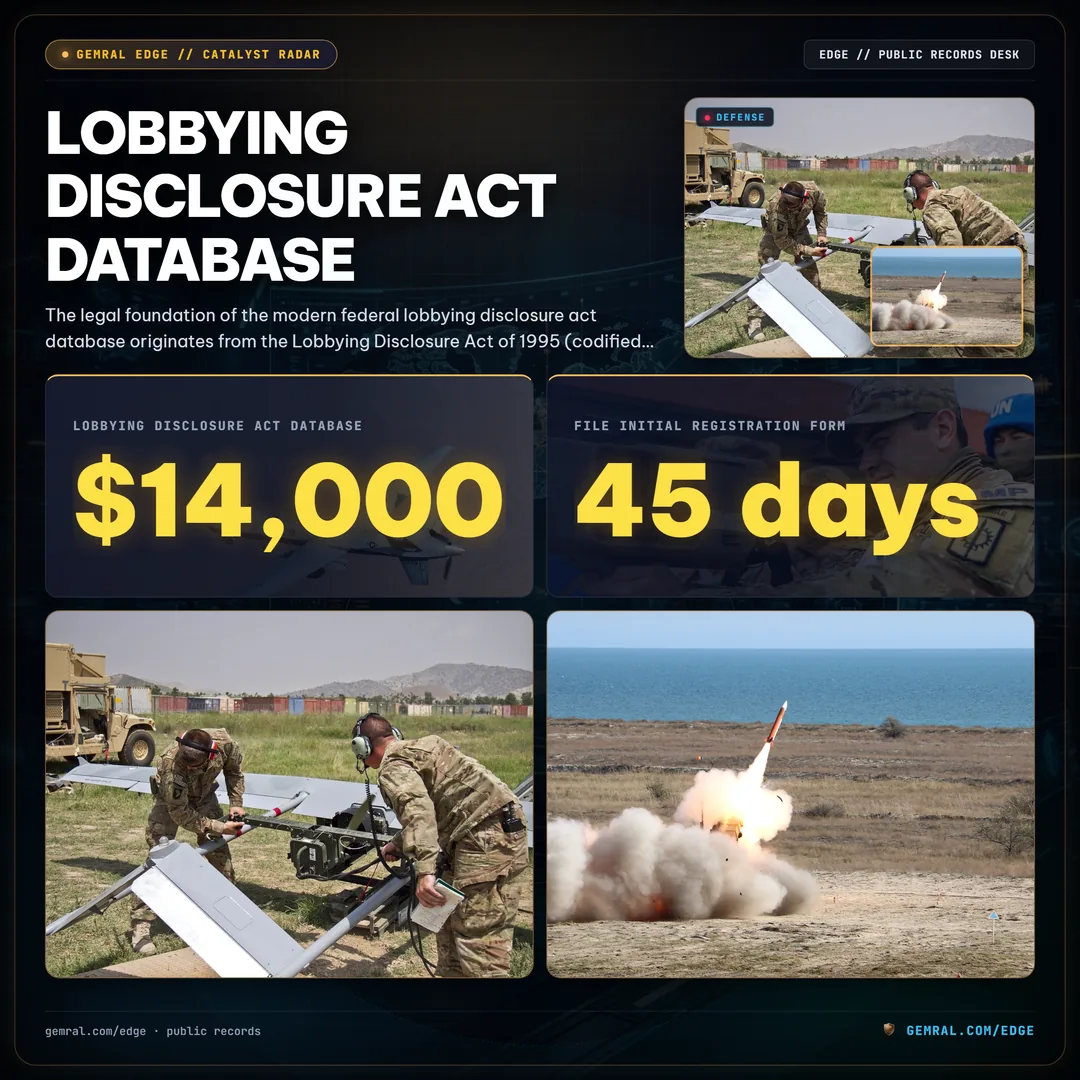
The legal foundation of the modern federal lobbying disclosure act database originates from the Lobbying Disclosure Act of 1995 (codified at 2 U.S.C. § 1601 et seq.) and its significant expansion under the Honest Leadership and Open Government Act (HLOGA) of 2007. Prior to these statutory reforms, federal lobbying disclosures were fragmented, submitted on paper, and lacked standardized accounting definitions. The modern framework mandates electronic submission through unified systems operated jointly by the Secretary of the Senate Office of Public Records (SOPR) and the Clerk of the House of Representatives Legislative Resource Center.
Federal statute establishes precise legal thresholds determining who must register and file within the database. An individual qualifies as a federal lobbyist under statutory rules if they meet three cumulative tests:
- Lobbying Contacts Test: The individual makes more than one direct lobbying contact with covered executive branch or legislative branch officials.
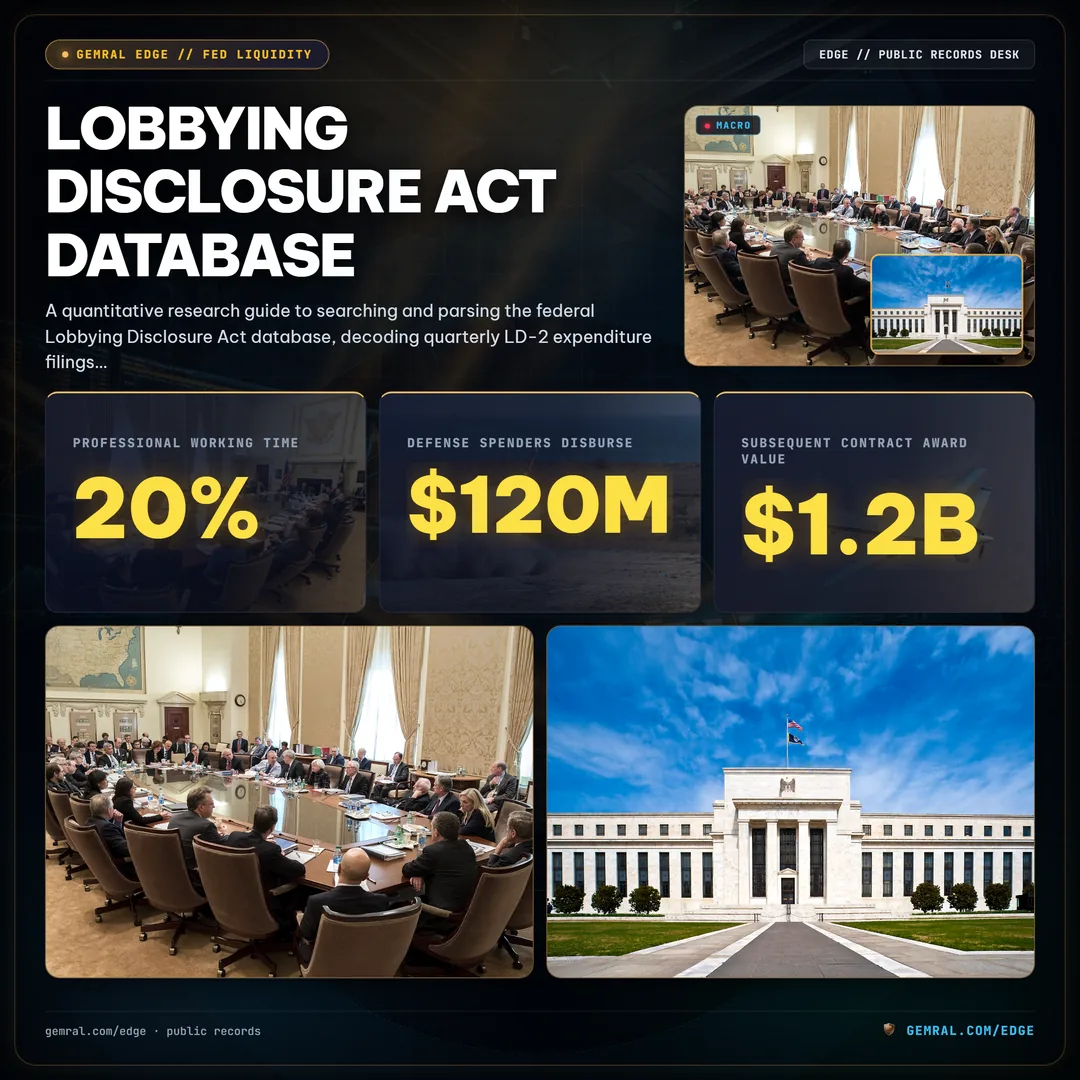
- Time Allocation Test: The individual spends at least 20 percent of their professional working time engaged in lobbying activities on behalf of a specific client during any quarterly period.
- Financial Threshold Test: The total expenses incurred for lobbying by an organization with in-house lobbyists exceed statutory quarterly limits ($14,000), or total income earned by a retained lobbying firm from a specific client exceeds quarterly minimums ($3,000).
Once these statutory criteria are triggered, the registrant must file initial registration Form LD-1 within 45 days of making a lobbying contact or being employed to do so. Following registration, the entity enters an ongoing quarterly compliance regime that records all federal policy activities in the public ledger.
Searching Quarterly LD-2 Expense Filings, Registrants, and Client Disclosures
The operational heartbeat of the lobbying disclosure act database is the quarterly Form LD-2 disclosure report. While Form LD-1 records organizational setup, Form LD-2 documents actual money spent, bills targeted, federal agencies contacted, and specific lobbyists assigned during each three-month calendar quarter.
Statutory filing deadlines for Form LD-2 occur exactly 20 days following the close of each calendar quarter:
- First Quarter (Q1: January 1 – March 31): Filing deadline is April 20.
- Second Quarter (Q2: April 1 – June 30): Filing deadline is July 20.
- Third Quarter (Q3: July 1 – September 30): Filing deadline is October 20.
- Fourth Quarter (Q4: October 1 – December 31): Filing deadline is January 20.
When querying quarterly filings, researchers must account for statutory rounding rules. All reported lobbying expenses and client income figures are rounded to the nearest $10,000. For organizations that maintain internal lobbying staff, expenses can be calculated either using statutory LDA expense definitions or through internal accounting methods conforming to Section 162(e) of the Internal Revenue Code (IRC). Identifying which accounting methodology a corporation selects is essential for maintaining longitudinal consistency in financial time-series modeling.
Furthermore, every LD-2 filing categorizes activities using 79 standardized statutory issue codes. These issue codes range from defense (DEF) and aerospace (AER) to taxation (TAX), healthcare (HCR), energy (ENE), and telecommunications (TEC). Within each assigned issue code, registrants must itemize the specific House and Senate committees, federal executive agencies (such as the Department of Defense, FDA, or FTC), and specific bill numbers (such as National Defense Authorization Act provisions) that formed the subject of their lobbying contacts.
Registrants vs. In-House Retainers: Resolving Corporate Beneficiaries and Covered Officials
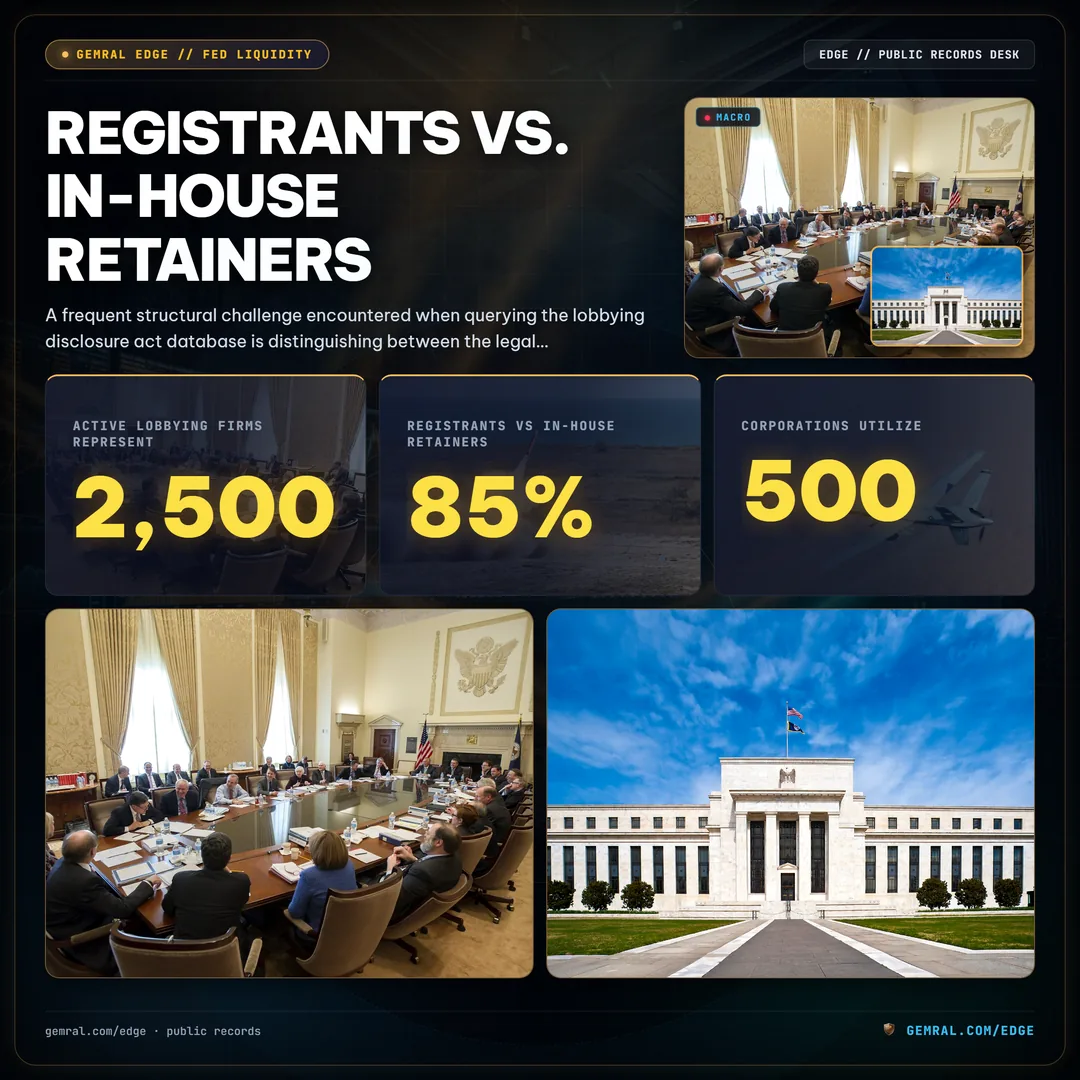
A frequent structural challenge encountered when querying the lobbying disclosure act database is distinguishing between the legal "registrant" and the true corporate "client." In federal reporting, a commercial lobbying firm (e.g., Akin Gump or Brownstein Hyatt) is the legal registrant, while the operating enterprise funding the effort (e.g., a defense contractor, semiconductor manufacturer, or biotechnology firm) appears as the client.
Conversely, multinational corporations that maintain dedicated government affairs teams in Washington, D.C., file as self-registrants, listing themselves as both the registrant and the client. To build an accurate picture of total corporate policy spend, quantitative analysts must aggregate two separate filing streams:
- Self-Filed In-House Expenses: Internal corporate expenditures reported directly by the enterprise's internal government relations division on self-filed LD-2 forms.
- External Retained Contract Spend: Payments disbursed to third-party lobbying firms, where the corporate entity is named as the client on external LD-2 forms filed by outside legal and government affairs registrants.
Across the federal registry, approximately 2,500 active lobbying firms represent external clients, while over 85% of Fortune 500 corporations utilize a blended model that combines an in-house policy office with specialized external retainers. In addition to financial accounting, the database records critical personnel transparency through mandatory "covered official" disclosures. Under HLOGA statutory requirements, any lobbyist who previously served as a covered executive branch official (such as a Cabinet officer, agency head, or senior military officer) or a covered legislative branch official (such as a Member of Congress, committee counsel, or senior legislative director) within 20 years prior to lobbying must disclose their prior public positions. Semiannually, these individuals must also submit Form LD-203 reporting political contributions exceeding statutory thresholds of $200 per recipient. Tracking the movement of former congressional staff into specialized corporate lobbying roles provides quantitative confirmation of institutional access in heavily regulated sectors.
Policy Momentum and Procurement Shifts: Extracting Signals from Systematic LDA Data
Systematic ingestion of the lobbying disclosure act database enables research desks to detect capital allocation shifts and policy momentum before regulatory outcomes appear in trade press or corporate press releases. Sudden, statistically significant surges in quarterly lobbying expenditures frequently precede major government procurement awards, antitrust actions, or tax incentive authorizations.

For example, in defense and aerospace manufacturing, prime contractors consistently accelerate lobbying expenditures 6 to 12 months prior to major multi-year platform procurement decisions. Historical public filings demonstrate that the top 10 defense spenders disburse over $120 million annually in combined federal lobbying, actively positioning for program authorizations that average $1.2 billion in subsequent contract award value. By isolating quarterly LD-2 filings tagged with issue code DEF and tracking the specific sub-agencies targeted—such as the Defense Logistics Agency or Air Force Materiel Command—systematic models can map corporate advocacy efforts directly to federal budgetary line items.
Similarly, in the pharmaceutical and healthcare sectors, monitoring filings tagged under issue code HCR reveals corporate preparation for Medicare price negotiation cycles, patent reform legislation, or FDA accelerated approval frameworks. When multiple competing enterprises within an industry simultaneously escalate lobbying expenditures by 40% to 65% on identical statutory provisions, it indicates an impending legislative catalyst that will redistribute economic rents across the sector.
Lobbying Disclosure Act Database FAQ: Access, Penalties, and Reporting Cycles
What is the Lobbying Disclosure Act database and where is it hosted?
The Lobbying Disclosure Act database is an open-access statutory repository administered jointly by the U.S. Senate Office of Public Records and the U.S. House Office of the Clerk. It contains machine-readable records of all registered federal lobbyists, the specific policy issues they influence, federal agencies contacted, and itemized quarterly expenditures.
Who is required to file quarterly disclosures in the LDA database?
Any individual who makes more than one lobbying contact and spends at least 20 percent of their professional time engaged in lobbying activities on behalf of a client or organization over a three-month period must register on Form LD-1 and submit quarterly Form LD-2 expense reports.
What are the statutory expense thresholds for filing an LD-2 report?
Under statutory inflation-adjusted thresholds, lobbying firms that earn $3,000 or more from a client in a quarter, and organizations employing in-house lobbyists that incur $14,000 or more in federal lobbying expenses in a quarter, must report their expenditures rounded to the nearest $10,000.
What are the compliance penalties for non-filing or false statements under the LDA?
The U.S. Attorney's Office for the District of Columbia enforces compliance. Failure to correct non-filings after formal notice can result in civil monetary penalties of up to $200,000 per violation, and knowing and corrupt failure to comply carries criminal penalties of up to 5 years imprisonment.
Regulatory Disclaimer & Public Transparency Notice
Public data · not investment advice. All lobbying expenditure records, registrant filings, and covered official disclosures cited in this report are retrieved directly from official public records maintained by the Secretary of the Senate Office of Public Records and the Clerk of the House of Representatives under 2 U.S.C. § 1601. Gemral Edge provides systematic public record aggregation and entity resolution for compliance and research desks. Institutional data feeds and API access are available through our Edge Data Plans ($39 Pro, $299 B2B, $2000 API).