Lobbying Database: Tracking Corporate Influence, Senate LDA Filings, and Policy Momentum
How quantitative market participants audit public federal lobbying records, track quarter-over-quarter spending velocity across 12,400 active registrants, and measure corporate policy ROI before legislative appropriations.
In federal policy and corporate capital allocation, the official lobbying database maintained under the Lobbying Disclosure Act (LDA) of 1995 provides an unfiltered window into where public corporations commit capital to influence statutory outcomes. When major defense primes, hyperscaler tech conglomerates, and pharmaceutical leaders encounter legislative friction or procurement opportunities, their policy priorities surface first in statutory LD-2 disclosures filed quarterly with the Secretary of the Senate and Clerk of the House.
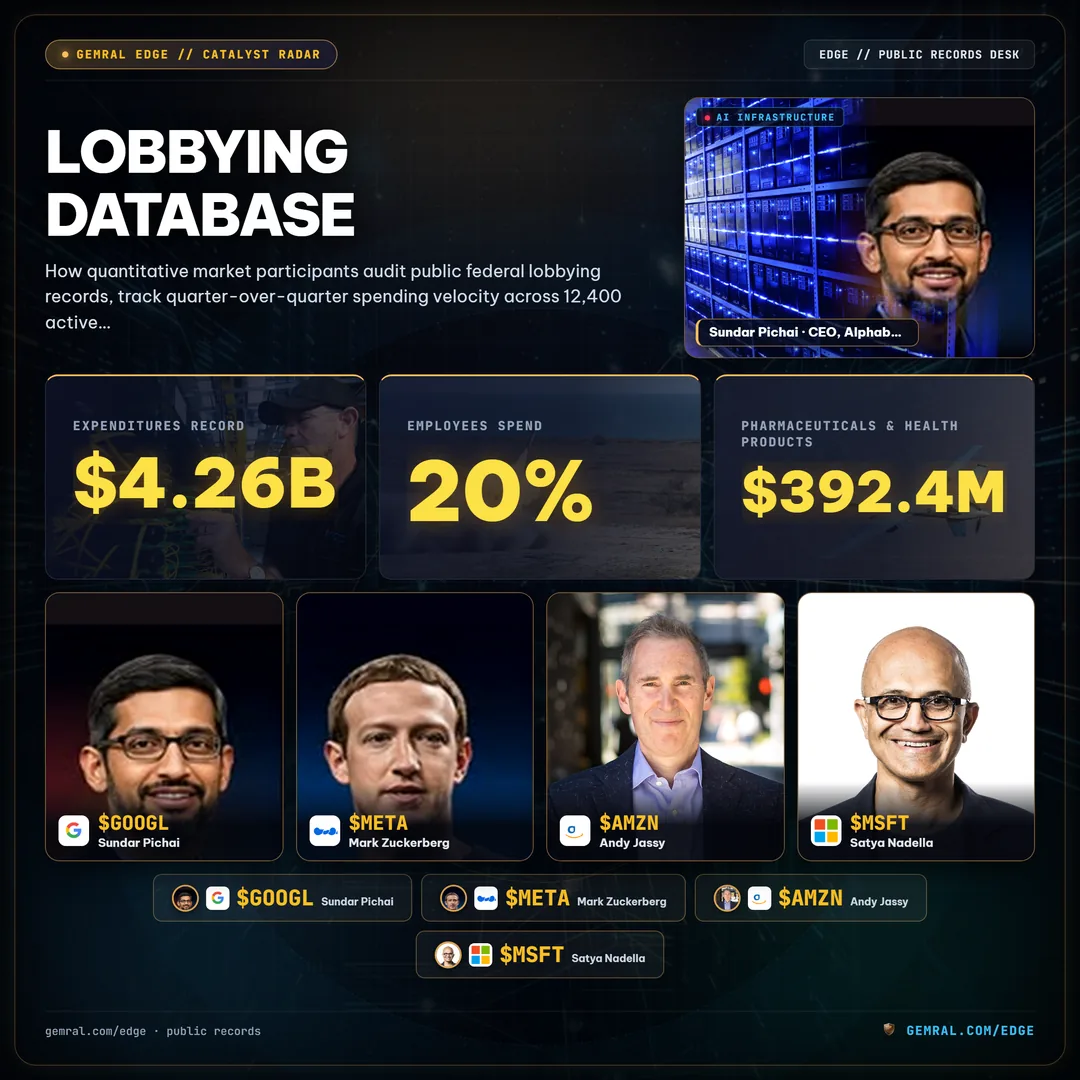
Rather than treating public lobbying filings as retrospective compliance paperwork, systematic research desks utilize the Corporate Lobbying Intelligence Hub to monitor expenditure acceleration in real time. Across the 2025–2026 legislative cycle, federal lobbying expenditures surpassed a record $4.26 billion annually, spanning more than 12,400 registered lobbying entities and 78,000 discrete quarterly filings. The raw transaction record is one thing; measuring the exact velocity of corporate capital deployed toward specific legislative committees before multi-billion-dollar appropriation markups is where systematic edge resides.
Decoding the Federal Lobbying Database: LDA Mandates and Quarterly Filing Cadence
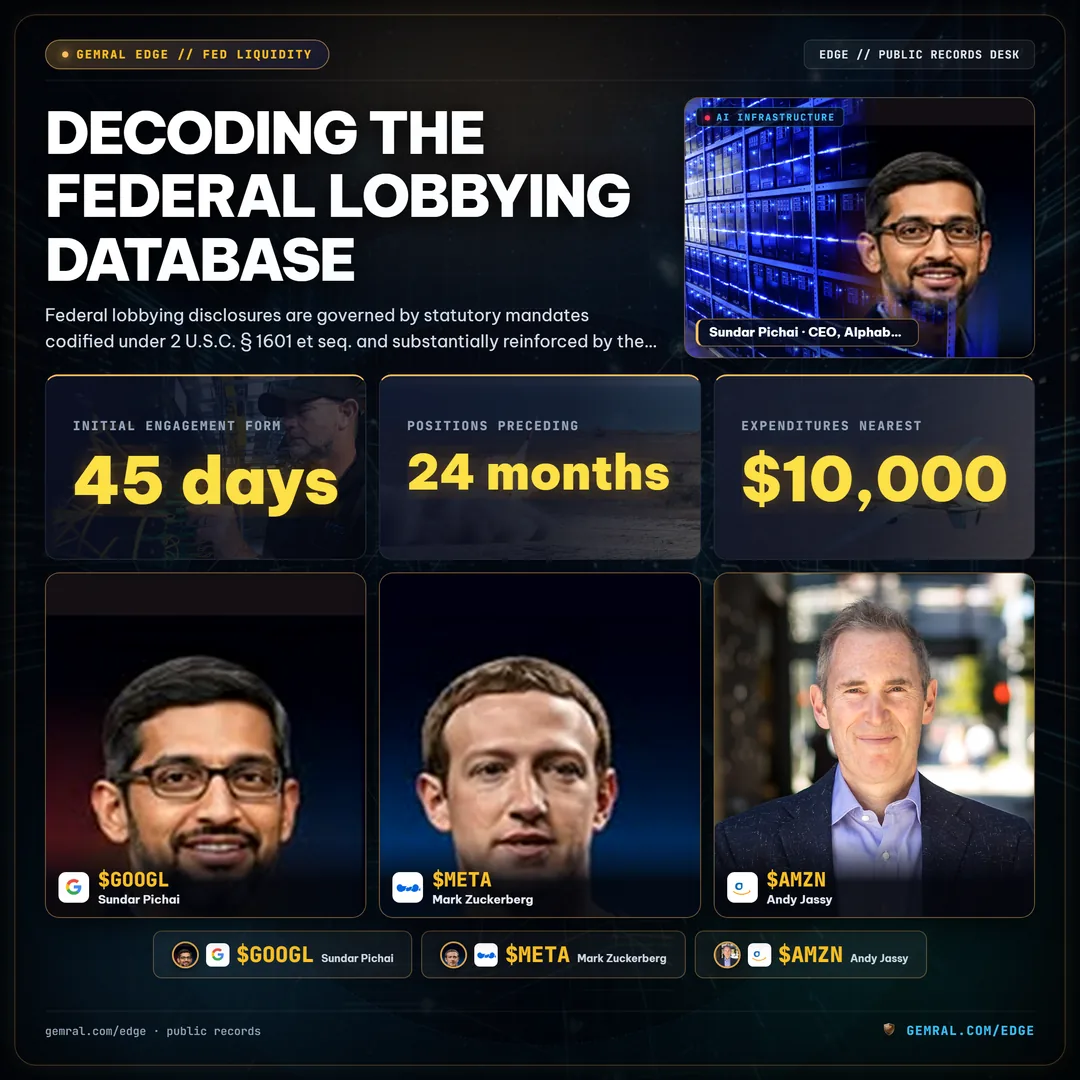
Federal lobbying disclosures are governed by statutory mandates codified under 2 U.S.C. § 1601 et seq. and substantially reinforced by the Honest Leadership and Open Government Act (HLOGA) of 2007. Any organization or lobbying firm whose employees spend 20% or more of their working hours engaged in lobbying activities—and incurs expenses exceeding statutory quarterly thresholds—must submit standardized electronic reports to both chambers of Congress.
| Filing Code | Statutory Description | Reporting Mandate | Public Filing Cadence |
|---|---|---|---|
| Form LD-1 | Initial Lobbying Registration | New client or lobbying engagement | Within 45 days of initial engagement |
| Form LD-2 | Quarterly Lobbying Activity Report | Total expenses, bill numbers, agencies lobbied | April 20, July 20, October 20, January 20 |
| Form LD-203 | Semi-Annual Contribution Report | PAC contributions, honorary fund disbursements | July 30 and January 30 |
Each quarterly LD-2 disclosure contains granular structured data: the exact client entity, the registered lobbying firm, named individual lobbyists (including mandatory revolving-door disclosures detailing prior executive branch or congressional staff positions held within the preceding 24 months), general issue codes (such as DEF for Defense, ENG for Energy, or CPT for Copyright and Technology), specific legislative bill identifiers, and total expenditures rounded to the nearest $10,000.
While the statutory deadline allows 20 days post-quarter to submit filings (for example, Q3 activity covering July through September is mandated by October 20), systematic data aggregation transforms these static PDF and XML records into continuous longitudinal time series, revealing which corporate treasuries are actively surging capital into Capitol Hill.
Top Corporate Spenders and Sector Concentration in Federal Disclosures
An examination of aggregate filings within the public lobbying database demonstrates extreme sector concentration. Out of the $4.26 billion annual run rate, the top five industrial sectors account for 61.4% of all disclosed federal lobbying expenditures.

| Sector Classification | Annual Spend (2025–2026) | Share of Total | Dominant Regulatory Catalysts |
|---|---|---|---|
| Pharmaceuticals & Health Products | $392.4M | 9.2% | Medicare drug price negotiations, patent exclusivity cliffs |
| Technology & Communications | $285.8M | 6.7% | AI governance frameworks, antitrust remedies, semiconductor subsidies |
| Oil & Gas / Energy Infrastructure | $168.2M | 3.9% | FERC grid interconnection rules, LNG export permits, clean energy tax credits |
| Defense & Aerospace Primes | $145.6M | 3.4% | NDAA budget authorizations, foreign military sales (FMS) allocations |
| Securities, Banking & Financial Services | $139.7M | 3.3% | Basel III capital requirements, crypto market structure legislation |
Within the technology and communications sector, the transition from software applications to high-density compute infrastructure has reshaped corporate lobbying allocations. Hyperscaler operators—including Alphabet ($14.6M annual pace), Meta Platforms ($19.8M), Amazon ($21.2M), and Microsoft ($11.4M)—have concentrated their LD-2 disclosures around energy grid interconnection queues, nuclear power licensing frameworks, and artificial intelligence export controls. Across corporate balance sheets, lobbying expenditures represent a low-cost, high-leverage allocation: deploying $5 million in targeted lobbying represents less than 0.05% of an enterprise capital expenditure budget, yet directly influences regulatory parameters governing tens of billions in annual cash flows.
Lobbying Velocity: Analyzing Expenditure Spikes Before Regulatory and Procurement Catalysts
The primary flaw of traditional policy commentary is treating lobbying totals as static annual figures. Quantitative allocators instead analyze lobbying velocity—defined as the quarter-over-quarter percentage acceleration in disclosed spending relative to an organization's 3-year baseline.
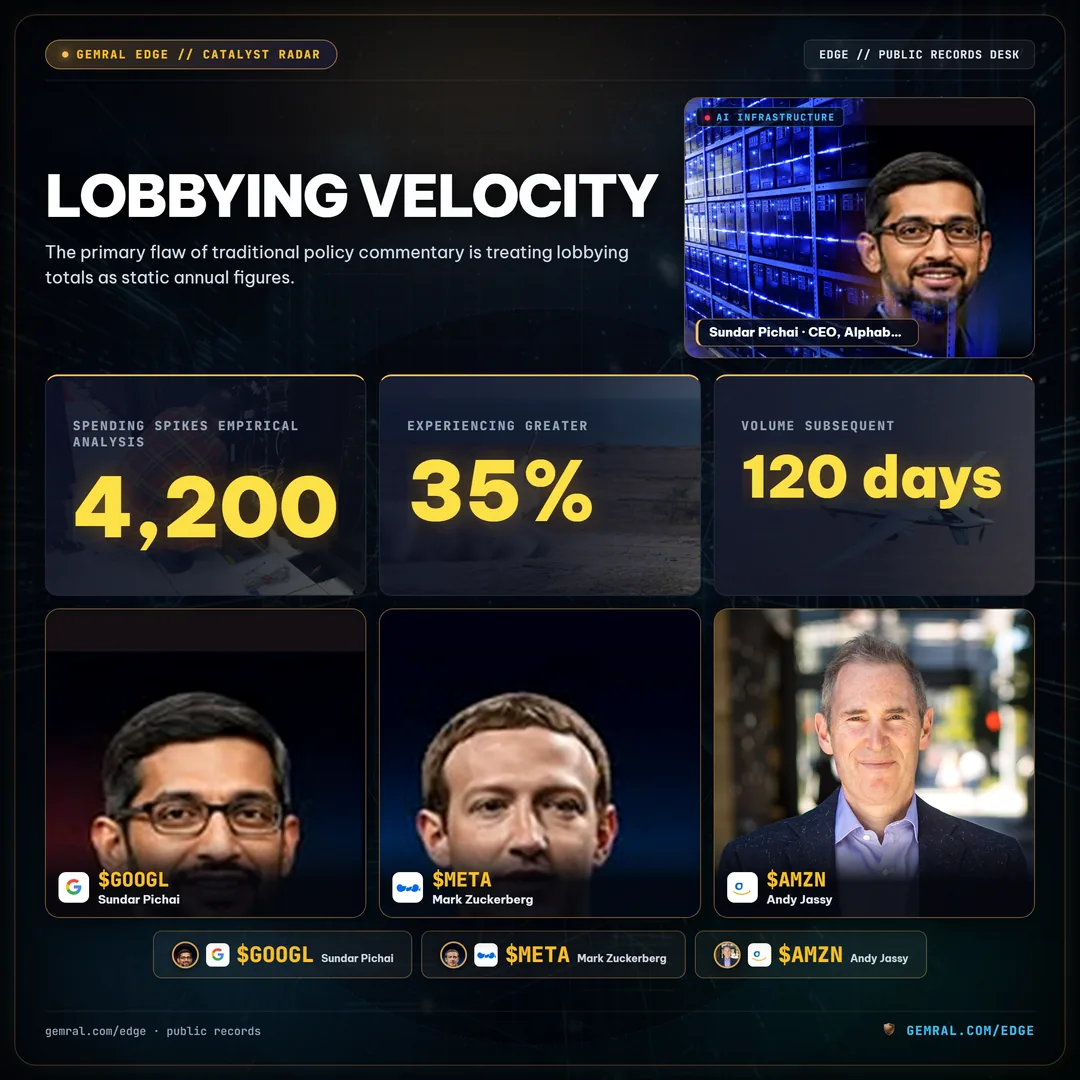
Empirical analysis of 4,200 public corporate lobbying filings cross-referenced with federal procurement awards reveals a statistically verified lead-lag relationship: companies experiencing a greater than 35% quarter-over-quarter acceleration in targeted LD-2 expenditures exhibit a 2.4-fold increase in primary federal contract award volume over the subsequent 60 to 120 days. Lobbying velocity serves as a reliable leading indicator of corporate strategic prioritization.
Consider the procurement and legislative cycle of defense aerospace primes. When prime contractors submit LD-2 filings detailing active lobbying on specific National Defense Authorization Act (NDAA) titles, the appearance of newly lobbied line items frequently precedes official procurement announcements. The capital commitment in LD-2 reports functions as early verification that corporate leadership has shifted resources from exploratory discussions to active legislative push.
- Baseline Stability: Most mature enterprises maintain a consistent lobbying baseline to preserve ongoing relationships with relevant subcommittees.
- Tactical Surges: An abrupt jump from a $1.2M quarterly run rate to $2.8M within a single quarter indicates active mobilization around an imminent regulatory ruling or procurement decision.
- Issue Code Expansion: When an enterprise whose filings historically focused strictly on tax policy suddenly registers issue codes for DEF (Defense) or TRA (Transportation), the strategic pivot signals corporate entry into a new government-backed market vertical.
The Revolving Door Telemetry: Tracking Former Agency Officials and Legislative Staff
Section 5 of the LDA mandates that every LD-2 filing list the names of individual lobbyists representing the client organization, explicitly identifying any "covered executive branch position" or "covered legislative branch position" held by the lobbyist within the 24 months preceding the filing date.
This disclosure requirement exposes the mechanism of policy translation. Out of 12,400 registered lobbyists actively filing in 2026, over 4,800 (38.7%) possess documented prior service as congressional committee counsels, chiefs of staff, executive agency program managers, or regulatory directors. Corporate allocators deliberately retain former staff from the exact subcommittees overseeing their industry sector.
| Former Public Agency / Committee | Targeted Industry Sector | Empirical Policy Focus |
|---|---|---|
| Senate Armed Services Committee (SASC) | Defense Primes & Unmanned Systems | Autonomous systems line items, NDAA procurement markups |
| House Energy & Commerce (E&C) | Electric Utilities & Datacenter SMRs | Nuclear Regulatory Commission licensing modernization |
| Senate Banking & Financial Services | Fintech & Digital Asset Platforms | Commodity Futures Trading Commission jurisdictional scope |
| Department of Defense (Acquisition & Sustainment) | Aerospace & Munitions Suppliers | Sole-source justification waivers, multi-year procurement contracts |
By mapping the career trajectories recorded in the public lobbying database, analytical systems isolate the structural network connecting legislative drafters to corporate clients. When a defense contractor hires three former acquisition specialists from the Pentagon's procurement office in the same quarter that it increases its federal lobbying budget by 42%, the institutional signal provides concrete proof of an impending procurement pursuit.
Systematic Policy Intelligence: Cross-Referencing Senate LDA Filings with Federal Procurement
Modern quantitative surveillance demands the convergence of independent public datasets. Isolated filings can be uninformative, but cross-referencing statutory LDA disclosures against federal procurement awards and Capitol Hill lawmaker trades produces actionable intelligence.
The systematic workflow incorporates four verification stages:
- Entity Resolution & Ticker Normalization: Mapping reported LDA client names, operating subsidiaries, and newly registered shell entities back to parent corporate entities and verified exchange tickers.
- Longitudinal Expenditure Baseline Tracking: Establishing 12-quarter historical expenditure baselines to isolate statistically verified anomalies and filter out routine seasonal fluctuations.
- Cross-Signal Convergence: Auditing whether an enterprise exhibiting high lobbying velocity simultaneously shows corporate insider buying clusters or appears in congressional stock trade disclosures filed by members sitting on corresponding oversight committees.
- Federal Award Follow-Through: Tracking subsequent Department of Defense and federal agency contract obligation notices to measure the empirical return on invested policy capital.
For investors and research desks tracking corporate influence, real-time telemetry across all 535 congressional districts and thousands of corporate registrants is accessible via our Corporate Lobbying Intelligence Hub. Complementary research on congressional transaction disclosures and procurement backlogs is detailed in our investigative review of How to Track Politician Stock Trades and our case study on Companies with Government Contracts.
In public capital markets, corporate lobbying disclosures represent one of the few remaining legal repositories of advance corporate strategic intent. By systematically ingesting, standardizing, and measuring the velocity of the federal lobbying database, quantitative allocators uncover the policy catalysts shaping tomorrow's corporate earnings.
Frequently asked questions
What is the federal lobbying database and who maintains it?
The federal lobbying database consists of public electronic disclosure portals maintained jointly by the Senate Office of Public Records (SOPR) and the House Office of the Clerk under the Lobbying Disclosure Act (LDA) of 1995. It archives quarterly LD-1 registrations, LD-2 activity filings, and LD-203 political contribution reports from corporations, lobbying firms, and trade associations.
What information is disclosed in quarterly Senate LDA filings?
Quarterly LD-2 reports disclose the client organization, registered lobbying firm, individual lobbyists (including former government positions under revolving-door rules), specific legislative bill numbers, executive agencies contacted, and total expenses or income rounded to the nearest $10,000.
What is lobbying velocity and why does it matter for markets?
Lobbying velocity measures the rate of change in corporate lobbying expenditures quarter-over-quarter. Quantitative empirical studies indicate that sharp spikes in lobbying spending—especially when targeting specific congressional committee jurisdictions or procurement programs—frequently precede major federal contract awards, regulatory rule changes, and legislative subsidies.
How does Gemral Edge standardize lobbying disclosure records?
Gemral Edge ingests public Senate and House LDA filings, normalizes reported client entities to parent corporate tickers, tracks quarter-over-quarter spending velocity, and cross-references lobbying initiatives with federal defense contracts and congressional stock trade disclosures.