Hedge Fund Database Architecture: Bitemporal Schema Design for Point-in-Time Public Records
An architectural deep dive into designing an institutional hedge fund database for alternative data, decoupling real-world transaction dates from publication timestamps to eliminate look-ahead bias across 850,000+ resolved public events.

In quantitative asset management, building an institutional hedge fund database for non-traditional datasets represents one of the most critical engineering challenges facing systematic research teams. While commoditized market quote feeds and accounting tables follow rigid reporting cadences, alternative data gathered from statutory government disclosures, federal procurement actions, and legislative filings arrives through irregular, asynchronous reporting channels. Engineering an infrastructure capable of handling these streams without introducing simulation distortions requires a disciplined bitemporal data architecture.
When quantitative researchers construct predictive equity features from public disclosures, conventional relational models fail to capture the temporal nuances of regulatory distribution. Overwriting modified records in place, failing to account for statutory publication delays, or mapping historical transactions to today's corporate parent entities introduces severe look-ahead bias and survivorship distortion. To understand how quantitative research desks structure institutional data ingestion, consult our reference framework on Alternative Data for Hedge Funds. For comparative evaluations of institutional alternative feeds, review our deep dive on Alternative Data Sources and federal procurement backlogs in Drone Companies with Government Contracts.
Why Modern Hedge Funds Require Bitemporal Database Architecture
The architecture of a modern hedge fund database must solve a fundamental temporal problem: market participants can only execute trades based on information that was publicly accessible at that specific instant in history. In academic literature and basic data pipelines, data engineers often rely on a single date column, typically labeled event_date or transaction_date. In federal procurement and statutory disclosures, however, the date an action is signed by an agency contracting officer is almost never the date the record becomes visible in statutory procurement portals.

Consider the federal contracting arena, where annual procurement allocations exceed $750 billion across aerospace, defense, and information technology prime vendors. When the Department of Defense awards a major defense contract modification to a prime contractor, statutory operational security rules mandate a minimum 90-day publication delay before the transaction is published in federal award registries. If a quantitative backtesting engine joins equity price series using the contractual signing date rather than the verified publication timestamp, the quantitative simulation consumes information 90 days before the broader market could legally observe it.
A bitemporal database architecture eliminates this defect by explicitly tracking two distinct temporal axes for every individual observation:
- Valid Time (Business Time): The specific date and time when the economic or contractual event occurred in the physical world (for example, the contractual award date or the trade execution date).
- Transaction Time (Ingestion Time): The immutable timestamp recorded by the ingestion engine indicating when the public disclosure was verified, parsed, and stored in the database repository.
By implementing bitemporal indexing across a historical corpus of 850,000+ resolved public events, quantitative models can reconstruct the exact state of global corporate intelligence as of any historical timestamp. To inspect the scale of this temporal mapping across listed companies, quantitative researchers can review the public institutional data coverage portal.
How Bitemporal Schemas Decouple Event Dates from Publication Timestamps
Decoupling valid time from transaction time requires an immutable storage pattern. In traditional operational databases, when an agency issues a correction to a prior contract modification or an elected official amends an annual disclosure, the software executes an UPDATE statement that overwrites existing table values. In a quantitative hedge fund database, in-place updates are strictly prohibited. Every amendment, cancellation, or correction is ingested as a distinct append-only row tagged with its own effective validity range: system_from and system_to.

| Public Record Dataset | Valid Event Date | Median Public Delay | 90th Percentile Delay | Underlying Statutory Mechanism |
|---|---|---|---|---|
| Defense Contract Transactions | Contract Signing Date | 90 days | 91 days | Statutory 90-day operational security embargo |
| Congressional Stock Trades | Execution Date | 27 days | 63 days | STOCK Act 45-day statutory filing window |
| Corporate Insider Filings | Trade Execution Date | 1 day | 4 days | Statutory two-business-day corporate insider reporting mandate |
| Quarterly Lobbying Disclosures | Quarter End Date | 20 days | 21 days | Lobbying Disclosure Act 20-day quarterly filing rule |
| Civilian Agency Procurement | Action Obligation Date | 3 days | 14 days | Federal acquisition agency batch upload cycle |
The empirical distribution of reporting lags highlights the operational necessity of bitemporal schema separation. Across 50,000+ congressional trade disclosures and 35,000+ corporate insider filings, the gap between trade execution and public visibility varies substantially. In congressional trading records, the median lag between transaction date and statutory disclosure is 27 days, with the 90th percentile reaching 63 days. Similarly, quarterly lobbying reports under the Lobbying Disclosure Act feature a median lag of 20 days following the conclusion of each calendar quarter.
In defense procurement, empirical measurement across 9,158 dual-tracked defense contracts demonstrates that daily contract announcements precede federal contract registry postings by a median of 90 days across $1.07 trillion in announced obligations. For systematic quantitative models, executing a point-in-time join on publication timestamps guarantees zero look-ahead bias, ensuring that simulated portfolio rebalancing reflects true historical execution constraints.
Point-in-Time Entity Resolution Across Ticker Transitions and Acquisitions
While bitemporal timestamps solve the temporal leakage problem, point-in-time entity resolution addresses corporate identity fragmentation. Public corporations do not operate as monolithic entities; they win government business, hire lobbyists, and manage physical infrastructure through complex hierarchies of subsidiaries, joint ventures, and operating divisions. A major aerospace prime contractor, for example, may maintain over 350 active commercial and government entity CAGE codes and subsidiary identifier keys.

The core engineering flaw in commercial vendor feeds is the practice of mapping all historical transactions to the corporate parent that owns the asset today. This static relational approach corrupts historical backtests by crediting revenue and contract wins to an acquiring corporation years before the merger was finalized.
To measure the exact distortion introduced by static entity mapping, consider a quantitative audit of federal contract transactions:
- Current Table Misattribution: Mapping resolved federal contract transactions through today's corporate parent table instead of the parent valid on the publication date credits $89.6 billion (3.3% of $2.7 trillion, spanning 8,568 transactions) to the wrong equity ticker.
- Post-Close Contract Rolls: Exactly 659 federal contract actions were signed before an acquisition closed but published after the transaction was finalized. In an audited bitemporal pipeline, 651 actions rolled to the listed acquiring entity, while 8 actions had unlisted acquirers and carried no ticker.
- Ticker Transitions: Exactly 254 contract actions were executed by corporations that changed their equity ticker between signing and publication. A point-in-time resolver correctly attaches the active trading ticker on the day the record becomes public.
- Subsidiary Hops: A measured $191.9 billion of ticker-linked contract transactions (7.1% of dollars, comprising 13,465 transactions) reach a listed company only through a dated subsidiary relationship link. The recipient name on the primary award is not the listed parent company.
Consider the corporate evolution of defense giants such as RTX Corporation, L3Harris Technologies, and General Dynamics. When United Technologies merged with Raytheon Company in 2020 to form Raytheon Technologies (later rebranded as RTX), contracts awarded to legacy subsidiaries required date-aware parent linkage. Joining historical events through a static parent table incorrectly projects modern enterprise scale onto historical trading periods. Researchers examining specific ticker-level disclosure histories can inspect historical corporate event trails directly through public research portals such as RTX Corporation Disclosure Telemetry (gemral.com/edge/s/RTX), alongside peer defense profiles for L3Harris Technologies Telemetry (gemral.com/edge/s/LHX) and General Dynamics Telemetry (gemral.com/edge/s/GD).
Static SQL Snapshots vs Immutable Bitemporal Parquet Lakehouses
Building an institutional hedge fund database requires selecting an underlying storage architecture capable of supporting petabyte-scale simulation queries. Traditional relational database management systems (RDBMS) configured with standard row-oriented layouts incur high overhead when executing temporal interval joins across hundreds of thousands of historical corporate events.
| Architecture Metric | Relational SQL Snapshots | Bitemporal Parquet Lakehouse | Quantitative Research Advantage |
|---|---|---|---|
| Storage Format | Row-oriented relational tables | Columnar Apache Parquet files | 8x to 12x compression with vectorized columnar scans |
| Temporal Query Mechanism | Complex SQL self-joins with BETWEEN clauses | Partitioned snapshot paths by publication date | Zero-scan partition pruning for backtesting runs |
| Record Mutability | In-place UPDATE and DELETE queries | Append-only immutable record versioning | Cryptographic SHA-256 manifest verification |
| API & Bulk Egress | Direct database connections with connection limits | High-throughput REST API and pre-built bundles | Deterministic batch ingestion into local compute clusters |
| Survivorship Bias Handling | Delisted tickers frequently purged to save space | Historical universe preserved including delisted names | Accurate simulation across 4,745 historical tickers |
In production research workflows, institutional quantitative funds transition from transactional SQL instances to columnar lakehouse architectures. Storing alternative data in standardized Apache Parquet format offers distinct computational advantages. Parquet's columnar compression allows quantitative research engines to scan only the necessary numerical columns (such as action_amount, event_published_at, and ticker_asof) while bypassing hundreds of megabytes of descriptive textual metadata.
Furthermore, by organizing Parquet directories using temporal partition pruning (for example, partitioning datasets by publication year and month), backtesting compute clusters can execute time-travel queries across historical horizons in milliseconds. Quantitative researchers can inspect verified sample rows and schema definitions directly through the Edge Data Preview repository.
Data Integrity Gates: Eliminating Look-Ahead and Survivorship Ingestion Bias
Data architecture is only as reliable as the quality gates enforcing its ingestion pipeline. In alternative data engineering, pipelines must implement mechanical verification gates before any batch is committed to the analytical data lakehouse. Relying on vendor self-attestation or ad-hoc data cleaning introduces latent errors that degrade quantitative model efficacy.
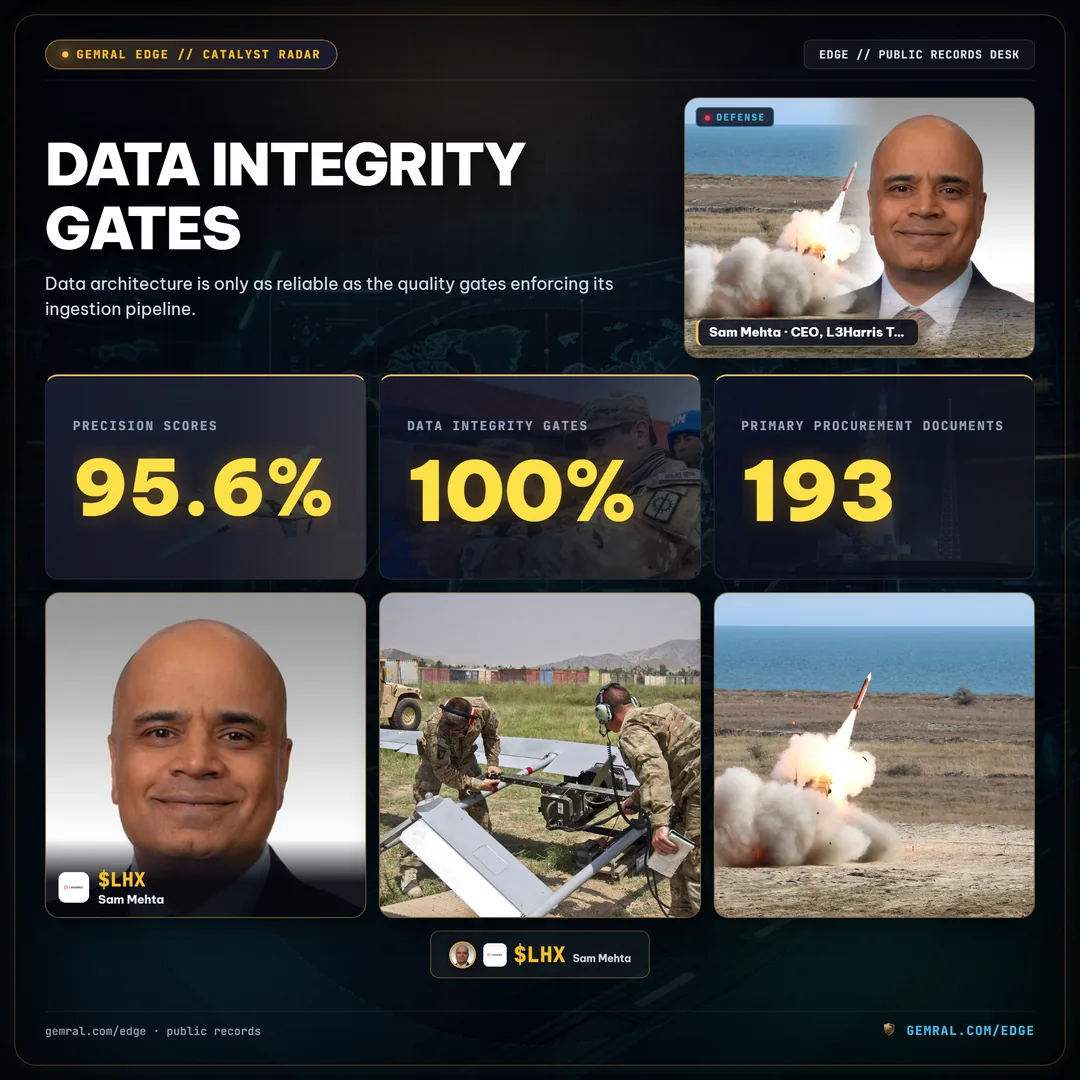
To maintain institutional data standards, our data engineering pipeline subjects all incoming public records to double-blind accuracy sampling against primary public source documents before dataset publication. In our latest verified sampling batches, all 13 primary record types achieved precision scores between 95.6% and 100%:
- Federal Contract Awards: 98.5% precision (193 of 196 verified against primary procurement documents).
- Congressional Stock Trades: 97.7% precision (168 of 172 verified; 28 records were not checkable due to automated source access restrictions).
- Corporate Lobbying Registrations: 96.0% precision (192 of 200 verified against legislative filing records).
- Pre-Award Procurement Notices: 97.0% precision (192 of 198 verified against federal solicitations).
- Bid Protests: 97.0% precision (194 of 200 verified against administrative legal dockets).
Full transparency requires stating cumulative precision scores across historical dataset builds. Cumulative precision across all historical batches reflects lower scores for four categories (contracts 91.2%, pre-award notices 76.4%, subcontractor links 94.0%, and bid protests 92.5%) because early pipeline iterations were graded before the advanced entity resolver was deployed in October 2026.
Additionally, quantitative researchers must account for coverage boundaries. Approximately 49.3% of FY2018+ federal contract transaction dollars are linked to listed public tickers. The remaining 50.7% of contract dollars flow to private corporations, non-profit institutions, university research labs, or foreign entities that do not trade on public equities exchanges. In bid protests, exactly 13,850 protests are tracked, with 25.3% (3,505 protests) formally linked to a contract transaction and awardee identifier, and 61.7% matching the statutory 100-day decision deadline.
Connecting Federal Procurement Telemetry into Systematic Trading Pipelines
Once primary alternative datasets are organized into an immutable bitemporal database, quantitative engineers can wire these clean data streams into systematic quantitative research workflows. Modern quantitative teams consume alternative data feeds through three complementary delivery mechanisms:
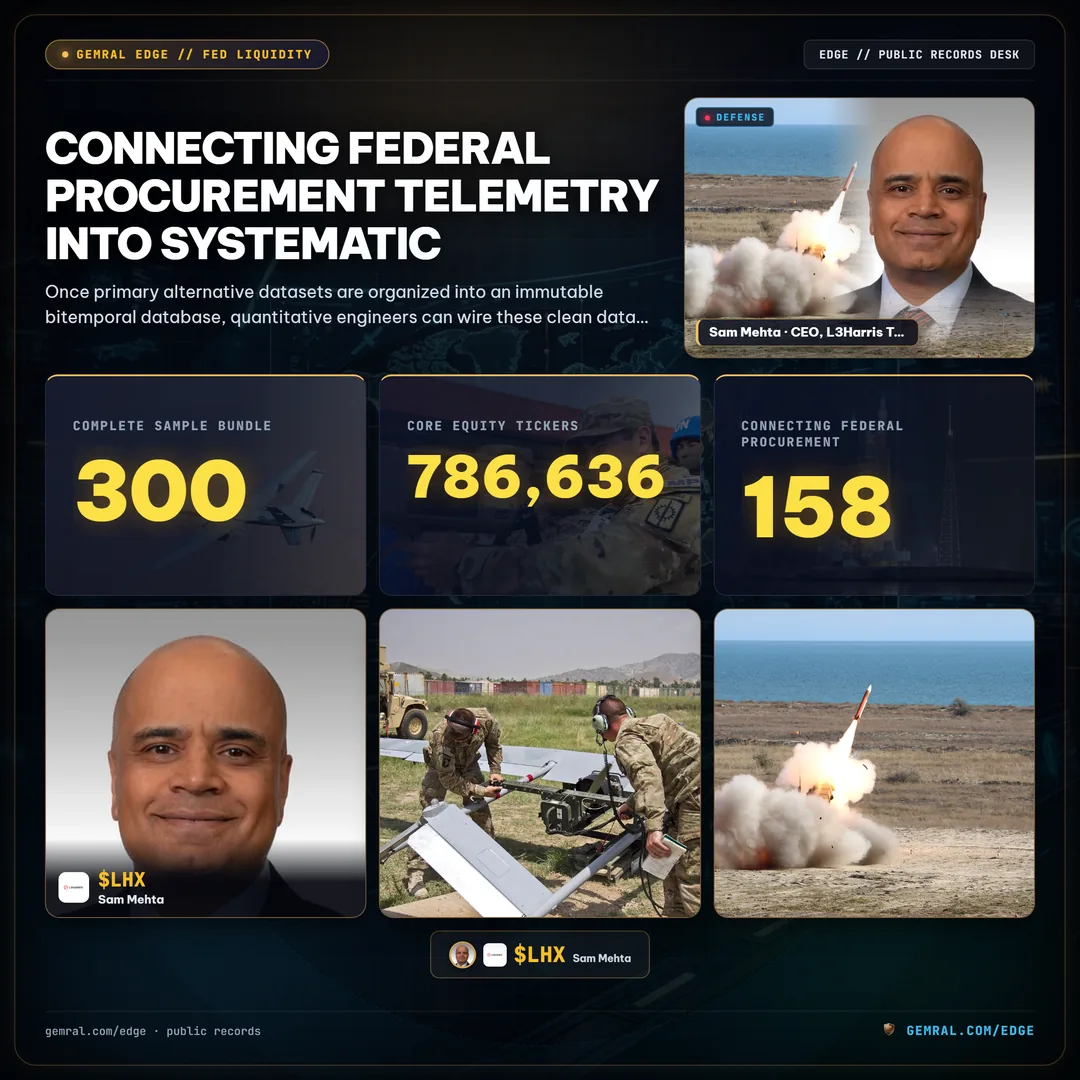
- Institutional Sample Packs & Bulk Parquet: Research desks conducting initial quantitative evaluations ingest standardized Parquet archives. A complete sample bundle across 300 core equity tickers comprises 786,636 rows distributed across 158 Parquet files and 24 relational tables, accompanied by cryptographic manifests confirming complete row-level integrity.
- Programmatic REST API: Production execution algorithms synchronize operational states via high-throughput REST APIs, pulling verified delta feeds at scheduled intervals following statutory market closes.
- Interactive Analytical Research Desks: Discretionary quantitative portfolio managers and research analysts interrogate corporate exposure, contract backlog burn rates, and regulatory filings through purpose-built intelligence terminals.
For quantitative funds, hedge fund data engineers, and institutional asset allocators evaluating alternative data feeds, Gemral Edge provides transparent access tiers across retail research, professional analytics, and enterprise data delivery. To explore individual and enterprise research access, view the Gemral Edge Pricing and Plan Specifications, featuring transparent access tiers from our Pro tier at $39/month to the B2B research desk at $299/month, and the institutional API tier at $2,000/month.
Frequently asked questions
What is a bitemporal hedge fund database architecture?
A bitemporal database tracks two timeline dimensions simultaneously: valid time (when an event occurred in the real world) and transaction time (when the record was ingested into the system). For hedge funds, this ensures backtests only execute trades using information available at that exact historical moment, preventing look-ahead bias.
How does point-in-time entity resolution work in alternative data pipelines?
Point-in-time entity resolution maps awards, filings, and disclosures filed under diverse subsidiary names, vendor codes, or historical ticker symbols to the exact public equity ticker active on the publication date, accurately accounting for corporate spin-offs, mergers, and ticker renames.
Why do traditional relational SQL snapshots fail for quantitative simulation?
Traditional relational databases typically overwrite revised records in place. When federal agencies retroactively correct contract figures or companies submit amended disclosures, in-place updates create retroactive leakage in historical simulations, leading to false statistical significance during backtesting.
What data formats and delivery standards do institutional quant funds require?
Institutional quantitative funds require immutable, columnar Apache Parquet files partitioned by publication date, accompanied by cryptographic SHA-256 manifests, row-level verification ledgers, and high-throughput REST APIs for seamless backtesting and production ingestion.