Federal Contracts Database: Analyzing Federal Award Obligations and Parent Entity Resolution
An institutional technical breakdown of federal procurement database architecture, detailing transaction-level obligation accounting, CAGE code entity resolution, and point-in-time modeling for quantitative capital allocators.
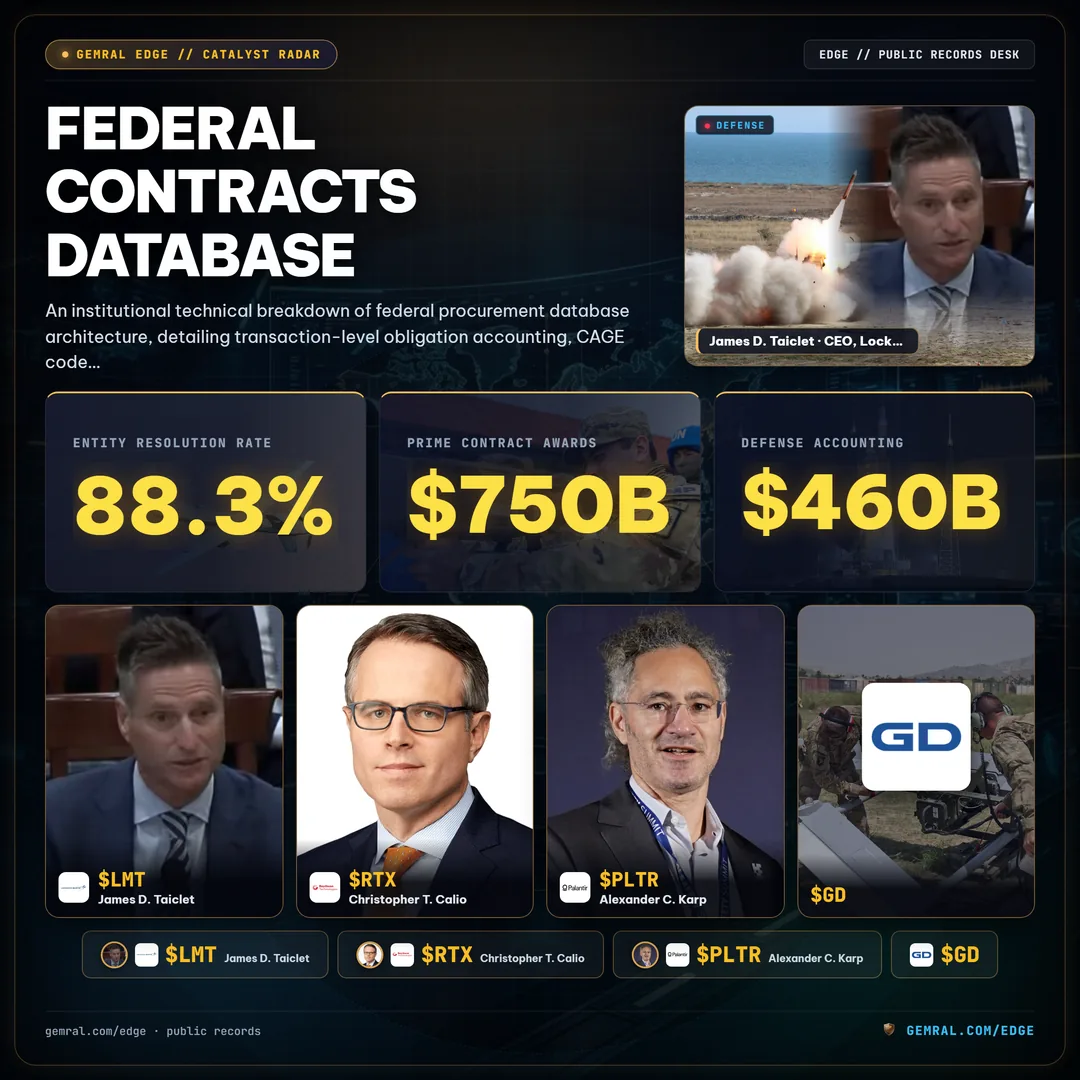
Across global capital markets, sovereign public procurement represents the single largest recurring deployment of balance sheet capital. Annually, the United States federal government authorizes in excess of $750 billion in prime contract awards across defense and civilian departments, with the Department of Defense accounting for over $460 billion—or approximately 61.3% of total discretionary contracting activity. Yet, despite the statutory transparency mandates codified under the Federal Funding Accountability and Transparency Act (FFATA), institutional researchers and quantitative analysts routinely struggle to transform raw federal procurement feeds into actionable market intelligence.
The challenge does not stem from a scarcity of disclosures, but rather from systemic structural complexity. Raw federal award records capture isolated operational events across hundreds of federal contracting offices, utilizing specialized identification keys, decentralized ledger systems, and legal subsidiary corporate hierarchies that mask the true corporate beneficiaries. Comparing our sector rankings of defense contractors by market cap and targeted research on small cap defense stocks demonstrates how procurement capitalization scales from subsystem innovators to prime integrators. Transforming these fragmented records requires institutional data pipelines that can parse transaction telemetry, map subsidiary entities back to parent equities at historical points in time, and distinguish between binding committed obligations and hypothetical contract ceilings.
Understanding Federal Contracts Database Architecture: Primary Award Repositories and Data Feeds
A comprehensive federal contracts database aggregates, cleanses, and synchronizes telemetry from multiple government repositories. The operational backbone of federal procurement reporting is the Federal Procurement Data System (FPDS), administered by the General Services Administration (GSA), which functions as the official statutory system of record for all federal contract awards exceeding the micro-purchase threshold ($10,000). Every federal agency is legally required to submit detailed transactional data to FPDS, encompassing over 650,000 individual contract actions, delivery orders, and bilateral modifications annually.
Concurrently, the System for Award Management (SAM) serves as the definitive registry for government vendors, managing entity registrations, corporate representations, and pre-award solicitations. When quantitative funds build data pipelines to ingest federal records—such as those accessible via the Federal Contracts Explorer and institutional data preview—they must ingest and normalize several distinct record layers:
- Definitive Contracts (C-type): Standalone procurement agreements that establish binding obligations, scope of work, and performance schedules for major defense acquisition programs (MDAPs) and civilian infrastructure undertakings.
- Indefinite Delivery Vehicles (IDVs): Umbrella contracting instruments—including Indefinite Delivery Indefinite Quantity (IDIQ) contracts, Government-Wide Acquisition Contracts (GWACs), and Federal Supply Schedules (FSS)—that establish pricing terms and ceiling limits for multi-year agency procurement without obligating immediate funds.
- Delivery & Task Orders (D-type / F-type): Transaction-level funding instruments executed against parent IDVs that authorize specific outlays for defined quantities of goods or professional services.
- Contract Modifications: Post-award administrative adjustments that record deobligations, incremental funding injections, scope changes, and option period exercises. Modifications represent nearly 48.7% of all recorded procurement transactions in any given fiscal year.
Dissecting Transaction Telemetry: Contract Obligation Amounts vs Total Potential Ceiling Values
The single most pervasive failure mode in federal contract analysis is confusing the total potential contract ceiling with the action obligation amount. Headline press releases and retail screener platforms frequently announce that a defense contractor has received a "$5.0 billion federal contract award." In procurement reality, this headline figure almost universally denotes the maximum cumulative capacity authorized over a multi-year IDIQ vehicle across a potential five-to-ten-year ordering period.
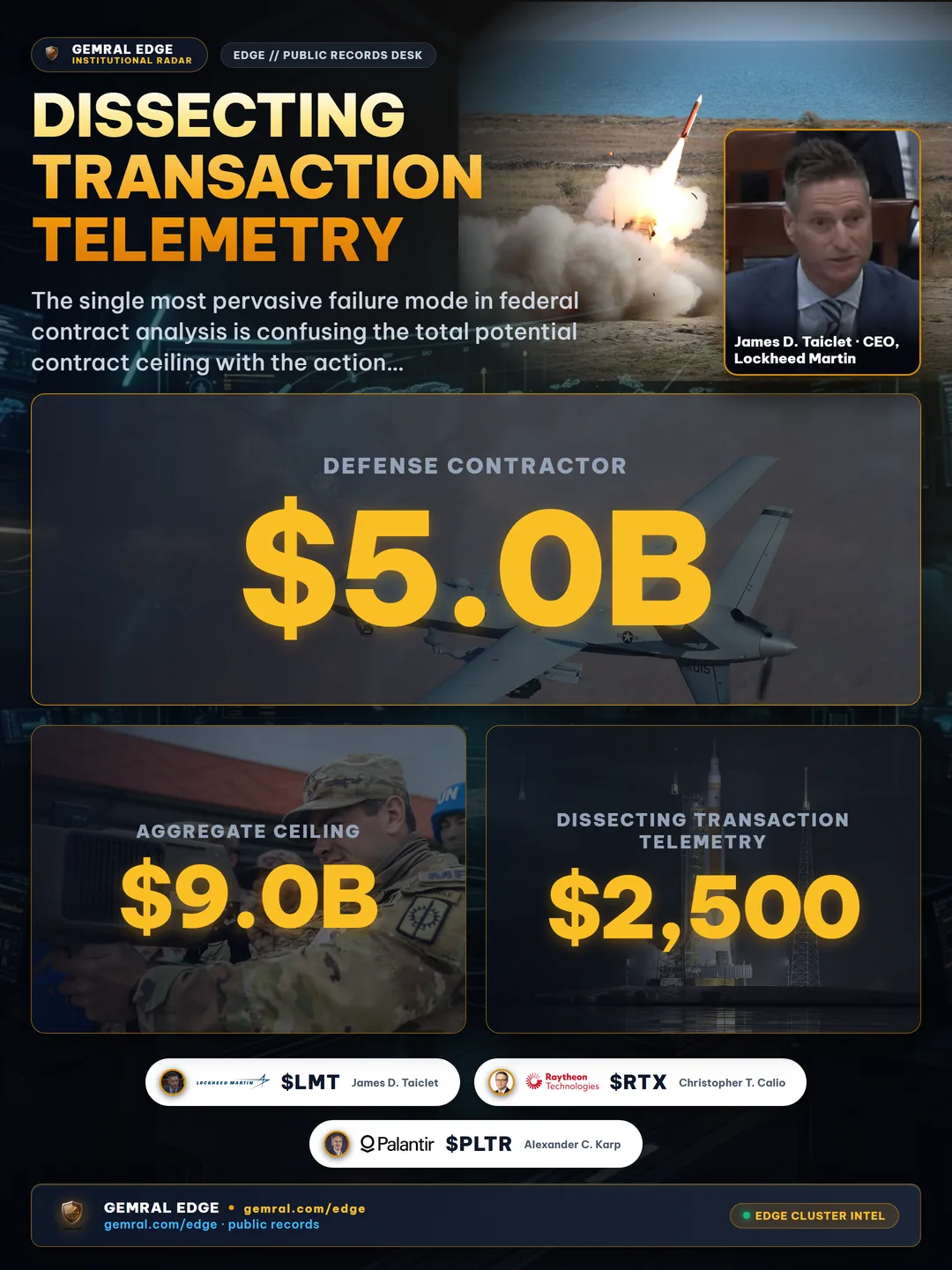
Consider an empirical example: In a five-year, multi-award enterprise software IDIQ carrying an aggregate ceiling of $9.0 billion distributed among six prime awardees, the initial obligated amount per vendor at execution may be as modest as the statutory minimum guarantee—frequently just $2,500 to $10,000. Assuming that the contractor will recognize $1.5 billion in annualized revenue based solely on the ceiling creates catastrophic valuation distortions in equity revenue projection models.
Institutional procurement databases maintain rigorous mathematical separation between three distinct financial metrics on every transaction record:
- Action Obligation: The net dollar change incurred by a specific procurement transaction. Positive values denote newly committed funds, while negative values record deobligations resulting from program cancellations, contract closeouts, or descoped requirements.
- Current Contract Value (Base and Exercised Options): The cumulative dollar sum of all funds obligated to date plus the value of formally exercised option periods. This metric reflects the current legally enforceable liability of the federal government.
- Ultimate Potential Contract Value (Base and All Options): The maximum theoretical value of the contract assuming every unexercised option year is fully funded and all discretionary ceilings are reached.
By tracking transaction-level incremental obligations across consecutive fiscal quarters, quantitative researchers can calculate the true burn rate and funding velocity of major aerospace, IT modernization, and defense programs.
Procurement Vehicles and Commercial Velocity: FAR-Based Competitive Bids vs Other Transaction Authority
The statutory framework governing a federal award directly dictates the velocity of capital deployment and the underlying margin profile of the contractor. Traditional federal acquisitions are executed under the stringent legal mandates of the Federal Acquisition Regulation (FAR). A standard FAR Part 15 negotiated procurement requires comprehensive cost and pricing data, adherence to government Cost Accounting Standards (CAS), and exhaustive milestone reviews. Consequently, the procurement lifecycle from initial Request for Information (RFI) to final award execution routinely extends across 24 to 36 months.
In stark contrast, modern dual-use commercial technology and agile defense systems increasingly bypass traditional FAR mechanisms through Other Transaction Authority (OTA) agreements authorized under Title 10 U.S.C. § 4022. OTAs are non-procurement contracts exempt from standard FAR compliance, allowing the Department of Defense to collaborate with non-traditional defense contractors and commercial tech leaders on terms resembling commercial enterprise negotiations.
The procurement dynamics of OTAs exhibit profound velocity advantages over FAR baselines:
- Compressed Award Horizons: Prototype OTA solicitations executed through defense innovation hubs (such as DIU, AFWERX, and DARPA) achieve contract finalization within 6 to 9 months, representing a 75% compression in procurement friction relative to standard FAR timelines.
- Direct Transition to Production: Under 10 U.S.C. § 4022(f), a contractor that successfully completes a competitively awarded prototype OTA can directly transition into a non-competitive, follow-on production contract worth hundreds of millions of dollars without undergoing a second multi-year procurement competition.
- Enhanced Intellectual Property Retention: Unlike standard FAR contracts where the federal government demands broad Unlimited Rights or Government Purpose Rights to technical data, OTA agreements permit private enterprises to retain commercial proprietary software and hardware IP, protecting long-term enterprise valuation multiples.
Parent Entity Resolution: Mapping CAGE Codes and Subsidiaries to Public Equity Tickers
Perhaps the most critical engineering challenge in building an institutional federal contracts database is executing precise parent entity resolution. Federal procurement awards are not issued to public stock tickers (e.g., NYSE: LMT, NYSE: RTX, Nasdaq: PLTR); they are awarded to hyper-specific operational physical facilities registered under unique Commercial and Government Entity (CAGE) codes and federal Unique Entity Identifiers (UEIs).
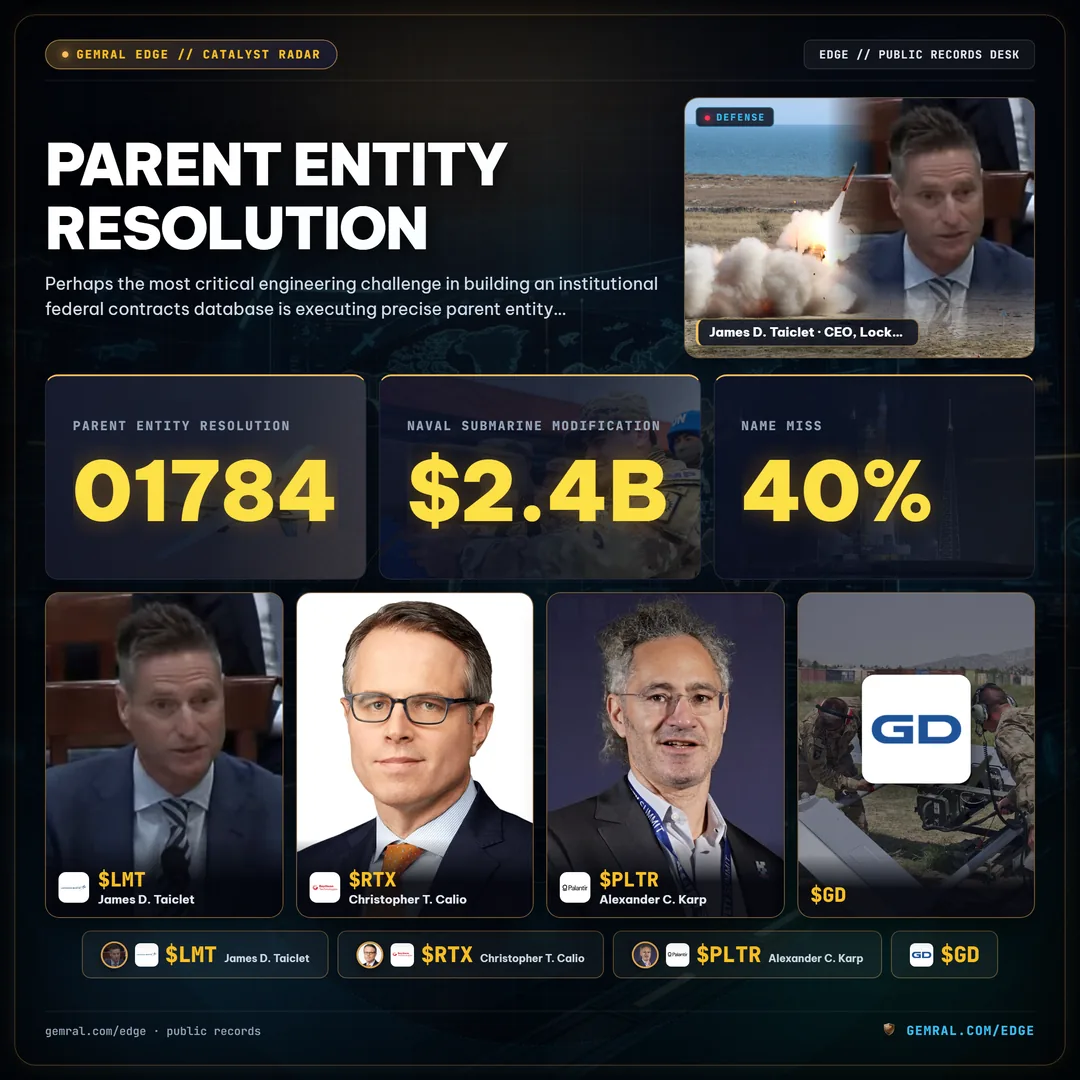
A major aerospace prime contractor does not exist in FPDS as a single monolithic corporate entity. Instead, it operates across hundreds of specialized legal subsidiaries, joint ventures, and facility locations. For instance, General Dynamics Corporation (NYSE: GD) maintains distinct CAGE codes for Bath Iron Works (CAGE: 01784), Electric Boat Corporation (CAGE: 02882), and General Dynamics Land Systems (CAGE: 18876). When a $2.4 billion naval submarine modification is awarded, the prime awardee listed in government raw feeds is often a municipal ship facility rather than the parent holding corporation.
Without automated parent resolution algorithms, an institutional screener querying raw records by corporate name will miss between 40% and 65% of the total award revenue flowing to publicly traded parents. As documented in our datasets overview, our research platform achieves an 88.3% entity resolution rate across active defense procurement contractors, mapping 489 of 554 high-conviction federal awardees back to their ultimate public parent equity tickers.
Executing point-in-time parent entity resolution requires maintaining a living graph of corporate mergers, divestitures, spin-offs, and CAGE code reassignments:
- CAGE / UEI Ingestion: Ingesting physical facility registry records to extract primary business addresses, Congressional districts, and NAICS product classifications.
- Cross-Referencing SEC 10-K Exhibit 21: Programmatically extracting annual subsidiary disclosure filings from official SEC regulatory archives to construct the definitive corporate family tree for all public filers.
- Historical Temporal Boundary Anchoring: Assigning effective acquisition and divestiture dates to every branch of the corporate tree to prevent look-ahead bias during historical simulation modeling.
Subcontractor Flow-Down Analysis: Tracking Tier-1 Prime Recipients vs Tier-2 Beneficiaries
While prime contracts provide direct visibility into government procurement priorities, a substantial portion of obligated dollars never remains on the prime contractor's balance sheet. Under Federal Acquisition Regulation Subpart 19.7, any prime contractor receiving a federal award exceeding $750,000 ($1.5 million for construction) must submit and execute an approved Small Business Subcontracting Plan. In defense aerospace procurement, prime system integrators routinely subcontract between 40% and 60% of the total program value to Tier-1 and Tier-2 specialized component fabricators.

The flow-down of procurement capital is captured in statutory subaward reporting systems, including the Electronic Subcontracting Reporting System (eSRS) and the FFATA Subaward Reporting System (FSRS). When a prime defense contractor secures a $12.8 billion award for sixth-generation fighter development, the ultimate capital flow ripples across specialized publicly traded suppliers:
- High-Frequency Microwave & Radar Assemblies: Merchant suppliers producing active electronically scanned array (AESA) radar subassemblies, specialized gallium nitride (GaN) semiconductors, and electronic warfare modules.
- Thermal Management & Cryogenic Systems: Precision manufacturers delivering liquid cooling manifolds and closed-loop heat exchangers engineered for power-dense avionics.
- Composite Aerostructures: Specialized titanium casting and advanced carbon-fiber fabricators delivering lightweight airframe sections.
Institutional investors who only monitor prime contract announcements consistently miss the high-margin revenue acceleration experienced by Tier-2 subsystem specialists. By mapping subaward flow-down percentages across defense programs, analysts can identify specialized mid-cap and small-cap suppliers whose revenue growth outpaces prime integrators.
Eliminating Survivorship and Revision Bias: Building Research-Grade Government Procurement Models
To deploy federal contract data within institutional quantitative research, data engineers must confront two critical econometric distortions: survivorship bias and point-in-time (PIT) revision lag.
Survivorship bias occurs when historical datasets are backfilled using contemporary corporate mappings. If Contractor A acquired Contractor B in 2024, a static database that retroactively reclassifies Contractor B's 2021 contract awards under Contractor A's public ticker will introduce severe look-ahead bias into historical simulations. Quantitative models trained on such distorted datasets falsely credit the acquiring parent with revenue momentum years before the transaction closed and cash flows consolidated.
Equally critical is the phenomenon of procurement revision lag. Although federal agencies are legally mandated to submit transaction records within 30 days of award execution, national defense awards frequently undergo statutory 90-day redaction delays for operational security screening. Furthermore, post-award audits routinely result in retroactively adjusted obligation figures, deobligations, and administrative corrections that alter historical quarters weeks after the initial reporting window.
To resolve these distortions, institutional systems maintain immutable point-in-time snapshot architectures. Every record reflects strictly what was publicly known on any given historical date, preserving the exact state of the federal ledger. At Gemral Edge, our historical telemetry maintains strict point-in-time compliance (the revision log started in October 2026), ensuring that researchers can model predictive signals and evaluate procurement cycles without retroactive contamination.
Whether tracking emerging prototype allocations under Other Transaction Authority, analyzing prime contractor flow-downs, or querying real-time transaction modifications, a modern federal contracts database provides the essential telemetry required to evaluate sovereign capital deployment with institutional precision.
Frequently asked questions
What is the difference between an obligation amount and a contract ceiling in a federal contracts database?
An obligation represents legally committed federal funds that an agency has officially disbursed or authorized for immediate outlay. A contract ceiling is the maximum cumulative dollar threshold authorized under an Indefinite Delivery Indefinite Quantity (IDIQ) or multi-year vehicle, which may never be fully funded or obligated.
How does parent entity resolution connect federal procurement awards to public equities?
Federal procurement awards are issued to specific operating sites identified by Commercial and Government Entity (CAGE) codes or Unique Entity Identifiers (UEIs). Parent entity resolution cross-references historical corporate hierarchical trees to trace subsidiary awardees back to their ultimate publicly traded parent ticker at the exact time of award.
Why do traditional federal contract screeners suffer from survivorship bias?
Static databases often resolve historical awards using current corporate parent structures rather than point-in-time ownership. When an acquired defense contractor's historical revenue is retroactively credited to an acquirer prior to the acquisition date, it creates look-ahead and survivorship distortion in quantitative models.
How do Other Transaction Authority (OTA) agreements differ from standard FAR-based contracts?
Other Transaction Authority (OTA) agreements bypass standard Federal Acquisition Regulation (FAR) procurement friction to rapidly prototype commercial dual-use defense technologies. OTAs operate on compressed 6-to-9 month award cycles compared to 24-to-36 month traditional FAR solicitations, accelerating revenue realization.