Small Cap Defense Stocks: Tracking Prototype Awards, Defense Subcontractor Networks, and Federal Backlog Ratios
An institutional data study evaluating small cap defense stocks through Other Transaction Authority awards, prime contractor tier allocations, and funded backlog-to-market-cap multiples across public records.
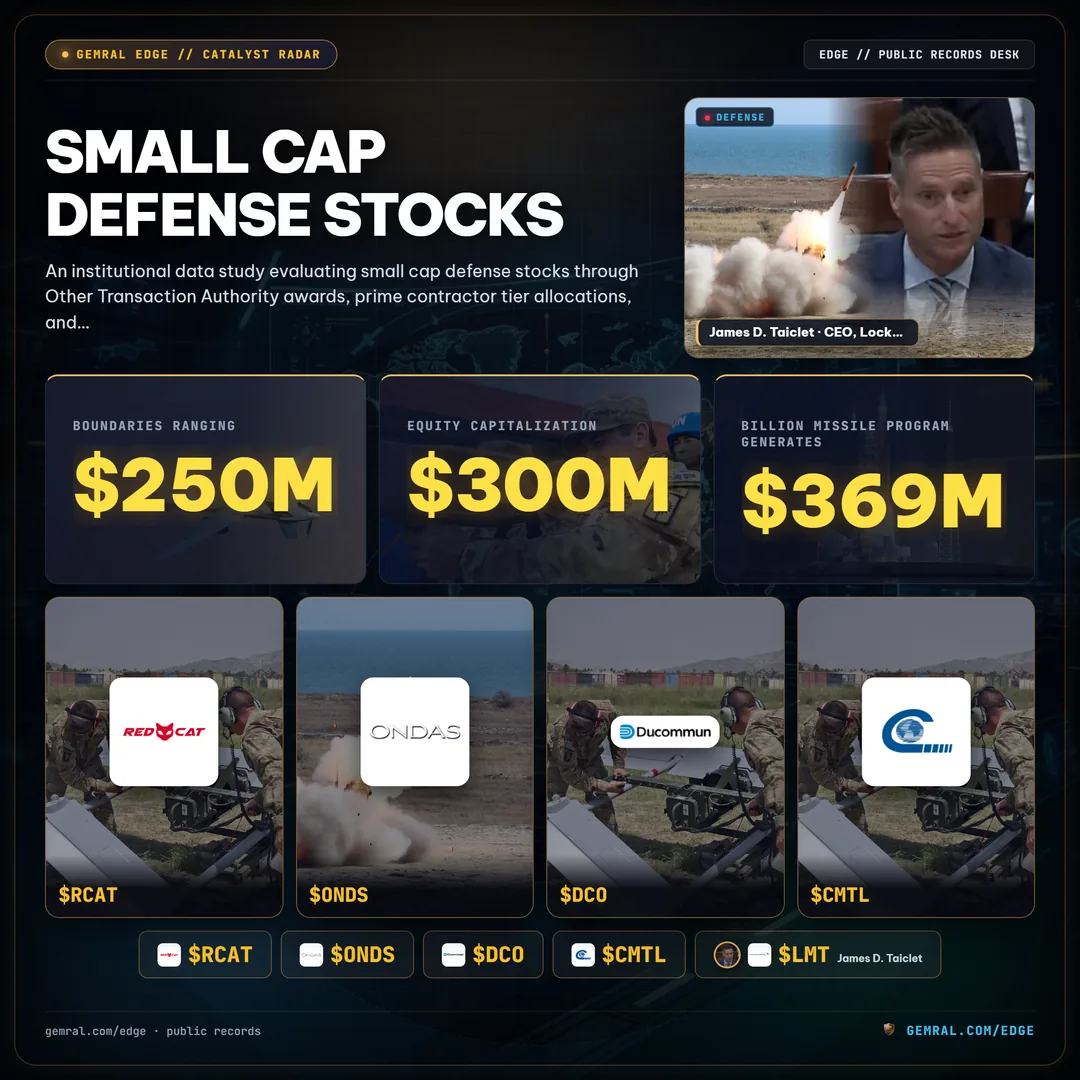
While institutional attention routinely gravitated toward multi-hundred-billion-dollar aerospace primes, specialized capital increasingly concentrates on small cap defense stocks. These emerging manufacturers, component fabricators, and autonomous hardware developers occupy the tactical vanguard of modern defense procurement. Operating within capitalization boundaries typically ranging between $250 million and $2.5 billion, small cap defense equities offer acute structural leverage to targeted Pentagon spending initiatives that mega-cap integrators cannot match in revenue elasticity.
Evaluating these agile innovators requires reconciling public corporate balance sheets with statutory Department of Defense procurement databases. Institutional analysts track this procurement momentum through our specialized defense intelligence terminal and federal contract database, cross-referencing Tier-1 contractor allocations against our rankings of defense contractors by market cap and specialized profiles of drone companies with government contracts.
What Defines Small Cap Defense Stocks: Capitalization Tiers, Prime Subcontracting, and Procurement Access
In federal equity classification, small cap defense stocks represent publicly traded corporations maintaining enterprise valuations between $250 million and $2.5 billion that generate the majority of their gross billings from national defense appropriations. Unlike diversified commercial aerospace conglomerates, these companies function either as sole-source subsystem suppliers to Tier-1 prime contractors or as specialized direct vendors solving urgent operational bottlenecks for military service branches.

The operational landscape of small cap defense equities spans several distinct industrial categories:
- Tactical Uncrewed Systems & Autonomous Robotics: Companies engineering Group 1 and Group 2 reconnaissance drones, ground robotics, and loitering munitions, such as Red Cat Holdings (Nasdaq: RCAT, ~$480M market cap) with its Teal Golden Eagle platform, and Ondas Holdings (Nasdaq: ONDS, ~$180M market cap) developing autonomous drone-in-a-box surveillance enclosures.
- Counter-UAS & Directed Energy Shielding: Developers specializing in acoustic, radio frequency, and artificial intelligence detection systems to defeat hostile uncrewed aerial threats, exemplified by DroneShield (ASX: DRO / OTC: DRSHF, ~$650M market cap).
- Precision Subsystems & Aerostructures: Merchant component manufacturers fabricating structural brackets, titanium housings, and high-frequency microwave assemblies for fighter jets and guided missiles, such as Ducommun Incorporated (NYSE: DCO, ~$850M market cap).
- Tactical Communications & Troposcatter Hardware: Providers of secure beyond-line-of-sight command networks and satellite ground modems, including Comtech Telecommunications (Nasdaq: CMTL, ~$140M market cap).
The critical structural advantage of small cap defense stocks lies in prime contractor flow-down mandates. Under the Federal Acquisition Regulation (FAR Subpart 19.7), prime contractors securing federal awards exceeding $750,000 are statutorily required to adopt Small Business Subcontracting Plans. The Department of Defense establishes an annual statutory baseline requiring approximately 23.0% of prime contracting dollars to flow toward small business entities. For an emerging subsystem fabricator with an equity capitalization of $300 million, securing a 4.5% subsystem allocation on an $8.2 billion missile program generates $369 million in multi-year committed obligations, completely transforming the company's valuation multiple.
Defense Procurement Dynamics: Other Transaction Authority (OTA) and Middle Tier Acquisition
Traditional federal procurement through FAR Part 15 is notoriously encumbered by bureaucratic friction, often requiring 24 to 36 months to progress from formal Request for Proposal (RFP) to signed contract execution. For innovative small cap hardware developers, this protracted timeline historically created fatal cash burn cycles commonly known as the procurement valley of death.
To bypass these systemic delays, the Pentagon increasingly leverages non-traditional contracting vehicles governed by Other Transaction Authority (OTA) under Title 10 U.S.C. Section 4022. OTAs exempt prototype projects from burdensome federal cost accounting standards (CAS) and standardized acquisition statutes. Consequently, prototype award cycles contract from 36 months down to 6 to 9 months, allowing small cap firms to demonstrate battlefield capabilities rapidly.
Complementing OTAs, Congress established the Middle Tier of Acquisition (MTA) pathway under Section 804 of the National Defense Authorization Act (NDAA). The Section 804 pathway empowers military program executive offices to complete rapid prototyping projects within two to five years without undergoing the extensive documentation required for Major Defense Acquisition Programs (MDAPs). Small cap contractors participating in Defense Innovation Unit (DIU) solicitations, Army Applications Laboratory sprints, and AFWERX challenge competitions leverage these streamlined mechanisms to scale prototype obligations directly into high-rate initial production (HRIP) funding lines.
How to Track Small Cap Defense Stocks: Federal Backlog Ratios and Contract Obligation Velocity
Evaluating small cap defense equities demands analytical frameworks fundamentally different from consumer software or retail equities. Rather than tracking price-to-earnings ratios on trailing twelve-month figures, institutional analysts prioritize the funded backlog-to-market-cap ratio and transaction-level obligation velocity.

The funded backlog reflects legally binding federal obligations recorded on official agency ledgers where funds have already been apportioned by Congressional appropriations committees. Calculating the ratio provides immediate forward clarity:
Consider the comparative mechanics between prime integrators and small cap pure-plays. When a mega-cap prime like Lockheed Martin records a $1.2 billion contract modification against its $138 billion equity capitalization, the award represents less than 0.9% of enterprise equity value. Conversely, when a small cap developer with a $200 million market capitalization captures a $145 million firm-fixed-price delivery order from the U.S. Army, the obligation represents 72.5% of the firm's entire market value.
Tracking contract velocity requires monitoring the transition of unexercised option periods into funded delivery orders. Federal defense agreements are structured with a base performance year followed by multiple one-year options. When military program officers execute option modifications on federal procurement systems, the action represents an immediate injection of capital that bypasses secondary market equity offerings.
Evaluating Pentagon Funding Risks: Continuing Resolutions, Cost-Plus Caps, and Subcontractor Margins
While small cap defense stocks offer asymmetric revenue growth, they operate under distinct operational risks that institutional investors must model rigorously:
- Continuing Resolution (CR) Bottlenecks: When Congress fails to pass full-year defense appropriations bills prior to the October 1 start of the federal fiscal year, the Department of Defense operates under stopgap Continuing Resolutions. Under a CR, statutory rules strictly prohibit new program starts or quantity production increases. Small cap contractors dependent on initial prototype transitions frequently experience revenue pauses lasting from 45 to 180 days.
- Contract Type Bifurcation (Cost-Plus vs Firm-Fixed-Price): Mega-cap primes historically buffered inflation risks through cost-plus-incentive-fee structures. Small cap suppliers, however, are overwhelmingly awarded Firm-Fixed-Price (FFP) contracts. In high-inflation regimes, component cost spikes directly compress operating margins from targeted 14.0% levels down to 4.5% or lower.
- Customer Revenue Concentration: Small cap defense firms frequently derive between 45% and 85% of total annual revenues from a single defense program or prime customer. If the Pentagon terminates a program for convenience or reallocates funding to peer initiatives, unprotected suppliers face immediate corporate restructuring.
- Supply Chain and Security Clearance Overhead: Defense suppliers must maintain strict compliance with National Institute of Standards and Technology (NIST) SP 800-171 protocols and Cybersecurity Maturity Model Certification (CMMC) standards. Maintaining cleared facility security clearances (FCL) imposes measurable fixed administrative costs that weigh heavily on sub-$500M market cap balance sheets.
Small Cap Defense Pure-Plays vs Prime Defense Contractors: Asymmetric Multipliers and Revenue Concentration
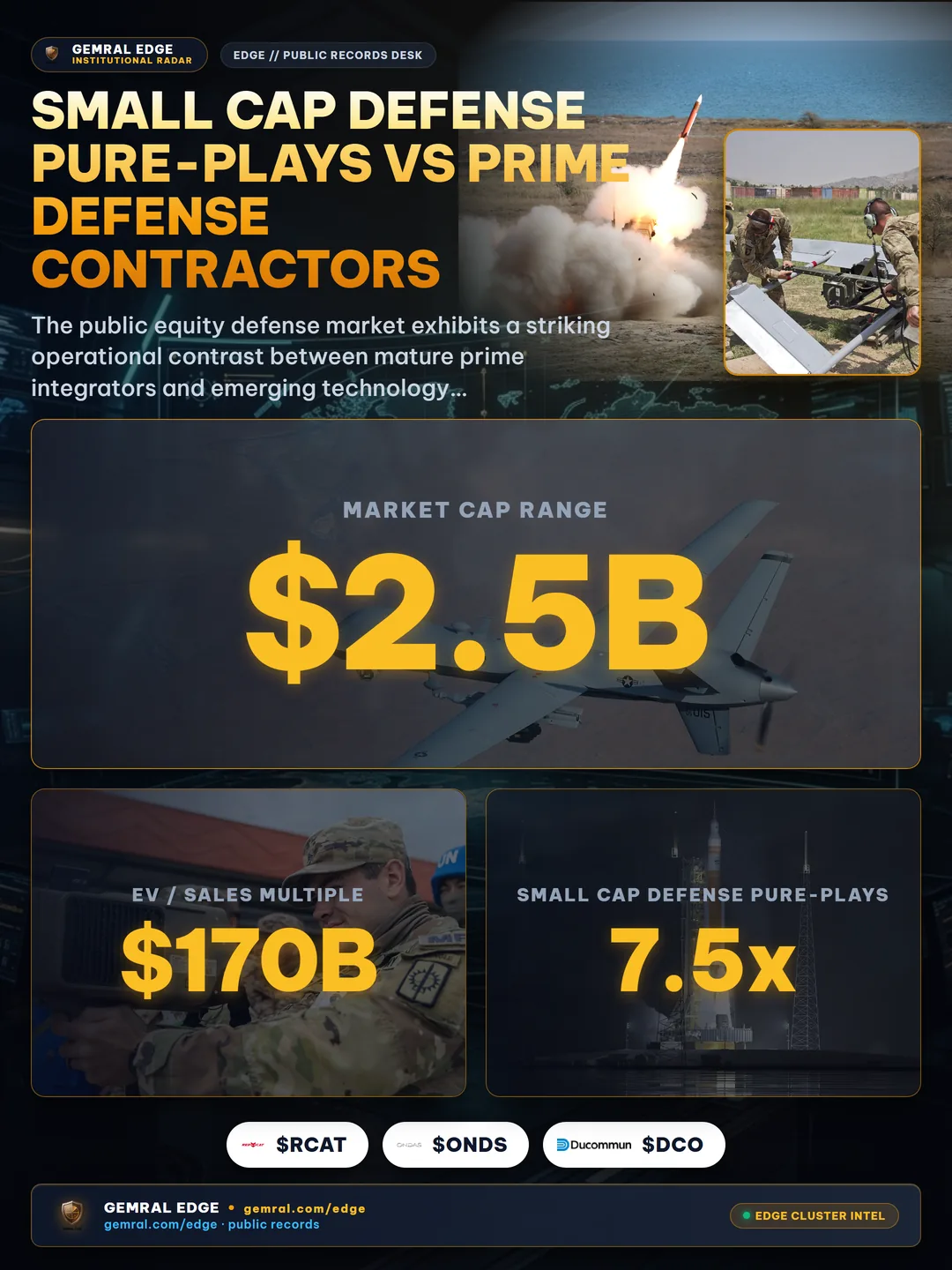
The public equity defense market exhibits a striking operational contrast between mature prime integrators and emerging technology pure-plays. Comparing their fundamental operating profiles illustrates the differentiated risk-return trade-offs:
| Metric / Dimension | Small Cap Defense Pure-Plays | Mega-Cap Defense Primes |
|---|---|---|
| Market Cap Range | $250M - $2.5B | $45B - $170B |
| EV / Sales Multiple | 3.5x - 7.5x | 1.4x - 2.1x |
| Operating Margins (Normalized) | 12.0% - 22.0% | 9.0% - 12.5% |
| Procurement Mechanism | OTAs, SBIR Phase III, Subcontracting | FAR Part 15 Major Defense Programs |
| Revenue Sensitivity to New Awards | High (Single award can equal 30-80% cap) | Low (Single award rarely exceeds 2% cap) |
| Programmatic Moat | Proprietary IP, Autonomy Software, Sensor Edge | Multi-Decade Political & Industrial Footprint |
Because small cap pure-plays command proprietary software algorithms, specialized intellectual property, and high-frequency production lines, public equity markets frequently award them valuation multiples resembling defense tech software firms rather than traditional metal-bending defense contractors. When these firms transition prototype demonstrations into multi-year defense production contracts, institutional re-rating occurs rapidly across both revenue growth and margin expansion dimensions.
Verifying Federal Award Obligations: Public Disclosure Systems and CAGE Code Disclosures
Institutional investors conducting due diligence on small cap defense stocks cannot rely solely on corporate investor presentations or promotional press releases. Public record verification requires establishing a direct audit trail linking corporate legal entities to federal procurement registries.
Every domestic defense contractor performing work for the U.S. government must register with the Defense Logistics Agency and secure a five-character Commercial and Government Entity (CAGE) code alongside a federal Unique Entity Identifier (UEI). By cross-referencing corporate CAGE codes within official federal procurement databases and primary contractor disclosure archives, institutional researchers can audit:
- Definitive Contract vs Task Order Structure: Confirming whether an award represents an Indefinite Delivery / Indefinite Quantity (IDIQ) ceiling that requires subsequent delivery orders, or a directly obligated firm-fixed-price definitive award.
- Funding Agency and Treasury Account Symbol (TAS): Identifying the specific military service branch funding the obligation and verifying whether funds originate from Research, Development, Test & Evaluation (RDT&E) accounts or Operations & Maintenance (O&M) accounts.
- Subcontract Flow-Down Disclosures: Tracking sub-awards reported through federal reporting systems where prime contractors formally disclose dollar allocations distributed to tier-two and tier-three component suppliers.
- Congressional District Procurement Footprints: Mapping the physical manufacturing facilities of small cap contractors against defense appropriations committee jurisdictions, revealing political alignment with Congressional oversight committees.
Systematically capturing these public procurement disclosures enables quantitative analysts to detect federal obligation momentum weeks before corporate management discloses aggregate figures in quarterly SEC Form 10-Q filings.
Public Record Sources & Verification Methodology
- Defense Logistics Agency CAGE Code Master Registry: cage.dla.mil/Search
- U.S. Department of Defense Daily Contract Disclosures: defense.gov/News/Contracts
- Office of the Under Secretary of Defense for Acquisition and Sustainment (Defense Pricing and Contracting): acq.osd.mil/asda/dpc
Disclaimer: Public data analysis compiled exclusively from federal disclosure records and statutory procurement filings. Not investment advice or an endorsement to buy or sell securities. Enterprise telemetry provided by Gemral Edge ($39 Pro, $299 B2B, $2000 API).
Frequently asked questions
What qualifies a company as a small cap defense stock?
A small cap defense stock is an equity with a market capitalization generally below $2.5 billion that derives a substantial portion of its operating revenue from the Department of Defense, federal intelligence agencies, or tier-one prime defense contractors. Common specializations include loitering munitions, tactical uncrewed aerial systems (UAS), electronic warfare subsystems, and satellite ground equipment.
How does Other Transaction Authority (OTA) benefit small cap defense contractors?
Other Transaction Authority (OTA) under Title 10 U.S.C. Section 4022 exempts prototype contracts from the Federal Acquisition Regulation (FAR), slashing solicitation cycles from multi-year marathons down to 6 to 9 months. This streamlined pathway enables non-traditional and small cap defense innovators to deploy advanced hardware directly into Pentagon testing pipelines.
What is the backlog-to-market-cap ratio in defense investing?
The backlog-to-market-cap ratio divides a defense contractor's total funded and unfunded order backlog by its public equity market capitalization. In small cap defense equities, this ratio frequently surpasses 1.5x to 2.5x following major programmatic selection, offering substantial multi-year revenue visibility relative to corporate enterprise valuation.
How can investors verify federal contract obligations for small defense contractors?
Federal contract awards are verified through public procurement disclosure systems including the Defense Logistics Agency (DLA) CAGE code database and daily Pentagon contract bulletins. Monitoring transaction-level modifications and sub-award flow-downs reveals prime contractor allocations to small cap component suppliers.