
Tracking defense contractor stocks through federal procurement disclosures has become an established practice among institutional equity research desks seeking fundamental exposure to state military expenditure. However, standard quantitative workflows that map public procurement actions directly to corporate parent tickers often introduce severe structural distortions. The federal contracting process involves complex multi-year development cycles, frequent corporate restructuring, and statutory reporting delays that undermine simplistic relational database joins. Institutional analysts evaluating prime defense contractors must implement rigorous point-in-time entity resolution to ensure historical procurement records reflect what market participants could legally observe on each publication date. Researchers can inspect live procurement feeds, regulatory filings, and corporate linkage trees directly through our defense contractor records and ticker history portal.
In federal contracting analytics, the primary vulnerability stems from survivor bias and retrospective parent attribution. When an equity research platform evaluates historical awards using a contemporary parent lookup table, it retroactively assigns past contract obligations to current corporate parents long before those corporate combinations legally took effect. In a comprehensive audit of historical federal contracting records, mapping resolved transactions through today's parent table rather than the parent entity valid at publication resulted in $89,600,000,000 across 8,568 transactions being credited to the wrong equity ticker. This $89.6 billion distortion represents approximately 3.31% of the $2,706,000,000,000 in analyzed federal awards, demonstrating that static corporate mapping creates substantial data contamination for institutional factor models.
Beyond retrospective attribution, institutional market participants must navigate the divergence between physical contract execution and official public disclosure. The Department of Defense operates under statutory publication lags that defer the public posting of detailed contract transactions, even while Pentagon press desks issue daily contract summaries. Furthermore, approximately $191,900,000,000 in federal contract dollars flows through operating subsidiaries where the awarded entity name bears no direct textual resemblance to the listed parent corporation. Disentangling these overlapping layers requires an architectural approach grounded in dated legal relationships, statutory delay adjustments, and verified point-in-time transaction histories.
The Look-Ahead Hazard in Defense Contractor Stocks: Why Static Parent Mapping Distorts Procurement Analysis
Public equity analysts frequently treat government procurement disclosures as an unvarnished stream of fundamental revenue intelligence. Yet the mechanisms through which federal agencies award, modify, and publish procurement obligations differ fundamentally from standard financial market feeds. A primary pitfall in quantitative defense research is the look-ahead hazard introduced by static parent mapping. When an analyst queries a public spending database today, the query engine typically resolves supplier records against the supplier's most recent ultimate parent company. While convenient for modern operational screening, this practice fundamentally corrupts historical backtesting by assuming market participants in prior fiscal periods possessed foresight regarding future mergers, acquisitions, and divestitures.
Consider the defense aerospace industrial base over the past decade. The sector has witnessed multi-billion-dollar consolidations, including the merger of United Technologies Corporation (UTX) and Raytheon Company to form RTX Corporation (RTX), the combination of Harris Corporation (HRS) and L3 Technologies to establish L3Harris Technologies (LHX), and major asset sales across General Dynamics (GD), Northrop Grumman (NOC), and Science Applications International Corporation (SAIC). When an analytical pipeline applies modern parent identifiers retrospectively, contract obligations awarded to legacy standalone entities in 2018 or 2019 are categorized under ticker symbols that did not exist or corporate entities that held no claim to those cash flows at the time.
This dynamic introduces false predictive power into quantitative equity strategies. An algorithmic strategy evaluating historical contract momentum might register a surge in awarded obligations for an acquiring entity months or years before the transaction closed, attributing economic performance to a corporate balance sheet that had not yet absorbed the underlying operational assets. Furthermore, static mapping erases historical corporate failures and restructuring events, creating a survivorship distortion where acquired or restructured entities are directly absorbed into the continuous operational record of large-cap prime contractors. Addressing this distortion requires maintaining an effective-dated corporate ownership ledger that anchors each procurement transaction to the exact legal entity and traded equity symbol active on the specific date the record was published.
Understanding these historical tracking mechanics is essential when cross-referencing corporate procurement pipelines against broader political disclosures. For instance, institutional research desks frequently monitor congressional portfolio activity alongside procurement momentum, as documented in our recent examination of what stocks did congress buy. Without point-in-time ticker resolution, an analyst attempting to align legislative committee assignments with procurement beneficiaries risks matching historical congressional trades against corporate tickers that were legally divorced from the awarded contracts on the transaction date.
Point-in-Time Ticker Rolls: Tracking 659 Federal Contracts Across M&A Transitions
The operational necessity of point-in-time entity resolution is most sharply illustrated by transactions that span corporate acquisition closing dates. Across federal contracting history, our data engineering pipeline identified a specific cohort of 659 federal contract actions that were signed prior to the formal closure of a corporate acquisition but were published to public spending registries only after the merger had finalized. This phenomenon occurs routinely in the defense industrial sector due to statutory publication delays, administrative review cycles, and multi-agency reporting workflows.

Under a naïve attribution methodology, these 659 contract records create immediate operational errors. If an analytical model indexes contracts strictly by their legal signature date (action date), the records are assigned to the legacy acquired company. However, if the legacy company ceased public equity trading upon merger closure, the assigned ticker symbol becomes a dead identifier in institutional pricing and portfolio models. Conversely, if an analytical model blindly updates historical databases to reflect the new parent entity without tracking the transition date, it injects look-ahead bias by making the acquirer appear larger in periods preceding the public announcement.
To resolve this structural mismatch, our data architecture executes a formal point-in-time ticker roll. In our resolved procurement dataset, all 659 contract actions preserve the original signing corporate entity within the direct recipient identifier, while the attributed trading ticker dynamically rolls to the security that was actively trading on the publication date. Among these 659 contract actions:
- 651 Contract Actions Rolled to Listed Acquirers: Exactly 651 transactions successfully rolled to the publicly traded acquiring corporate entities valid on their respective public release dates. Prominent recipient ticker migrations included 361 contract actions rolling to RTX Corporation (RTX), 124 contract actions rolling to L3Harris Technologies (LHX), 49 contract actions rolling to United Technologies Corporation (UTX) prior to its subsequent restructuring, 49 actions rolling to General Dynamics (GD), 43 actions rolling to Northrop Grumman (NOC), and 25 actions rolling to Science Applications International Corporation (SAIC).
- 8 Contract Actions Assigned Null Tickers: Exactly 8 contract actions involved target companies acquired by private equity sponsors or unlisted international entities. Because no publicly traded equity security existed on the publication date, these records carry a verified null ticker status, preventing the false attribution of private debt-financed awards to public capital markets.
- 254 Renamed Ticker Migrations: An additional cohort of 254 federal contract actions involved corporate entities that underwent formal ticker rebranding between the contract signing date and the public release date. These actions cleanly migrated to their updated trading symbols upon publication, including 121 transitions from UTX to RTX, 68 transitions from HRS to LHX, 44 transitions from JEC to Jacobs Solutions (J), 17 transitions from ASGN to Endeavor Foods (EFOR), 3 transitions involving Ball Corporation (BALL), and 1 transition for Marsh & McLennan (MRSH).
Executing these granular ticker rolls ensures that quantitative equity portfolios ingest clean, actionable identifier mappings without creating orphaned records or dead ticker references. Institutional models can subsequently link daily market price action against public disclosures with complete temporal integrity.
The $89.6 Billion Misattribution: How Today's Parent Table Distorts Historical Pentagon Awards
To quantify the financial magnitude of static mapping errors across institutional equity strategies, our research team conducted a comprehensive audit comparing point-in-time entity resolution against contemporary parent lookup tables across all resolved federal contract records from fiscal year 2018 through 2026. The empirical findings reveal that static parent mapping does not merely introduce minor marginal discrepancies; it causes substantial capital misallocation across defense sector factor models.

Across a total corpus of 197,201 resolved federal contract transactions totaling $2,706,000,000,000 in obligated procurement capital, evaluating records through today's parent corporate table instead of the parent entity valid on the publication date misattributes $89,600,000,000 across 8,568 distinct contract actions. This misattribution represents 3.31% of the total analyzed dollar value. In institutional portfolio management, where tracking error budgets and active factor tilts are calculated in basis points, a 331 basis-point misallocation introduces severe noise into multi-factor equity models.
The misattribution is particularly pronounced in long-dated defense contracts characterized by multi-year performance periods and periodic funding modifications. A major defense program awarded to an independent aerospace firm in 2018 may undergo dozens of administrative modifications, scope changes, and funding de-obligations over a five-to-seven-year operational lifecycle. If the original prime contractor is acquired midway through the contract lifecycle, applying a static modern parent lookup attributes early modifications to the acquirer years before the transaction closed, while failing to capture the organic growth profile of the acquired firm during its independent operational history.
For quantitative researchers developing alternative data signals, this misattribution undermines fundamental revenue decomposition. Factor models that calculate government revenue exposure ratios (federal contract obligations divided by total recognized corporate revenue) will severely overestimate the defense revenue concentration of acquiring corporations while understating the exposure of divested or spun-off entities. Implementing effective-dated parent linkage tables eliminates this distortion by preserving the exact legal ownership structure governing each contract modification on the date it was executed and disclosed.
Multi-Tier Award Chains: The 7.1% Dollar Share Tied to Subsidiaries
A second major challenge in evaluating defense contractor stocks through public procurement registries is the pervasive use of corporate subsidiaries, joint ventures, and specialized operating units. Large prime defense contractors rarely execute government contracts directly under the corporate name of their publicly traded parent holding company. Instead, procurement awards are issued to hundreds of legally distinct operating subsidiaries, research facilities, and specialized manufacturing divisions.

Our quantitative audit established that $191,900,000,000 in ticker-linked federal contract transactions—representing 7.1% of all analyzed contract dollars and 13,465 distinct transactions—reach a publicly listed corporate equity only through an effective-dated subsidiary relationship link. On these awards, the legal entity name appearing on the government procurement authorization bears zero textual resemblance to the parent corporation's stock ticker or market identifier. For example, awards issued to specialized missile propulsion laboratories, maritime shipyards, or tactical communications research units frequently operate under historical division titles that do not contain the parent corporate moniker.
Standard entity-matching algorithms that rely on string matching or fuzzy text distance metrics fail to capture these subsidiary relationships, resulting in systemic under-counting of prime contractor procurement volumes. An automated crawler searching solely for the corporate name of a major defense prime will omit billions of dollars in critical contract awards executed through wholly owned operating subsidiaries. Conversely, naive database matching that lacks effective dating will continue to attribute awards from a divested subsidiary to its former parent long after the subsidiary has been spun off or sold to a competitor.
This multi-tier dependency structure is equally critical when analyzing advanced technology suppliers expanding into military computing, unmanned systems, and cyber defense, a dynamic we observed when tracking AI companies with government contracts. High-growth technology firms frequently establish classified or ring-fenced government solutions subsidiaries to isolate federal defense compliance obligations from commercial enterprise operations. Capturing this capital flow requires an entity resolution framework that maps subsidiary ownership structures with exact beginning and ending validity timestamps.
Statutory Publication Lags: The 90-Day Defense Rule vs. Real-Time Daily Announcements
Beyond entity resolution and subsidiary hierarchies, the temporal sequencing of defense procurement data introduces unique market microstructural characteristics. In standard commercial procurement, contract actions are published to federal spending portals with minimal administrative delay. However, Department of Defense procurement records operate under distinct statutory rules designed to protect operational security and sensitive supply chain details.

Under federal procurement statutory provisions, defense contract actions are subject to a mandatory 90-day publication lag before detailed transactional line items are released into public spending repositories. In our empirical analysis of historical procurement records, defense contract transactions account for approximately 59% of all contract rows and 65% of all obligated dollars in a 3% block sample of federal transactions of $1,000,000 or more. Consequently, the majority of high-value federal procurement data does not appear in standard public databases until three months after the contractual award has been executed.
A backtesting model that utilizes the contract action date (the date the contract was signed) as the timestamp for information availability introduces a 90-day look-ahead bias. Dating procurement events by activity date rather than publication date puts information into historical backtests early by a full 90 days for defense contract actions. For context, this look-ahead distortion dwarfs other public disclosure lags: congressional trades exhibit a median publication lag of 27 days (90th percentile 63 days) relative to transaction execution, insider trades exhibit a median lag of 1 day (90th percentile 4 days), and quarterly lobbying filings exhibit a median lag of 20 days (90th percentile 21 days) following quarter end.
However, institutional investors can bridge this 90-day information gap through daily Pentagon contract announcements. The Department of Defense public affairs office issues daily evening summaries detailing prime contract awards exceeding $7,500,000. In an empirical audit of 9,158 defense contracts that appear in both daily contract announcements and detailed award registries, the daily announcement preceded the formal database entry in 93.5% of cases, leading detailed transactional records by a median of exactly 90 days across $1,070,000,000,000 in announced value. Incorporating daily defense announcements alongside point-in-time transaction histories allows quantitative desks to capture real-time procurement momentum without violating information causality rules.
Evaluating Defense Equities: Data Hygiene, Coverage Limits, and Institutional Verification
As institutional asset allocators and fundamental research desks integrate federal procurement metrics into their investment processes, maintaining absolute clarity regarding dataset scope and coverage boundaries is paramount. While federal spending data provides an unparalleled window into prime contractor revenue backlogs, quantitative analysts must account for several structural limitations inherent in public records telemetry.
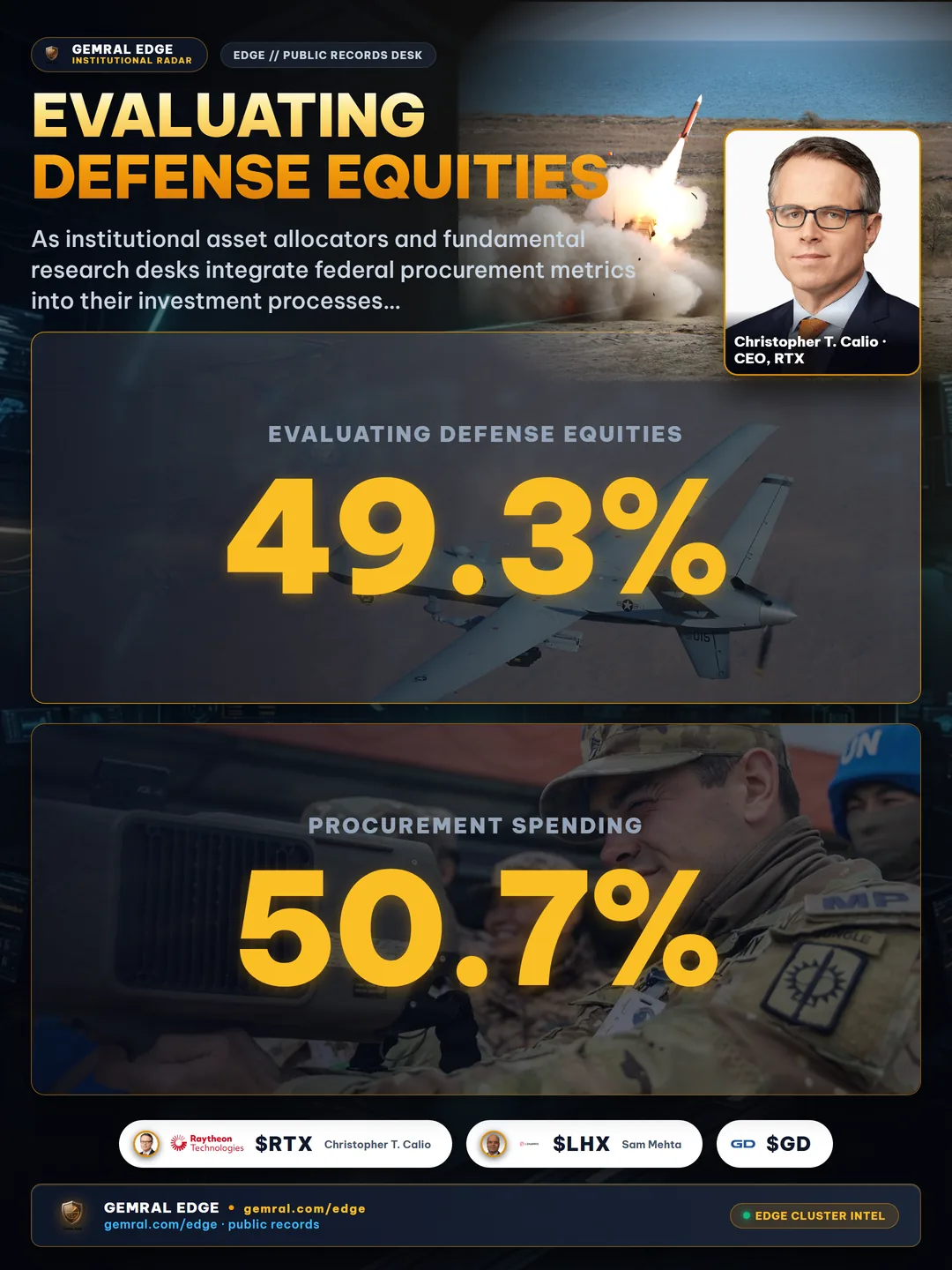
First, public procurement coverage is bounded by the participation of publicly listed entities within the broader defense industrial base. In our comprehensive accuracy audit measured on October 23, 2026, approximately 49.3% of all federal contract transaction dollars from fiscal year 2018 onward are linked to a publicly traded equity ticker. The remaining 50.7% of procurement spending is awarded to privately held enterprises, specialized boutique manufacturers, academic research centers, federally funded research and development centers (FFRDCs), or foreign allied governments. Analysts must not assume that federal procurement spending equates entirely to public equity market capitalization.
Second, institutional researchers must verify the versioning mechanisms governing contract amendments and administrative corrections. In our data infrastructure, a dedicated revision log was initiated in October 2026 to track historical document changes explicitly. Prior to October 2026, amended insider-ownership reports and amended House trade reports are maintained as distinct historical records at their respective filing dates, while amended Senate reports and corrected contract modifications reflect the latest verified state. Institutional due diligence requires understanding these versioning boundaries when modeling longitudinal contract revisions.
When constructing robust defense contractor tracking frameworks, institutional research teams should enforce three core verification protocols:
- Enforce Publication Timestamps Over Action Dates: Always index contract events by the precise timestamp on which the record was published to public repositories, applying statutory 90-day defense offsets to eliminate look-ahead contamination.
- Utilize Effective-Dated Corporate Family Trees: Reject static parent company lookup tables in favor of dynamic entity relationship graphs that track corporate mergers, divestitures, and subsidiary hops on a daily basis.
- Cross-Validate Prime and Announcement Feeds: Reconcile daily Pentagon contract press releases against lagged transactional databases to monitor procurement momentum across $1.07 trillion in federal obligations while maintaining point-in-time legal attribution.
For investment organizations deploying capital across the aerospace and defense sector, access to clean, verified, and point-in-time public records telemetry provides the foundation for rigorous equity analysis. To inspect our coverage of federal procurement awards, corporate subsidiary linkages, and defense contract announcements, explore our live data preview, review the datasets catalog, or inspect our point-in-time public records telemetry.
Public records telemetry and regulatory disclosures. Sourced directly from official federal contract databases, Pentagon procurement announcements, and corporate disclosure filings. Not investment advice or an endorsement of specific corporate securities. Published by Edge Research.
Frequently asked questions
Why does static parent mapping fail when analyzing defense contractor stocks?
Static parent mapping evaluates historical federal contract awards against today's corporate ownership structures rather than the legal ownership valid on the date each contract became publicly accessible. Because major defense contractors frequently execute multi-billion-dollar mergers, divestitures, and ticker rebranding, static joins attribute historical revenue to acquiring entities years before deals close, introducing severe look-ahead errors.
How does statutory defense procurement delay affect contract publication dates?
Under federal procurement statutes, Department of Defense contract actions are subject to a mandatory 90-day publication delay before detailed transaction records appear in public spending repositories. However, daily Pentagon press announcements publish contract awards immediately upon signing, leading detailed transactional records by a median of 90 days across 93.5% of paired award instances.
What proportion of federal procurement dollars reach defense stocks via subsidiaries?
Approximately $191.9 billion in federal contract transactions, representing 7.1% of all contract dollars and 13,465 distinct transactions, flow through operating subsidiaries where the awarded entity name differs entirely from the publicly traded parent ticker. Without effective-dated corporate family trees, these awards cannot be linked to the parent equity.
What percentage of federal contract dollars are mapped to publicly traded defense tickers?
Across fiscal years 2018 through 2026, approximately 49.3% of federal contract transaction dollars are linked to publicly traded tickers. The remaining procurement capital is awarded to privately held defense enterprises, academic institutions, non-profit federated research laboratories, and foreign suppliers.