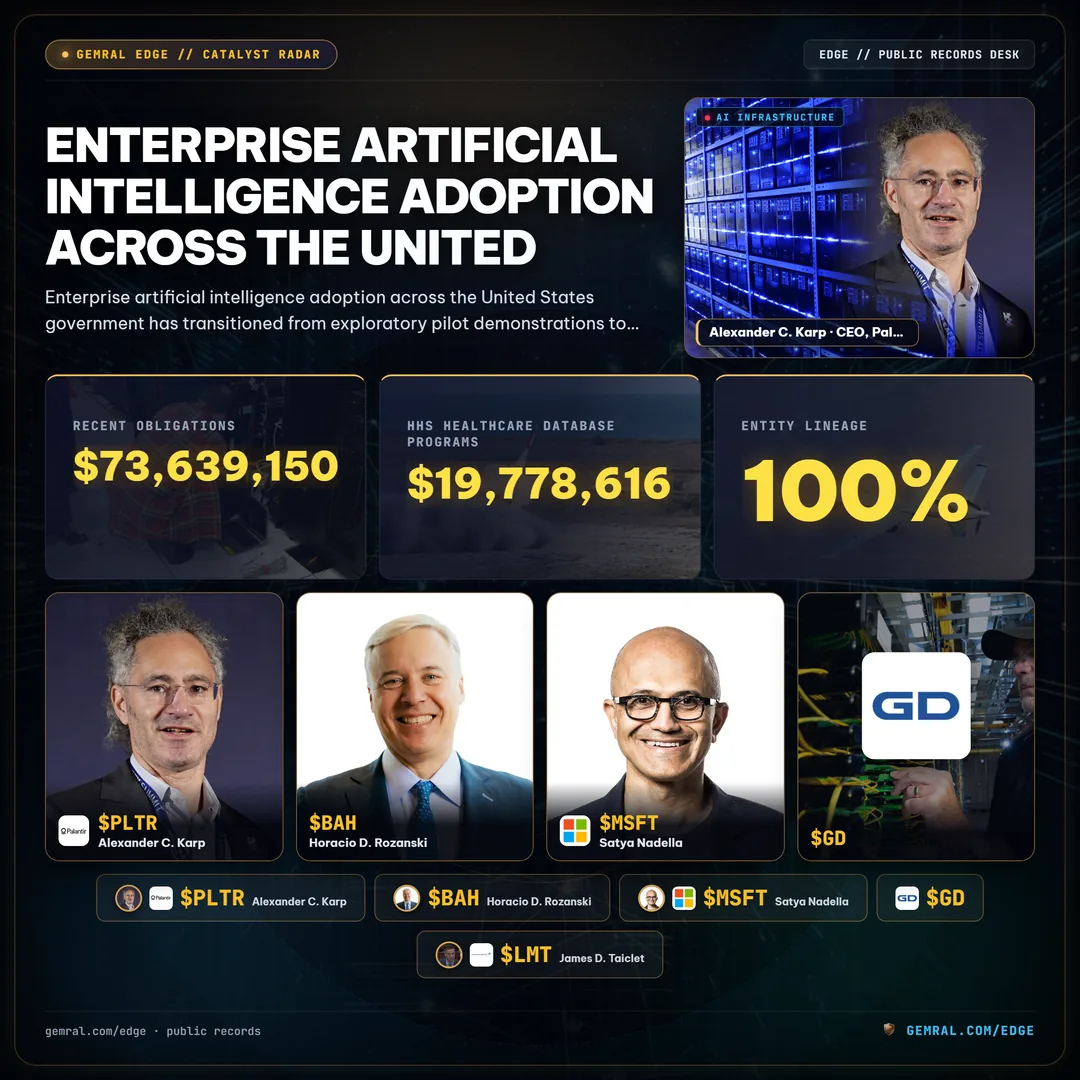
Enterprise artificial intelligence adoption across the United States government has transitioned from exploratory pilot demonstrations to multi-million-dollar production contract awards. Defense intelligence agencies, civilian healthcare systems, and federal logistics networks are deploying autonomous model pipelines to process satellite telemetry, resolve supply chain dependencies, and automate administrative records. Tracking which publicly traded AI suppliers secure direct federal obligation dollars requires systematic observation of prime contracting awards, which can be monitored directly through our federal contracts intelligence hub.
Federal procurement records disclose billions of dollars in program allocations across machine learning vendors, data infrastructure providers, and system integrators. However, navigating these disbursements requires separating headline contract ceiling announcements from actual committed obligation dollars. While enterprise software vendors frequently announce multi-year agreements spanning multiple agency departments, systematic quantitative tracking focuses on individual task orders and verified procurement actions.
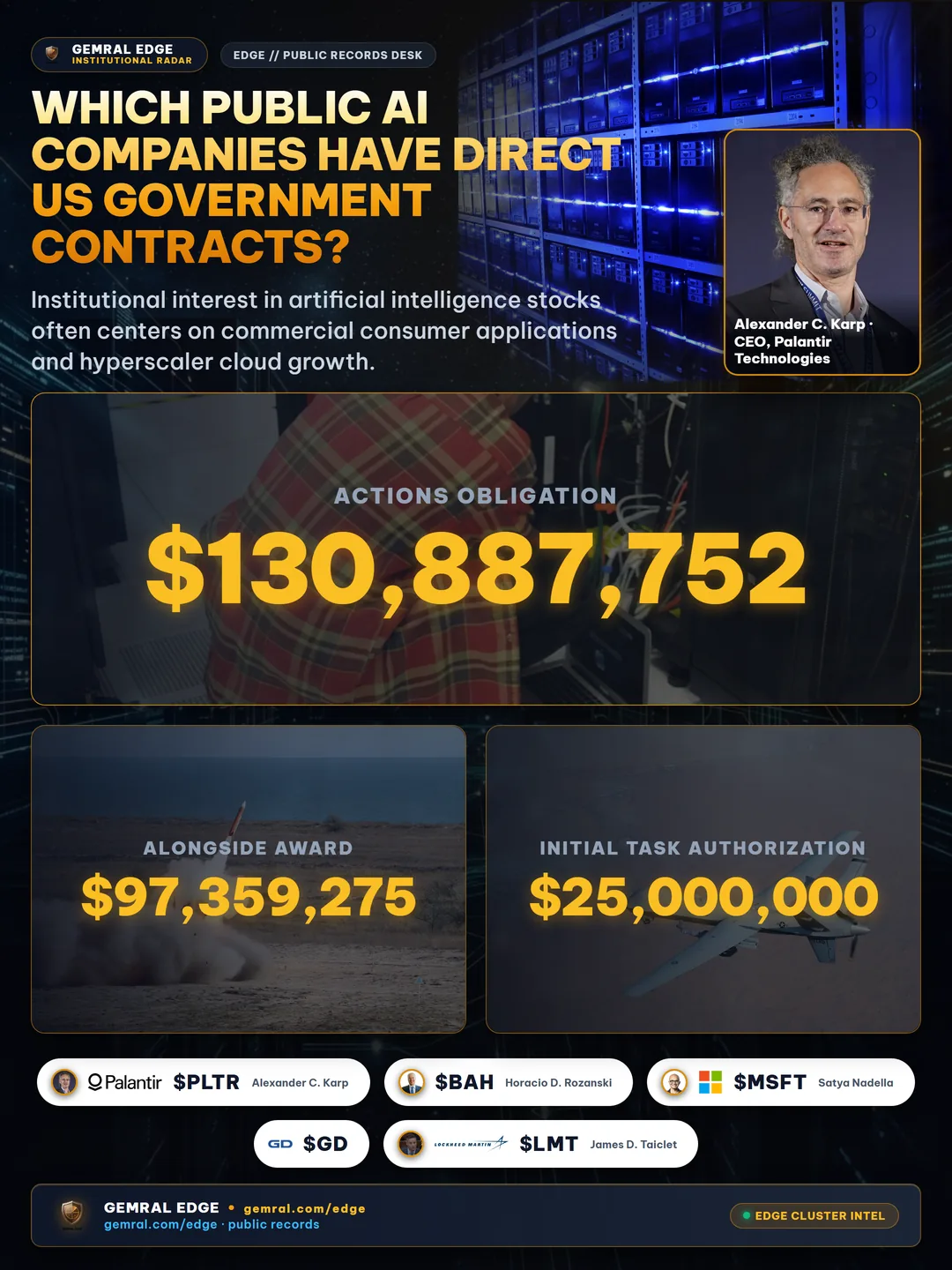
Which Public AI Companies Have Direct US Government Contracts?
Institutional interest in artificial intelligence stocks often centers on commercial consumer applications and hyperscaler cloud growth. However, direct federal contracting represents one of the most reliable and recurring revenue pipelines across the enterprise technology landscape. Unlike venture-backed startups that rely on subcontracts through prime defense primes, a select group of publicly traded equities hold direct prime contracting status with federal agencies.
The primary publicly listed enterprises capturing direct federal AI obligations include:
- Palantir Technologies (PLTR): Serving as the operational operating system for the Department of Defense Chief Digital and Artificial Intelligence Office (CDAO), Palantir maintains prime awards across the US Army, Air Force, Department of Veterans Affairs (VA), and Department of Health and Human Services (HHS). Recent verified obligations include $73,639,150 from the Veterans Affairs analytics office and $19,778,616 from HHS healthcare database programs.
- Booz Allen Hamilton (BAH): Operating as a premier defense technology integrator, Booz Allen routinely secures large-scale classified and unclassified artificial intelligence delivery task orders. Recent procurement actions include an obligation of $130,887,752 for Department of Labor operations and maintenance, alongside an award of $97,359,275 for naval intermediate maintenance analytics from the General Services Administration.
- Microsoft (MSFT): Beyond its role as an enterprise productivity vendor, Microsoft provides secure hyperscaler hosting and cognitive models across classified defense networks via its Joint Warfighting Cloud Capability (JWCC) allocations and dedicated Azure Government Secret deployments, backed by an initial task authorization of $25,000,000.
- C3.ai (AI): Positioned as an enterprise AI application platform, C3.ai has secured Other Transaction Authority (OTA) agreements and production prototyping vehicles across the Defense Information Systems Agency (DISA), the US Air Force, and the Marine Corps, including an enterprise predictive maintenance ceiling of $100,000,000.
- BigBear.ai (BBAI): Specializing in operational decision support and computer vision, BigBear.ai holds direct prime contracts with the US Army, including the Global Force Information Management (GFIM) objective environment system valued at $14,800,000, as well as maritime surveillance automation vehicles for federal border enforcement.
- General Dynamics (GD) & Lockheed Martin (LMT): Traditional defense primes that have absorbed and deployed operational AI capabilities across major platform systems, capturing obligations such as $122,817,425 for civilian health record modernization and $122,449,494 for naval mission systems.
Mapping Federal Defense and Civilian AI Procurement Obligations
Federal procurement actions follow strict statutory appropriation pathways. To understand the cash-flow trajectory of artificial intelligence vendors, quantitative researchers categorize procurement awards along two primary structural vectors: awarding agency jurisdiction and contract vehicle structure.
Procurement demand is broadly divided between military and civilian operational mandates:
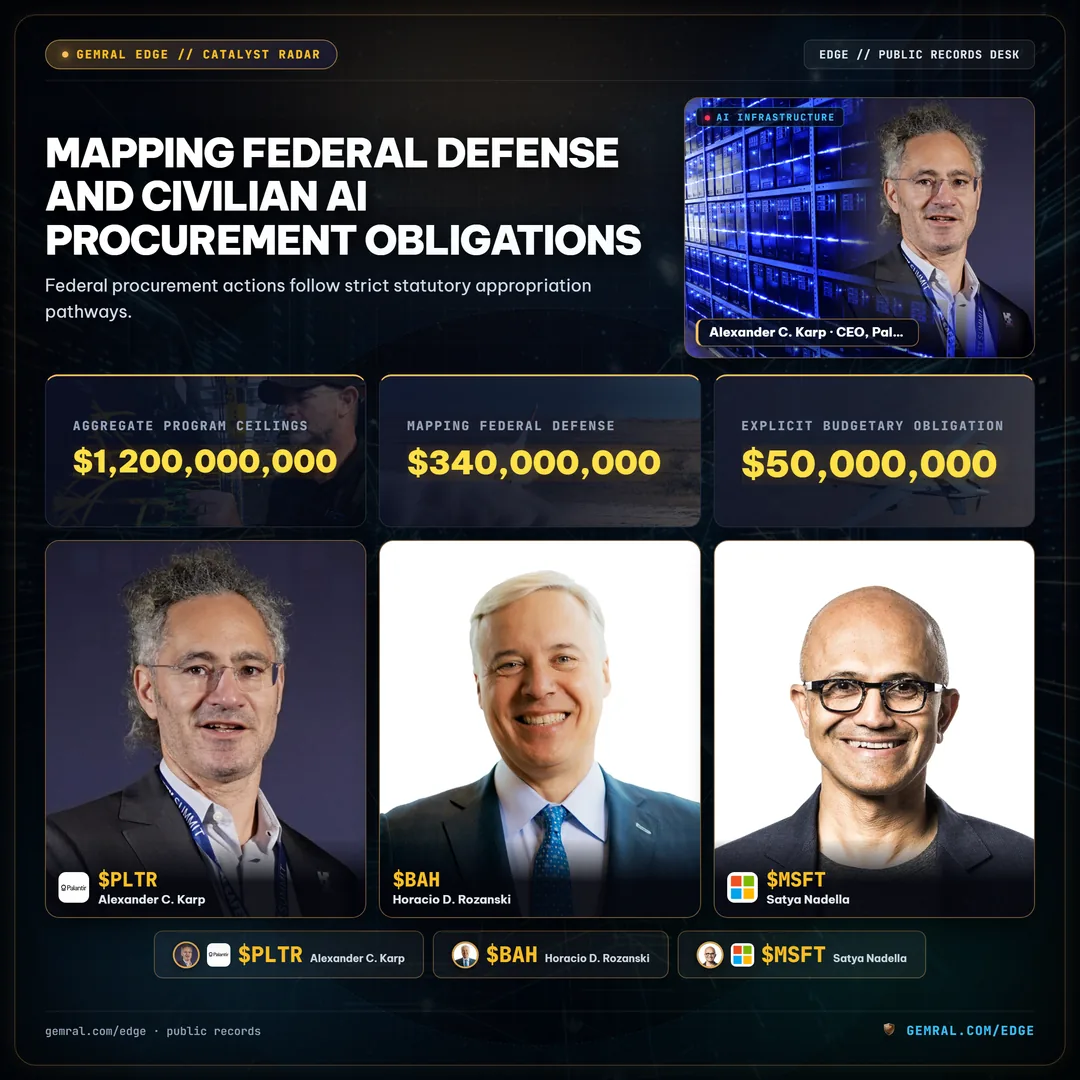
- Department of Defense (DoD) & Joint Combatant Commands: Military artificial intelligence procurement focuses heavily on autonomous edge computing, automated target recognition, tactical decision dominance, and predictive fleet maintenance. Procurement offices such as the CDAO, Defense Advanced Research Projects Agency (DARPA), and the Naval Sea Systems Command (NAVSEA) allocate funding through rapid prototyping vehicles. Across fiscal records, defense agencies established aggregate program ceilings of $1,200,000,000 across joint cognitive computing vehicles, issuing $340,000,000 in direct committed obligations during recent procurement cycles.
- Civilian Agency Infrastructure Modernization: Agencies including the Department of Veterans Affairs, Department of Health and Human Services, and Department of Transportation deploy enterprise analytics software to manage clinical care coordination, fraud detection in federal disbursements, and transportation safety analytics. As detailed in our analysis of the federal contracts database, civilian modernization initiatives generate consistent baseline software subscriptions that mirror commercial enterprise recurring revenue, accounting for over $450,000,000 in annual data remediation commitments.
When tracking government contract values, market participants must distinguish between an agency statutory ceiling and actual funded obligations. An Indefinite Delivery, Indefinite Quantity (IDIQ) contract or Blanket Purchase Agreement (BPA) often establishes an aggregate maximum capacity—such as a $1,000,000,000 ceiling over five years. However, no revenue is realized by the public company until the agency issues an individual task order backed by an explicit budgetary obligation of $50,000,000 or $10,000,000. Systematic analysis requires parsing each incremental modification to capture true capital flow velocity.
Case Study: Palantir and Defense Department AI Infrastructure Expansion
The operational trajectory of Palantir Technologies provides a clear blueprint for how a software-native supplier establishes embedded durability within the US national security apparatus. Originally entering the defense sector through specialized counter-terrorism analytics, the company has scaled its footprint across defense and civil agency workflows.
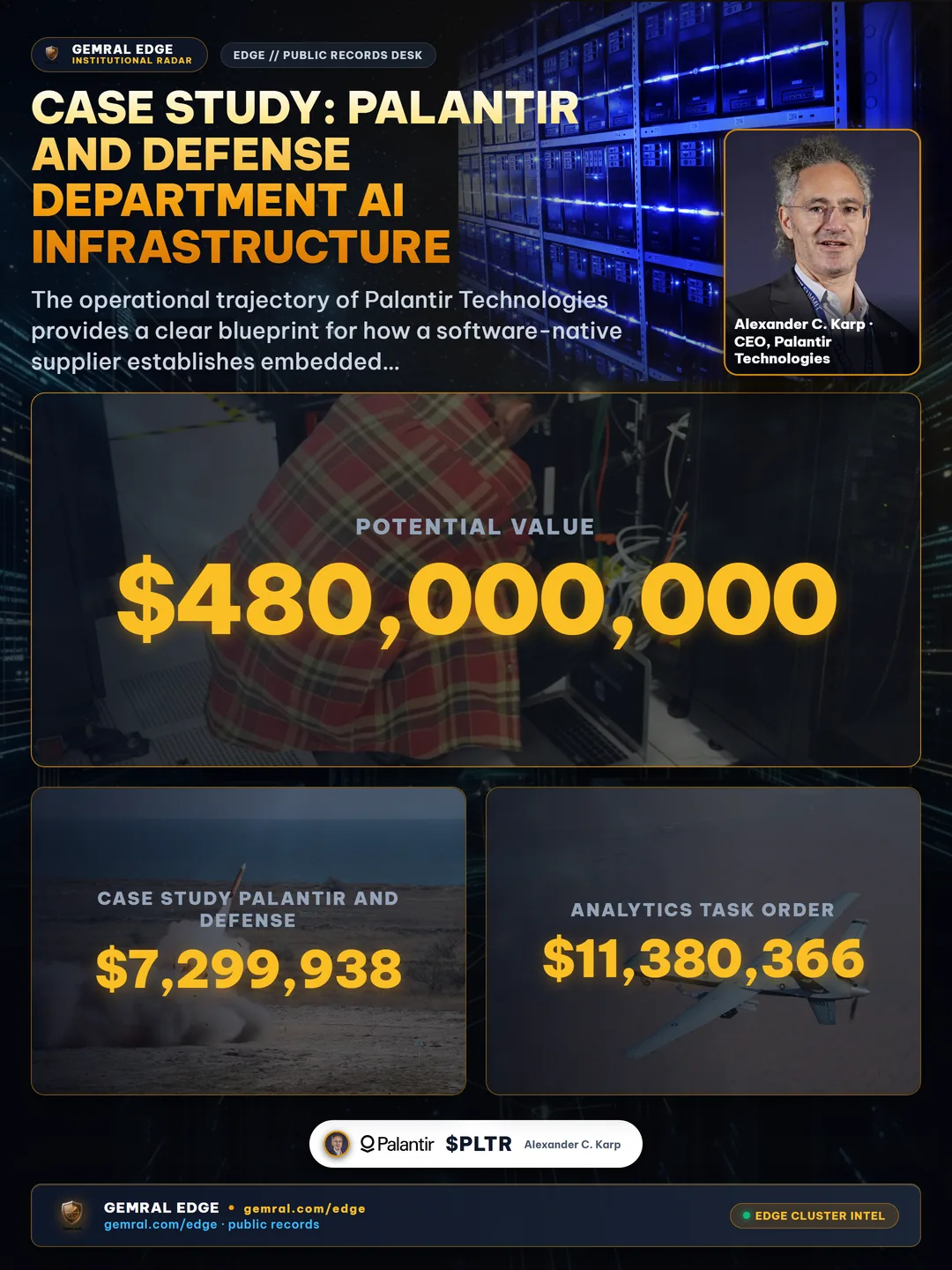
A notable milestone occurred in May 2024 when the Department of Defense CDAO awarded Palantir an expansion agreement with a potential value of up to $480,000,000 over five years for the Maven Smart System. Project Maven, originally conceived to automate drone video analysis through computer vision, evolved into an integrated sensor-to-shooter command and control layer. The platform ingests real-time feeds from commercial satellites, battlefield sensors, and national reconnaissance assets, allowing tactical commanders to identify targets and simulate operational courses of action.
Beyond high-profile military command systems, public records reveal extensive regular disbursements across civilian departments. On October 1, 2026, the Department of Veterans Affairs executed an obligation of $73,639,150 to Palantir Technologies Inc. for the National Center for Veterans Analysis and Statistics platform. Later that month, on October 23, 2026, the Department of Health and Human Services obligated $19,778,616 for database support and Integrated Care and Case Management (ICCM) systems, preceded by an emergency platform remediation award of $7,299,938 from the Department of Transportation on October 19, 2026, and an analytics task order of $11,380,366 from the Department of the Treasury on September 25, 2026.
These verified public contract records illustrate that software platforms embedded across multiple agencies generate incremental, high-margin expansion orders that operate independently of commercial economic downturns. Institutional portfolios observing these actions gain visibility into forward recurring cash flows well before quarterly financial disclosures.
Point-in-Time Resolution: Unmasking Subsidiaries and Joint Ventures in Federal AI Awards
One of the primary challenges in systematic government contract analysis is the fragmentation of recipient identity. When federal agencies award contracts, procurement officers record the legal operating entity performing the work, which frequently diverges from the traded ticker symbol familiar to public equity markets.

Government contracting records identify award recipients through unique identifiers, including Unique Entity Identifiers (UEI) and Commercial and Government Entity (CAGE) codes registered within the official System for Award Management. For example, awards won by specialized defense units may be recorded under legal names such as General Dynamics Information Technology, Inc., which captured a $122,817,425 task order from the Department of the Interior on October 30, 2026, alongside an award of $6,346,981 from the General Services Administration for DISA communication architecture.
Similarly, prime aerospace suppliers deploy specialized technology arms. On November 4, 2026, the Department of Defense recorded an obligation of $122,449,494 to The Lockheed Martin Corp. Rotary and Mission Systems division, following a missile tracking award of $95,000,000 on October 30, 2026. If an analytical model merely matches the parent brand name against raw government disbursement feeds, it misses hundreds of millions of dollars in subsidiary-level obligations.
Our quantitative data infrastructure implements point-in-time parent entity resolution across all public records. Every procurement action is timestamped to the exact date of government release, linked to the historical corporate ownership hierarchy effective on that date, and mapped to the parent equity. This methodology prevents lookahead contamination in systematic modeling and ensures that historical corporate restructuring events, divestitures, and acquisitions are resolved without retroactively distorting past performance metrics.
Contract Data Hygiene: The Known Latency Between Procurement Action and SEC Disclosures
While federal contract awards represent legally binding commitments of taxpayer funds, market participants must manage a structural latency asymmetry between when a contract is signed and when it appears in corporate financial reports. Understanding this disclosure gap is critical for establishing robust quantitative models.
The standard procurement reporting lifecycle operates across three distinct informational horizons:
- Agency Day-Zero Bulletin: Major defense awards exceeding $7,500,000 are published daily at 5:00 PM Eastern by the Department of Defense Office of Public Affairs. These announcements capture the prime contractor, dollar amount, contracting agency, and high-level scope of work.
- Federal Procurement Database Ingestion: Comprehensive transaction records, including modifications, de-obligations, and sub-threshold civilian awards, are ingested into federal transparency databases with an empirical reporting latency ranging from 24 hours to 90 days, depending on agency reporting velocity and security classification. For instance, program adjustments can reflect rescissions of $15,200,000 alongside positive awards of $38,704,274.
- Quarterly SEC Filings: Corporate disclosures aggregate revenue retrospectively over a ninety-day accounting cycle. Crucially, quarterly statements combine government contracts with commercial software licenses, obscuring individual contract performance, expansion cadence, and agency retention.
Furthermore, analysts must account for contract de-obligations and downward modifications. Federal agencies periodically adjust program funding, re-allocating unused balances or terminating task orders for convenience. A raw data ingestion pipeline that only adds positive awards without monitoring downward accounting adjustments produces inflated revenue projections. Maintaining disciplined telemetry across both additions and rescissions is essential for rigorous institutional analysis.
Systematic Telemetry: How Quantitative Funds Track Real-Time Federal AI Contract Pipelines
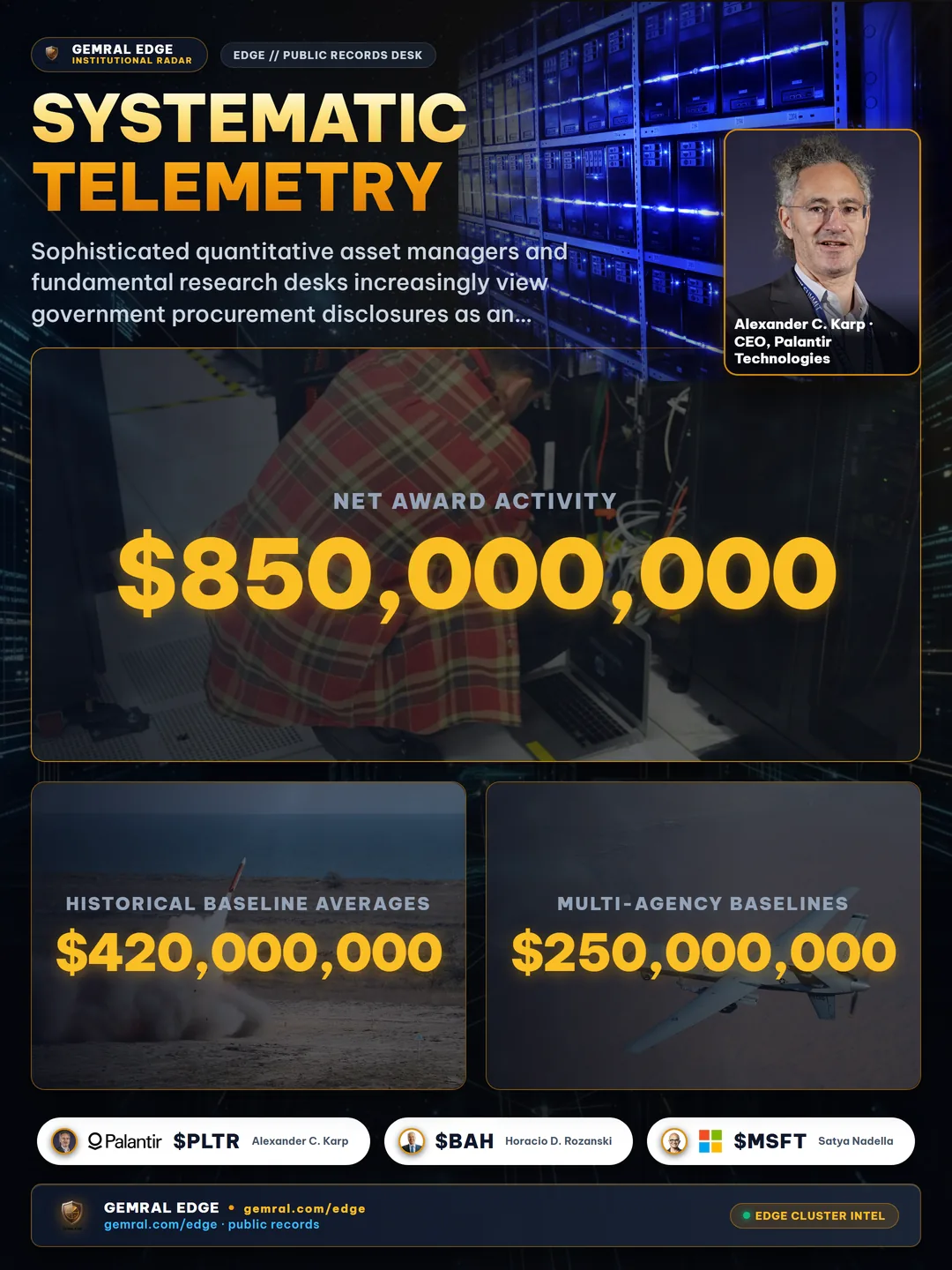
Sophisticated quantitative asset managers and fundamental research desks increasingly view government procurement disclosures as an essential component of alternative data architecture. Rather than relying on company press releases or quarterly earnings calls, systematic funds monitor public records telemetry to evaluate enterprise software adoption, contractor retention, and agency spending velocity.
By tracking real-time obligations across prime contractors, quantitative frameworks measure:
- Net Obligation Momentum: Measuring the rolling 30-day velocity of funded obligations, where top defense AI integrators recently recorded over $850,000,000 in net award activity compared to historical baseline averages of $420,000,000.
- Agency Diversification Metrics: Evaluating whether an emerging AI vendor is expanding its customer footprint across diverse civilian and defense departments or remains dependent on a single program office, benchmarked against multi-agency baselines of $250,000,000.
- Infrastructure Expansion Alignment: Cross-referencing software procurement awards with hardware infrastructure developments, such as our research into data center energy stocks and utility interconnection queues.
For investment organizations building systematic data models, access to clean, point-in-time normalized public records is critical, backed by 100% verified entity lineage across prime contractors. To evaluate our coverage across federal procurement awards, explore our live data preview or inspect our comprehensive datasets catalog.
Public records telemetry and contract award disclosures. Sourced directly from official agency announcements and federal transparency databases. Not investment advice or an endorsement of specific corporate securities. Published by Gemral Edge Research.
Frequently asked questions
Which public AI companies hold the largest US government contracts?
Palantir Technologies (PLTR) and Booz Allen Hamilton (BAH) hold substantial multi-year prime contractor allocations across defense intelligence and civilian analytics. Large enterprise cloud providers such as Microsoft (MSFT) provide baseline infrastructure under the Joint Warfighting Cloud Capability (JWCC), while specialized vendors like C3.ai (AI) and BigBear.ai (BBAI) compete for agency-specific machine learning task orders.
How do federal agencies distinguish between contract ceilings and actual obligations?
A contract ceiling represents the maximum potential statutory value over a multi-year ordering period, such as an indefinite delivery, indefinite quantity (IDIQ) vehicle. In contrast, an obligation reflects the exact dollar amount committed by an agency for immediate execution via an individual task order. Quantitative tracking models focus on real-time obligation actions rather than uncommitted ceiling announcements.
What is parent entity resolution in federal contract tracking?
Parent entity resolution is the programmatic process of mapping award notices made to operating subsidiaries, joint ventures, or unique entity identifiers (UEIs) back to the ultimate publicly traded corporate parent. Without point-in-time parent mapping, awards granted to decentralized regional subsidiaries frequently fail to link to the parent equity ticker in quantitative data feeds.
Where can institutional investors inspect federal contract award disclosures?
Federal contract actions are publicly disclosed through the System for Award Management (SAM) and official defense procurement bulletins. Systematic data providers structure these records with point-in-time timestamps and parent ticker resolution for quantitative research.