
The rapid expansion of artificial intelligence compute clusters has triggered a structural convergence between Silicon Valley hyperscalers and the North American electrical power grid. While initial market attention centered on semiconductor designers and server assemblers, physical power availability has emerged as the decisive bottleneck governing forward infrastructure deployments. Large-scale language model training facilities and real-time inference clusters demand continuous, uninterrupted electric baseload, transforming power generation capacity into one of the most heavily scrutinized variables in technology capital allocation. Institutional market participants tracking this transformation can inspect live filings, regulatory dockets, and capacity telemetry through our power and utility infrastructure telemetry platform.
According to projections from the Electric Power Research Institute (EPRI), data center electricity consumption across the United States is forecast to expand from approximately 21 gigawatts in 2023 to more than 54 gigawatts by 2030, representing up to 9.1% of total national electricity demand. In localized wholesale regional transmission markets, the impact is even more acute. Hyperscalers such as Microsoft, Alphabet, Amazon Web Services, and Meta Platforms have committed annual infrastructure capital expenditures exceeding $200,000,000,000, but translating capital into active compute requires secured interconnection points, continuous baseload contracts, and physical power delivery apparatus.
As transmission queues expand and localized utility grids face reserve margin pressures, capital allocation is undergoing a historic rotation. Power infrastructure equities—spanning independent power producers, regulated utilities, turbine manufacturers, and electrical equipment providers—are being re-priced as foundational beneficiaries of the ongoing computing super-cycle. Understanding the mechanics of this energy transition requires analyzing utility interconnection queues, wholesale capacity pricing dynamics, nuclear power purchase agreements, and the physical hardware supply chain.
The Hyperscaler Grid Crunch: Why AI Data Center Power Stocks Diverged from Pure Chips
During the opening phase of the generative artificial intelligence cycle, enterprise capital poured directly into compute accelerators, high-bandwidth memory, and specialized networking silicon. However, by mid-2024, a secondary operational constraint began to dictate cluster commissioning schedules: regional utility interconnection queues. An advanced cluster housing 100,000 state-of-the-art accelerators can consume between 100 megawatts and 300 megawatts of continuous electrical load—an energy footprint equivalent to a mid-sized American municipality. Because commercial high-density GPUs operate at unprecedented power densities, hyperscale data center operators can no longer rely solely on speculative merchant grid connections.
This dynamic precipitated a distinct equity performance divergence across equity markets. While merchant silicon manufacturers faced cyclical supply digestion and component delivery normalization, specialized power generation providers and grid equipment suppliers experienced structural backlog expansion. Public equity investors re-evaluated independent power producers (IPPs), regulated electric utilities, turbine manufacturers, and high-voltage apparatus providers as essential conduits for artificial intelligence scaling, expanding upon patterns identified in our analysis of data center energy stocks. The market recognized that compute cannot be monetized without electrons, prompting a flight of capital toward firms with existing operational generation permits, uncommitted megawatts, and proven interconnection priority.
Furthermore, the physical geography of artificial intelligence deployments has shifted toward regions with available baseload and transmission capacity. Clusters that historically clustered in Northern Virginia and Silicon Valley are facing local substation rationing and multi-year interconnection delays. In response, data center developers are actively negotiating bilateral supply agreements across the PJM Interconnection, ERCOT in Texas, and MISO in the Midwest, driving multi-billion-dollar valuation re-ratings across merchant power generators operating within deregulated wholesale markets.
The divergence between compute equities and power infrastructure also reflects differing economic characteristics. While semiconductor hardware faces rapid multi-year obsolescence cycles as chip architectures advance every twelve to eighteen months, electrical power generation assets operate on multi-decade depreciation schedules. A commissioned natural gas turbine or an operational nuclear plant produces durable, non-depreciating contractual cash flows that compound over fifteen to thirty years, providing institutional capital with long-dated visibility.
Nuclear Power Purchase Agreements: Behind-the-Meter Baseload and SMR Reactor Timelines
To reconcile continuous computing demands with aggressive corporate net-zero decarbonization mandates, hyperscalers have turned decisively toward commercial nuclear energy. Intermittent renewable generation from wind and solar photovoltaic assets requires utility-scale battery energy storage systems that remain economically and logistically unviable for sustaining continuous gigawatt-scale data center operations. Commercial nuclear generation represents the only operational, zero-carbon technology capable of delivering 24/7 baseload capacity with capacity factors routinely exceeding 90%.
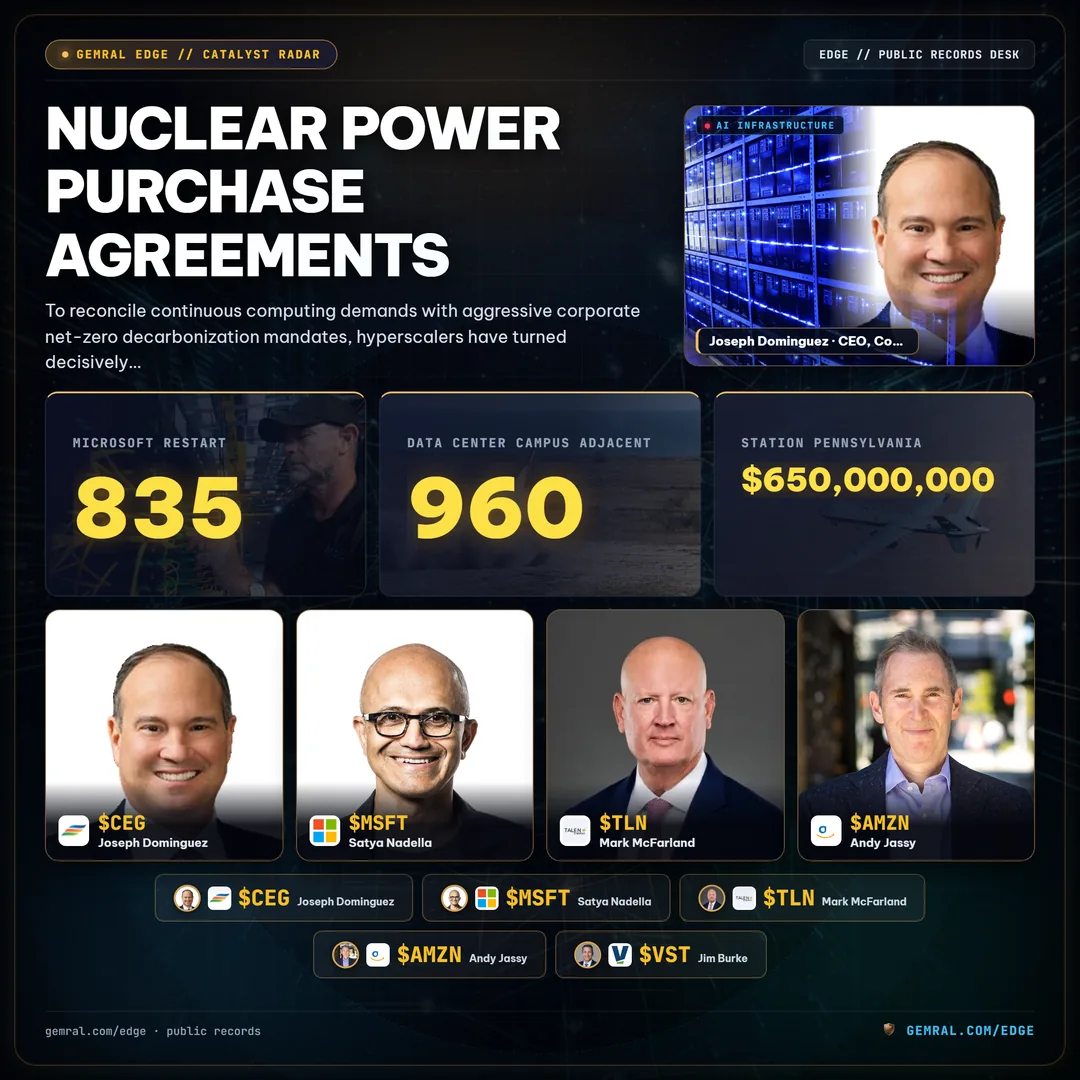
The strategic value of existing commercial nuclear fleets was crystallized through landmark bilateral agreements executed throughout 2024. In September 2024, Constellation Energy (CEG) finalized a historic 20-year power purchase agreement with Microsoft to restart the 835-megawatt Unit 1 reactor at Three Mile Island, newly christened the Crane Clean Energy Center, targeting operational restart by 2028. This followed Talen Energy's (TLN) landmark transaction with Amazon Web Services, in which Amazon acquired the Cumulus data center campus adjacent to the 960-megawatt Susquehanna nuclear generation station in Pennsylvania for $650,000,000, securing direct access to carbon-free baseload electricity.
Similarly, Vistra Corp (VST) expanded its nuclear baseload footprint following its acquisition of Energy Harbor, consolidating over 6,400 megawatts of nuclear capacity across its commercial fleet alongside more than 41,000 megawatts of total generation assets. These commercial transactions highlight the immense competitive advantage held by independent power producers possessing operational or dormant nuclear reactor licenses. While building a conventional greenfield gigawatt-scale nuclear plant requires fifteen to twenty years and tens of billions of dollars in regulatory review, existing reactor sites already possess NRC operating licenses, water discharge permits, and heavy-duty switchyard connectivity.
Beyond existing commercial fleets, institutional research desks are actively tracking long-term small modular reactor (SMR) development pipelines. Major technology platforms have committed early-stage development capital to advance commercial SMR deployments, aiming to place localized modular reactors directly alongside future campus footprints. However, commercial deployment timelines for advanced SMR architectures—championed by publicly traded developers—remain targeted toward the early 2030s due to extensive Nuclear Regulatory Commission (NRC) design certification requirements and specialized high-assay low-enriched uranium (HALEU) fuel supply chain development.
Gas Turbines and Aeroderivative Peakers: The Fast-Interconnection Bridge for 2026 Gigawatt Loads
While nuclear power provides an ideal long-term carbon-free profile, its commercial restart and construction cycles cannot satisfy the immediate, compressed capacity requirements of hyperscaler data centers over the 2024 to 2027 horizon. Consequently, natural gas-fired generation has established itself as the indispensable operational bridge for near-term artificial intelligence infrastructure expansion. Dual-fuel combined-cycle plants and quick-start aeroderivative gas turbines represent the only mature power generation technologies capable of being permitted, engineered, and energized within compressed multi-year delivery windows.
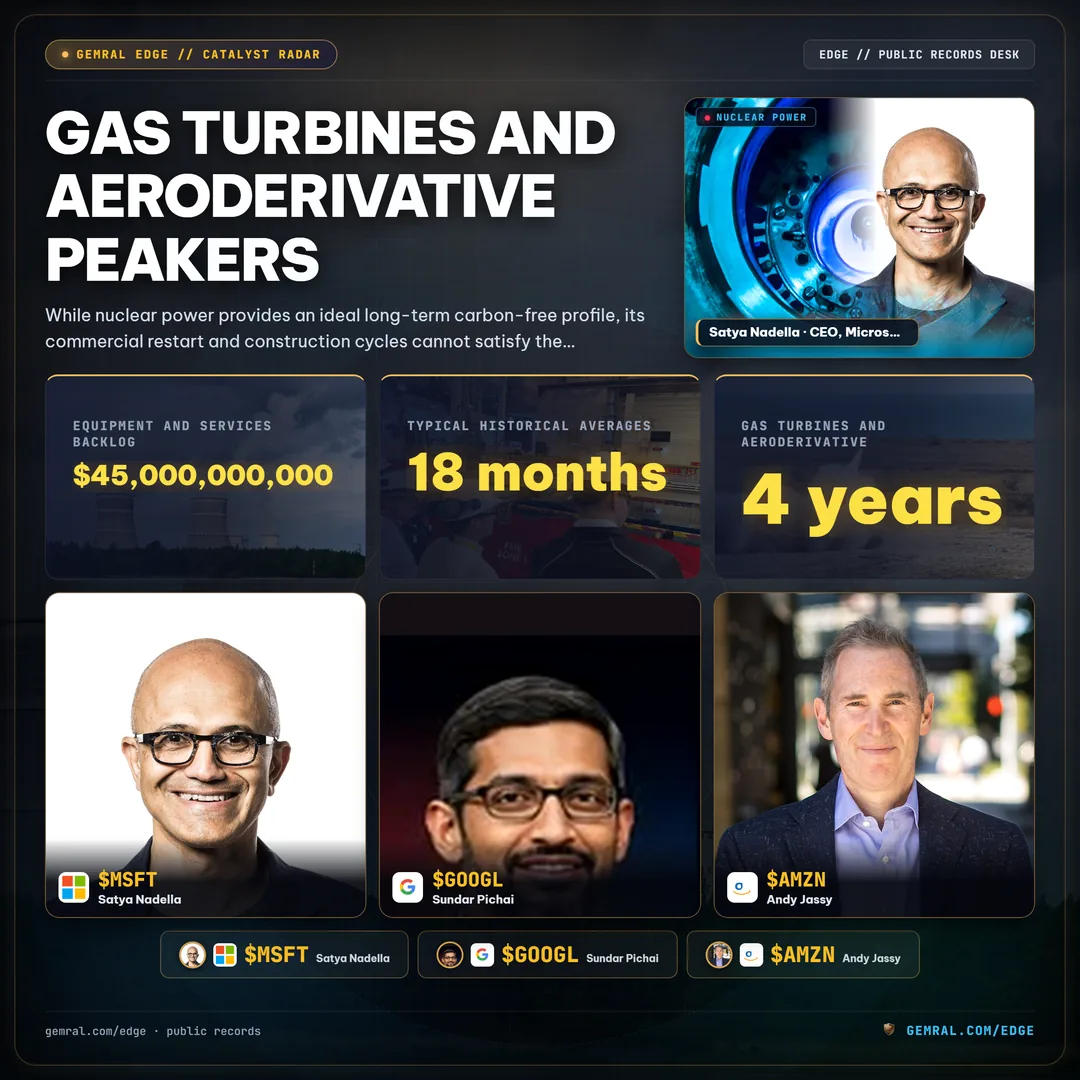
This operational reality has positioned power equipment industrial manufacturers at the epicenter of capital expenditure deployments. GE Vernova (GEV), which completed its independent public listing in April 2024, has reported surging global order intake across its gas power segment, amassing an electrical equipment and services backlog exceeding $45,000,000,000. Manufacturing lead times for heavy-duty frame gas turbines have extended from typical historical averages of 18 months to between 3 and 4 years, effectively creating an equipment allocation barrier for developers seeking rapid grid interconnection.
Hyperscalers are increasingly exploring "islanded" or microgrid topologies, installing on-site aeroderivative natural gas turbines directly behind the utility meter to bypass congested transmission queues. These quick-start peaker configurations allow data center operators to bring compute clusters online years ahead of regional utility transmission upgrades, utilizing natural gas pipeline access while maintaining secondary dual-fuel distillate backup. In wholesale markets like Texas (ERCOT), where rapid load growth has stressed local grid reserves, on-site natural gas generation offers a proven pathway to energize 100-megawatt to 500-megawatt data centers without waiting for multi-year transmission line construction.
As a result, pipeline operators, midstream gathering systems, and natural gas turbine manufacturers have become critical components of institutional data center investment baskets. The durability of gas turbine demand is further reinforced by the continuous service and maintenance agreements attached to heavy-duty power assets. Industrial providers generate recurring high-margin aftermarket revenues through long-term service agreements (LTSAs) that span the 25-year operational lifecycle of modern turbine units.
Regulated Utilities vs. Independent Power Producers: Interconnection Queues and PJM Capacity Auctions
The institutional investment landscape for data center power stocks is fundamentally bisected between regulated utilities and merchant independent power producers. Regulated utilities, such as NextEra Energy (NEE), Southern Company (SO), and Dominion Energy (D), operate under traditional state public utility commission rate-base frameworks. These entities earn authorized returns on equity (ROE) by investing capital in transmission lines, substations, and regulated power generation plants, providing stable, defensive earnings streams with structural multi-year growth trajectories.
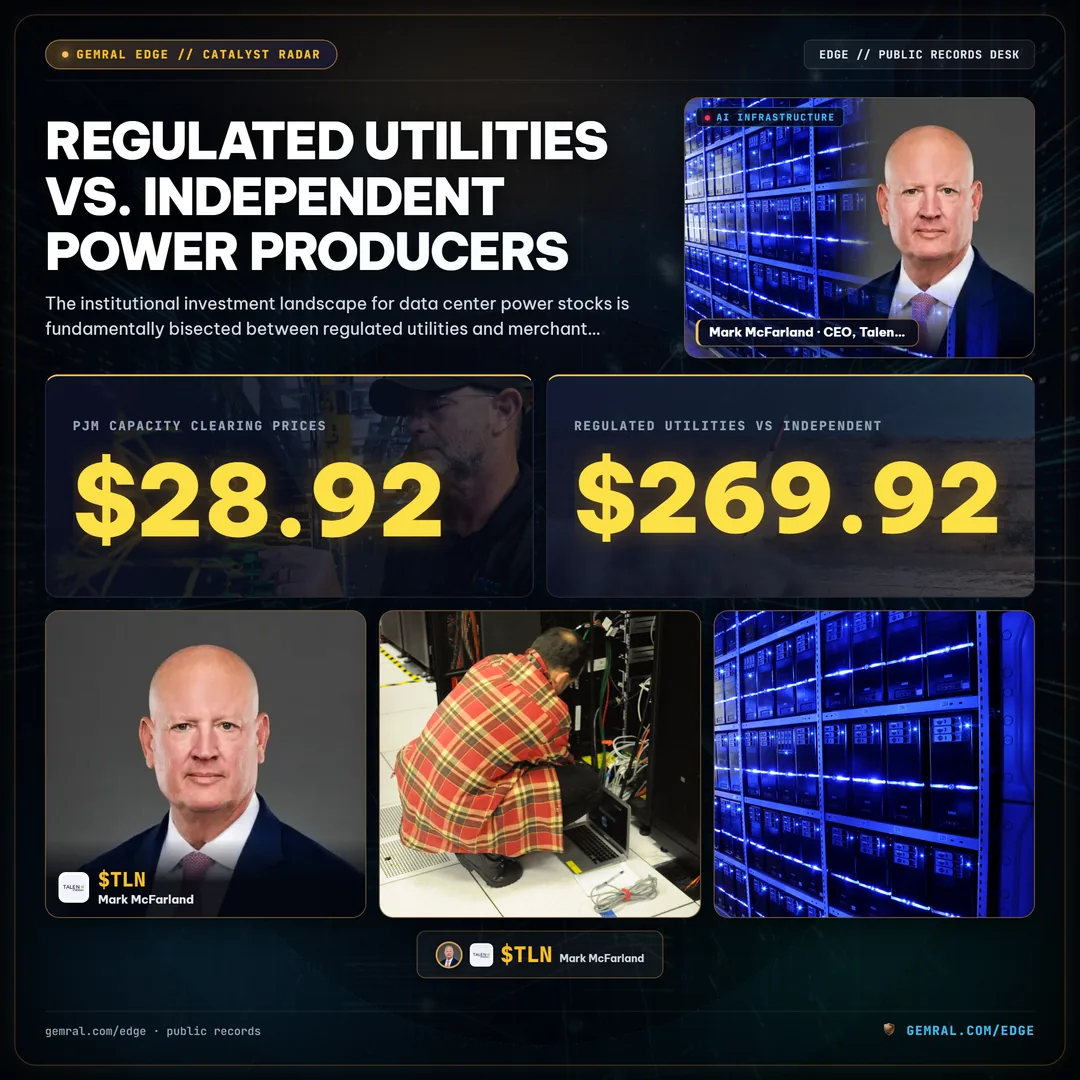
In contrast, independent power producers (IPPs) operate within deregulated competitive wholesale power markets, selling capacity and energy directly through competitive auction mechanisms and private bilateral power purchase agreements. The operating leverage of merchant generators was demonstrated in the PJM Interconnection 2025/2026 Base Residual Auction conducted in mid-2024. Reflecting steep reserve margin declines driven by projected data center demand and accelerating thermal plant retirements, PJM capacity clearing prices escalated from $28.92 per megawatt-day to $269.92 per megawatt-day—a structural increase exceeding 833%.
However, merchant power strategies also carry regulatory policy risks. On November 1, 2024, the Federal Energy Regulatory Commission (FERC) issued an order in Docket ER24-2172 rejecting an amended Interconnection Service Agreement (ISA) between PJM, PPL Electric Utilities, and Talen Energy by a 2-1 vote. The order highlighted emerging regulatory scrutiny over "behind-the-meter" data center co-location, questioning whether large industrial consumers might shift grid transmission reliability costs onto ordinary residential and commercial utility ratepayers. Quantitative models must incorporate these regulatory precedents when evaluating the durability of bilateral merchant power agreements.
Regulated utilities, meanwhile, are leveraging their captive service territories to execute record capital expenditure plans. Utility holding companies operating in Virginia, Georgia, and the Carolinas are filing multi-gigawatt integrated resource plans (IRPs) with state regulators to finance new transmission corridors and natural gas peakers. While regulated utilities offer lower revenue volatility and robust dividend yields compared to merchant IPPs, their earnings growth is constrained by statutory rate-making caps, whereas IPPs capture pure commodity and capacity spread expansion during peak demand pricing events.
Thermal Load, Transformers, and High-Voltage Equipment: The Physical Supply Bottleneck
Beyond generation turbines and nuclear reactor cores, the physical distribution of electrical energy within high-density artificial intelligence computing facilities introduces complex hardware constraints. Modern data center architectures housing high-performance computing racks require multi-stage voltage step-down transformations, transitioning from utility transmission voltages (115 kV to 500 kV) down to distribution levels (13.8 kV to 34.5 kV) and ultimately to server-level 415 V or 48 V direct current architectures.
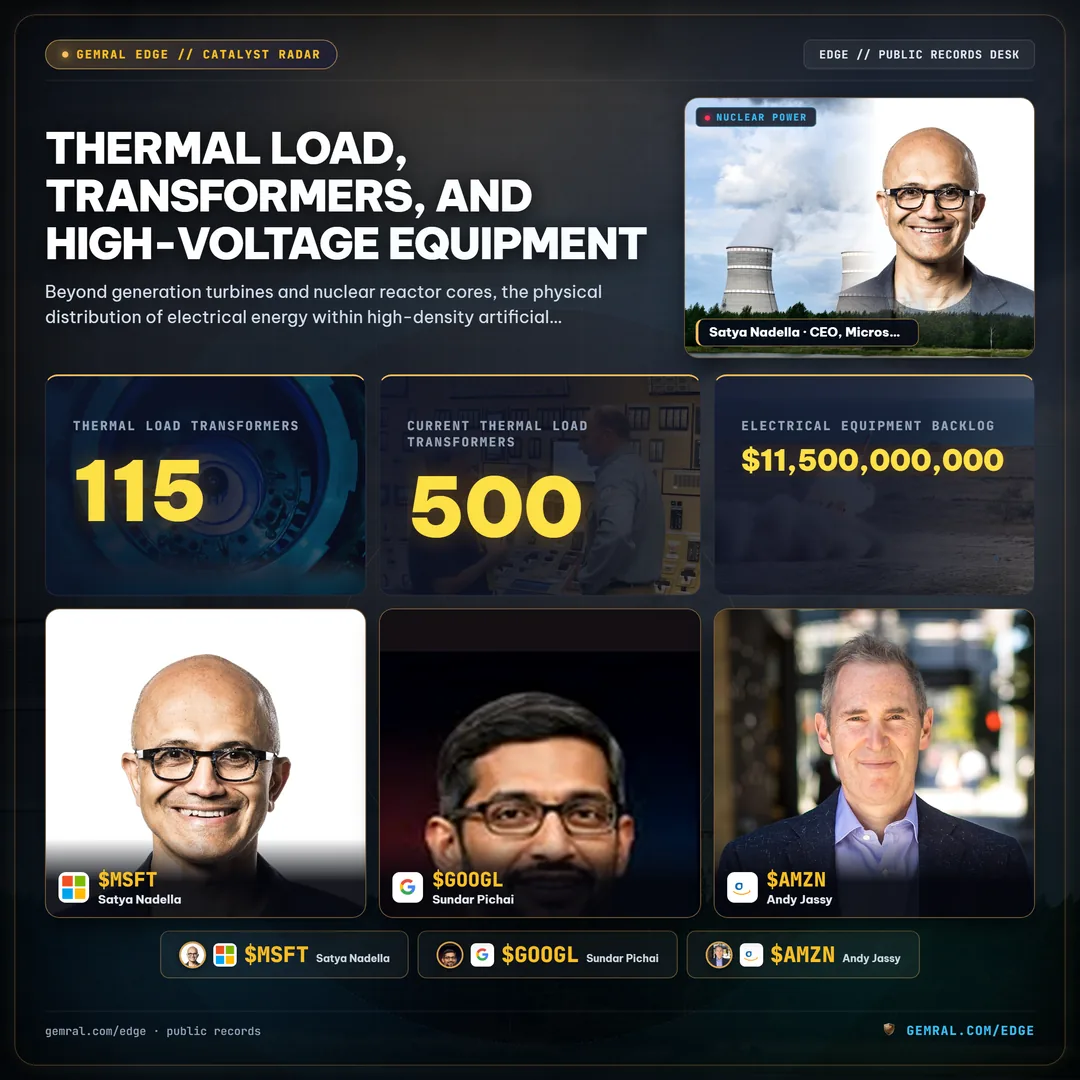
This multi-stage physical infrastructure requirement has generated severe supply chain bottlenecks across high-voltage electrical equipment manufacturers. Eaton Corporation (ETN), a premier global provider of intelligent power management solutions, maintains an electrical equipment backlog of approximately $11,500,000,000. Procuring large power transformers (LPTs) currently involves industry lead times ranging between 120 and 160 weeks, driven by global shortages of electrical-grade grain-oriented electrical steel (GOES), skilled winding labor, and high-voltage testing capacity.
Simultaneously, the thermal dissipation demands of high-density graphics clusters have catalyzed a complete re-engineering of data center cooling topologies. Legacy air-cooled raised-floor architectures cannot effectively dissipate thermal densities exceeding 40 kW to 100 kW per rack. Equipment providers like Vertiv Holdings (VRT), which maintains an order backlog of $7,000,000,000, are capturing rapid adoption for liquid-to-air and direct-to-chip liquid cooling distribution units (CDUs). The integration of liquid cooling manifolds, closed-loop heat exchangers, and uninterrupted power supply (UPS) batteries makes specialized industrial equipment suppliers primary beneficiaries of the ongoing data center power expansion.
The intersection of thermal dynamics and electrical power delivery represents a critical structural moat. Even if a data center operator secures an interconnection agreement and a contracted power source, commissioning cannot occur without switchgear, busbars, power distribution units (PDUs), and precision chillers. Companies that manufacture these specialized electrical components enjoy pricing power and elevated book-to-bill visibility, shielding their operating margins from broader macroeconomic fluctuations.
Evaluating AI Data Center Power Stocks: Backlog Quality, Fuel Access, and Interconnection Risk
As institutional asset allocators navigate the artificial intelligence energy ecosystem, separating temporary momentum from durable cash-flow generation requires a disciplined analytical framework. With over 2,600 gigawatts of generation and storage capacity currently backlogged across regional United States interconnection queues, simply announcing an ambitious data center energy project does not guarantee commercial operation, a principle mirrored in our institutional tracking of AI companies with government contracts.

When conducting fundamental and quantitative due diligence across public power equities, institutional research desks evaluate four core operational vectors:
- Interconnection Queue Maturity and Legal Rights: Verifying whether a developer holds executed, non-contingent Interconnection Service Agreements (ISAs) or merely preliminary speculative feasibility studies within regional RTO queues. Speculative queue entries experience attrition rates exceeding 70% in regional interconnection markets.
- Firm Fuel Access and Water Availability: Evaluating dual-fuel supply resilience, proximity to interstate natural gas pipelines, and local water rights for evaporative or closed-loop cooling towers. Facilities lacking firm pipeline transportation contracts face severe winter reliability curtailments.
- Regulatory Precedent and Cost-Allocation Risk: Monitoring FERC rulings and state public service commission proceedings to measure whether behind-the-meter co-location structures face regulatory curtailment or cost-shifting penalties. Regulatory cost-allocation challenges can delay co-located project commissioning by twelve to twenty-four months.
- Equipment Backlog Longevity: Auditing multi-year book-to-bill ratios and supply chain procurement visibility across critical equipment providers including GE Vernova, Eaton, and Vertiv. Tracking whether order backlogs reflect non-cancellable contractual commitments backed by customer cash deposits.
For investment organizations deploying capital across the AI infrastructure complex, tracking clean, timestamped public filings and regulatory dockets is essential for identifying forward supply-demand imbalances. To inspect our coverage of power generation assets, utility regulatory proceedings, and industrial supply agreements, examine our live data preview, explore the datasets catalog, or review our point-in-time public records telemetry.
Public records telemetry and regulatory disclosures. Sourced directly from official FERC dockets, PJM market auction reports, and SEC filings. Not investment advice or an endorsement of specific corporate securities. Published by Gemral Edge Research.
Frequently asked questions
Which public companies are the top AI data center power stocks?
The primary AI data center power stocks include independent nuclear power producers such as Constellation Energy (CEG), Vistra Corp (VST), and Talen Energy (TLN); turbine and power equipment manufacturers such as GE Vernova (GEV); electrical power distribution and liquid cooling providers such as Eaton (ETN) and Vertiv (VRT); alongside utility operators including NextEra Energy (NEE) and Southern Company (SO).
Why are Big Tech hyperscalers signing nuclear power purchase agreements?
Hyperscalers require 24/7 continuous baseload electricity with near-zero greenhouse gas emissions to satisfy corporate sustainability commitments while running 100,000-accelerator compute clusters. Intermittent solar and wind require multi-day battery storage systems that are currently uneconomic at multi-gigawatt scales, making existing nuclear plants and advanced small modular reactors (SMRs) the preferred power solution.
What regulatory risks do behind-the-meter data center contracts face?
Behind-the-meter (BTM) configurations, where a data center connects directly to a power generation facility without utilizing local transmission grids, face scrutiny from federal and state utility regulators. On November 1, 2024, the Federal Energy Regulatory Commission (FERC) rejected an amended interconnection agreement between Talen Energy and PJM, establishing that co-located data centers must not shift transmission upgrade costs or reliability burdens onto public utility ratepayers.
What is the primary equipment supply bottleneck for new power generation?
The most acute physical bottlenecks are high-voltage step-up transformers (with procurement lead times stretching to 120 to 160 weeks) and aeroderivative gas turbines (with backlogs extending between 36 and 48 months). Equipment producers such as GE Vernova and Eaton maintain multi-year backlogs that constrain the pace of physical grid expansion.