SAM Gov Contract Opportunities: Connecting Pre-Award Notices to Public Listed Suppliers
An empirical breakdown of federal procurement solicitations, presolicitation notices, and agency RFPs, mapping early-stage government demand pipelines directly to publicly traded defense primes and commercial technology contractors.
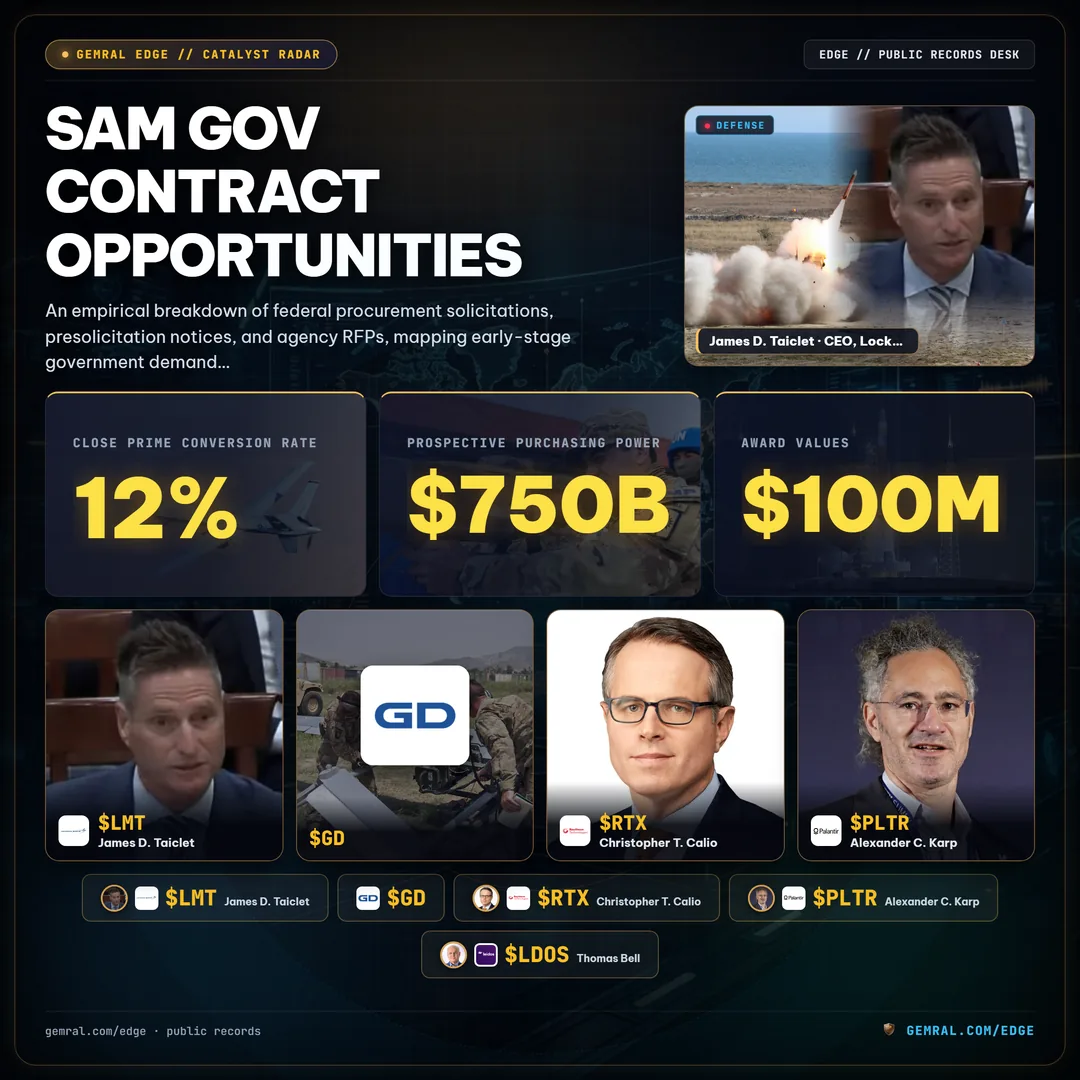
When enterprise procurement teams and quantitative equity analysts examine SAM Gov contract opportunities, they are observing the primary front door of United States federal spending. Every fiscal year, executive branch departments and defense agencies publish more than 90,000 active procurement notices across the official federal portal. These notices represent over $750 billion in prospective purchasing power, spanning classified intelligence infrastructure, cloud architecture modernizations, aerospace manufacturing, and advanced engineering services.
While traditional market participants wait for quarterly earnings conference calls or post-award announcements to evaluate federal contracting backlogs, sophisticated research desks track the pre-award phase. By utilizing our real-time federal contract awards tracker alongside our pre-award procurement telemetry, quantitative researchers monitor solicitations as they post, mapping early agency requirements directly to prospective corporate bidders weeks before awards materialize into formal contract obligations.
Active SAM Gov Contract Opportunities: Reading Pre-Award Solicitations and RFPs
Under the statutory mandate of Federal Acquisition Regulation (FAR) Part 5, federal contracting officers are legally required to publicize proposed contract actions expected to exceed $25,000. These postings populate the public opportunities portal across five distinct classification types, each signaling a specific stage in the federal procurement lifecycle:
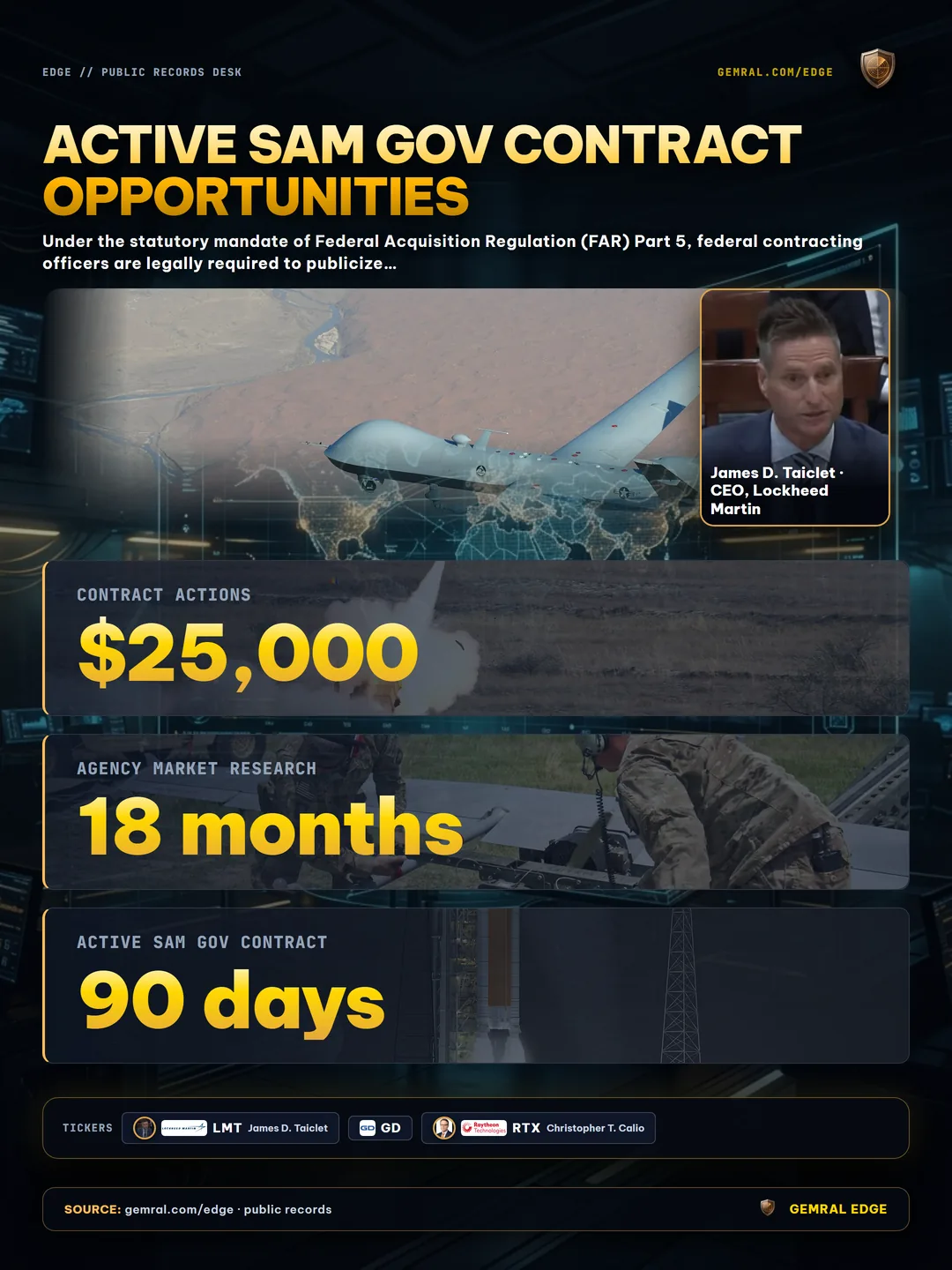
- Sources Sought and Requests for Information (RFI): Early agency market research conducted 6 to 18 months before solicitation release, designed to assess vendor capability, shape procurement specifications, and determine small business set-aside feasibility.
- Presolicitation Notices: Formal synopses issued at least 15 calendar days prior to the release of a solicitation, detailing project scope, estimated award dollar ranges, and anticipated closing dates.
- Solicitations and Requests for Proposals (RFP / RFB): Binding government invitations containing complete Statements of Work (SOW), Performance Work Statements (PWS), and Section M evaluation criteria. Contractors typically have 30 to 90 days from posting to assemble and submit technical proposals.
- Combined Synopsis / Solicitations: Streamlined commercial item acquisitions conducted under FAR Part 12, collapsing pre-announcement and bidding timelines into compressed windows as short as 10 to 20 days.
- Award Notices: Public announcements revealing winning vendors, award dollar amounts, and contract vehicle numbers, closing out the pre-award cycle.
Understanding these notice classifications allows market observers to track where an agency sits in its capital deployment cycle. An influx of RFI notices from the Department of Defense signals long-term strategic priority shifts, whereas high-value RFPs indicate near-term budget execution before fiscal year-end deadlines.
How to Search SAM Gov Contract Opportunities by Agency, NAICS, and Set-Aside
Navigating the federal repository effectively requires mastering the underlying taxonomy used by government contracting officers. Federal solicitations are organized under standardized classification frameworks that enable precise filtering:
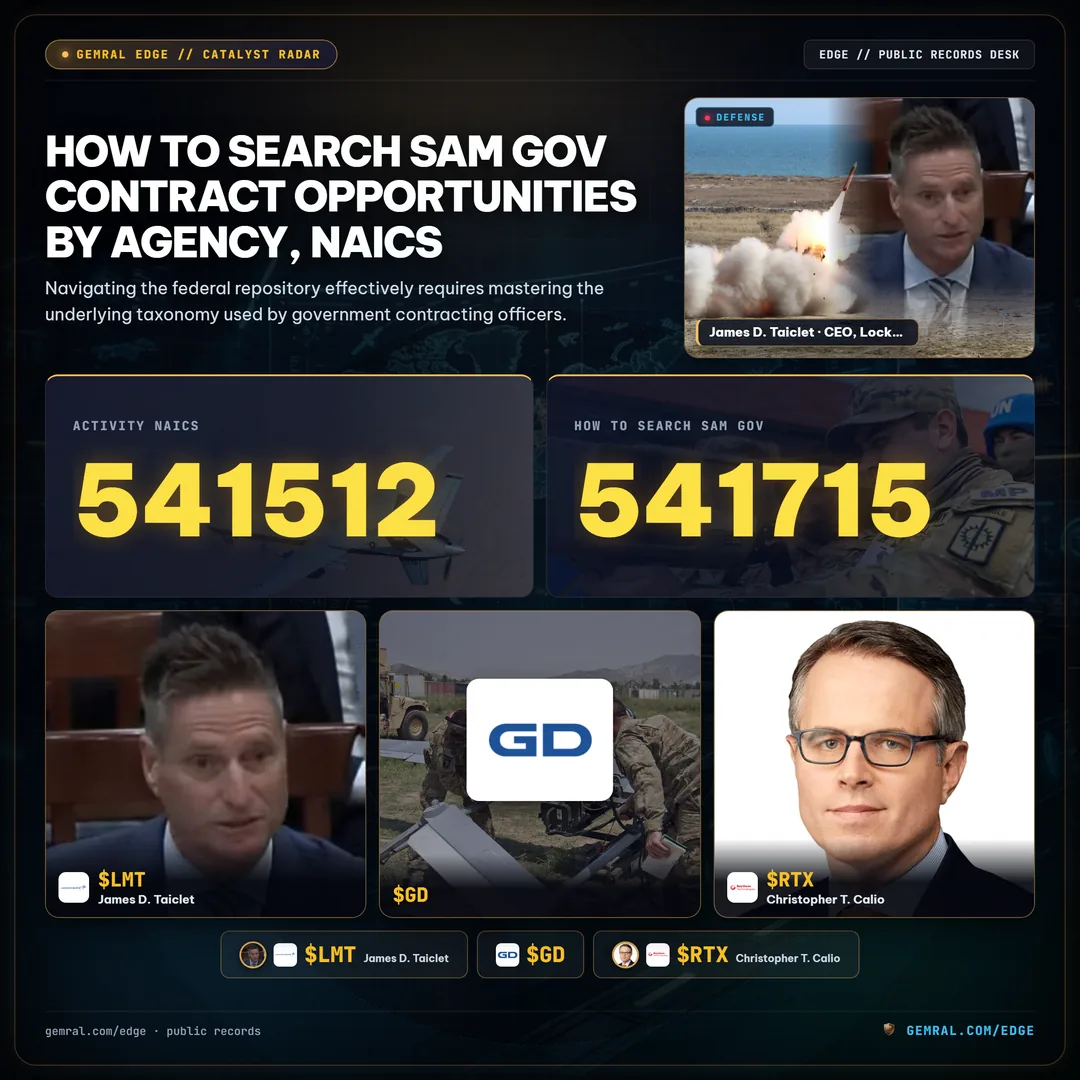
- North American Industry Classification System (NAICS) Codes: Six-digit numerical identifiers defining specific economic activities. Core categories generating substantial public contractor activity include NAICS 541512 (Computer Systems Design Services), NAICS 541715 (R&D in Physical, Engineering, and Life Sciences), NAICS 336411 (Aircraft Manufacturing), and NAICS 541330 (Engineering Services).
- Product and Service Codes (PSC): Four-character alphanumeric codes describing the exact physical product, commodity, or professional service being procured, ranging from IT defense telecommunications to specialized maritime maintenance.
- Contracting Agency and Sub-Tier Hierarchy: Filtering by specific procuring commands—such as the Naval Air Systems Command (NAVAIR), Army Contracting Command (ACC), or Defense Logistics Agency (DLA)—reveals distinct operational budgets and localized supplier preferences.
- Set-Aside Distinctions: Opportunities are categorized as Total Small Business, 8(a) Business Development, Service-Disabled Veteran-Owned Small Business (SDVOSB), HUBZone, or Full and Open Competition. Publicly traded primes primarily capture Full and Open awards, while frequently establishing mentor-protégé partnerships to participate in set-aside subcontracts.
For systematic analysts auditing market volume, filtering by high-threshold NAICS codes pinpoints solicitations with award values exceeding $100 million. To examine historical corporate participation across these sectors, review our comprehensive database covering companies with government contracts.
Connecting Federal Solicitations to Public Listed Suppliers and Defense Primes
The critical inflection point for public equities research occurs when federal solicitations intersect with the capabilities and existing contract vehicles of listed enterprises. Unlike smaller private vendors that bid on transactional micro-purchases below $10,000 or simplified acquisitions under $250,000, publicly traded contractors compete for complex multi-year enterprise programs.
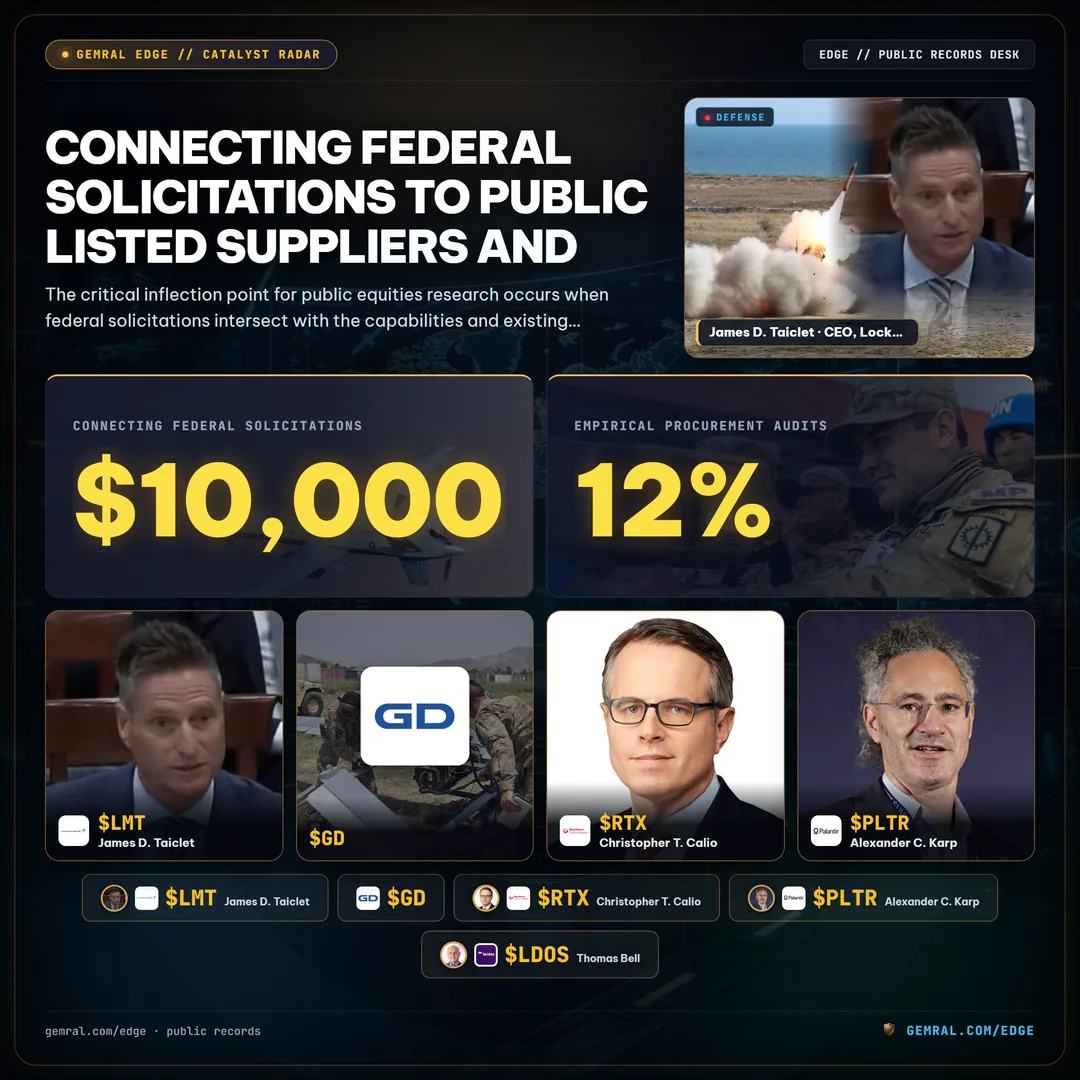
Empirical procurement audits reveal that between 12% and 18% of major pre-solicitation notices convert directly into single-award enterprise prime contracts. The remainder are structured as Indefinite Delivery, Indefinite Quantity (IDIQ) task order vehicles, Government-Wide Acquisition Contracts (GWACs), or Blanket Purchase Agreements (BPAs).
When an agency issues an RFP for cloud infrastructure or autonomous sensor integration, major defense primes and enterprise IT suppliers position their proposals based on incumbent advantage. Key public players actively competing across high-dollar opportunities include:
- Lockheed Martin (LMT) and General Dynamics (GD): Dominating heavy aerospace, naval systems, and combat vehicle solicitations, where barriers to entry and security clearance requirements exclude non-traditional entrants.
- RTX Corporation (RTX): Capturing high-density solicitations across precision guidance, electronic warfare, and advanced radar sensing. Detailed revenue metrics for these contractors are benchmarked in our comparative study on defense contractors by market cap.
- Palantir Technologies (PLTR) and Leidos Holdings (LDOS): Leading large-scale defense IT modernization, multi-agency data ontology platforms, and battlefield command software procurements.
- CACI International (CACI) and Booz Allen Hamilton (BAH): Capturing recurring mission-critical IT, national security consulting, and cyber defense technical solicitations.
By cross-referencing pre-award notices against incumbent contract expiration dates, analysts identify recompete vulnerabilities where competitor primes challenge established sole-source positions.
Automating Contract Opportunities Telemetry: From Pre-Award Postings to Systematic Backlog Signals
Extracting quantitative signals from federal opportunity feeds presents complex computational challenges. The raw federal portal produces high volumes of unstructured PDFs, amended solicitation documents, and fluctuating proposal submission deadlines. Furthermore, connecting parent equity tickers to operational subsidiary entities requires extensive entity resolution infrastructure.
Institutional quant funds and risk desks ingest automated, normalized opportunity feeds to construct predictive procurement backlogs. Tracking changes in solicitation values, amendment frequencies, and bidder qualification criteria provides early visibility into federal budget allocation velocity.
Subscribers access complete historical coverage and live telemetry feeds through the Gemral Edge platform across structured tiers: the Pro Tier ($39/month) for individual investors, the B2B Intelligence Tier ($299/month) for multi-seat analyst desks, and the Institutional API Tier ($2,000/month) for quantitative funds requiring programmatic ingestion. Institutional investors seeking raw historical procurement data and cross-referenced entity graphs can explore our specialized alternative data packages.
Frequently asked questions
What are SAM Gov contract opportunities?
SAM Gov contract opportunities are official pre-award public notices published by federal executive agencies, encompassing presolicitations, requests for proposals (RFPs), sources sought notices, and contract award announcements.
How do companies search and qualify for SAM Gov contract opportunities?
Contractors search opportunities by filtering specific NAICS industry codes, contracting agency offices, classification codes, and small business set-asides while maintaining active Unique Entity Identifier (UEI) registrations.
How do pre-award contract opportunities impact publicly listed defense primes?
Pre-award notices provide early quantitative visibility into agency procurement budgets, recompete timelines, and weapon systems modernization programs 30 to 90 days before binding obligation capital is allocated to public suppliers.
What is the difference between SAM Gov opportunities and contract obligation data?
SAM Gov contract opportunities reflect prospective procurement solicitations before a vendor is selected, whereas federal obligation databases record legally binding capital outlays after contract execution.