Data Center Liquid Cooling Stocks: Direct-to-Chip Thermal Management and Hyperscaler Retrofits
An empirical deep dive into the physical infrastructure constraints driving artificial intelligence clusters, evaluating rack-level power densities, direct-to-chip distribution units, supply chain import telemetry, and the public equities enabling thermal management across hyperscale facilities.
In modern institutional capital markets, evaluating data center liquid cooling stocks requires moving beyond software narratives to analyze the uncompromising laws of physical thermodynamics. The transition toward high-density artificial intelligence compute clusters has triggered an unprecedented thermal bottleneck across enterprise data centers. For two decades, commercial computing facilities operated comfortably with air-cooled server cabinets drawing between 5kW and 15kW of electrical power. Today, state-of-the-art accelerated computing racks—housing dense clusters of tensor processors and high-bandwidth memory—routinely demand between 40kW and 120kW+ per enclosure.
At these extreme power densities, forced-air cooling reaches its absolute aerodynamic and thermodynamic boundary. Pushing sufficient air volume through cramped server chassis requires fans to spin at decibel levels that cause mechanical vibration damage while consuming more electricity than the processors themselves. To sustain the operational uptime of high-performance semiconductor clusters, hyperscale cloud operators and colocation providers are executing comprehensive facility retrofits. Rather than waiting for delayed corporate press releases, institutional analysts monitor real-time physical deployments through our AI infrastructure telemetry tracker to evaluate how cooling hardware suppliers navigate this generational structural shift.
How Data Center Liquid Cooling Operates Across High-Density AI Cluster Racks
The core engineering imperative behind liquid cooling is fluid thermodynamics: liquid possesses roughly 25 times the thermal conductivity and more than 3,000 times the volumetric heat capacity of ambient air. This physical property allows liquid coolant loops to extract heat directly from microscopic semiconductor silicon gates far more efficiently, maintaining microchip junction temperatures below critical thermal throttling limits of 85°C to 105°C.
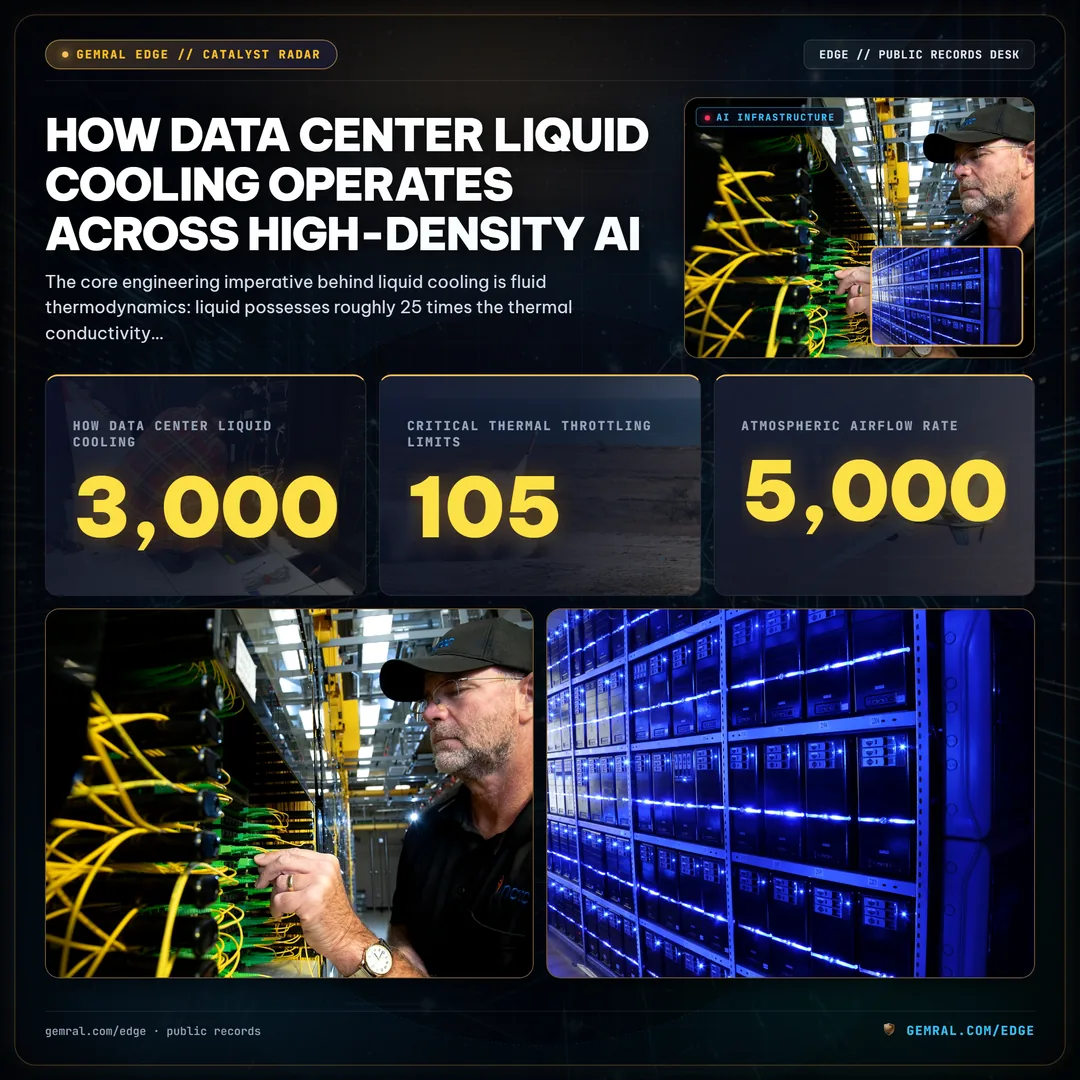
When high-density computing clusters exceed 40kW per cabinet, standard thermal heat sinks become physical impossibilities. An air-cooled rack consuming 60kW would require an atmospheric airflow rate exceeding 5,000 cubic feet per minute (CFM), effectively requiring hurricane-force air velocities across delicate server chassis. By substituting forced air with high-density fluid circulation, data center operators achieve substantial reductions in power consumption:
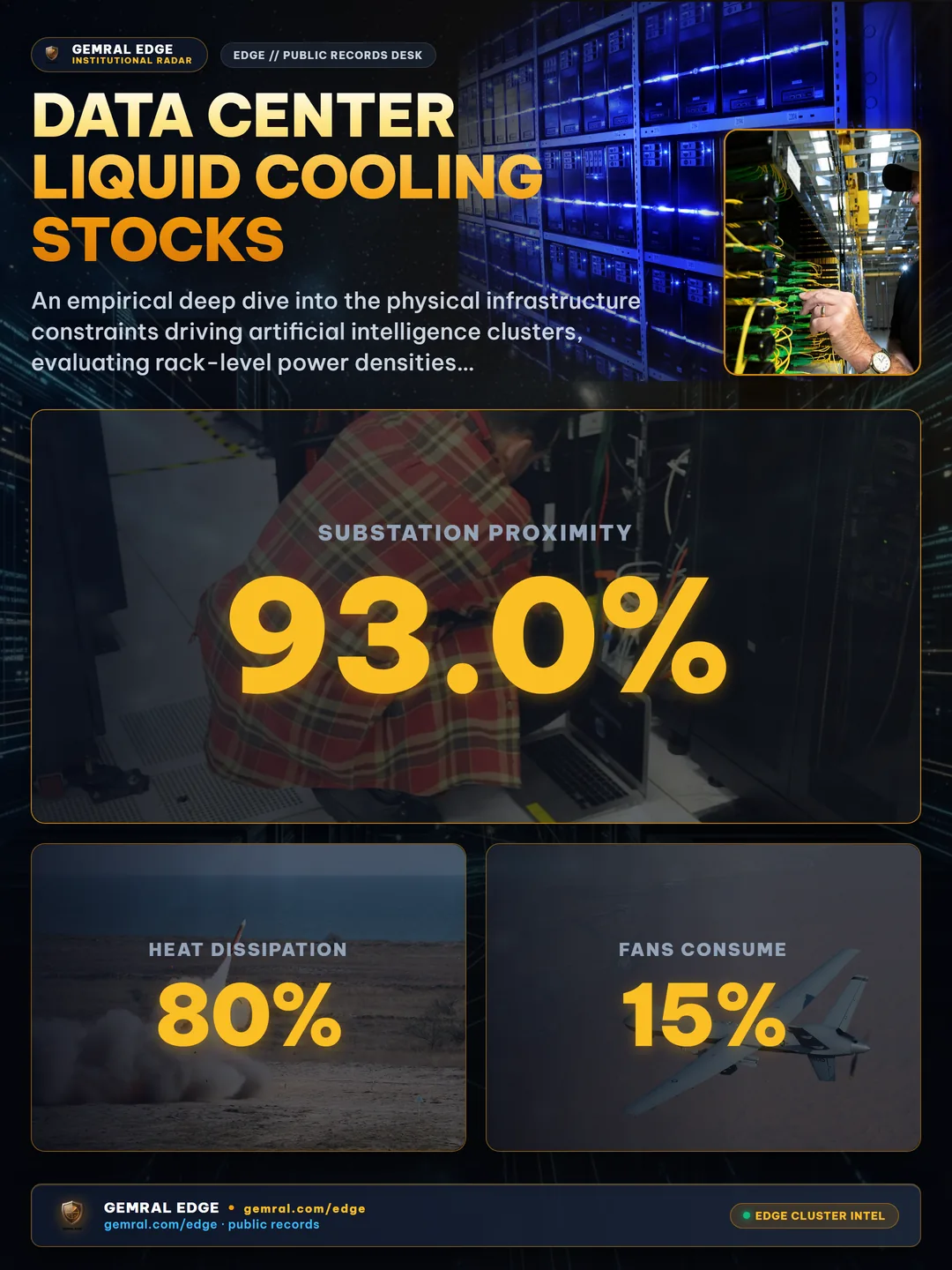
- Direct Thermal Coupling: Liquid coolants circulate through micro-channeled copper cold plates placed directly in contact with silicon processor dies, capturing over 80% to 90% of total heat dissipation at the exact point of generation.
- Parasitic Load Reductions: High-speed server chassis fans frequently consume 15% to 20% of total rack power in air-cooled environments. Eliminating server fans cuts auxiliary power consumption dramatically, lowering baseline rack operating overhead.
- PUE Compression: Facility Power Usage Effectiveness (PUE) ratios drop from traditional legacy air-cooled benchmarks of 1.45–1.60 down to 1.10–1.15 in fully optimized liquid-cooled facilities, redirecting hundreds of megawatts of electrical power directly into productive compute.
Thermodynamic Principles: Primary Facility Chilled Loops vs. Secondary Technology Cooling Loops
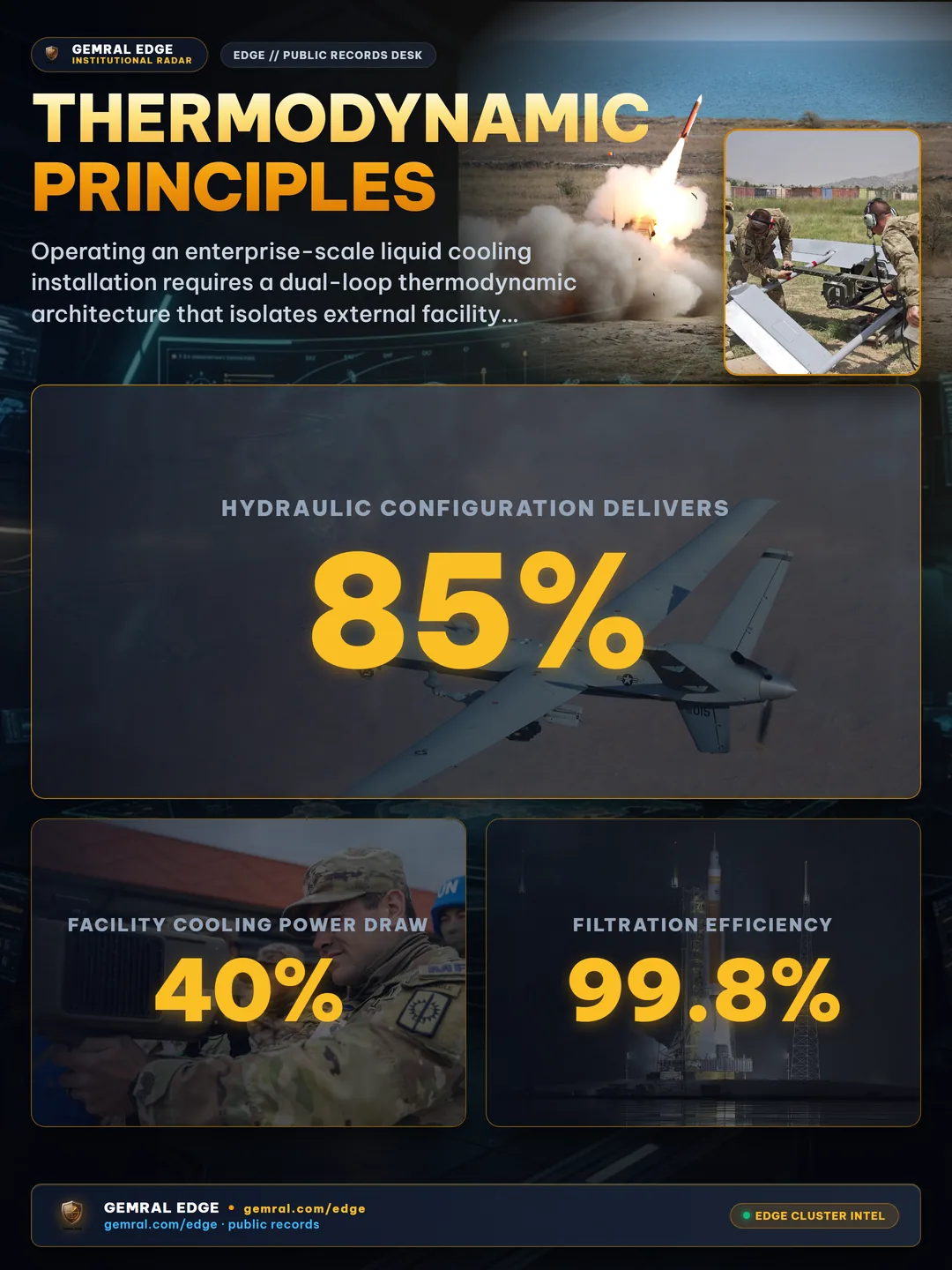
Operating an enterprise-scale liquid cooling installation requires a dual-loop thermodynamic architecture that isolates external facility plumbing from internal server rack electronics. In modern AI clusters, this hydraulic configuration delivers up to an 85% improvement in thermal transfer efficiency while cutting facility cooling power draw by over 40% compared to traditional chillers:
- The Primary Facility Water System (FWS Loop): Managing external heat rejection, the primary loop circulates facility water between external cooling towers, chillers, or dry coolers and the building interior. This loop operates with supply water temperatures typically ranging between 15°C and 32°C, pumping high volumetric flow rates of 25 to 50 gallons per minute (GPM) to remove heat from the facility perimeter.
- The Secondary Technology Cooling System (TCS Loop): A closed-loop circuit connects directly to the server blades inside the data hall. Using deionized water, specially formulated propylene glycol mixtures, or non-conductive dielectric engineered fluids, the secondary loop absorbs heat from processing nodes and returns fluid at elevated temperatures of 45°C to 65°C.
- Coolant Distribution Units (CDUs): Functioning as the hydraulic heart of the facility, CDUs house precision liquid-to-liquid plate heat exchangers, variable-speed circulation pumps, chemical dosing monitors, and particulate filters operating at 99.8% filtration efficiency. CDUs maintain precise hydraulic pressure differentials between 15psi and 45psi, ensuring steady fluid velocity while preventing condensation.
- Blind-Mate Manifolds and Quick-Disconnect Couplings: Vertical supply and return manifolds routed along rack frames feature dripless quick-disconnect valves rated for zero spillage during hot-swap operations, enabling continuous 24/7 server maintenance without taking cluster arrays offline.
Direct-to-Chip Cold Plates vs. Immersion Cooling: Comparing Thermal Architectures
Institutional investors evaluating thermal management equities must distinguish between the two primary competing technological architectures: Direct-to-Chip (DLC) cold plates and Immersion Cooling.
| Engineering Dimension | Direct-to-Chip (DLC) Cold Plates | Single/Two-Phase Immersion Cooling |
|---|---|---|
| Thermal Mechanism | Liquid pumped through copper micro-channel cold plates mounted on silicon | Entire server chassis fully submerged in dielectric synthetic hydrocarbon or fluorochemical bath |
| Power Density Range | 40kW to 100kW+ per standard vertical 42U/48U cabinet | 100kW to 250kW+ per specialized horizontal tank enclosure |
| Facility Compatibility | High compatibility; can be retrofitted into existing raised-floor data halls | Requires purpose-built floor structural reinforcement and overhead crane hoists |
| Maintenance Complexity | Standard front/rear rack access with blind-mate quick-disconnect valves | Specialized vertical extraction requiring fluid drainage and protective handling |
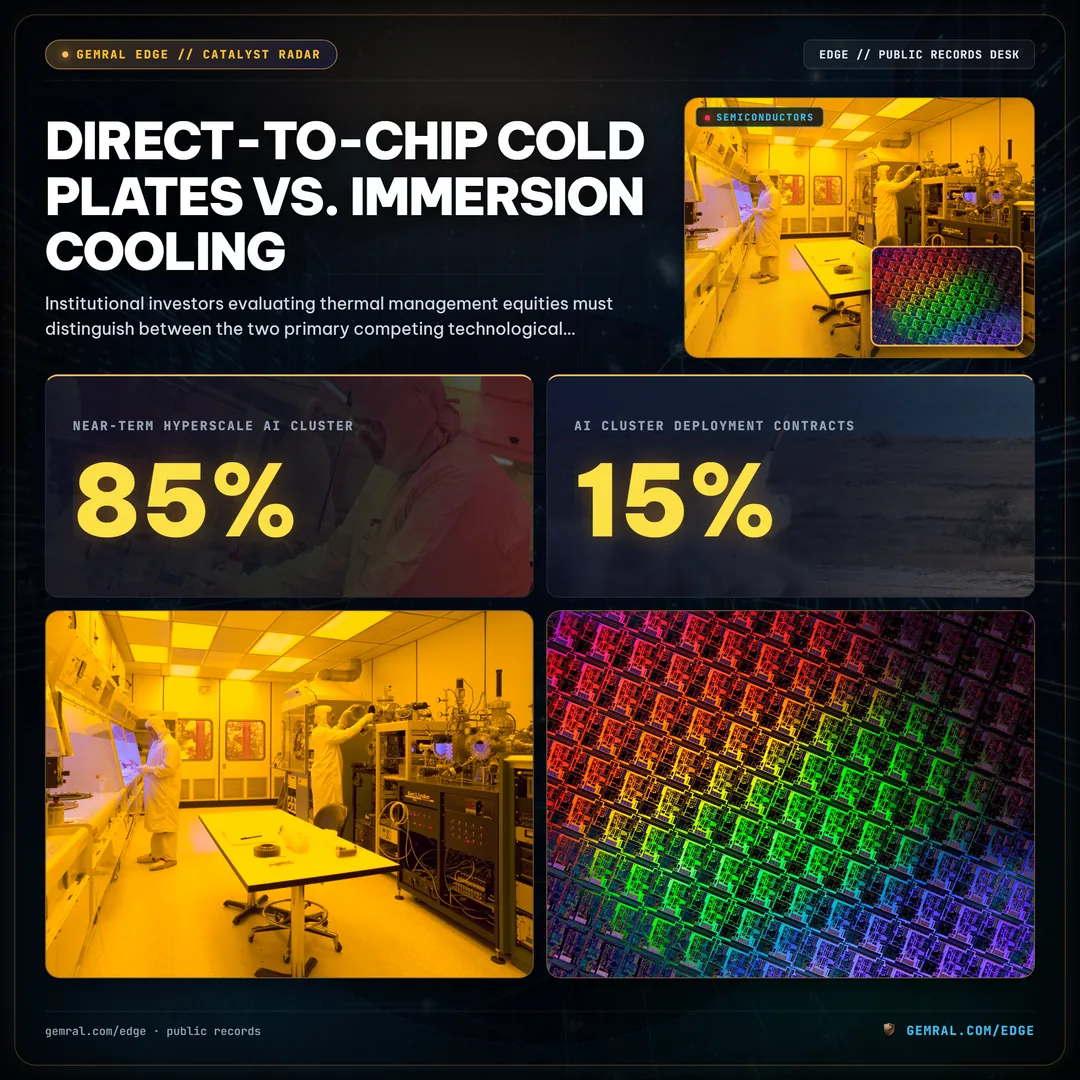
| Commercial Adoption Share | Over 85% of near-term hyperscale AI cluster deployment contracts | Roughly 15% share across niche compute installations and advanced pilot clusters |
Direct-to-Chip cooling has emerged as the overwhelmingly dominant commercial standard, capturing over 85% of near-term hyperscale AI cluster contracts, while immersion solutions maintain approximately 15% market penetration concentrated in specialized high-density supercomputing installations. Because DLC retrofits fit into standard vertical 42U and 48U cabinets, operators preserve existing data hall layouts and technician service protocols.
Tracking Physical Telemetry: CDUs, Manifolds, and Equipment Import Shipments
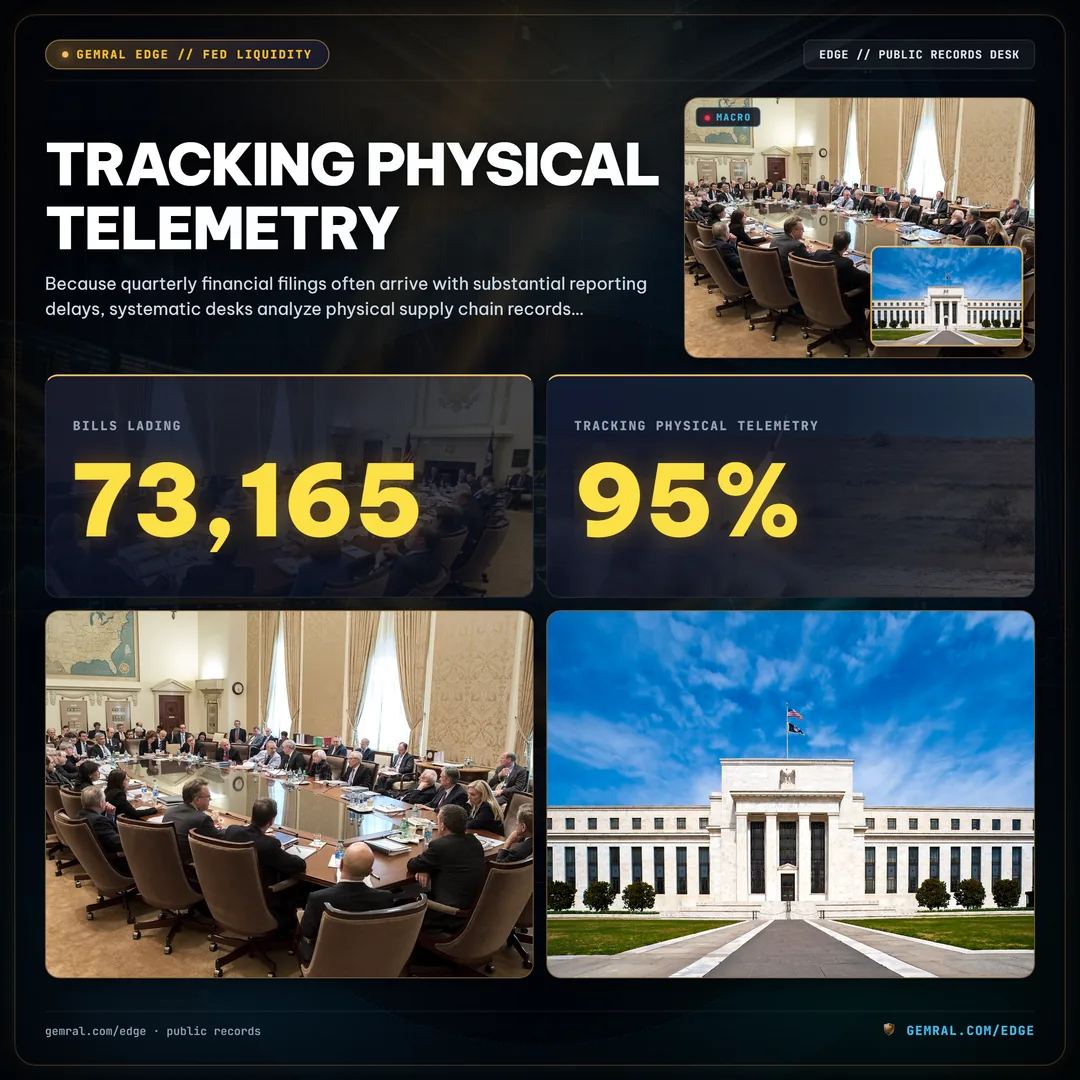
Because quarterly financial filings often arrive with substantial reporting delays, systematic desks analyze physical supply chain records to track real-world infrastructure delivery cadences. Within our Feed 2 surveillance pipeline, quantitative analysts evaluate point-in-time physical records across 49 covered corporate entities in the AI infrastructure universe (measured as of October 19, 2026).
The supply chain validation process relies on several independent physical datasets:
- Point-in-Time Equipment Import Shipments: By tracking maritime customs bills of lading across 73,165 recorded import rows (measured as of October 25, 2026), quantitative models monitor the physical arrival of harmonized tariff code shipments representing specialized liquid-to-liquid CDUs, fluid manifolds, and precision-machined copper cold plates. This equipment import dataset provides industry context by product code and origin country, not company-level shipments. In historical backtests, this physical equipment import telemetry demonstrates an empirical nowcast correlation of r = 0.41 (95% CI 0.21–0.57 across 174 company-quarters, measured as of October 24, 2026) against subsequent reported segment revenues.
- Delivery Lead Times and Bill-of-Lading Metrics: Heavy industrial cooling equipment manufactured in specialized overseas facilities requires transit windows between 30 and 90 days. Tracking monthly shipment container counts allows analysts to verify whether hardware supplier order backlogs are converting into physical dock arrivals.
- Cross-Border Logistics Verification: Discrepancies between public management revenue forecasts and customs import volumes frequently highlight regional supply bottlenecks or port customs delays before they appear in quarterly investor calls.
Regulatory and Utility Constraints: High-Voltage Substations and Air Quality Permitting
Deploying high-density liquid cooling equipment cannot be evaluated in isolation from regional utility and environmental regulatory constraints:
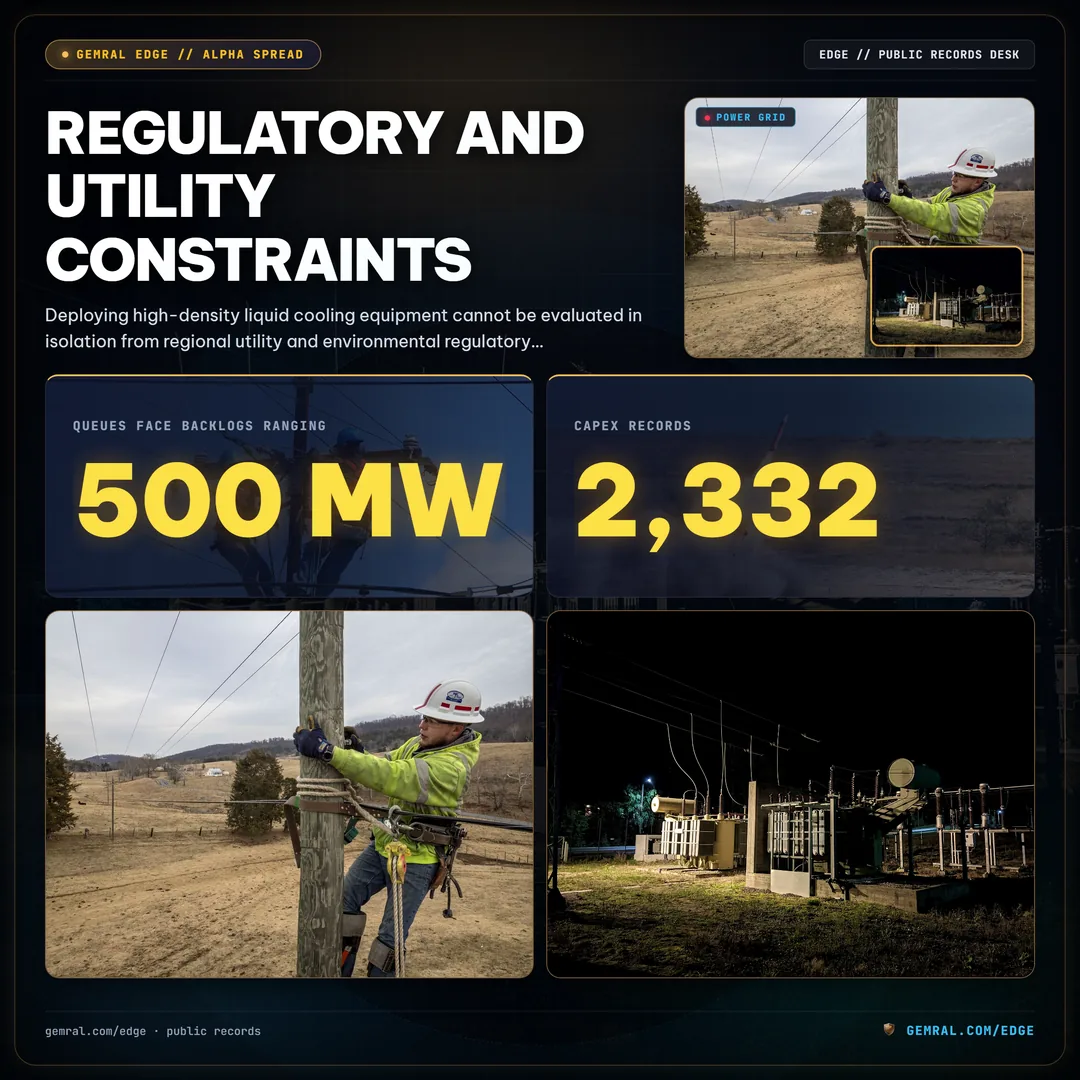
- High-Voltage Substation Interconnection: Cooling large facilities requires substantial power for electric chillers and pumping stations. Across our verified facility registry, 93.0% of data center sites maintain mapped proximity to high-voltage electrical substations (measured as of October 18, 2026). In major hubs, regional utility interconnection queues face backlogs ranging from 500MW to over 2GW, making direct grid proximity the ultimate pacing factor for data center energization.
- Air Quality and Backup Generator Permitting: Expanding server compute capacity demands matching expansions in standby diesel and natural gas generator capacity. Our regulatory telemetry monitors permitted megawatt capacity across key regional jurisdictions, including 46 active state air permits in Georgia and 34 verified permits in Texas (measured as of October 19, 2026). Permitted generator capacity represents an upper bound on on-site backup capacity, not IT load. Tracking regional infrastructure buildouts often reflects broader liquidity shifts analyzed in our report on repo market dynamics and institutional liquidity.
- Capital Expenditure Normalization: Tracking 2,332 normalized quarterly capex records (measured as of October 19, 2026) enables quantitative analysts to verify when corporate capital plans transition into concrete construction work. Desks evaluating broader market allocations can examine public disclosures in our analysis of what stocks did congress buy.
Evaluating Liquid Cooling Suppliers and Hyperscaler Retrofit Pipelines
The commercial landscape of data center liquid cooling stocks spans several corporate tiers, from specialized pure-play thermal providers to diversified industrial engineering conglomerates and server original equipment manufacturers:
1. Pure-Play and Industrial Thermal Specialists: Companies dedicated to precision cooling architecture supply the core CDUs, external chillers, and fluid distribution networks required by hyperscalers:
- Vertiv Holdings (VRT): One of the largest global providers of critical digital infrastructure, Vertiv manufactures end-to-end power and thermal management systems, including row-based CDUs, liquid-to-air cooling modules, and high-capacity chillers engineered specifically for accelerated AI compute clusters.
- Modine Manufacturing (MOD): Traditionally a diversified thermal engineering supplier, Modine has aggressively expanded its Airedale data center division, producing custom chillers, fan coil walls, and direct-to-chip CDU architectures experiencing rapid hyperscaler adoption.
- nVent Electric (NVT): A leading manufacturer of electrical enclosures, connection systems, and fluid management manifolds, nVent provides the specialized stainless steel fluid piping, quick-disconnect couplings, and rack manifolds necessary to route liquid safely inside high-density server cabinets.
2. Systems Integrators and Server OEMs: Hardware assemblers that design, manufacture, and liquid-cool complete server racks serve as the primary distribution channel for enterprise deployments:
- Super Micro Computer (SMCI): Supermicro designs integrated plug-and-play liquid-cooled server racks, incorporating custom cold plates, CDUs, and manifold systems directly into mass-produced AI server clusters to reduce lead times for cloud colocation customers.
- Diversified Industrial Conglomerates: Global engineering giants such as Schneider Electric and Eaton Corporation provide broader electrical infrastructure, modular data center pods, and integrated facility-level cooling controls that coordinate with rack-level CDU deployments.
As hyperscale cloud operators commit hundreds of billions of dollars in multi-year capital expenditures to build out accelerated AI infrastructure, thermal management has transitioned from an ancillary building operational expense into a primary structural gating factor for semiconductor deployment.
The Gemral Edge platform delivers point-in-time physical infrastructure telemetry and alternative supply chain data feeds across multiple professional subscription tiers: the Pro Tier ($39/month) for individual equity analysts tracking custom hardware supply chains, the B2B Intelligence Tier ($299/month) for institutional research teams modeling physical data center deployments, and the Institutional API Tier ($2,000/month) for quantitative desks and systematic hedge funds requiring low-latency programmatic access to physical import records, substation mappings, and capex tracking feeds. Investment teams conducting historical backtests can explore our institutional data preview or integrate comprehensive alternative data packages directly into quantitative factor models.
Frequently asked questions
What are data center liquid cooling stocks?
Data center liquid cooling stocks are public companies that manufacture industrial thermal management hardware, including direct-to-chip cold plates, coolant distribution units (CDUs), immersion cooling enclosures, heat exchangers, and fluid distribution manifolds designed to dissipate extreme heat from high-density AI accelerators.
Why is liquid cooling required for next-generation AI data centers?
High-density AI server racks housing advanced GPUs and tensor accelerators draw between 40kW and 120kW+ per cabinet. Traditional fan-driven air cooling cannot physically move enough air volume through cramped server chassis to keep semiconductor junction temperatures below operational limits, making liquid cooling thermodynamically essential.
What is the difference between direct-to-chip cooling and immersion cooling?
Direct-to-chip (DLC) cooling pumps dielectric fluid or treated water through specialized copper cold plates mounted directly on processors, leaving standard server enclosures largely intact. Immersion cooling submerges entire server blades in tanks of non-conductive dielectric fluid, offering maximum heat transfer efficiency but requiring substantial facility re-engineering.
How can institutional analysts verify liquid cooling equipment deployments?
Institutional desks track physical hardware supply chains by monitoring monthly bill-of-lading import shipments of CDUs and cold plates, tracking facility electrical substation capacity expansions, and auditing quarterly capital expenditures across data center operators.