Senate Stock Trades: Tracking STOCK Act Periodic Transaction Reports in the US Senate
An empirical examination of public equity transactions disclosed by members of the United States Senate, auditing statutory filing windows, disclosure lags, committee trade concentration, and asset class distributions under Public Law 112-105.
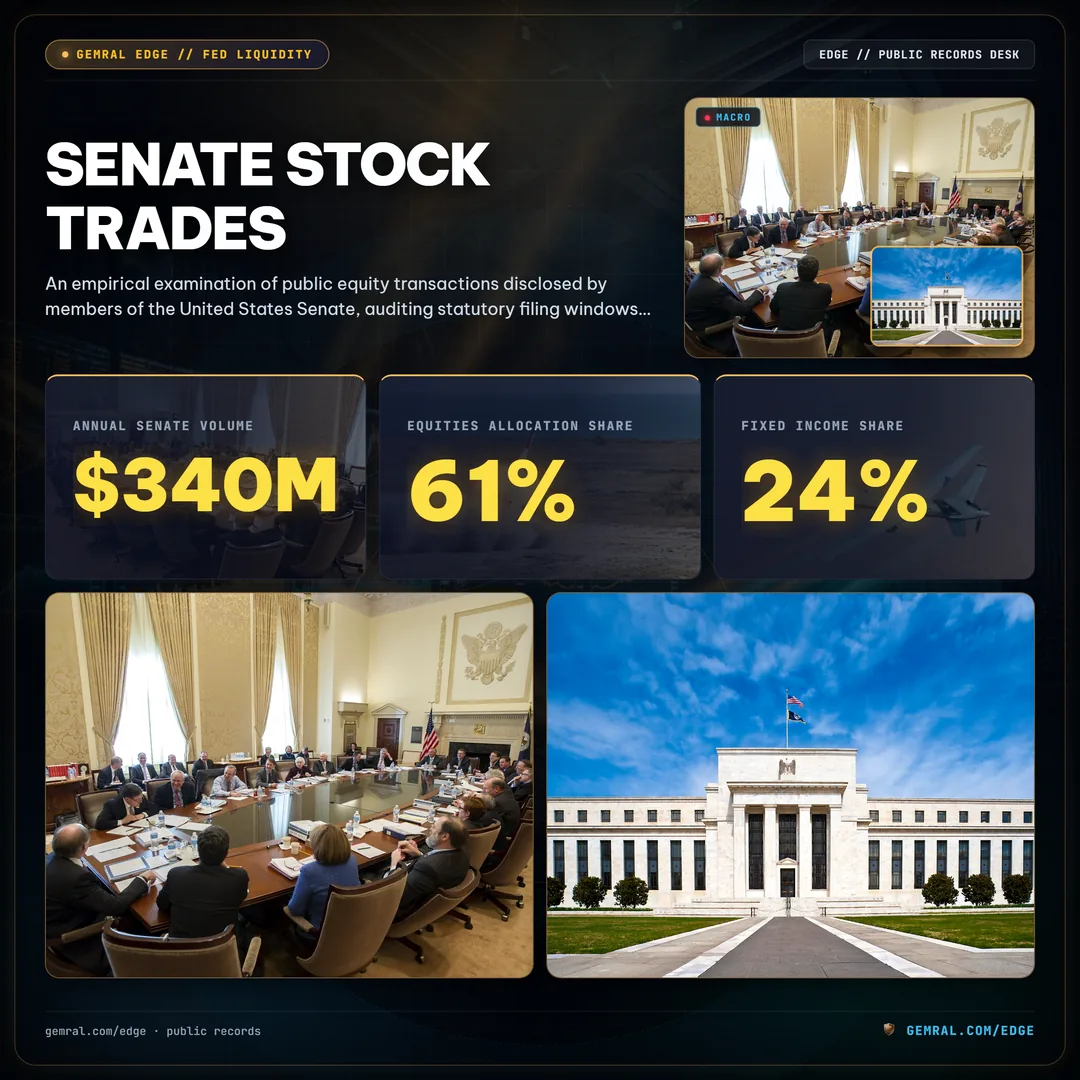
In federal financial surveillance, senate stock trades offer a distinct window into capital allocation at the highest level of legislative oversight. The United States Senate holds exclusive constitutional authority over treaty ratifications, federal judge confirmations, executive branch cabinet appointments, and regulatory commission leadership. Concurrently, the 100 Senators cast decisive roll-call votes on national industrial policy, corporate taxation rates, federal procurement appropriations, and multi-trillion-dollar annual budget reconciliation bills.
Across recent legislative sessions, reported annual transaction volume disclosed by Senators and their immediate households has reached approximately $340M in aggregate trades. For quantitative researchers, tracking upper chamber transactions is essential for understanding committee focus areas and legislative timing. Rather than treating political disclosures as speculative signals, institutional data teams audit public electronic records systematically through our senate stock trades tracker to separate verified reporting facts from media noise.
How Senate Stock Trades Are Disclosed Under the STOCK Act and eFD System
The statutory foundation governing personal financial transactions in the upper chamber is established by the Stop Trading on Congressional Knowledge (STOCK) Act of 2012 (Public Law 112-105). Enacted by the 112th Congress, the law codified that members of the Senate owe a fiduciary duty to Congress, federal institutions, and the public, explicitly prohibiting lawmakers from executing securities trades based on nonpublic material information derived from their official duties.
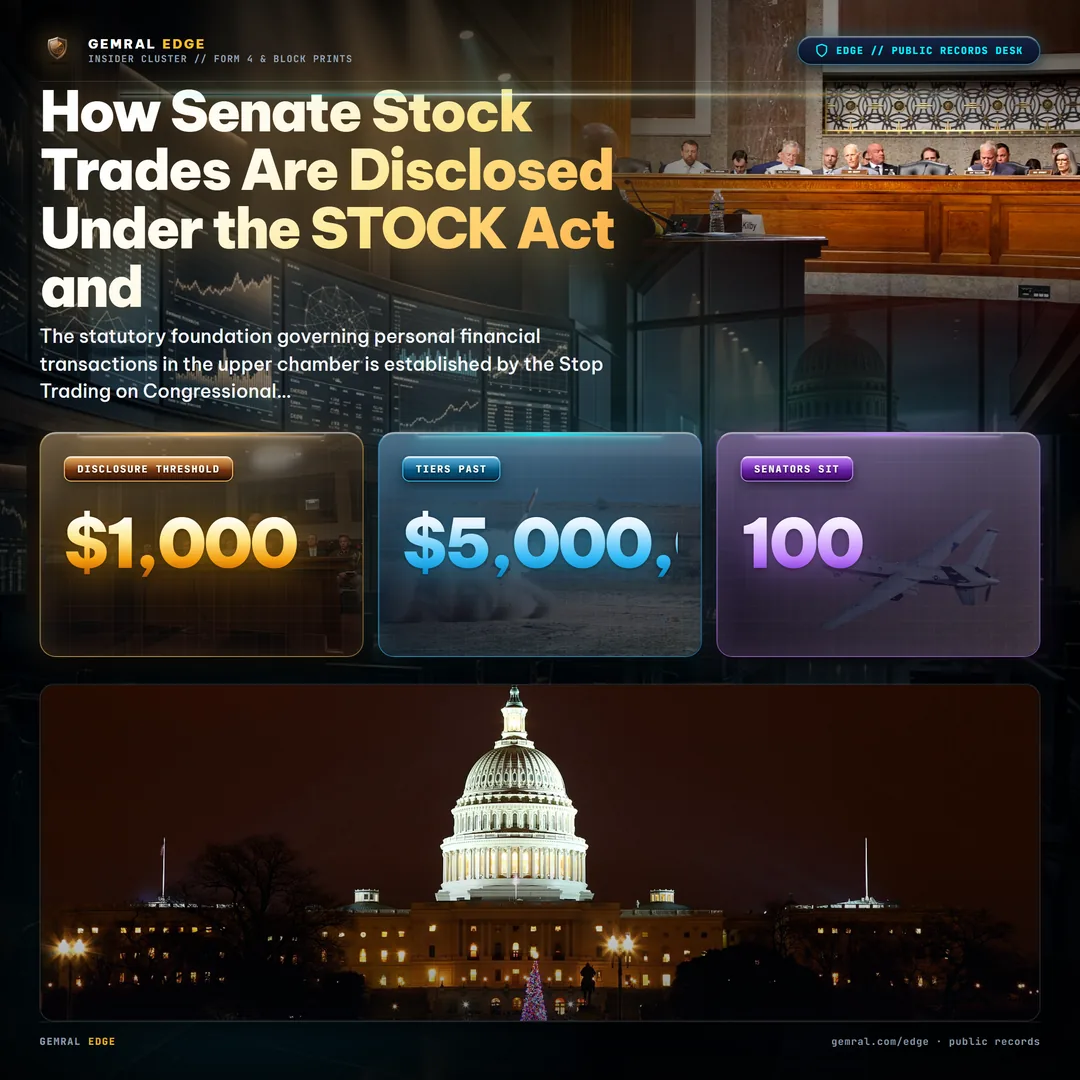
In practical compliance, the law established the Periodic Transaction Report (PTR) mechanism. Whenever a Senator, their spouse, or a dependent child purchases, sells, or exchanges covered assets with an aggregate transaction value exceeding $1,000, a formal PTR filing must be generated and submitted to the Senate Office of Public Records through the Electronic Financial Disclosure (eFD) portal.
Public Senate eFD records reveal several structural compliance characteristics:
- Covered Financial Instruments: The reporting mandate covers individual common equities, corporate debt securities, commodity futures, and exchange-traded options contracts. Broad-based domestic index mutual funds and registered exchange-traded funds (ETFs) that track standard market indices are exempt from periodic reporting, focusing regulatory reporting strictly on single-entity corporate securities.
- Statutory Value Buckets: In contrast to standard corporate insider disclosures that record exact share volumes or purchase prices, Senate PTR disclosures do not record exact share volumes or purchase prices. Instead, transactions are cataloged in statutory tiers: $1,001–$15,000, $15,001–$50,000, $50,001–$100,000, $100,001–$250,000, $250,001–$500,000, $500,001–$1,000,000, and larger tiers reaching past $5,000,000 for mega-bracket transactions.
- Concentration Among Lawmakers: While 100 Senators sit in the chamber, empirical analysis of annual disclosure logs demonstrates that between 18 and 24 Senators actively report individual stock purchases or sales in any given calendar year. The remaining 76 to 82 Senators limit personal wealth holdings to cash deposits, broad-based mutual funds, Treasury debt, or certified qualified blind trusts.
- Administrative Noncompliance Penalties: Late filings submitted past the statutory deadline incur a standard administrative late filing fee of $200. This administrative fine can be waived by the Senate Select Committee on Ethics upon written review of an unexpected clerical delay, a dynamic that has drawn scrutiny from transparency researchers.
Senate Filing Lags: The 45-Day Statutory Window vs. Empirical Reporting Delays
A frequent source of misinterpretation in retail trade replication is the belief that Senate stock trades are published concurrently with trade execution. Under federal statute, lawmakers are subject to a dual-deadline reporting timetable:
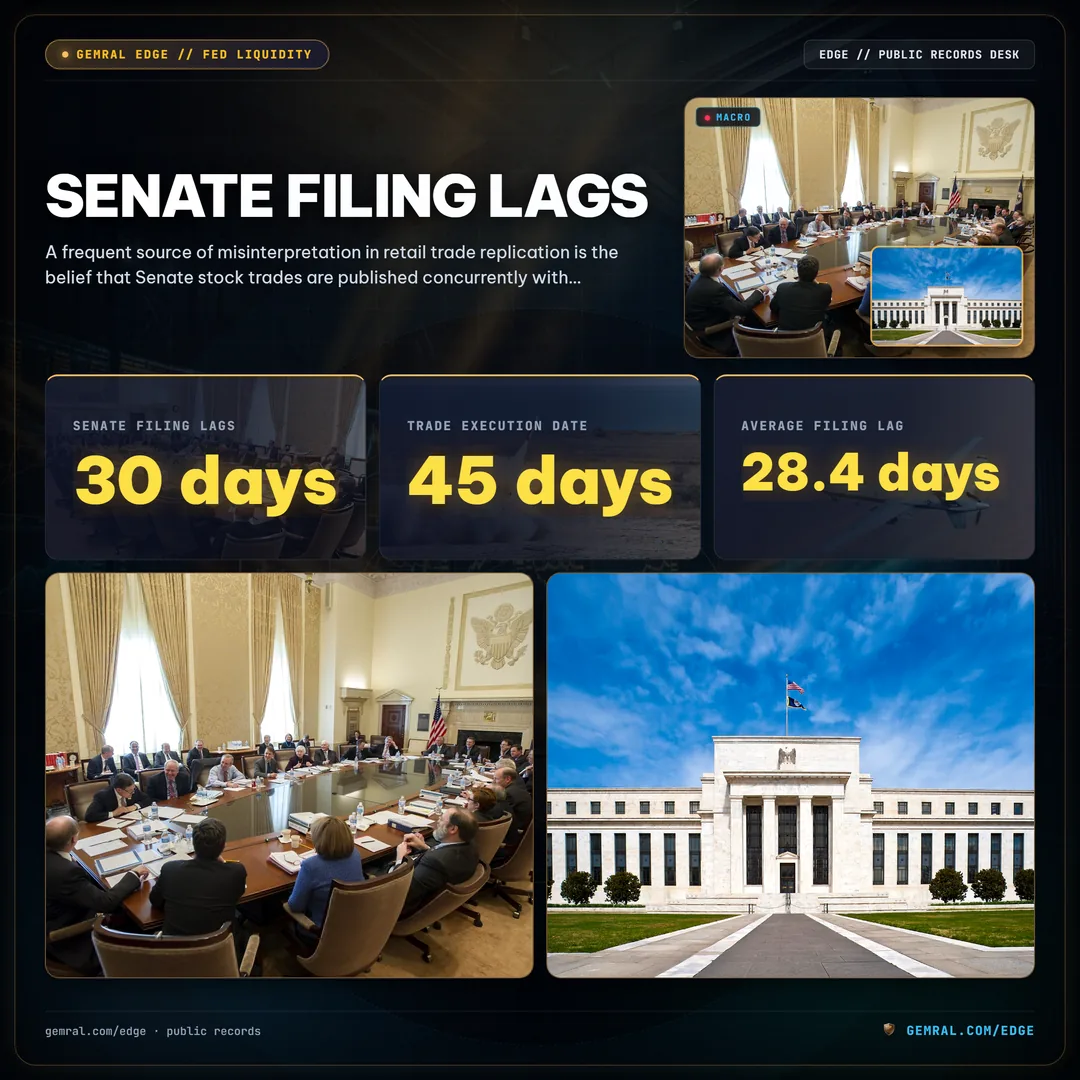
- The filing must be submitted within 30 days of the date on which the Senator receives official notification or broker trade confirmation that a transaction has executed.
- In all circumstances, the disclosure must be officially filed no later than 45 days after the trade execution date, irrespective of when brokerage notices are delivered.
This structural 45-day outer statutory limit creates a measurable reporting delay between portfolio actions and public disclosure. Empirical measurement across verified Senate PTR filings indicates an average filing lag of 28.4 days between execution and public availability. While rapid compliance filings can appear in as few as 12 days, prolonged reporting intervals routinely approach the 45-day outer boundary.
| Disclosure Metric | Statutory Mandate (STOCK Act) | Empirical Senate Baseline |
|---|---|---|
| Broker Notification Window | 30 calendar days from notice | Commonly logged between 14 and 25 days |
| Maximum Permitted Lag | 45 calendar days from trade date | Average measured delay of 28.4 days |
| Minimum Measured Delay | Immediate submission permitted | Fastest consistent filings arrive in 12 days |
| Minimum Transaction Threshold | $1,000 aggregate amount | Sub-$1,000 transactions legally omitted |
| Noncompliance Penalty | $200 administrative fee | Subject to ethics committee waiver review |
From an institutional quantitative perspective, this empirical lag requires point-in-time discipline. Disclosures cannot be used as real-time intraday indicators; instead, systematic researchers analyze multi-month accumulation trends across legislative subcommittees to isolate long-term capital rotation. For broader context on Capitol Hill reporting standards across both chambers, review our analysis of congressional stock trading.
Committee Jurisdictions and Trading Patterns: Commerce, Banking, and Armed Services
The informational value of Senate stock trades is heavily tied to committee assignments. Unlike House members who typically serve on two standing committees, Senators frequently hold assignments on three or four standing committees and multiple specialized subcommittees, broadening their institutional exposure to regulatory decisions.
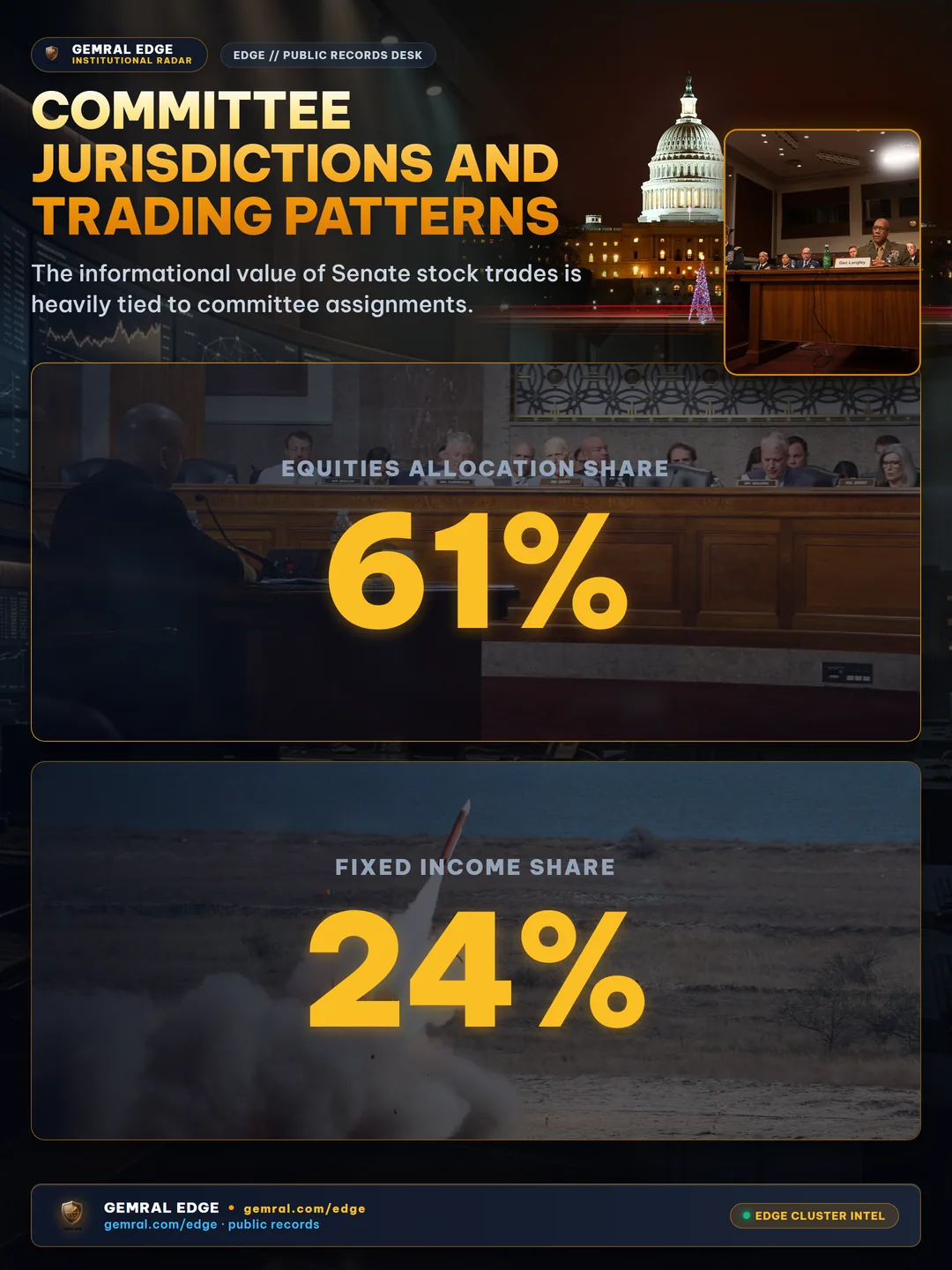
Empirical categorization of disclosed transactions across asset classes illustrates the broad scope of Senate financial activity:
- Individual Equities (61%): Common stock transactions in commercial corporations represent 61% of all filed PTR line items, with elevated concentration in defense manufacturing, semiconductor technology, healthcare pharmaceuticals, and commercial banking.
- Fixed Income and Municipal Bonds (24%): Corporate debt securities, state municipal revenue bonds, and local utility development bonds account for 24% of transaction volume, reflecting estate preservation strategies.
- Exchange-Traded Derivatives (11%): Call and put option contracts constitute 11% of disclosed volume, predominantly utilized by a small subset of high-frequency trading households.
- Private Placements and Commodities (4%): Energy partnership interests, real estate operating trusts, and physical commodity instruments comprise the remaining 4% of reported assets.
Transaction concentration routinely clusters around major regulatory bodies. Lawmakers seated on the Senate Committee on Commerce, Science, and Transportation oversee commercial aviation, telecommunications, and digital infrastructure standards. Members of the Senate Committee on Armed Services oversee annual National Defense Authorization Act (NDAA) markups and weapons procurement contracts. Meanwhile, the Senate Committee on Banking, Housing, and Urban Affairs exercises direct oversight over the Federal Reserve, the SEC, and national depository institutions. When multiple lawmakers within the same legislative committee file transactions in overlapping corporate sectors, institutional models record cluster events for further structural review.
Spousal Disclosures, Value Brackets, and Blind Trusts in the US Senate
An integral component of upper chamber trade analysis involves understanding household reporting mechanisms. Under Title I of the STOCK Act, reporting obligations extend beyond the elected member to encompass the financial holdings of legal spouses and dependent children.
Public records from the Senate eFD system show that approximately 42% of total disclosed transaction dollar volume is attributed directly to spousal accounts or joint family trusts, designated in filings by ownership notations such as "SP" (Spouse) or "JT" (Joint). In many households, portfolio management is directed by an active private investor or financial management firm, creating distinct trading rhythms compared to member-executed orders.
To resolve potential conflicts of interest, federal ethics guidelines permit Senators to place assets into qualified blind trusts approved by the Senate Select Committee on Ethics. Under a qualified blind trust, the lawmaker transfers ownership of assets to an independent corporate trustee who holds sole discretion over buying and selling, with the Senator receiving only quarterly cash summaries and tax distribution statements. However, because establishing and maintaining an accredited qualified blind trust requires substantial ongoing legal and administrative expenses, only a small fraction of wealthy Senators maintain certified active blind trust agreements.
As public scrutiny of Capitol Hill investments continues, federal reform proposals seek to mandate divestment or qualified blind trusts for all seated lawmakers. For additional methodologies on monitoring legislative disclosures and custodian reports, consult our guide on how to track congress stock trades. Until legislative overhauls are enacted, institutional researchers rely on verified empirical pipelines provided by the Gemral Edge research desk to track disclosed transactions, monitor statutory compliance windows, and audit legislative capital movements with rigorous point-in-time precision.
Official Public Sources
Public data · not investment advice. Sourced from the U.S. Senate Office of Public Records under Public Law 112-105.
Frequently asked questions
What are senate stock trades and how are they tracked?
Senate stock trades are purchases, sales, and exchanges of publicly traded securities filed by US Senators under the STOCK Act of 2012. They are officially tracked through Periodic Transaction Reports (PTRs) logged in the Senate Electronic Financial Disclosure (eFD) database.
What is the filing deadline for Senate stock trades?
Under federal law, Senators must disclose covered financial transactions within 30 days of receiving brokerage trade notification and no later than 45 days following the trade execution date.
Are spouses and dependent children included in Senate stock disclosures?
Yes. Title I of the STOCK Act requires Senators to report covered transactions conducted by their spouses and dependent children, recorded under specific ownership designation codes in public PTR filings.
Why is the disclosure lag important when analyzing Senate stock trades?
Because the statutory reporting window allows up to a 45-day delay, public disclosures reflect historical portfolio positioning rather than immediate real-time signals, requiring systematic analysts to evaluate multi-filing accumulation trends rather than intraday movements.