Politician Stock Tracker: Analyzing Filing Delays, Spousal Accounts, and Committee Conflicts
An empirical investigation into automated politician stock tracking systems, auditing statutory disclosure timelines, empirical filing delays, spousal portfolio concentrations, and committee jurisdictional overlaps across the United States Congress under Public Law 112-105.
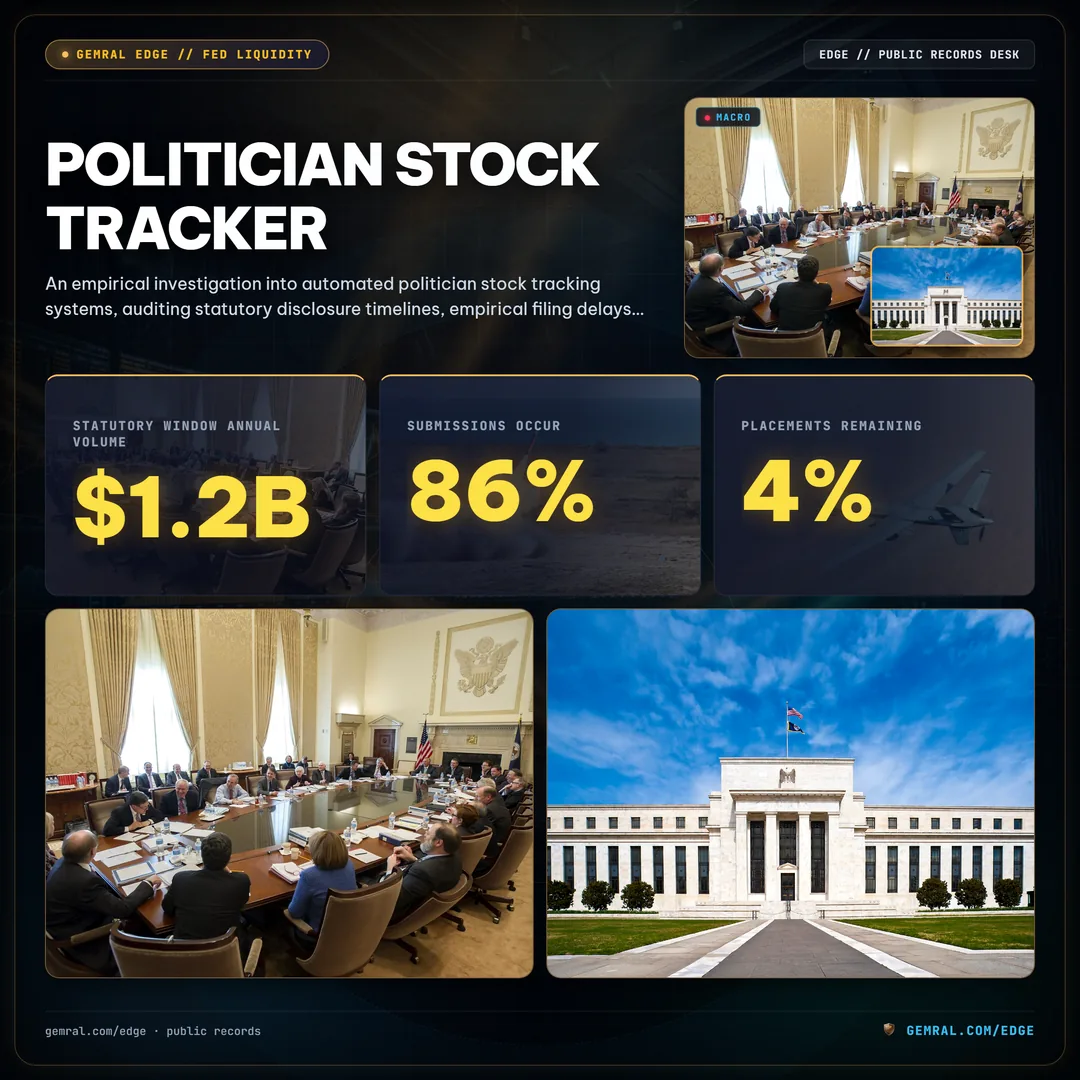
The Architecture of a Modern Politician Stock Tracker
The deployment of an automated politician stock tracker has evolved from a novelty among retail social media communities into a specialized discipline within quantitative intelligence. Under the Stop Trading on Congressional Knowledge Act of 2012 (STOCK Act), enacted during the 112th Congress as Public Law 112-105, members of the United States legislative branch are legally prohibited from trading securities on the basis of material nonpublic information gleaned from legislative activities. To enforce oversight, the statute requires periodic public disclosure of all covered transactions.
The federal legislature comprises 535 voting members: 435 in the House of Representatives and 100 in the Senate. When lawmakers or their immediate families execute securities trades exceeding $1,000 in value, they must disclose these events through Periodic Transaction Reports (PTRs). A sophisticated politician stock tracker does not merely republish raw government PDFs; it extracts structured transaction fields, maps tickers to committee oversight jurisdictions, and evaluates statistical anomalies against historical baseline trading patterns.
Rather than engaging in retail copy-trading, institutional researchers monitor these systems to detect policy inflection points, track structural sector rotations, and isolate asymmetric positioning ahead of major fiscal appropriations.
Legislative Disclosure Mechanics: The 30-Day and 45-Day Statutory Boundaries
To extract actionable signal from congressional transaction feeds, analysts must master the statutory reporting windows defined by federal law. A pervasive misconception is that politician trade trackers deliver real-time trade execution notifications. In reality, lawmakers operate under a dual-window statutory timeline:
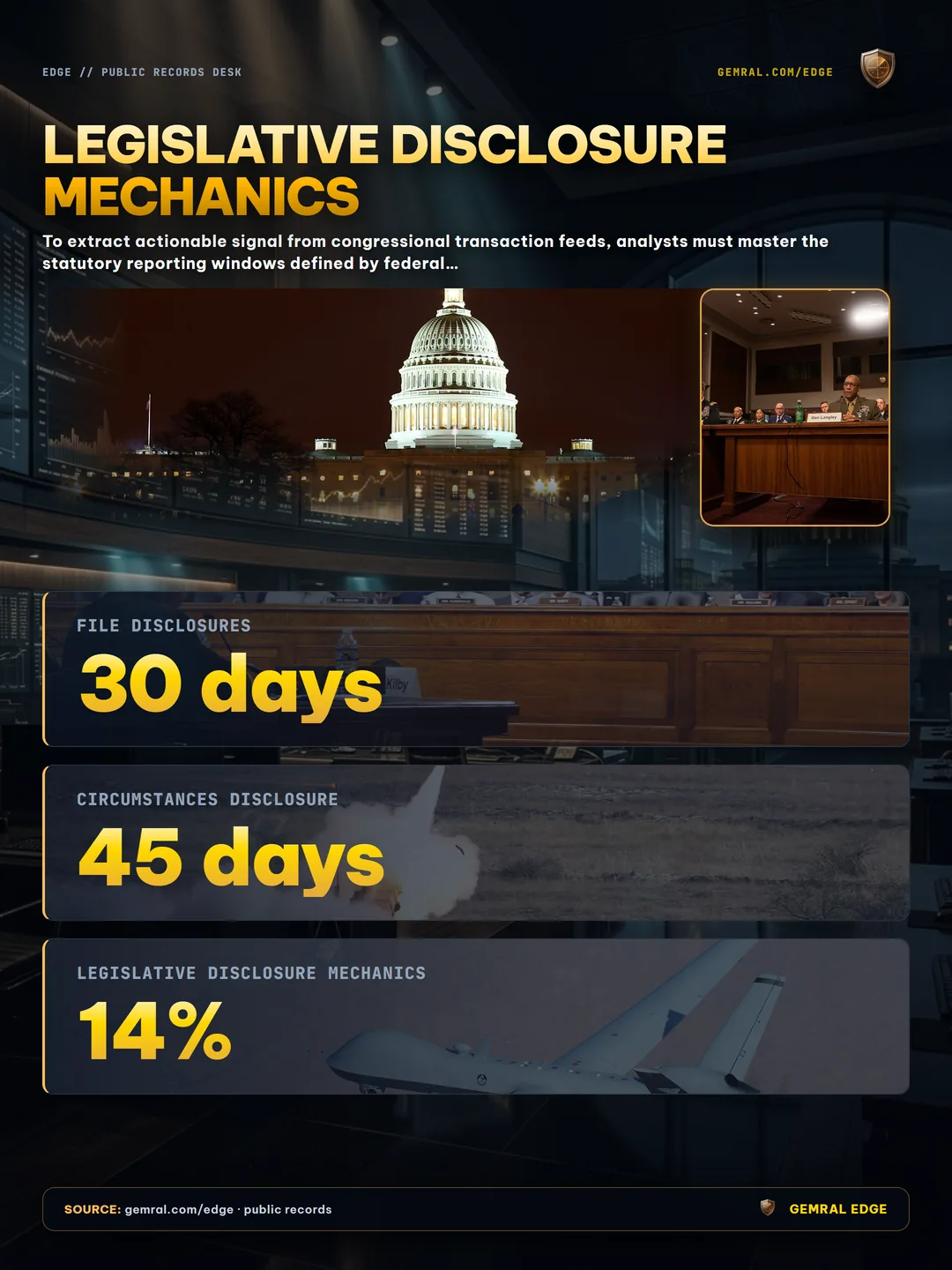
- The 30-Day Notification Window: Lawmakers are required to file disclosures within 30 days of receiving official trade confirmation from their custodian or broker.
- The 45-Day Absolute Window: Under no circumstances may a disclosure be filed more than 45 days after the transaction execution date, establishing an outer boundary for compliance.
This statutory construct means that by the time a trade surfaces on a politician stock tracker, the transaction may have occurred up to 45 days prior. Furthermore, enforcement remains lenient: late filings incur a nominal $200 statutory fine, which ethics officials frequently waive upon administrative appeal. Empirical audits reveal that timely submissions occur in approximately 86% of recorded filings, while the remaining 14% face extended delays extending from 60 days to 90 days.
Consequently, quantitative tracking algorithms treat the filing date not as an execution signal, but as a catalyst for cross-sectional portfolio re-weighting and legislative correlation analysis.
Data Ingestion Portals: Auditing House and Senate Financial Records
Automated tracking architectures ingest primary disclosure records directly from official government repositories maintained by the two legislative chambers:
House Office of the Clerk Portal
Accessible via disclosures-clerk.house.gov, this repository indexes financial reports for 435 voting Representatives and non-voting delegates.
While contemporary filings provide standardized PDF metadata, historical records often consist of scanned, handwritten forms requiring specialized document parsing and optical character verification engines.
Senate Electronic Financial Disclosure Portal
Operated by the Senate Office of Public Records, this portal archives electronic PTR filings for all 100 seated Senators.
The Senate interface enforces uniform electronic data submission, producing structured transaction records with greater schema consistency. For deeper historical trends, review our Senate stock trades analysis.
A resilient tracking system continuously polls these endpoints, standardizes disparate naming conventions, validates ticker identifiers against exchange symbology, and indexes disclosures into queryable time-series databases.
Dissecting Categorical Value Brackets and Asset Class Breakdowns
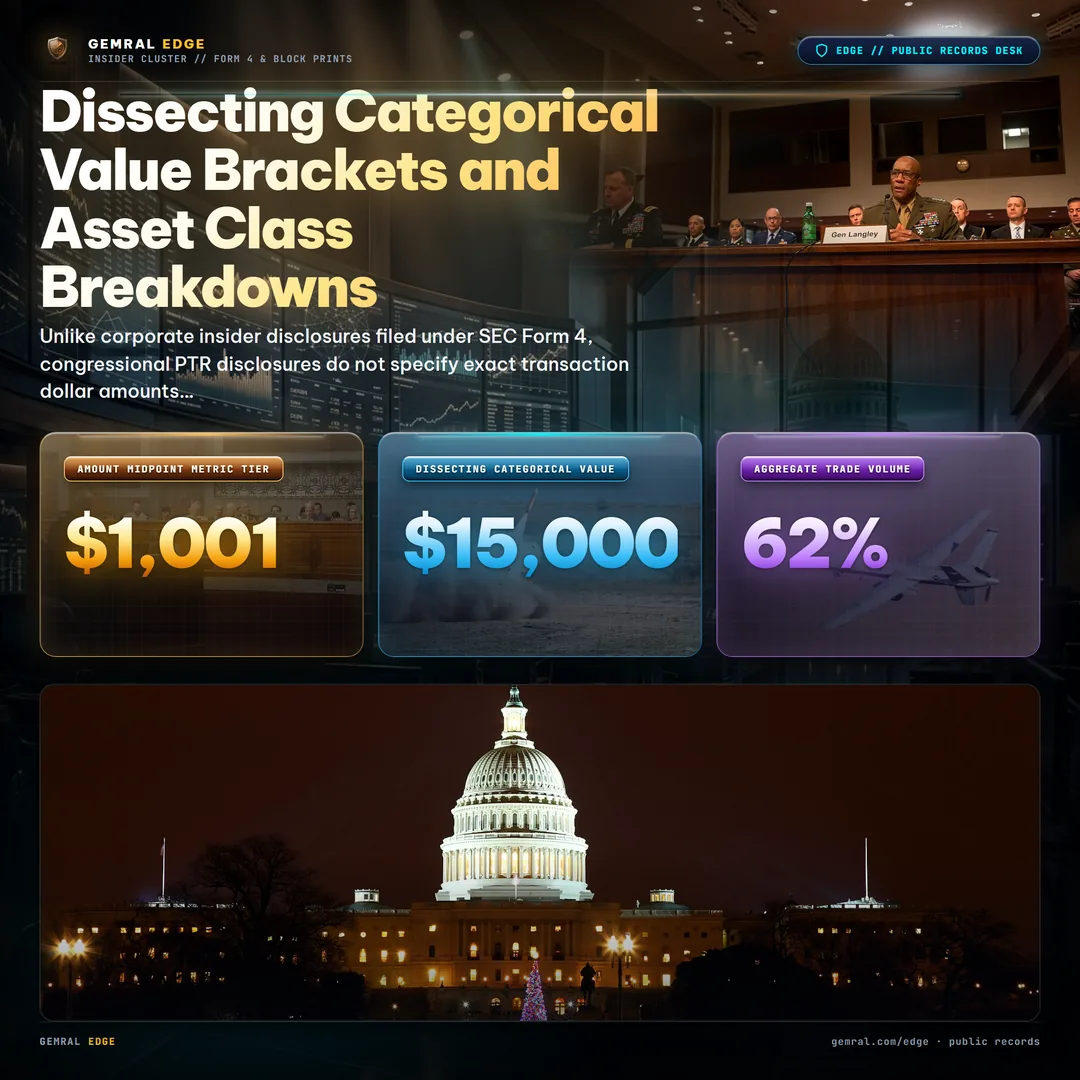
Unlike corporate insider disclosures filed under corporate insider equity filings, congressional PTR disclosures do not specify exact transaction dollar amounts or share quantities. Instead, lawmakers select from eight statutory value tiers:
| Reporting Tier | Minimum Amount | Maximum Amount | Midpoint Metric |
|---|---|---|---|
| Tier 1 | $1,001 | $15,000 | $8,000 |
| Tier 2 | $15,001 | $50,000 | $32,500 |
| Tier 3 | $50,001 | $100,000 | $75,000 |
| Tier 4 | $100,001 | $250,000 | $175,000 |
| Tier 5 | $250,001 | $500,000 | $375,000 |
| Tier 6 | $500,001 | $1,000,000 | $750,000 |
| Tier 7 | $1,000,001 | $5,000,000 | $3,000,000 |
| Tier 8 | $5,000,000+ | Unbounded | Upper Bracket Bound |
In terms of asset distribution across Capitol Hill, equities dominate total activity, comprising 62% of aggregate trade volume. Fixed income instruments represent 21%, options and derivative contracts account for 13%, and private placements make up the remaining 4%. Quantitative tracking models convert these tier intervals into mathematical midpoints to calculate weighted portfolio exposure shifts.
Analyzing Filing Delays, Empirical Lag Dynamics, and Spousal Accounts
The most critical telemetry metric calculated by an institutional tracking engine is the empirical disclosure latency: the exact number of days elapsed between trade execution and public registry publication. Across an annual trading volume of $1.2B executed by 118 active trading lawmakers, empirical measurements reveal an average filing delay of 31.6 days. While the fastest voluntary filers report within 12 days, complex accounts regularly utilize the outer 45-day statutory window.

Equally critical is ownership attribution. PTR disclosures categorize trade ownership into Self, Spouse, Joint, or Dependent Child. Notably, spousal accounts account for 44% of total reported congressional trading volume. In multiple instances, high-conviction transactions in sensitive industries—such as semiconductor foundries, artificial intelligence infrastructure, and defense prime contractors—are executed almost exclusively through spousal portfolios.
When assessing major legislative appropriations, cross-referencing spousal filings against federal outlay data provides vital structural context. For an in-depth examination of federal defense budget flows, see our defense contractor Pentagon outlay tracker.
Detecting Committee Jurisdiction Conflicts and Legislative Capital Overlaps
The true analytical edge of a politician stock tracker emerges when transaction records are overlaid onto congressional committee assignments. Lawmakers seated on key standing committees exercise direct statutory authority over regulatory frameworks, federal subsidies, and antitrust enforcement:
When a member of the Armed Services Committee acquires equity in a specialized defense sub-tier supplier days prior to committee markup hearings, the signal is qualitatively distinct from a generic broad-market allocation. Algorithmic surveillance architectures assign elevated weighting multipliers to transactions that directly overlap with a lawmaker's active committee responsibilities.
Overcoming the 45-Day Information Deficit: Algorithmic Normalization vs Retail Copy Trading
Retail investors who rely on generic politician stock tracking apps or social media trackers often suffer from severe performance drag due to three fundamental structural pitfalls:
- Information Decay: Copying trades upon public filing means entering positions 30 to 45 days after the trade occurred, when market prices have frequently already absorbed the anticipated catalyst.
- Lack of Contextual Filtering: Naive trackers fail to differentiate between discretionary capital allocation and non-informative events such as automatic reinvestment or tax-loss harvesting.
- Absence of Cross-Chamber Convergence: Single lawmaker trades carry high idiosyncratic noise; statistical conviction requires cross-chamber, multi-lawmaker accumulation patterns.
Quantitative intelligence platforms resolve these limitations by computing predictive distribution scores across all 535 voting lawmakers, isolating high-conviction multi-member clusters, and benchmarking flows against broad-market liquidity conditions. Institutional desks access these normalized feeds through our institutional data preview interface.
Quantitative Surveillance Frameworks for Institutional Allocators
For institutional capital allocators, congressional capital tracking is not a stand-alone systematic strategy, but an exogenous overlay integrated into multi-factor equity models. A robust surveillance protocol incorporates four distinct quantitative layers:
The Quantitative Congressional Surveillance Architecture
- Automated Web Ingestion: Continuous API and web scraping engines polling House Clerk and Senate repositories to ingest PTR documents within seconds of publication.
- Bracket Midpoint Normalization: Mapping reported dollar intervals (Tier 1 through Tier 8) into standardized continuous capital variables.
- Committee Jurisdiction Scoring: Applying sector-specific coefficients based on active committee memberships, subcommittee chairmanships, and legislative sponsorship history.
- Cross-Chamber Convergence Telemetry: Triggering institutional alerts exclusively when multiple lawmakers across both chambers accumulate the same ticker within a rolling 30-day window.
By transitioning from sensationalist narrative tracking to systematic, quantitative telemetry, market participants extract verifiable, regulatory-grade macro intelligence from congressional capital flows.
Frequently asked questions
What is a politician stock tracker and how does it function?
A politician stock tracker is an automated data architecture that ingests Periodic Transaction Reports (PTRs) filed with the House Office of the Clerk and Senate Office of Public Records, standardizing categorical brackets and matching trades against committee jurisdictions.
Why are spousal accounts critical when tracking politician stock portfolios?
Spousal accounts account for approximately 44% of total congressional trading volume and frequently hold high-conviction positions in defense, technology, and healthcare sectors subject to active committee oversight.
What is the typical filing delay observed in congressional stock trades?
Under the STOCK Act, lawmakers face a 45-day statutory filing limit, but empirical data shows an average disclosure lag of 31.6 days, with 14% of filings experiencing extended delays between 60 and 90 days.
How do quantitative analysts overcome the disclosure lag of politician stock trades?
Rather than copying individual trades at delayed disclosure dates, quantitative analysts cross-reference transaction clusters against legislative markup schedules, committee hearings, and multi-member accumulation patterns.