Nuclear SMR Stocks: Tracking Small Modular Reactor Contracts for AI Data Centers
An empirical deep dive into Small Modular Reactor (SMR) developers, behind-the-meter nuclear Power Purchase Agreements (PPAs), NRC regulatory milestones, and the utility supply chain powering gigawatt-scale AI campuses.
The AI Energy Bottleneck: Why Hyperscalers Face a 35GW Power Deficit by 2030
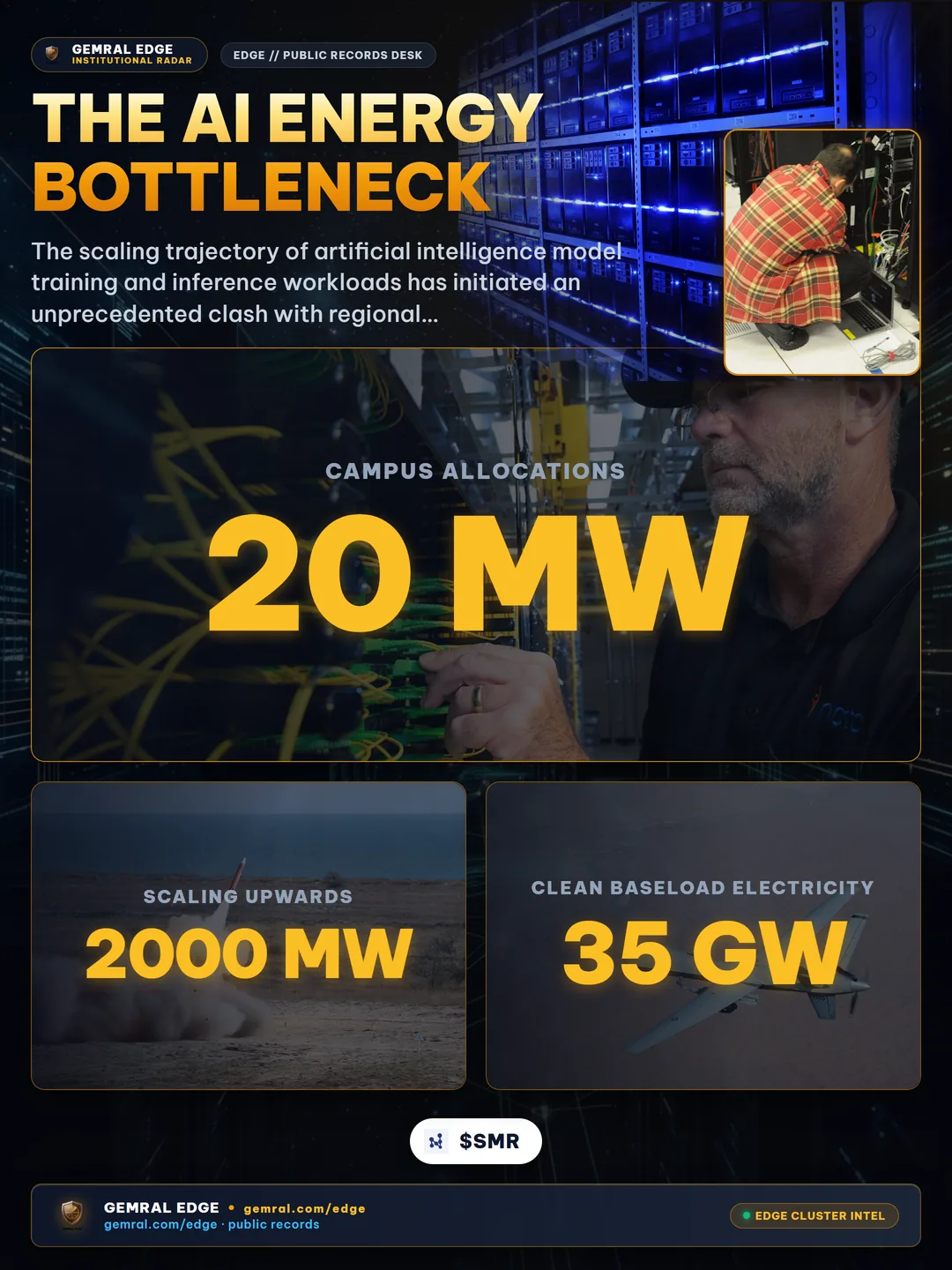
The scaling trajectory of artificial intelligence model training and inference workloads has initiated an unprecedented clash with regional electric transmission grids. While historical enterprise data centers operated with campus allocations between 20MW and 50MW, next-generation AI campuses demand continuous baseload capacity scaling from 500MW to upwards of 2000MW. Hyperscale operators face a projected cumulative deficit of 35GW of clean baseload electricity across North America by 2030, driven by the proliferation of multi-gigawatt computing facilities. Institutional research desks studying our nuclear smr stocks coverage examine this structural mismatch as the primary operational governor of computing expansion.
Traditional utility capacity additions are mechanically unable to satisfy this timeframe. Legacy coal plant retirements, coupled with strict carbon reduction mandates, have depleted dispatchable operating reserves across key regional transmission organizations. Meanwhile, intermittent renewables such as utility-scale solar and onshore wind maintain low capacity factors between 20% and 35%, necessitating costly multi-hour battery storage systems to deliver continuous uptime. Parallel research on liquid cooling stocks for data centers demonstrates that while thermal rack densities have expanded beyond 100kW per cabinet, thermodynamic efficiency gains at the server level cannot offset aggregate campus power intake constraints.
As a direct consequence, hyperscalers are executing long-term Power Purchase Agreements (PPAs) with nuclear power producers and Small Modular Reactor (SMR) developers. Field telemetry documented in our empirical dossier on datacenter nuclear power deals highlights that access to firm, carbon-free energy has surpassed fiber latency as the premier location selection criterion for large-scale compute infrastructure.
Small Modular Reactor Physics: Prefabricated Nuclear Modules vs Legacy Gigawatt Fleets
Small Modular Reactors differ fundamentally from traditional gigawatt-scale commercial reactors in manufacturing architecture, physical footprint, and thermodynamic control systems. Legacy Generation III nuclear power plants, such as the Westinghouse AP1000, produce between 1100 MWe and 1200 MWe per reactor core. These monumental civil engineering endeavors require 10 to 15 years of bespoke field construction, custom on-site containment pouring, and billions of dollars in financing carrying costs.
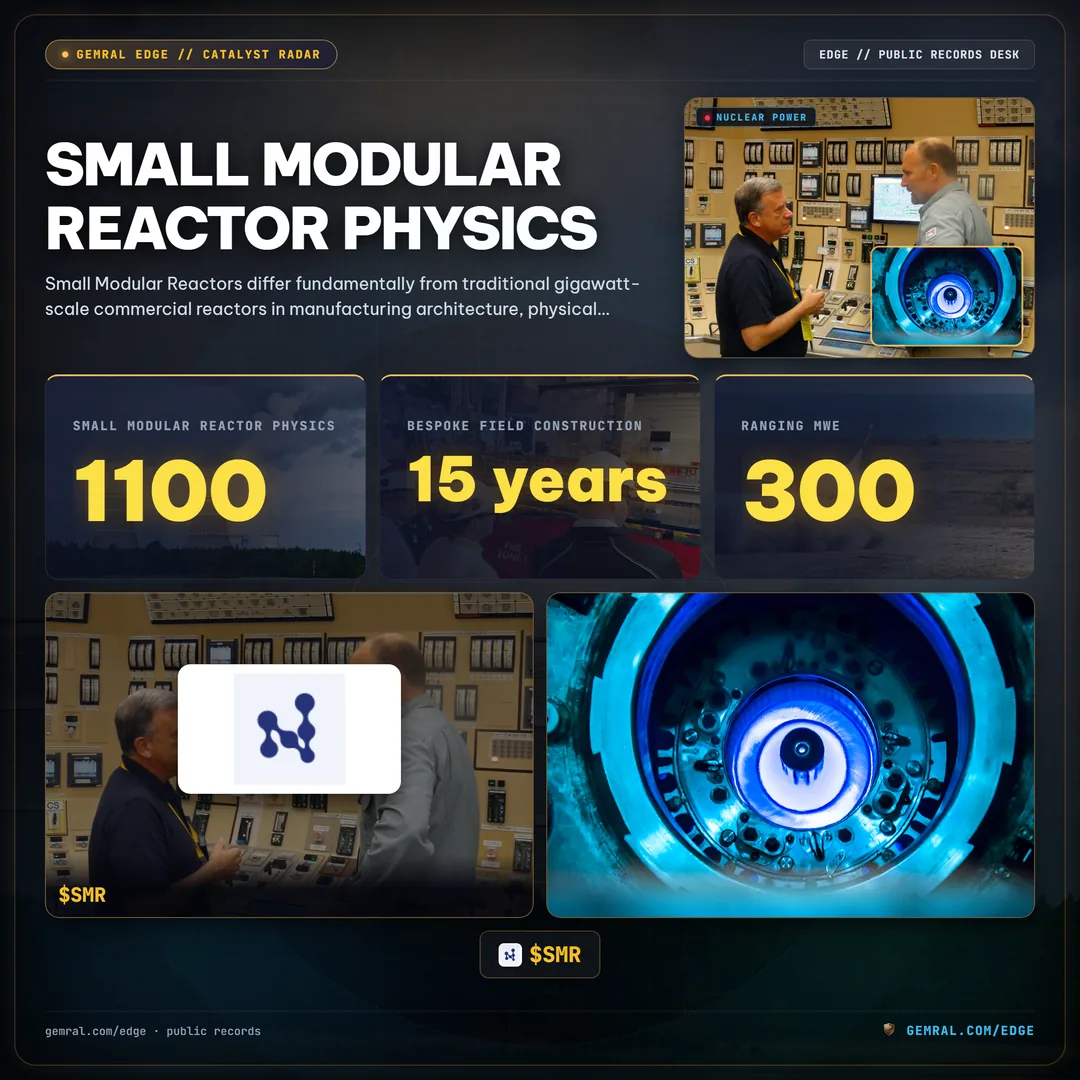
In contrast, Small Modular Reactors produce electrical outputs ranging from 50 MWe to 300 MWe per individual module. Their defining engineering advantages center on modularity and passive safety:
Factory Fabrication Economics
SMR pressure vessels, steam generators, and core barrels are manufactured within centralized, quality-controlled factory environments rather than assembled outdoors on construction sites.
Completed modules are transported via standard rail cars, barges, or heavy-haul trucks directly to the data center campus, compressing civil installation schedules to roughly 24 to 36 months per module cluster.
Passive Decay Heat Evacuation
Advanced SMR designs incorporate passive safety dynamics governed by natural circulation, convection loops, and gravity-fed cooling pools that operate indefinitely without off-site AC electrical power.
The elimination of external emergency diesel pumping loops drastically reduces containment volume requirements and allows for tightly constrained emergency planning zone boundaries down to site boundaries.
By combining factory repeatability with compact containment geometries, SMR architectures target overnight capital expenditures of approximately $6500 per kW upon reaching nth-of-a-kind serial production, establishing an economic foundation for multi-module data center campuses.
Behind-the-Meter Off-Grid Deployment: Bypassing Transmission Queue Interconnection Delays
The central operational catalyst driving hyperscalers toward SMR integration is the structural collapse of public utility interconnection processes. Across major transmission systems including PJM Interconnection, ERCOT, MISO, and CAISO, generator interconnection queues now experience systemic delays spanning 5 to 7 years from initial study filing to energized commercial operation. Over 2000GW of proposed generation and storage projects remain backlogged in study cycles nationwide, creating prohibitive timing uncertainty for compute deployments.
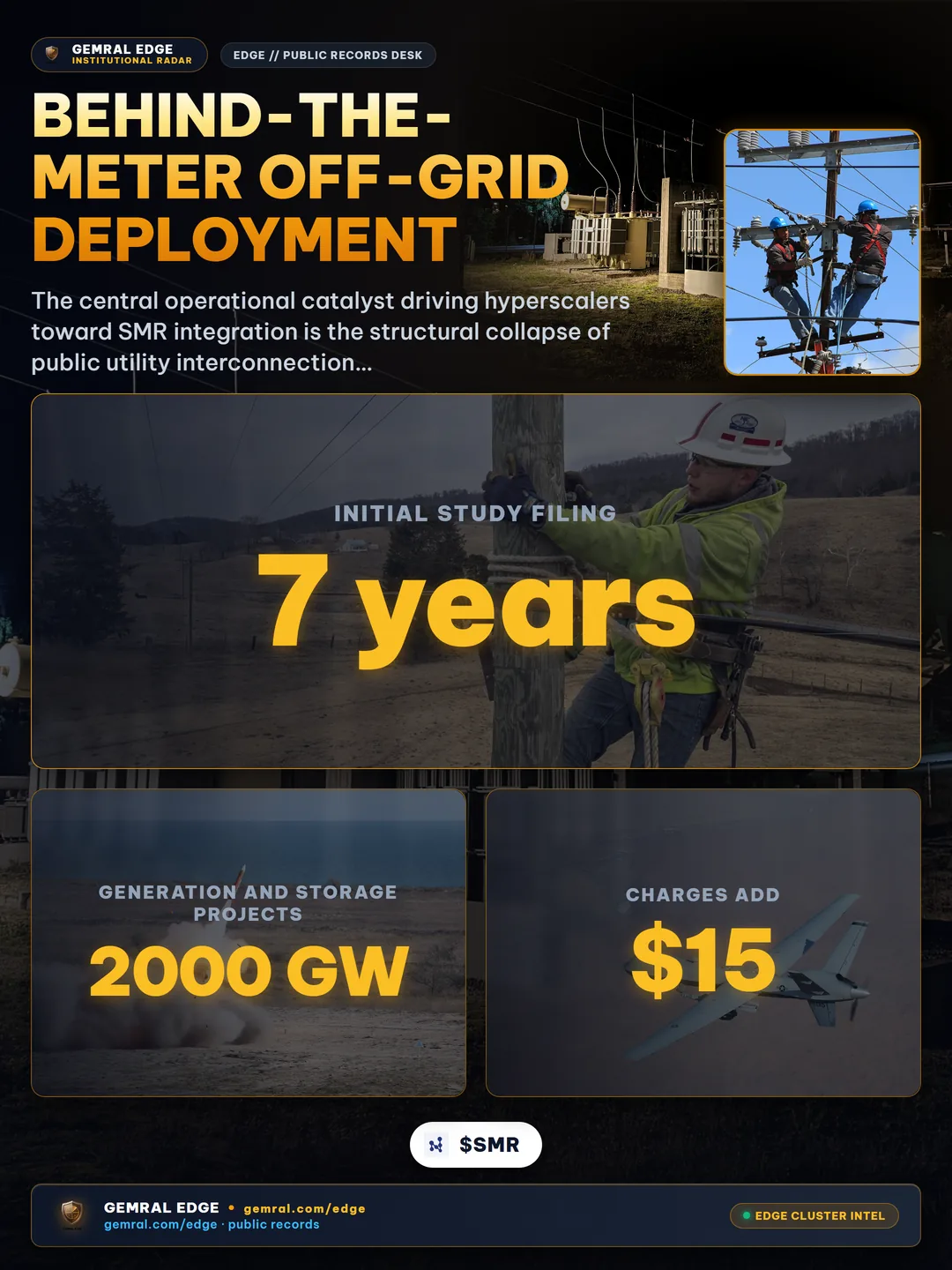
To circumvent this institutional bottleneck, data center developers are deploying Behind-the-Meter (BTM) configurations. Under a behind-the-meter colocation architecture, a cluster of 4 to 12 SMR modules is sited immediately adjacent to the computing facility, delivering electrical output directly to the data center substation via dedicated on-site busbars without traversing public high-voltage transmission lines.
| Architecture | Interconnection Delay | Transmission Tariff Cost | Grid Dependency Risk |
|---|---|---|---|
| Public Grid Delivery | 5 to 7 Years | Full Network Service Tariff | Subject to Regional Curtailment |
| Behind-the-Meter SMR | Direct Site Deployment | Zero Transmission Wheeled Fees | Dedicated Islanded Microgrid Capability |
This topology insulates computing facilities from regional grid congestion, eliminates network transmission charges that can add $15 to $25 per MWh to wholesale rates, and supports the 99.999% electrical reliability standards required by mission-critical training clusters. Similar structural shifts in asset allocation are examined in our institutional breakdown of treasury basis trade hedge funds, where institutional allocators price systemic latency and queue duration risks.
Permitting and Safety Telemetry: NRC Licensing Milestones, Air Permits, and Site Footprints
Commercial deployment of Small Modular Reactors in the United States is governed by the Nuclear Regulatory Commission (NRC) under 10 CFR Part 50 (two-step licensing) and 10 CFR Part 52 (combined licenses). Securing regulatory authorization requires navigating three rigorous technical phases:
- Standard Design Approval (SDA) / Design Certification (DC): Technical validation of the reactor core safety systems, thermodynamic margins, and containment integrity independent of a specific physical location.
- Early Site Permit (ESP): Environmental, geological, hydrological, and seismic qualification of the intended data center campus.
- Combined License (COL): Consolidated authorization to construct and operate a specific reactor installation at an approved site, targeting a 24 to 36 month regulatory review cycle.
In parallel with NRC nuclear licensing, data center campuses must secure environmental air quality permits from state environmental protection agencies for auxiliary diesel generators and black-start equipment. When analyzing datacenter power profiles, institutional analysts must note that air permit backup generator capacity represents an upper bound on on-site backup capacity, not IT load. Tracking verified public air permit filings across key states such as Virginia, Georgia, Texas, and Ohio provides physical verification of physical site readiness and capacity ceiling allocations.
Public Pure-Play SMR Developers vs Industrial Component Suppliers: Architectural Comparison
The public equity universe exposed to the advanced nuclear expansion bifurcates into pure-play SMR technology developers and diversified heavy industrial component manufacturers. Allocators must distinguish between balance-sheet profiles, technological readiness levels, and revenue recognition schedules across these cohorts:
| Company Category | Representative Tickers | Core Technology / Component | Commercialization Timeline |
|---|---|---|---|
| Pure-Play SMR Developers | SMR, OKLO, NANO | Light-water and fast-neutron SMR reactor modules | 2027 to 2030 Initial Commercial Operations |
| Nuclear Steam & Pressure Vessels | BWXT, FLR | Heavy forgings, reactor pressure vessels, defense reactors | Active Manufacturing & Defense Contracts |
| Turbine & Power Generation | GEV, ETN | Steam turbines, switchgear, medium-voltage distribution | Current AI Datacenter Infrastructure Delivery |
| Fuel Enrichment & Supply | LEU, CCJ | HALEU enrichment, uranium mining, conversion services | Scaling Domestic Enrichment 2025 to 2028 |
Pure-play developers offer direct operating leverage to SMR licensing approvals and hyperscale contract announcements, yet carry technological development risk and multi-year cash burn profiles prior to commercial reactor turnover. Conversely, heavy industrial suppliers generate immediate revenue from naval reactor contracts, replacement steam generator fabrication, and electrical switchgear equipment, providing lower-volatility exposure to the nuclear lifecycle.
Levelized Cost of Energy (LCOE) and Capital Economics: SMRs vs Solar Plus Battery Systems
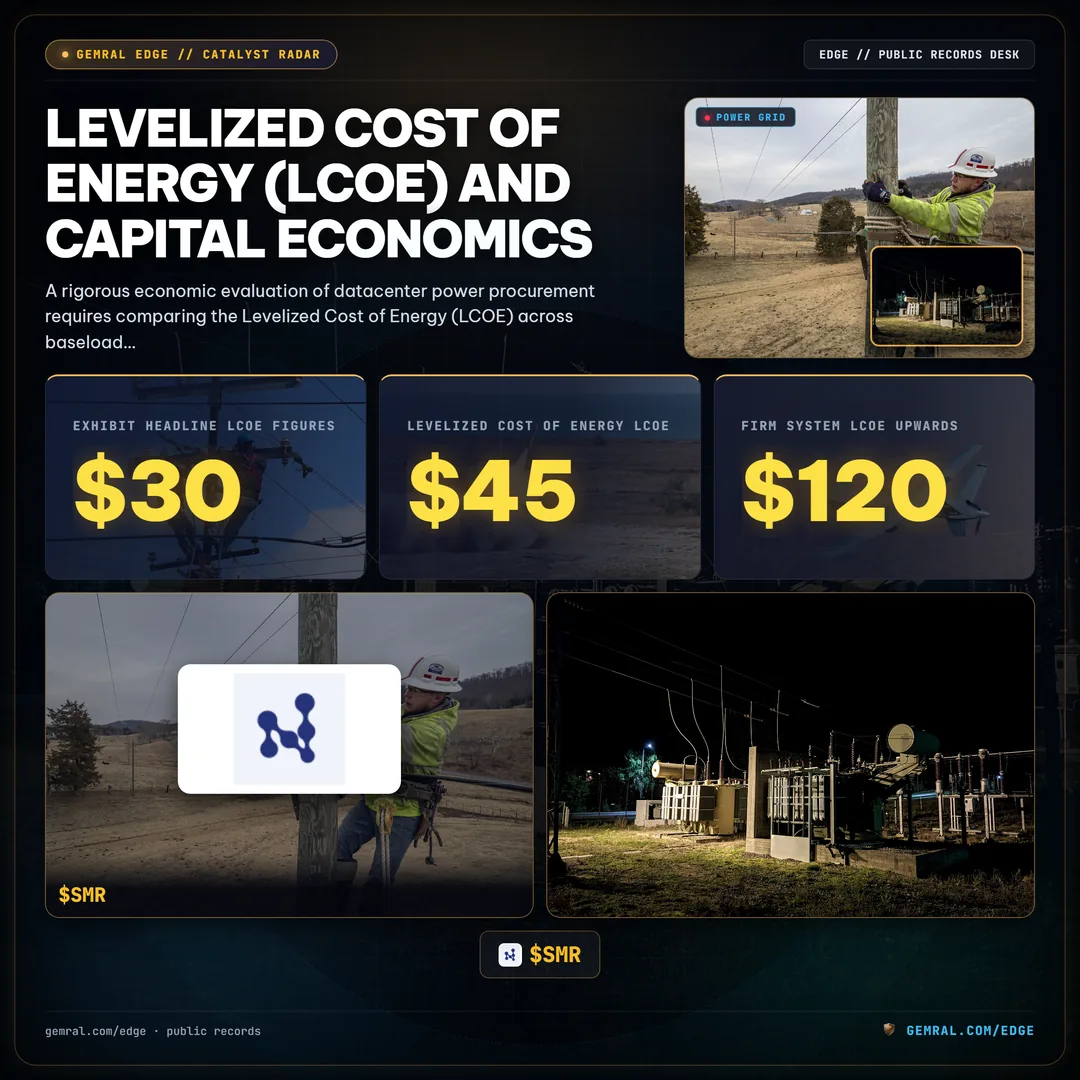
A rigorous economic evaluation of datacenter power procurement requires comparing the Levelized Cost of Energy (LCOE) across baseload generation options. While standalone solar photovoltaic arrays exhibit headline LCOE figures between $30 and $45 per MWh, their inability to produce power during non-solar hours forces operators to overbuild nameplate generation capacity by a factor of 4x to 5x and procure 8-to-16 hour Battery Energy Storage Systems (BESS).
Solar + Battery Firming Burden
Delivering 500MW of continuous 24/7 power via solar plus storage requires roughly 2500MW of solar nameplate capacity and 4000MWh of lithium-ion battery storage, driving firm system LCOE upwards of $120 to $160 per MWh.
Furthermore, 2500MW of solar installations demand between 10,000 and 15,000 acres of contiguous land, generating acute geographic zoning and environmental permitting barriers.
Compact SMR Baseloop Economics
An SMR facility delivering 500MWe operates at a 95% capacity factor, requiring less than 40 acres of dedicated land area directly contiguous with the data center campus.
First-of-a-kind SMR installations demonstrate levelized costs of $85 to $115 per MWh, which compresses toward $65 to $80 per MWh as serial factory manufacturing yields learning-curve efficiencies.
When factoring in transmission wheeling avoidance, reduced land acquisition capital, and 60-year operational asset lifespans, Small Modular Reactors present compelling long-term unit economics for gigawatt-scale computing clusters.
Supply Chain Critical Paths: HALEU Fuel Enrichment, Pressure Vessels, and Turbine Modules
While architectural designs are established, the commercial scale of Small Modular Reactors faces three primary industrial supply chain critical paths:
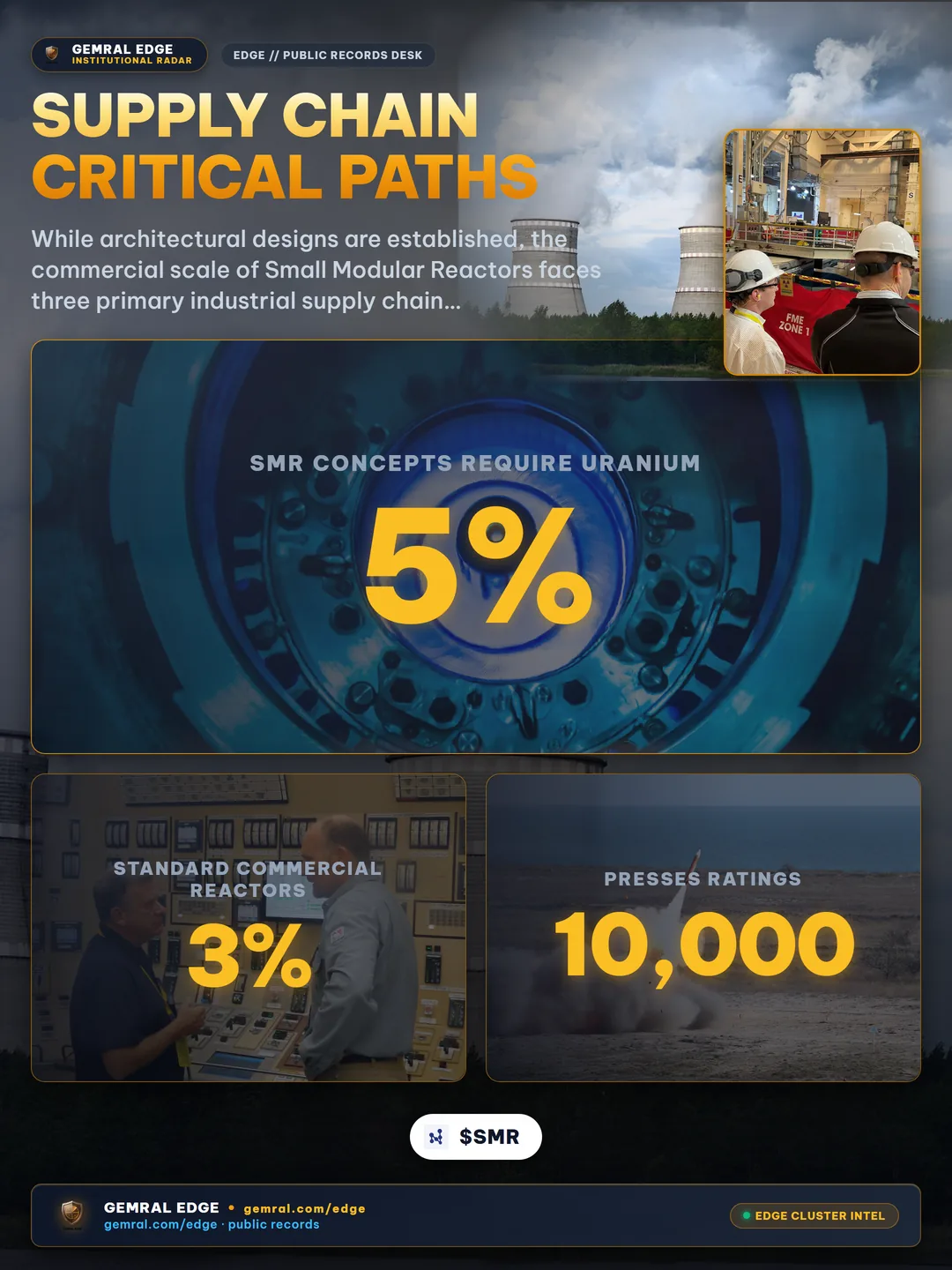
- High-Assay Low-Enriched Uranium (HALEU) Availability: Many advanced SMR concepts require uranium enriched between 5% and 20% U-235, compared to 3% to 5% for standard commercial reactors. Expanding domestic centrifuge cascade infrastructure remains vital to eliminate international enrichment dependency.
- Ultra-Heavy Forging Press Capacity: SMR reactor pressure vessels require heavy forged shells capable of withstanding operating pressures above 1500 to 2200 psi. Specialized heavy hydraulic presses with ratings exceeding 10,000 tons are concentrated among a small cadre of qualified domestic and international fabricators.
- Secondary Steam Turbine & Generator Delivery: Demand for medium-sized steam turbines (50MW to 150MW) and high-voltage step-up transformers faces competition from natural gas combined-cycle expansions, stretching factory delivery lead times to 36 to 48 months.
Institutional capital allocators monitor these procurement lead times to gauge real commercial deployment cadence. Investors seeking analogous empirical market structure breakdowns can review our deep dive into prediction market arbitrage, which dissects latency and clearing efficiencies across emerging institutional platforms.
Institutional Data Telemetry: Tracking Data Center Sites, Substations, and Physical Permits
Quantifying the intersection of artificial intelligence growth and nuclear power deployment requires empirical, point-in-time physical infrastructure telemetry. Relying solely on corporate press releases frequently obscures multi-year regulatory delays, utility disputes, and permitting revisions.
Comprehensive institutional due diligence pairs corporate entity filings with direct physical telemetry:
- Site-Level Data Center Mapping: Tracking physical campus footprints, operating parcels, and verified corporate parents across major computing hubs.
- Environmental Air Permits: Auditing state air quality permits detailing permitted on-site backup generator capacity across North America.
- Substation Proximity Telemetry: Measuring physical distances from data center parcels to the nearest high-voltage substations rated at or above 115 kV.
- Regional Grid Demand Feeds: Monitoring real-time hourly load dynamics across transmission balancing authorities to pinpoint regional capacity exhaustion.
By integrating point-in-time physical infrastructure tracking with corporate disclosures, institutional allocators identify structural inflection points across the energy supply chain well ahead of conventional market consensus.
Explore Point-in-Time AI Infrastructure Telemetry
Access point-in-time datasets tracking 57 US-listed AI infrastructure companies, verified datacenter sites, state environmental air permits, nearest high-voltage substations, and regional grid load metrics.
Frequently asked questions
What are nuclear SMR stocks and why are AI hyperscalers contracting them?
Nuclear SMR stocks are equities of firms commercializing factory-fabricated Small Modular Reactors. AI hyperscalers contract SMR developers through direct power purchase agreements (PPAs) to secure reliable 24/7 clean baseload power, avoiding 5-to-7 year utility transmission interconnection delays.
How do Small Modular Reactors differ from traditional nuclear power plants?
Unlike legacy gigawatt-scale reactors requiring bespoke onsite construction over a decade, SMRs are prefabricated in modular factory environments, deliver 50 to 300 MWe per unit, utilize passive safety systems, and require significantly smaller physical security perimeters.
What regulatory hurdles do nuclear SMR developers face before commercial deployment?
SMR developers must secure design certification and combined construction-operating licenses (COL) from the Nuclear Regulatory Commission (NRC). Environmental impact assessments, fuel supply chain verification (such as HALEU fuel enrichment), and local zoning approvals represent primary deployment gating items.
How does Gemral Edge track AI data center nuclear power infrastructure?
Gemral Edge maintains point-in-time alternative data tracking datacenter sites, verified power plant locations, public environmental air permits detailing permitted on-site backup generator capacity, and regional transmission interconnect queues across North American regional transmission organizations.