Senator Stock Trades: November 2026 Disclosures, Senate Leaders, and the 45-Day Lag
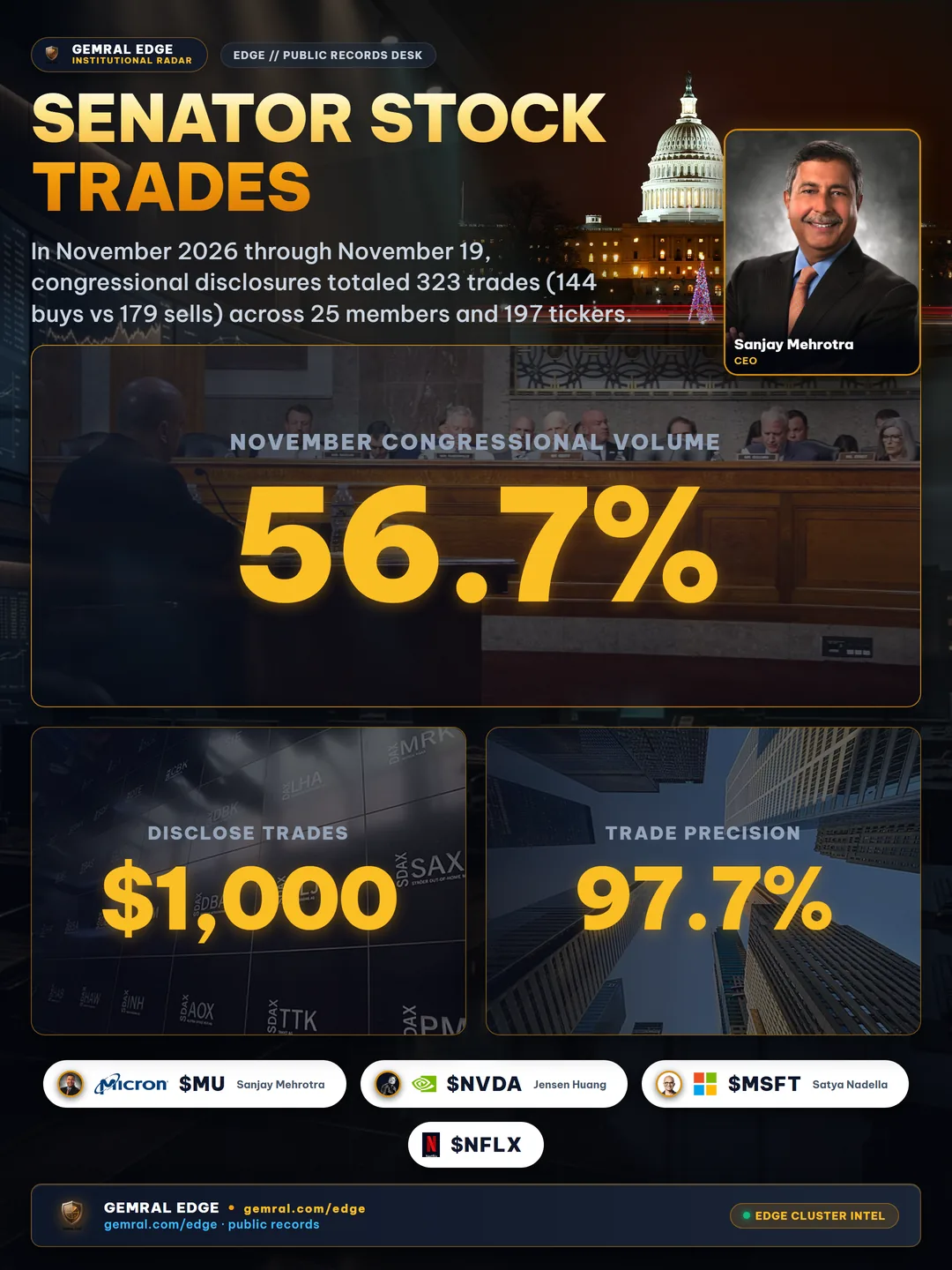
In November 2026 through November 19, congressional disclosures totaled 323 trades (144 buys vs 179 sells) across 25 members and 197 tickers. In the Senate, 2026 disclosures are led by John Boozman (114 trades), Richard Blumenthal (110 trades), Markwayne Mullin (90 trades), Sheldon Whitehouse (34 trades), and Shelley Moore Capito (28 trades).
Senator Stock Trades in 2026: November Filings and Senate Volume
323 congressional equity disclosures hit the public record between November 1 and November 19, 2026. When analysts examine senator stock trades alongside House filings over the same three-week window, the headline split leans net-sell: 144 purchases against 179 sales across 25 active lawmakers and 197 distinct equity tickers.
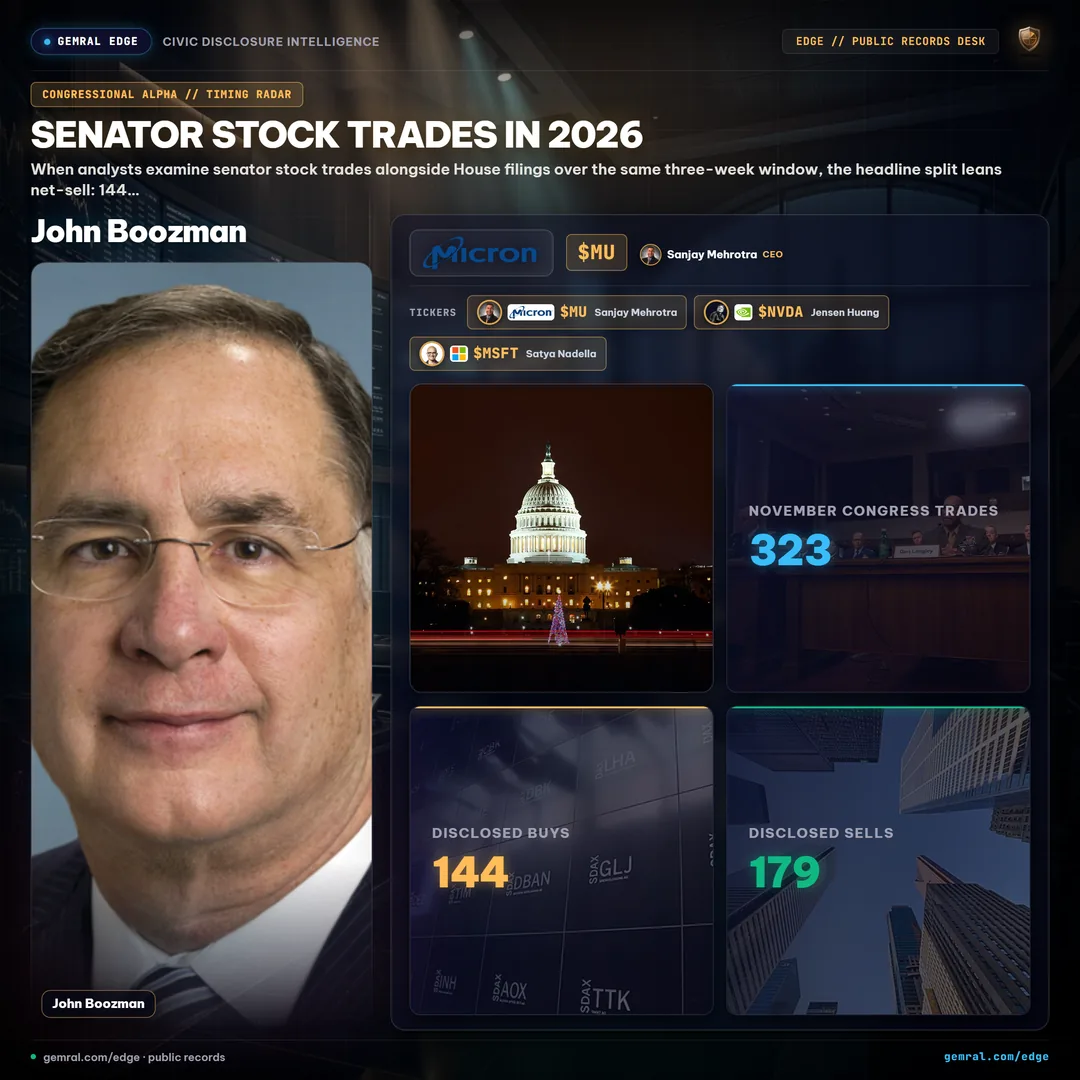
Within the US Senate specifically, 2026 filing activity is heavily concentrated among a handful of frequent filers rather than spread evenly across all 100 seats. Senator John Boozman (R-AR) leads sitting senators with 114 disclosed equity trades in 2026 (27 buys vs 87 sells, latest disclosure November 17, 2026). Senator Richard Blumenthal (D-CT) follows closely with 110 trades (1 buy vs 109 sells, latest disclosure October 26, 2026), while Senator Markwayne Mullin (R-OK) logged 90 trades (62 buys vs 28 sells, latest disclosure March 10, 2026).
| US Senator | Party / State | 2026 Trades | Buys / Sells | Latest Disclosure |
|---|---|---|---|---|
| John Boozman | R-AR | 114 | 27 / 87 | 2026-11-17 |
| Richard Blumenthal | D-CT | 110 | 1 / 109 | 2026-10-26 |
| Markwayne Mullin | R-OK | 90 | 62 / 28 | 2026-03-10 |
| Sheldon Whitehouse | D-RI | 34 | 2 / 32 | 2026-11-02 |
| Shelley Moore Capito | R-WV | 28 | 4 / 24 | 2026-11-04 |
| Katie Boyd Britt | R-AL | 23 | 16 / 7 | 2026-01-29 |
| Tommy Tuberville | R-AL | 15 | 3 / 12 | 2026-07-16 |
In November specifically, Senate disclosures included Sheldon Whitehouse (D-RI, latest filing November 2, 2026) and Shelley Moore Capito (R-WV, 4 sales disclosed November 4, 2026), while House volume was dominated by Representative Ro Khanna (D-CA), who accounted for 183 trades (83 buys vs 100 sells disclosed November 5, 2026)—56.7% of all November congressional volume—followed by Gilbert Ray Cisneros, Jr. (D-CA, 57 trades disclosed November 10, 2026) and David J. Taylor (R-OH, 19 trades disclosed November 12, 2026).
How to Track Senator Stock Trades Through Periodic Transaction Reports
Every Senate and House equity transaction becomes public through Periodic Transaction Reports (PTRs) filed under the STOCK Act of 2012. Federal law requires lawmakers to disclose covered trades exceeding $1,000 within 30 days of receiving notice of execution and no later than 45 days after the trade date. Rather than exact share counts, filings report dollar-value brackets such as $1,001 to $15,000 or $15,001 to $50,000.

Because a senator's spouse or external asset manager frequently executes portfolio rebalancing without day-to-day direction, institutional tracking separates individual filer volume from multi-member consensus. One member selling 9 blocks of a single software stock reflects one household portfolio decision; 6 different lawmakers disclosing sales in the same media ticker within a 19-day window represents a cross-member cluster worth isolating.
Across the full 50,000+ historical congressional trade dataset, sampled verification against original Senate and House public disclosures achieved 97.7% precision (168 of 172 checkable records in the October 23, 2026 audit, with 28 of 200 records blocked from automated re-checks by source-site access limits). Maintaining both execution dates and public filing dates ensures researchers never confuse a delayed report with real-time market knowledge.
Most-Disclosed Tickers in November 2026: WBD, NVDA, MSFT, and MU
Looking at ticker-level disclosures from November 1 through November 19, 2026 reveals sharp directional divergence between technology hardware and media or enterprise software names. While Tenable Holdings (TENB) topped raw transaction count with 9 sales from a single filer on November 5, 2026, Warner Bros. Discovery (WBD) showed the broadest multi-member consensus: 7 sales across 6 distinct lawmakers through November 19, 2026, with zero disclosed purchases.
| Ticker | Nov Trades | Buys / Sells | Distinct Members | Latest Disclosure |
|---|---|---|---|---|
| TENB | 9 | 0 / 9 | 1 | 2026-11-05 |
| WBD | 7 | 0 / 7 | 6 | 2026-11-19 |
| NVDA | 6 | 2 / 4 | 5 | 2026-11-18 |
| NFLX | 6 | 0 / 6 | 2 | 2026-11-16 |
| MSFT | 5 | 1 / 4 | 5 | 2026-11-19 |
| MU | 5 | 5 / 0 | 2 | 2026-11-05 |
On the buy side, Micron Technology (MU) stood out with 5 purchases and 0 sales across 2 members disclosed on November 5, 2026. Nvidia (NVDA) saw 6 trades across 5 members (2 buys vs 4 sells through November 18, 2026), while Microsoft (MSFT) logged 5 trades across 5 members (1 buy vs 4 sells through November 19, 2026), and Netflix (NFLX) recorded 6 sales across 2 members through November 16, 2026. As shown in our 2026 cross-signal congressional report, comparing monthly filing bursts against full-year accumulation highlights when lawmakers rotate out of concentrated mega-cap positions.
Senate Stock Trading Bills, the 45-Day Lag, and Verification Standards
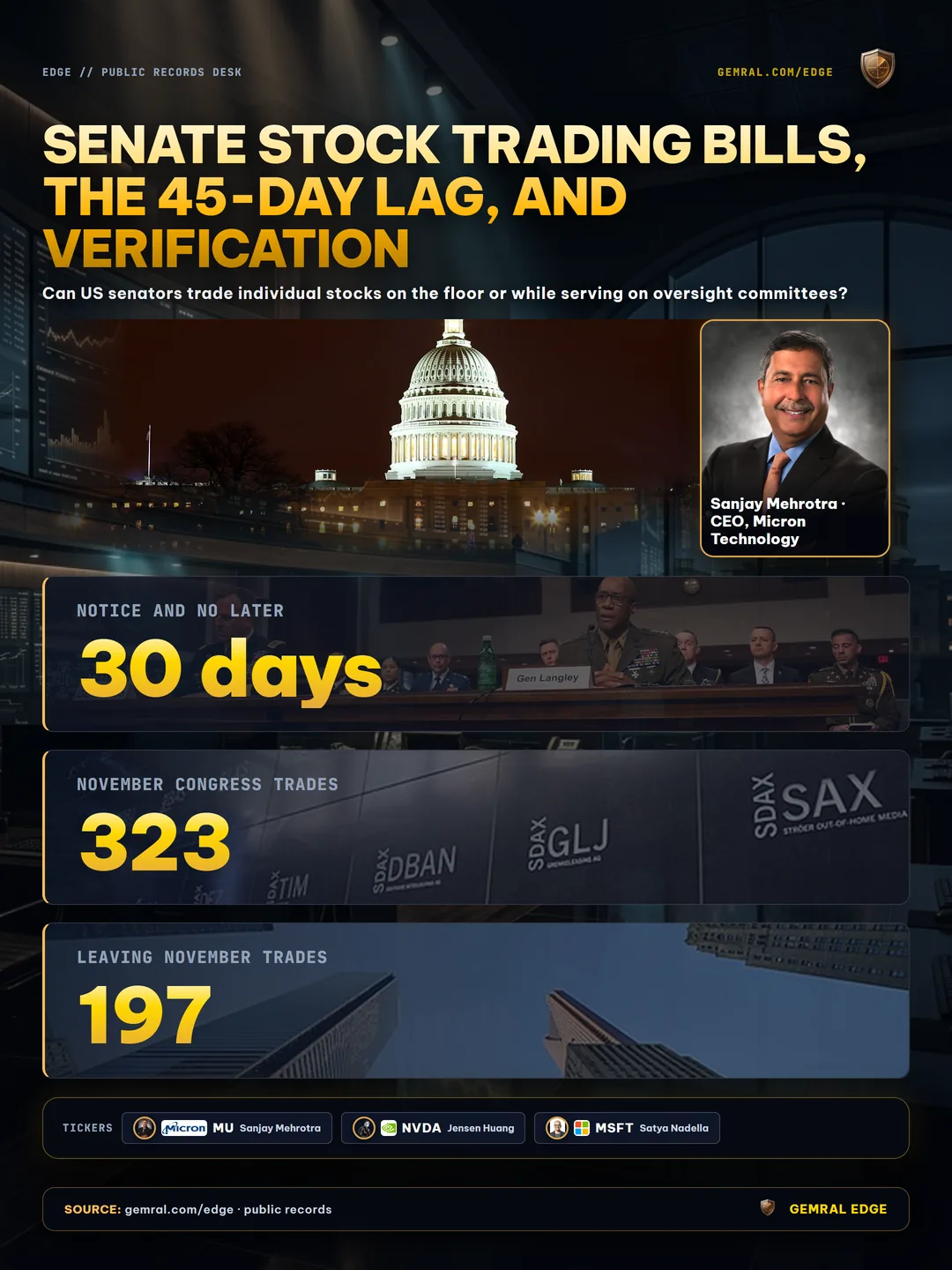
Can US senators trade individual stocks on the floor or while serving on oversight committees? Under existing STOCK Act rules in 2026, individual stock ownership and trading remain legal, even as bipartisan Senate stock trading ban bills continue to debate blind-trust mandates and divestment timelines. Until statutory reform passes both chambers, lawmakers must file within 30 days of notice and no later than the 45-day disclosure window, leaving 323 November trades across 197 tickers subject to that reporting lag.
As detailed in our congressional stock trading disclosure lag guide, filtering historical records strictly by `disclosure_date` rather than `tx_date` prevents look-ahead bias in systematic research. Institutional teams evaluating point-in-time congressional and federal procurement datasets can inspect live sample rows in the Gemral Edge data preview portal or browse full congressional tables at gemral.com/edge/congress.
Public data · not investment advice. Data comes only from public sources and contains no material non-public information.
Frequently asked questions
Can US senators still trade individual stocks in 2026?
Yes. Under current federal law, US senators may buy and sell individual stocks provided they file Periodic Transaction Reports within 30 days of notice and no later than 45 days after the trade date.
Which senators disclosed the most stock trades in 2026?
Based on 2026 Senate public disclosures through November 19, John Boozman logged 114 trades (27 buys vs 87 sells), Richard Blumenthal logged 110 trades (1 buy vs 109 sells), Markwayne Mullin logged 90 trades (62 buys vs 28 sells), Sheldon Whitehouse logged 34 trades, and Shelley Moore Capito logged 28 trades.
How can researchers verify senator stock trades without look-ahead bias?
Researchers separate execution date (tx_date) from public filing date (disclosure_date) and review point-in-time congressional tables on Gemral Edge at /edge/congress.