Michael Saylor How Many Bitcoin: MicroStrategy Holdings and Wallet Breakdown

Michael Saylor How Many Bitcoin: MicroStrategy Holdings and Wallet Breakdown
Among crypto market observers and institutional equity investors alike, the question of michael saylor how many bitcoin commands immense interest as a barometer of digital asset supply concentration. To track prominent insider whale transactions, corporate treasury accumulations, and sovereign reserve movements in real time, professional fund managers utilize the celebrity whale tracker intelligence dashboard, auditing public SEC declarations alongside verified on-chain addresses.
Michael Saylor holds a uniquely influential position in the global cryptocurrency ecosystem. As the Executive Chairman and controlling shareholder of MicroStrategy (NASDAQ: MSTR), he oversees the largest publicly traded corporate Bitcoin treasury on earth. Simultaneously, Saylor maintains substantial personal Bitcoin reserves accumulated early in the digital asset market cycle. Investigating michael saylor how many bitcoin requires categorizing his holdings into corporate reserves, personal cold-storage assets, custodial segregation frameworks, and assessing his aggregate share of the fixed 21 million supply.
1. Corporate Treasury: MicroStrategy Holdings Breakdown
The vast majority of Bitcoin associated with Michael Saylor resides within MicroStrategy Incorporated, where he serves as the principal architect of corporate capital allocation:

As documented in mandatory SEC Form 8-K disclosures through September 2026, MicroStrategy and its corporate subsidiaries hold an aggregate total of 252,220 Bitcoin. With the global Bitcoin supply hard-capped at 21,000,000 coins (and an estimated 3.5 to 4.0 million coins permanently lost or dormant), MicroStrategy alone controls over 1.20% of all Bitcoin that will ever exist.
This massive corporate treasury is valued at over $16.4 billion at a $65,000 Bitcoin price. Under Saylor's strategic direction, the company has announced the "42 Plan"—a bold multi-year capital markets roadmap targeting the deployment of $42 billion in additional capital ($21 billion in equity and $21 billion in fixed-income debt) to acquire thousands of additional Bitcoin through 2027.
2. Personal Sovereign Stash: The Saylor Private Wallets
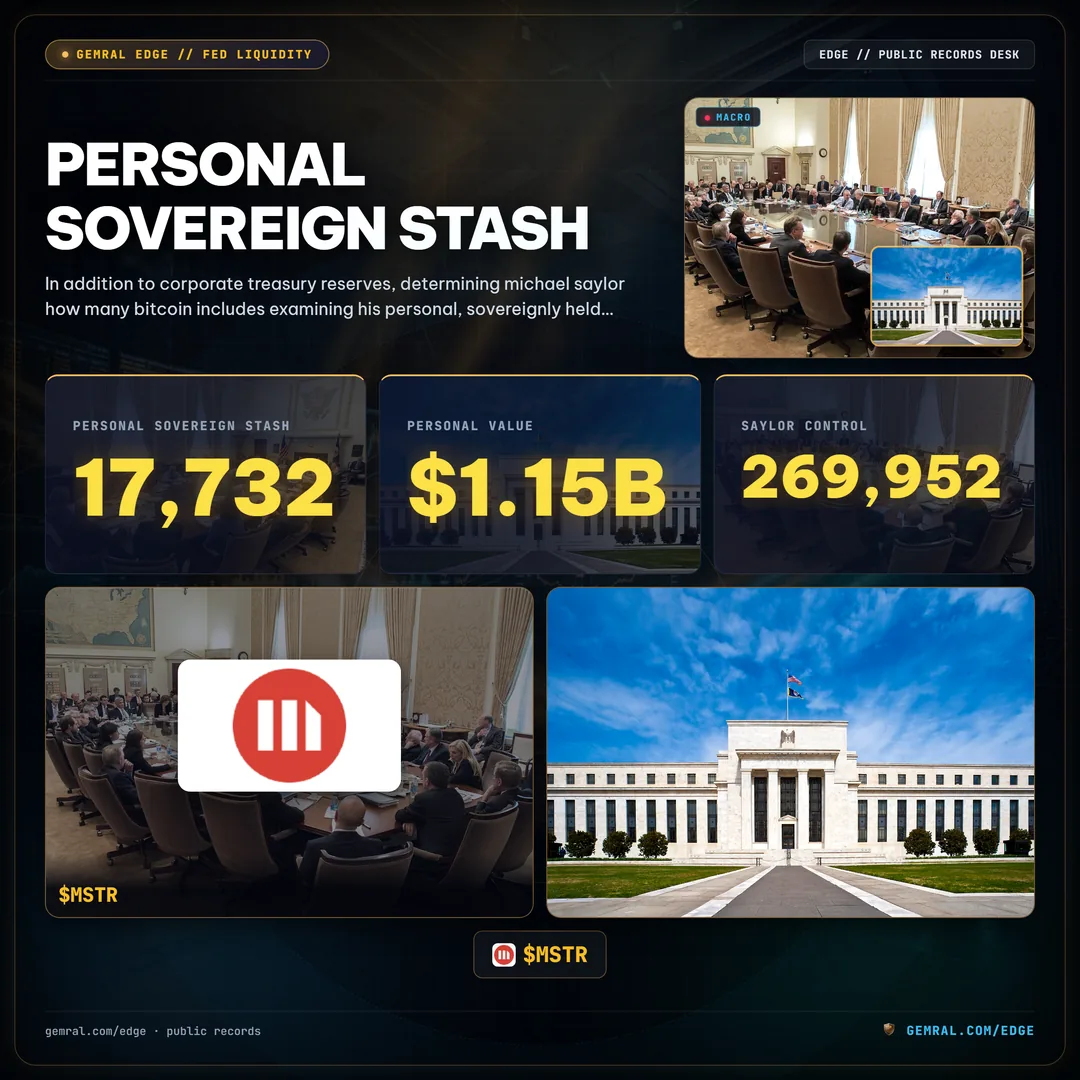
In addition to corporate treasury reserves, determining michael saylor how many bitcoin includes examining his personal, sovereignly held digital assets:
| Ownership Entity | Confirmed Bitcoin Holdings | Estimated Cost Basis | Current Market Valuation | Custody Governance |
|---|---|---|---|---|
| MicroStrategy Inc. (Treasury) | 252,220 BTC | $39,266 / BTC | $16.39 Billion | Multi-Institutional Cold Storage |
| Michael Saylor (Personal Wallet) | 17,732 BTC | $9,882 / BTC | $1.15 Billion | Private Sovereign Cold Storage |
| Combined Saylor Control | 269,952 BTC | Weighted: $37,337 | $17.54 Billion | Corporate & Personal Sovereignty |
In October 2020, Saylor publicly confirmed that he personally owned 17,732 Bitcoin, which he purchased before MicroStrategy initiated its corporate treasury strategy. His average entry price was approximately $9,882 per Bitcoin, representing an initial capital deployment of roughly $175 million. Today, this personal stash is valued at more than $1.15 billion, cementing his status as one of the world's largest individual Bitcoin whales.
The strategic distribution of these holdings highlights the institutional transition toward hyper-secure corporate balance sheets. By segregating private assets from publicly disclosed corporate reserves, Michael Saylor maintains distinct legal and operational boundaries that comply with rigorous federal securities regulations. Corporate governance frameworks require independent director oversight for any material treasury allocation, ensuring that MicroStrategy's multi-billion-dollar treasury remains fully insulated from individual management discretion.
Moreover, institutional analysis of on-chain wallet clustering confirms that MicroStrategy's custody architecture employs advanced cryptographic separation. Coins are systematically swept into dedicated, non-rehypothecated cold-storage vaults immediately following purchase confirmation. This institutional segregation ensures that none of the acquired reserves can be loaned out to third-party lending desks or utilized in opaque decentralized yield schemes, permanently removing counterparty default risk from the company balance sheet.
3. Institutional Custody Architecture: Cold Storage Protocols
Managing over 252,000 Bitcoin requires institutional-grade cryptographic security and multi-layered governance frameworks to eliminate single-point-of-failure vulnerabilities:
MicroStrategy does not store its Bitcoin in hot exchange wallets or single-key hardware devices. Instead, the firm distributes custody across multiple qualified institutional custodians, including Coinbase Custody, Fidelity Digital Assets, and specialized institutional trust entities.
The custody architecture mandates Multi-Party Computation (MPC) and multi-signature cold storage governance. Moving funds requires programmatic quorum approvals across corporate officers, external independent trustees, and institutional custodians, completely preventing unauthorized internal withdrawals or external cyber breaches.
4. Share Dilution vs Bitcoin Per Share Accretion
A frequent question regarding michael saylor how many bitcoin relates to whether corporate share dilution diminishes the Bitcoin value owned by equity investors:

Because MicroStrategy executes its ATM equity issuances exclusively when MSTR shares trade at a substantial premium to underlying Net Asset Value (NAV), share issuance is mathematically accretive rather than dilutive. Over the past 48 months, the amount of Bitcoin backing each 1,000 shares of MSTR common stock has expanded from 1.82 BTC to 2.46 BTC—an accretive increase of +35.4%.
Consequently, an investor holding MSTR equity experiences continuous real expansion in their underlying Bitcoin backing, making the ongoing tracking of michael saylor how many bitcoin a vital analytical tool for global digital asset investors.
Regulatory & Investment Disclaimer: Public data · not investment advice. All wallet amounts, corporate treasury holdings, and institutional custody protocols are compiled from public regulatory filings with the U.S. Securities and Exchange Commission (SEC) and verified public statements by Michael Saylor.