Sovereign AI Infrastructure Co-Investment: Bilateral Compute Compacts and Cloud Expansion
The global transition toward artificial intelligence has shifted from private software enterprise into foundational statecraft. Nation-states increasingly view artificial intelligence capability as critical national infrastructure comparable to energy grids, telecommunication backbones, and domestic defense manufacturing. This realization has sparked a global race to construct sovereign AI computing architectures—domestic computational clusters, indigenous training datasets, and air-gapped sovereign clouds operated within jurisdictional boundaries.

Rather than relying entirely on offshore public cloud instances subject to extraterritorial jurisdiction and foreign regulatory interventions, sovereign governments are establishing state-backed infrastructure partnerships. Over the past 2 years, sovereign wealth funds in the Middle East, Europe, and Asia have allocated tens of billions of dollars to co-invest alongside hyperscalers such as Microsoft (MSFT), Amazon (AMZN), Oracle (ORCL), and Alphabet (GOOGL), powered by accelerator clusters from Nvidia (NVDA).
The Acceleration of National Compute Clusters: Capitalizing Sovereign AI
The institutional momentum driving sovereign AI originates from three structural imperatives: data privacy preservation, economic productivity defense, and national defense readiness. Governments recognize that foundation models trained exclusively on external cultural corpora fail to capture native linguistic nuances, regulatory standards, and domestic legal doctrines. More critically, transmitting sovereign intelligence, public records, and defense telemetry through foreign data centers introduces existential supply chain and jurisdictional liabilities.
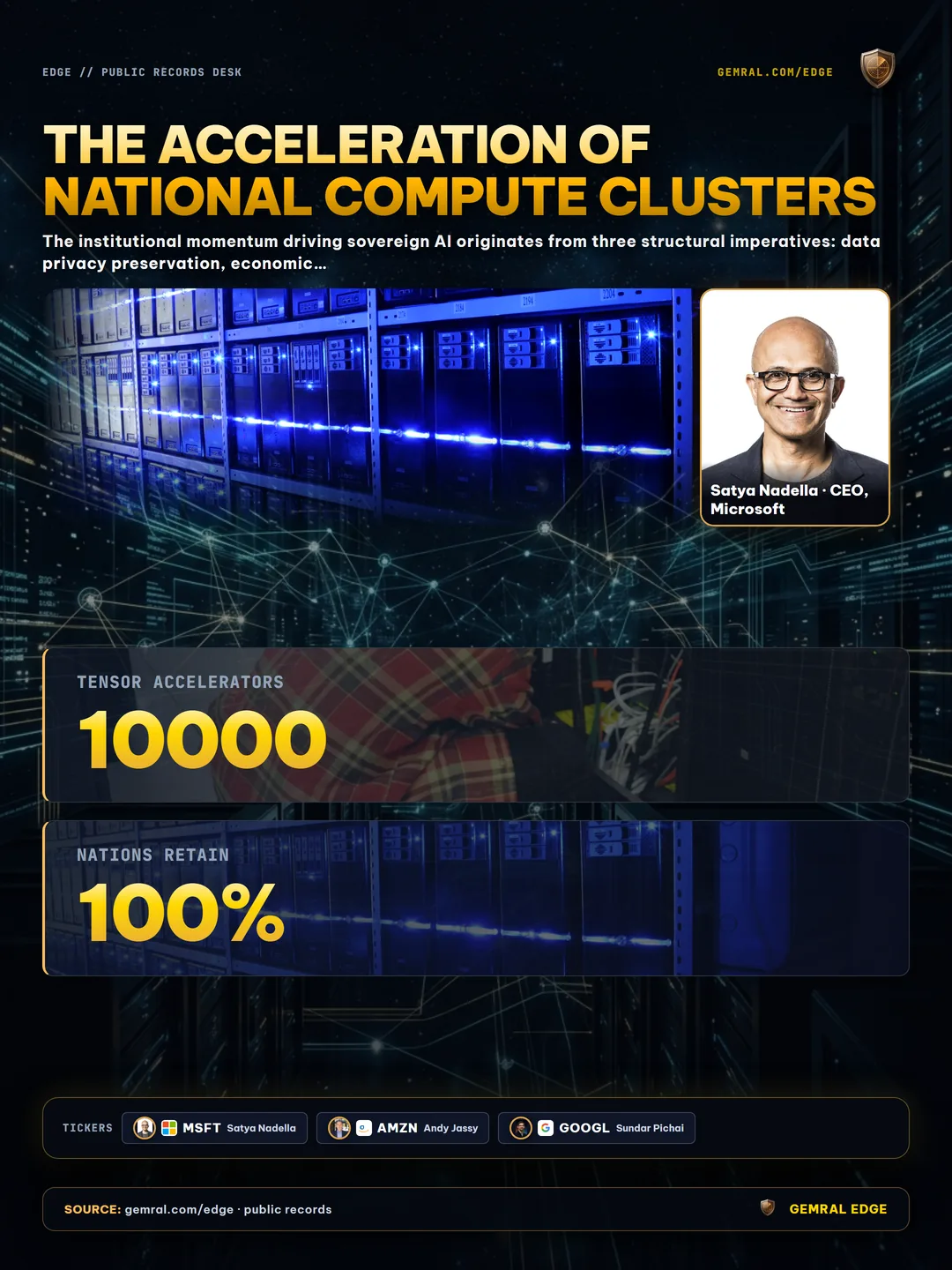
In response, governments are funding domestic supercomputing facilities equipped with 10000 to 50000 advanced tensor accelerators. In leading jurisdictions, state-owned telecommunications entities and utility operators are converting regional grid nodes into sovereign computation sites. By deploying localized hardware clusters, nations retain 100% legal ownership over data sovereignty while providing domestic researchers, defense ministries, and commercial enterprises with low-latency access to frontier models.
This macro deployment wave extends beyond developed western economies. Nations across the Gulf Cooperation Council, Southeast Asia, and Scandinavia have declared sovereign compute targets for 2026 through 2030. These programs are backed by dedicated budget appropriations, subsidized baseload electricity tariffs, and streamlined physical permitting for gigawatt-scale data center corridors.
Bilateral Government Compacts: Strategic Technology Pacts and Export Control Accords
Deploying advanced sovereign computation requires access to regulated silicon accelerators, high-bandwidth memory, and advanced lithography tools. Because advanced semiconductor production remains concentrated across specialized foundries, sovereign compute expansion depends heavily on bilateral diplomatic compacts between host nations and the United States government.
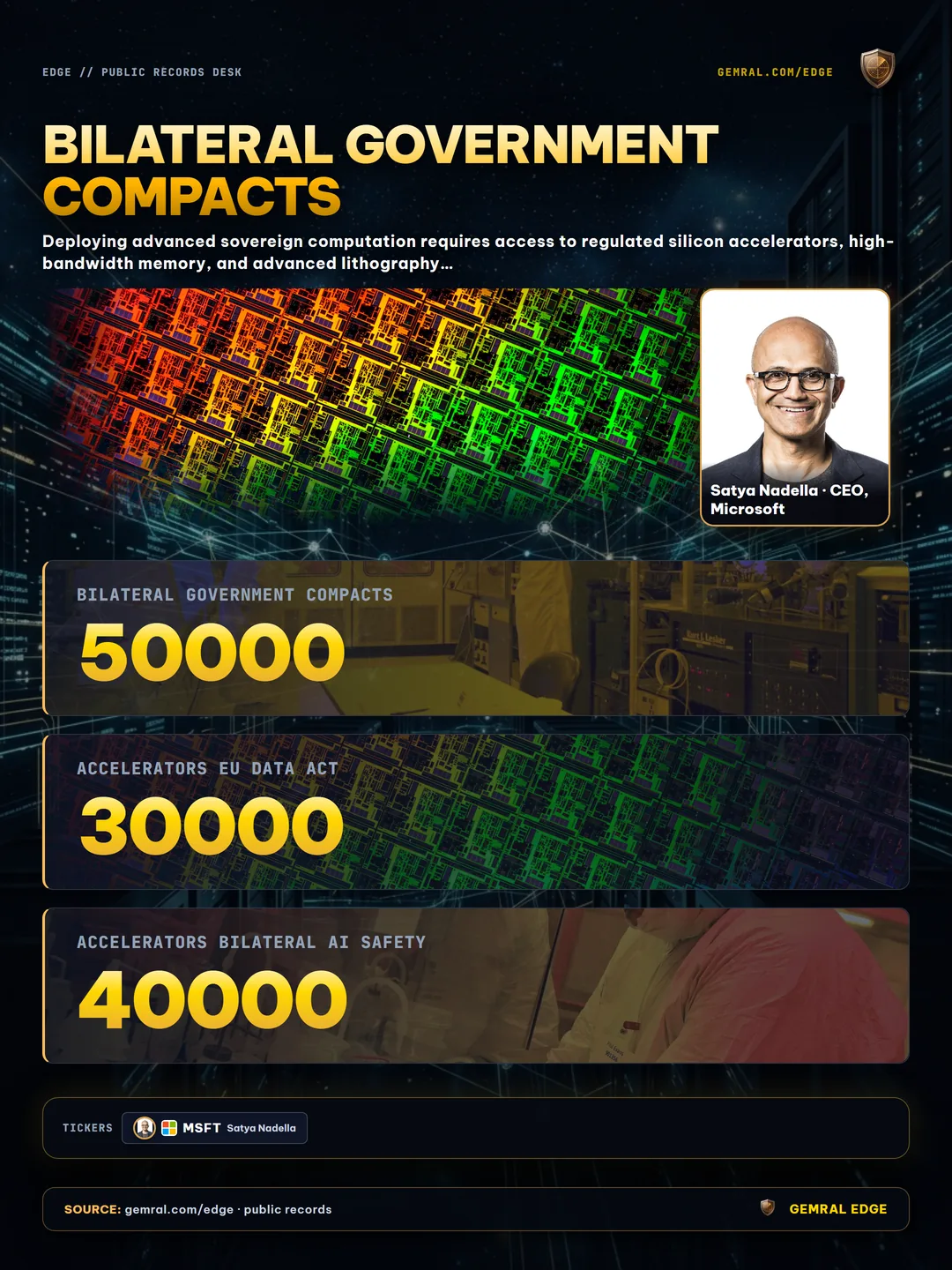
Recent diplomatic agreements between Washington and allied capitals illustrate how bilateral compacts unlock hardware deliveries. Under these frameworks, foreign governments agree to align national export control guidelines, cybersecurity standards, and foreign investment screenings with federal rules in exchange for validated end-user authorizations. These authorizations permit the export of thousands of high-performance accelerators, bypassing regional export caps while guaranteeing strict chain-of-custody tracking.
| Jurisdiction Compact | Lead Partners | Silicon Target | Key Regulatory Accord |
|---|---|---|---|
| United States · UAE Compact | G42, Microsoft, MGX | 50000 Accelerators | Intergovernmental Security Assurance · BIS Approval |
| European Sovereign Cloud | France, Germany, AWS, Mistral | 30000 Accelerators | EU Data Act Compliance · SecNumCloud Certification |
| Asia-Pacific Compute Hub | Singapore, Japan, Oracle, SoftBank | 40000 Accelerators | Bilateral AI Safety Network · Critical Infrastructure Security |
| Nordic Clean Power Corridor | Sweden, Norway, Local Hyperscalers | 20000 Accelerators | Nordic Grid Offtake Compact · Sovereign Enclave Rules |
These bilateral compacts transform commercial technology procurement into binding geopolitical treaties. When a host government signs an international compute compact, it cements multi-decade technological alignment, anchoring domestic software architecture to specific allied hardware ecosystems.
Sovereign Wealth Co-Investment: Project MGX, Mubadala, and BlackRock Infrastructure Funds
The scale of capital required to construct multi-gigawatt sovereign AI campuses has necessitated institutional co-investment vehicles. Traditional balance-sheet financing from enterprise software providers cannot bear the tens of billions in physical real estate, high-voltage transformers, and optical networking hardware required for global deployment.

To bridge this capital requirement, sovereign wealth funds have partnered directly with global asset managers. A primary milestone in this evolution is the Global AI Infrastructure Investment Partnership established by Abu Dhabi sovereign investment firm MGX, BlackRock, Global Infrastructure Partners, and Microsoft. The partnership initiated with $30B in private equity capital, designed to mobilize up to $100B in total investment capacity when factoring in debt financing structures.
Similarly, Mubadala Investment Company and international sovereign funds have committed billions into dedicated data center operating platforms. Microsoft executed a direct $1.5B strategic investment into Abu Dhabi artificial intelligence holding firm G42, establishing an operational blueprint for technology transfer paired with reciprocal equity participation. Sovereign wealth funds function not merely as passive capital allocators, but as active co-owners of national compute assets.
Capital Expenditure Realities: The $100 Billion Baseline for National AI Infrastructure
Quantifying the capital expenditure required to establish national computing independence reveals substantial infrastructure requirements. Building and outfitting a modern Tier 4 artificial intelligence computing center demands capital allocation across 4 distinct asset classes: semiconductor acceleration packages, high-voltage energy grid interconnections, liquid cooling infrastructure, and low-latency optical fabrics.
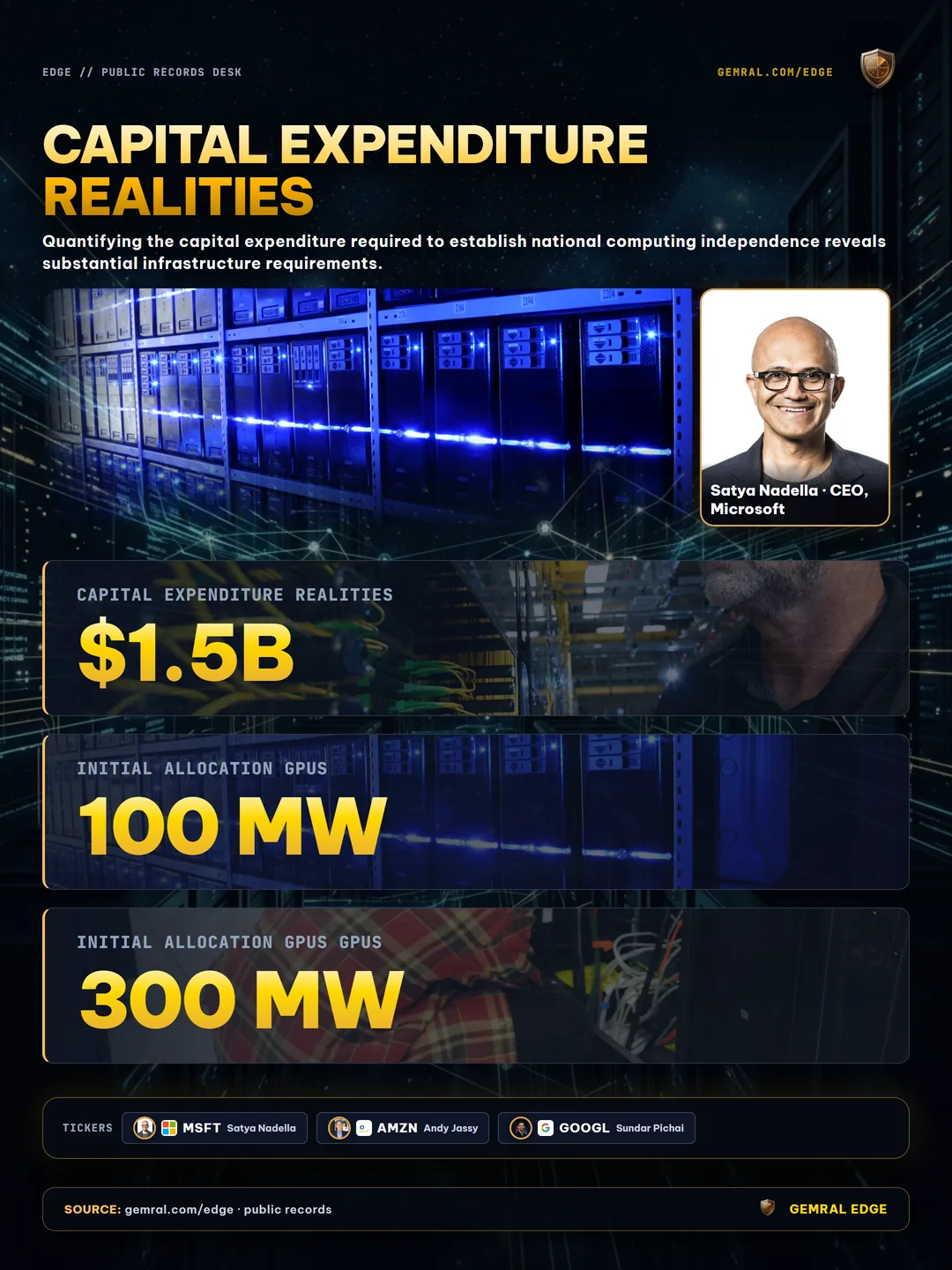
A flagship 50000 accelerator cluster incurs an immediate hardware acquisition cost between $1.5B and $2B. However, physical real estate and energy infrastructure amplify this baseline by a factor of 3 to 4. Sourcing dedicated power generation—whether through utility grid interconnections, advanced nuclear reactor agreements, or clean energy PPAs—requires long-term capital commitments spanning 10 to 20 years.
| Cluster Scale | Power Demand | Hardware Capex | Infrastructure & Facility Capex | Total Initial Allocation |
|---|---|---|---|---|
| 10000 GPUs | 100MW | $400M | $600M | $1B |
| 30000 GPUs | 300MW | $1.2B | $1.8B | $3B |
| 50000 GPUs | 500MW | $2B | $3B | $5B |
| 100000 GPUs | 1000MW (1GW) | $4B | $6B | $10B |
For nations pursuing full sovereign independence across all tier-one industrial sectors, aggregate capital deployment across multiple synchronized data centers approaches the $50B to $100B threshold over a 5-year investment cycle. These figures demonstrate why sovereign states must partner with institutional infrastructure syndicates to distribute balance sheet exposure.
Hyperscaler Architecture: Isolated Air-Gapped Clouds vs. Public Hyperscale Clusters
Architecturally, sovereign AI deployments differ sharply from commercial public cloud environments. Commercial hyperscale cloud availability zones operate on shared multi-tenant physical servers, utilizing software-defined networking and logical access controls to segment enterprise customer data. While logical multi-tenancy satisfies commercial compliance frameworks, it fails to meet the strict legal isolation demanded by sovereign defense and intelligence agencies.
To serve national customers, major cloud hyperscalers have engineered physically disconnected, air-gapped sovereign cloud regions. Microsoft Azure Sovereign Cloud, AWS European Sovereign Cloud, and Oracle Dedicated Region Cloud@Customer deliver full platform capability inside physical perimeters located entirely within host territory.
These specialized architectures feature 3 essential isolation mechanisms:
- Physical Data Isolation: Dedicated servers, bare-metal hardware racks, and cryptographic modules physically separated from commercial public networks, ensuring 100% data localization.
- Sovereign Personnel Screening: Operational maintenance and administrative root access restricted exclusively to security-cleared host-nation citizens residing within domestic boundaries.
- Air-Gapped Cryptographic Control: Identity management, encryption key vaults, and operational telemetry controlled entirely by national authorities, preventing remote shutdown or external surveillance.
By implementing these air-gapped controls, foreign technology providers can operate hyperscale infrastructure while guaranteeing host governments uncompromised sovereignty over operational state data.
Beyond network perimeter defense, architectural isolation relies on hardware-enforced confidential computing. Tensor processing units and accelerator clusters deployed inside sovereign enclaves utilize hardware roots of trust and cryptographic memory encryption. Memory spaces allocated for sensitive model weights and domestic intelligence remain entirely inaccessible to hypervisors, cloud operators, or remote management interfaces. Even in the event of physical hardware compromise or host compromise, data in execution remains encrypted at the silicon register level.
Furthermore, sovereign governance models demand that identity orchestration and access federation remain decoupled from global corporate directories. Rather than synchronizing employee identities through multi-region cloud tenants, host governments mandate dedicated, localized hardware security modules. These dedicated cryptoprocessors handle public key infrastructure, lifecycle auditing, and cryptographic key rotation within territorial perimeters, ensuring that external cloud personnel cannot unilaterally inject firmware updates or bypass sovereign administrative controls.
Geopolitical Supply Chain Security: Silicon Allocation and Energy Interconnection
The long-term durability of national compute programs depends on navigating acute physical supply chain bottlenecks. Silicon accelerator packaging, high-bandwidth memory (HBM3e/HBM4) integration, and liquid cooling distribution manifolds represent physical choke points where demand continues to outpace foundry manufacturing yields.
Simultaneously, electrical interconnection delays represent a primary operational hurdle. Modern sovereign compute campuses require 500MW to 1000MW of continuous, uninterrupted electrical capacity. Because municipal transmission grids often operate near peak capacity, sovereign compute operators are increasingly bypassing public utility queues by constructing dedicated on-site power generation.
Public filings indicate that institutional investors and sovereign entities are actively monitoring congressional actions, procurement awards, and congressional capital disclosures to gauge where regulatory support and capital grants will flow next. Companies providing specialized high-voltage infrastructure (VRT, SMCI) and clean baseload utilities (CEG) represent critical enablers for sovereign infrastructure deployment.
How to Track Sovereign AI Deployments
Tracking the intersection of sovereign wealth investments, federal export compacts, and hyperscaler compute infrastructure requires monitoring disparate regulatory registries, corporate filings, and procurement task orders. Manually cross-referencing intergovernmental agreements with physical site permits introduces latency that leaves market participants blind to major capital deployments.
The automated intelligence terminal aggregates global sovereign compute announcements, mapping hardware supply chain contracts, sovereign wealth commitments, and regional power allocations into structured market feeds. By correlating diplomatic compacts with public equity beneficiaries across semiconductors, data center real estate, and nuclear utilities, the platform illuminates structural capital rotations across the international technology ecosystem.
Institutional researchers, sovereign fund analysts, and technology investors can monitor these multi-signal developments directly through the dedicated intelligence hub at /edge/ai. Comprehensive data feeds and specialized cluster analytics are available via Pro at $39 per month, with full institutional terminal and API integration starting at $299 per month.
Frequently asked questions
What is sovereign AI and why is it becoming a national priority?
Sovereign AI refers to a nation's independent capability to develop, operate, and control its own artificial intelligence models and computational infrastructure, ensuring sensitive state records and domestic economic data remain entirely within sovereign borders rather than being routed through foreign commercial clouds.
How are sovereign wealth funds financing sovereign AI infrastructure?
Sovereign wealth funds like Abu Dhabi's MGX and Mubadala are partnering with global asset managers like BlackRock and hyperscalers like Microsoft, deploying initial equity vehicles of $30B scaling up to $100B in debt and infrastructure financing for multi-gigawatt computing campuses.
How does an air-gapped sovereign cloud differ from standard public cloud infrastructure?
Standard public clouds rely on shared multi-tenant servers and logical software access controls. In contrast, sovereign clouds feature physically isolated hardware racks, security-cleared domestic citizen administrators, and locally managed encryption vaults that prevent foreign remote access or extraterritorial jurisdiction.