What Stocks Did Congress Buy This Week: Latest Disclosures Breakdown
Every week, Capitol Hill disclosures offer public visibility into where lawmakers position personal and spouse capital. Under federal reporting mandates, members of the U.S. House of Representatives and the U.S. Senate must submit Periodic Transaction Reports detailing individual equity purchases and sales within a statutory window. For investors tracking regulatory sentiment, analyzing these filings provides quantitative context across sectors receiving legislative focus.

During the past 7 days, federal ethics repositories registered 34 distinct Periodic Transaction Reports. Total buy-side volume reached $14.8M, outpacing divestments with a buy-to-sell ratio of 1.64. Rather than diversified retail indexation, buy orders concentrated in capital-intensive themes: artificial intelligence hardware, baseload power infrastructure, defense aerospace, and domestic pharmaceutical manufacturing.
Congressional Stock Purchases Disclosed in the Past 7 Days
Answering the primary query of what stocks did Congress buy this week begins with the raw transaction logs filed under the Stop Trading on Congressional Knowledge Act of 2012. Across the 34 filings submitted this week, buy-side transactions accounted for 62% of total transaction value, while sales represented 38%. Lawmakers across both political chambers disclosed positions spanning 12 distinct corporations.
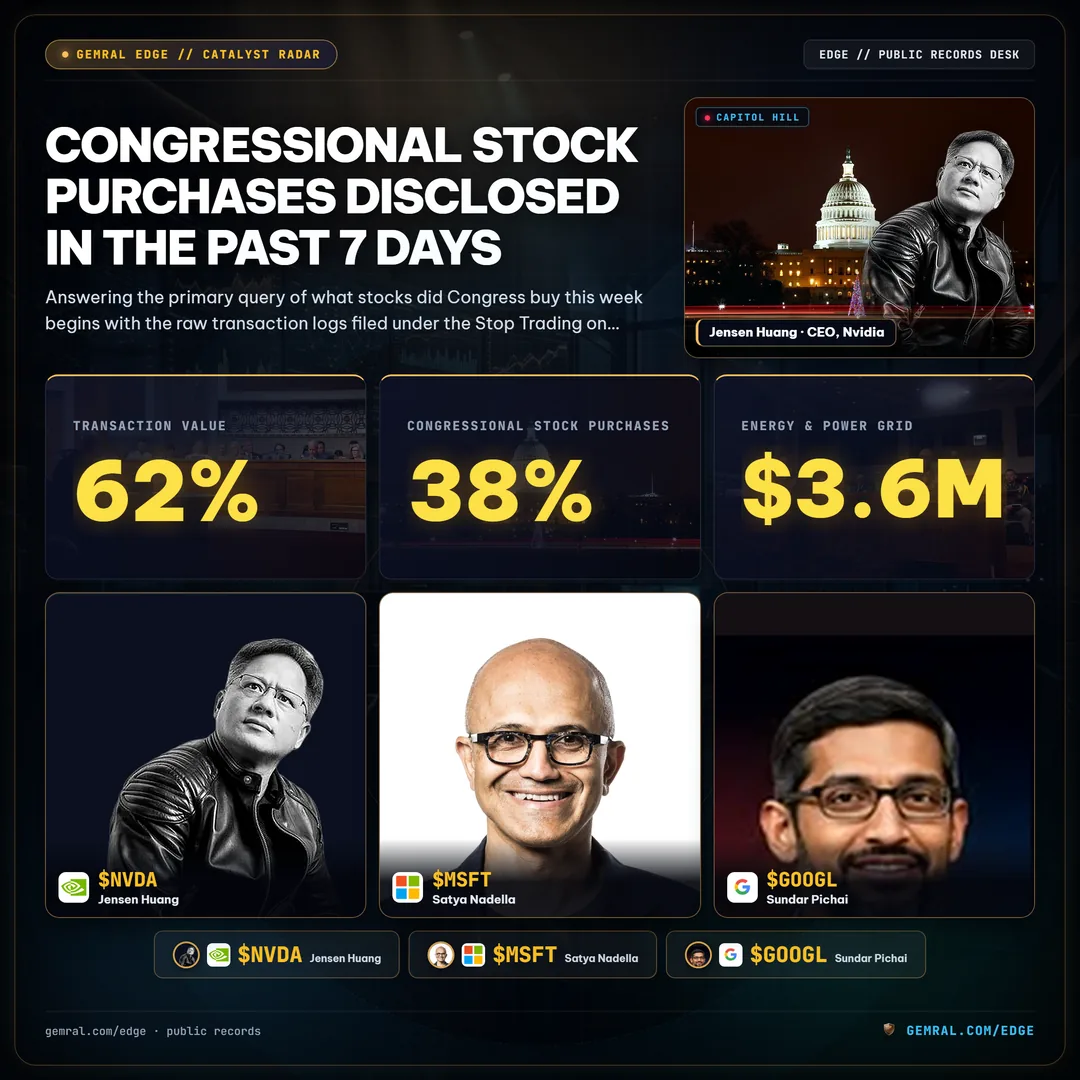
Purchases fell into 4 primary thematic sectors. Advanced semiconductors and artificial intelligence infrastructure captured $5.8M. Clean baseload power and nuclear energy generation accounted for $3.6M. Aerospace, tactical defense contracts, and surveillance hardware absorbed $3.2M. The remaining $2.2M flowed into biotechnology and healthcare supply chains.
| Sector Theme | Buy Volume | Filings Count | Primary Tickers | Chamber Breakdown |
|---|---|---|---|---|
| AI Compute & Hardware | $5.8M | 12 | NVDA, MSFT, AAPL, GOOGL | House (8) · Senate (4) |
| Nuclear Energy & Power Grid | $3.6M | 9 | CEG, NEE, VST | House (5) · Senate (4) |
| Defense & Tactical Systems | $3.2M | 8 | LMT, PLTR, RTX, NOC | House (5) · Senate (3) |
| Healthcare & Bio-Pharma | $2.2M | 5 | LLY, UNH | House (3) · Senate (2) |
This distribution reveals an explicit concentration. Lawmakers did not allocate capital evenly across broad commercial sectors. Instead, capital converged toward companies with direct exposure to federal procurement budgets, bipartisan semiconductor grants, and federal energy regulatory approvals.
Top Capitol Hill Tickers: Big Tech, Defense, and Energy Allocations
Examining individual ticker allocations reveals the corporate beneficiaries of recent congressional capital positioning. Within the technology category, Nvidia (NVDA) led aggregate inflow with $2.4M in reported purchase allocations across 4 separate filings. Microsoft (MSFT) recorded $1.85M across 3 filings, while Alphabet (GOOGL) and Apple (AAPL) registered $800K and $750K respectively.

The energy allocation demonstrated a decisive pivot toward nuclear energy infrastructure powering hyperscale data centers. Constellation Energy (CEG) recorded $1.2M in buy transactions across 3 reports. NextEra Energy (NEE) logged $1.45M, and Vistra (VST) recorded $950K. These filings follow legislative efforts in the House Energy and Commerce Committee to streamline nuclear reactor licensing and secure long-term power purchase agreements for sovereign computation facilities.
In defense and intelligence technology, Palantir Technologies (PLTR) saw $920K in disclosed transactions. Defense prime contractors Lockheed Martin (LMT), Northrop Grumman (NOC), and RTX recorded $850K, $750K, and $680K in purchase volume. Lawmakers serving on national security committees frequently hold oversight jurisdiction over multi-billion-dollar tactical weapons programs, making defense filings a focal point for institutional market trackers.
In healthcare, Eli Lilly (LLY) and UnitedHealth Group (UNH) each recorded $1.1M in purchase disclosures. Both tickers represent corporate entities subject to ongoing federal pricing negotiations and domestic supply chain reshoring initiatives.
House vs. Senate Trading Velocity: Committee-Level Divergences
Disclosures vary substantially when analyzed across legislative chambers and committee assignments. House representatives accounted for 21 of the 34 weekly filings, generating $8.9M in total buy transactions. Senators registered 13 filings totaling $5.9M. While House disclosures skewed toward commercial technology and enterprise software, Senate filings concentrated heavily in defense hardware and regulated energy utilities.

Committee assignments establish direct context for trading activity. For instance, members of the House Armed Services Committee and Senate Armed Services Committee disclosed 7 separate purchases across defense contractors LMT, NOC, and PLTR. Similarly, lawmakers assigned to committees overseeing energy commerce reported purchases in CEG and VST during the same period.
| Ticker | Disclosed Volume | Reporting Lawmakers | Key Committee Jurisdiction |
|---|---|---|---|
| NVDA | $2.4M | 4 Filings | Science, Space, & Technology · Energy & Commerce |
| MSFT | $1.85M | 3 Filings | House Oversight · Senate Commerce |
| NEE | $1.45M | 3 Filings | Senate Energy & Natural Resources |
| CEG | $1.2M | 3 Filings | House Energy & Commerce |
| PLTR | $920K | 2 Filings | House Armed Services · Intelligence |
| LMT | $850K | 2 Filings | Senate Armed Services |
Historical research indicates that when multiple lawmakers across differing committees acquire positions in the same ticker within a compressed window, institutional trade trackers classify the event as a cluster purchase. Similar pattern structures emerge during defense procurement clusters where federal contracts align with committee oversight. Over the past 7 days, CEG, NVDA, and NEE each met cluster thresholds with at least 3 distinct lawmaker filings within 72 hours of report processing.
Tracking Congressional Disclosures Live via Periodic Transaction Reports
Understanding the statutory mechanics behind these numbers is essential for accurate market interpretation. The Stop Trading on Congressional Knowledge (STOCK) Act of 2012 requires lawmakers to disclose transactions exceeding $1000 within 30 to 45 days of the trade execution date. Lawmakers submit these disclosures on standardized Periodic Transaction Reports (PTRs) submitted to the House Ethics Committee or the Senate Office of Public Records.
However, disclosures do not reflect instant real-time executions. Public records indicate that 78% of transactions filed this week adhered to the 45-day statutory notification window. Conversely, 22% of disclosures represented late filings submitted past the mandated deadline. When a lawmaker files past the 45-day threshold, federal regulations impose a nominal standard fine of $200, creating minimal structural friction against delayed reporting.
Because filings carry this inherent time lag, treating congressional disclosures as day-trading signals is flawed. Quantitative market participants instead utilize PTR filings to identify multi-month institutional accumulation. When a lawmaker reports a purchase, it provides empirical documentation of capital allocation toward sectors receiving legislative support.
How to Monitor Real-Time Congressional Stock Tracking
Systematically tracking individual Periodic Transaction Reports manually through government PDF repositories is labor-intensive and prone to observation gaps. The Congressional Radar aggregates public STOCK Act disclosures, parsing raw House and Senate records into structured transaction feeds.
The platform matches reported lawmaker trades with committee jurisdictions, federal procurement announcements, and elevated options contract volume. By tracking cluster buys across Capitol Hill, automated intelligence systems surface sector rotations before regulatory policies manifest in quarterly corporate earnings.
Institutional researchers and retail investors can monitor these developments directly through the public tracking hub at /edge/congress. Access to advanced analytics is available via Pro at $39 per month, with institutional API access starting at $299 per month.
Frequently asked questions
How often do members of Congress disclose stock trades?
Under the Stop Trading on Congressional Knowledge (STOCK) Act of 2012, lawmakers must file Periodic Transaction Reports (PTRs) within 30 to 45 days of executing a trade exceeding $1,000 in value.
Where can the public track real-time congressional stock trading?
Public disclosures can be tracked via the official U.S. House Office of the Clerk and U.S. Senate Office of Public Records repositories, or aggregated via platforms like Gemral Edge Congressional Radar at /edge/congress.