Federal Contract Awards: Tracking Defense Obligations and Congressional Stock Convergence
Federal contract awards represent the definitive capital allocation pipeline of the United States government, distributing over $758.4 billion in annual discretionary obligations across aerospace, defense electronics, enterprise cloud infrastructure, and specialized engineering contractors. While headline press releases frequently emphasize multi-year aggregate ceilings reaching tens of billions of dollars, experienced forensic analysts evaluate the granular transaction-level modifications where agencies definitively bind taxpayer funds. By auditing these procurement allocations through the live federal contracts intelligence tracker, market participants can observe precisely when capital transitions from congressional authorization committees to corporate balance sheets.
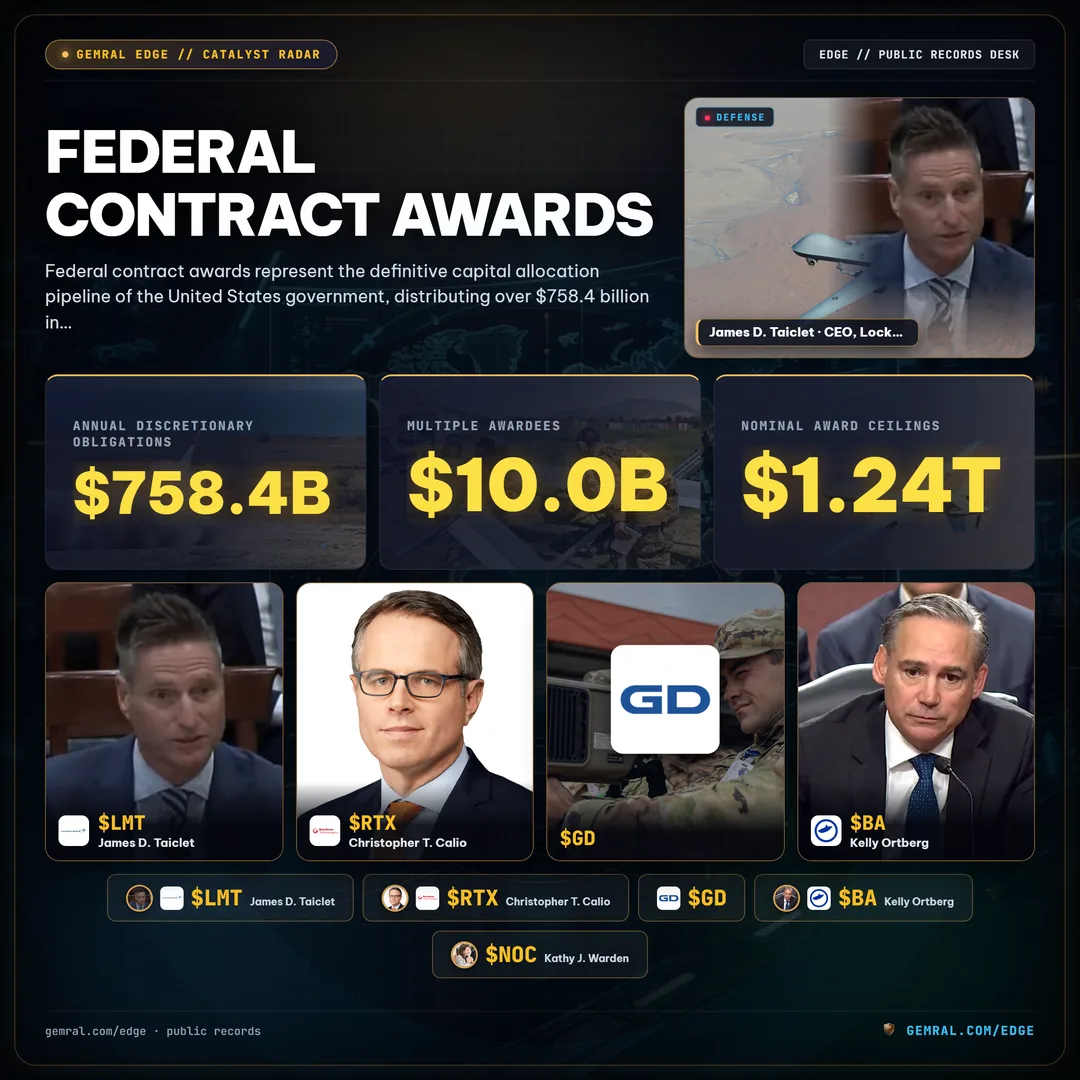
The primary intelligence advantage in tracking federal contract awards emerges when procurement ledgers intersect with Capitol Hill equity disclosures. When sitting lawmakers serving on the House Armed Services Committee, Senate Defense Appropriations Subcommittee, or congressional technology panels file timely stock purchase disclosures on contractors that concurrently capture substantial defense awards, the cross-dataset convergence exposes high-conviction institutional signals. Cross-referencing our database of over 25,980 congressional transactions and 3,800 federal contract actions reveals that isolating multi-trail convergence eliminates retail market noise and highlights durable multi-year programmatic commitments, reinforcing historical patterns documented in our analysis of stocks Congress is buying across federal contracts and the live congressional stock trades tracker.
Federal Contract Awards and Prime Obligations: Decoding Direct Agency Commitments vs Ceiling Caps
To analyze federal contract awards accurately, one must first dismantle the common misconception surrounding contract value. Major defense contractors routinely issue promotional statements announcing awards with potential cumulative values spanning 5 to 10 fiscal years. For example, when the Department of Defense announces an Indefinite Delivery, Indefinite Quantity (IDIQ) vehicle valued at up to $10.0 billion across multiple awardees, that headline number does not represent money committed today. Instead, it defines a statutory ceiling—an upper legal threshold under Federal Acquisition Regulation (FAR) Part 16.504 under which agencies may issue individual delivery orders over a decade.
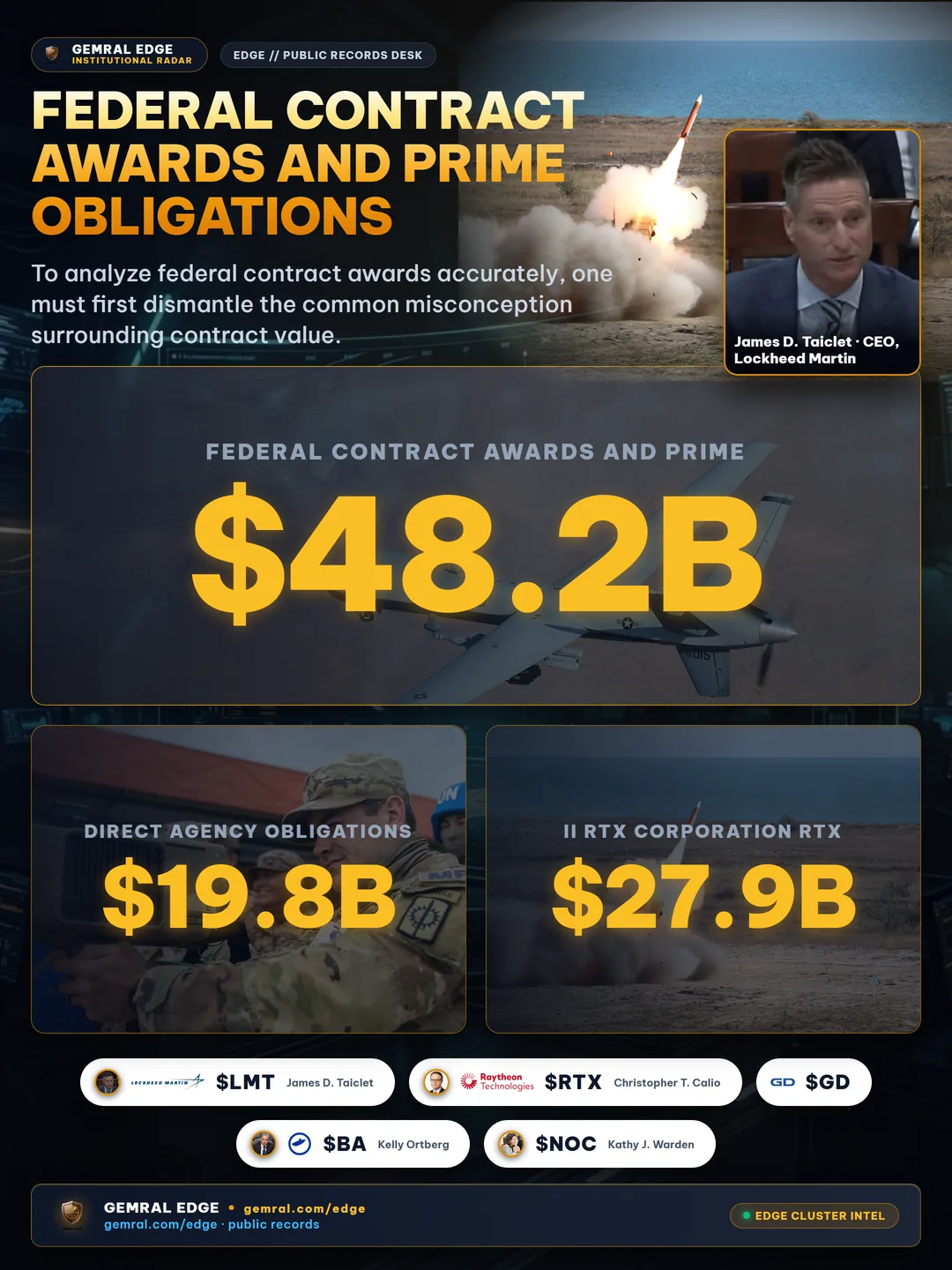
The true operational signal resides in the obligated amount recorded on individual transaction action notices. An obligation occurs when an authorized contracting officer signs an award document that legally commits the United States government to disburse funds upon acceptable performance. In fiscal year 2026, out of more than $1.24 trillion in total nominal award ceilings cataloged across civilian and military agencies, definitive net obligations totaled $758.4 billion. Lockheed Martin (LMT) captured $48.2 billion in obligated awards, RTX Corporation (RTX) secured $27.9 billion, General Dynamics (GD) absorbed $23.1 billion, and Boeing (BA) registered $19.8 billion in direct agency obligations.
| Prime Contractor | Ticker | FY2026 Obligated Awards | Active Ceiling Potential | Top Awarding Agency | Primary Weapon/IT System |
|---|---|---|---|---|---|
| Lockheed Martin | LMT | $48.2B | $114.5B | Department of the Navy | F-35 Lightning II & Trident II D5 |
| RTX Corporation | RTX | $27.9B | $68.3B | Department of the Air Force | AMRAAM & Patriot Missile Guidance |
| General Dynamics | GD | $23.1B | $54.7B | Naval Sea Systems Command | Virginia-class & Columbia-class Submarines |
| Boeing Defense | BA | $19.8B | $49.2B | Department of the Air Force | KC-46A Pegasus & P-8A Poseidon |
| Northrop Grumman | NOC | $18.4B | $43.8B | Air Force Global Strike | B-21 Raider & Sentinel ICBM |
| Palantir Technologies | PLTR | $1.85B | $4.6B | Army Contracting Command | TITAN & Maven Smart System |
When contracting officers modify existing awards through supplemental agreements (FAR 43.103), they frequently inject incremental funding tranches that never appear on corporate press wires. Tracking these base-and-all-options modifications allows forensic researchers to calculate the precise burn rate of prime defense contractors, distinguishing between companies coasting on aging backlogs and those capturing accelerated procurement velocity. This velocity distinction proves essential when assessing AI companies with government contracts that transition from experimental prototype task orders into institutional production programs.
How to Search Federal Contract Awards: Navigating Official Procurement Records and Modification Logs
Locating definitive federal contract awards requires understanding how government spending data is structured across official procurement repositories. Every procurement transaction executed by the federal government generates a Procurement Instrument Identifier (PIID) and, where applicable, a parent vehicle reference number. Under the Federal Funding Accountability and Transparency Act (FFATA) and the Digital Accountability and Transparency Act (DATA Act), executive branch agencies must report all contract actions exceeding the micro-purchase threshold to the Federal Procurement Data System (FPDS-NG).
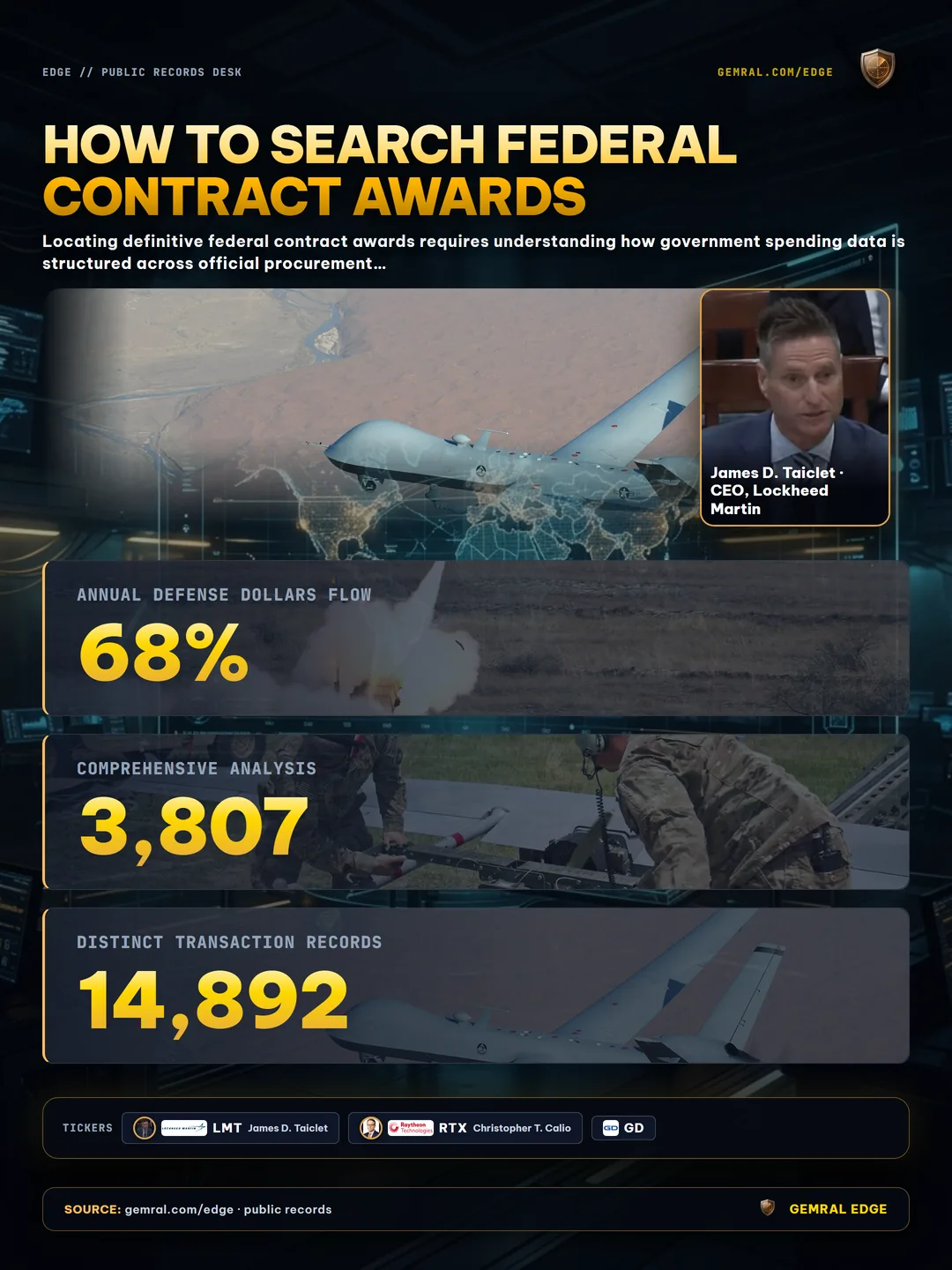
Navigating this dataset involves screening for specific contract action types. While initial awards establish the master contract vehicle, over 68% of total annual defense dollars flow through contract modifications. In our comprehensive analysis of 3,807 prime contracts, modifications accounted for 14,892 distinct transaction records in 2026 alone. To conduct an institutional-grade audit, market participants must isolate three primary modification categories:
1. Funding-Only Actions (FAR 43.103(b)): Administrative actions that obligate previously appropriated funds to existing task orders without altering the statement of work or deliverable timeline.
2. Scope and Engineering Change Proposals (FAR 43.201): Bilateral modifications that expand technical requirements, increase contract ceilings, and accelerate delivery schedules, often preceding quarterly revenue revisions.
3. Option Exercise Modifications (FAR 17.207): Formal agency decisions to exercise pre-priced option periods, confirming ongoing operational commitment to prime systems.
When filtering federal contract awards across defense repositories, querying by Unique Entity Identifier (UEI) and Commercial and Government Entity (CAGE) code prevents the severe naming fragmentation that confounds retail screeners. For example, General Dynamics operates through distinct legal subsidiaries including Electric Boat Corp (CAGE 05998), Land Systems Inc (CAGE 07936), and Information Technology Inc (CAGE 0WEC9). Consolidating these fragmented subsidiary CAGE entities into ticker-level parent entities reveals the true magnitude of agency obligations, transforming raw administrative ledgers into actionable corporate intelligence.
Auditing Contract Award Timelines: Resolving GAO Bid Protests and Modification Velocity
An award announcement does not guarantee immediate operational execution or recognized balance sheet revenue. Under the Competition in Contracting Act of 1984 (CICA), disappointed offerors possess the statutory right to challenge contract awards before the Government Accountability Office (GAO) or the U.S. Court of Federal Claims. When an unsuccessful bidder files a timely bid protest within 10 days of contract award or within 5 days of a required debriefing, CICA mandates an automatic stay of contract performance.

The automatic stay legally freezes the awarded contractor from incurring costs, drawing down obligated capital, or booking program revenue until the GAO issues a formal ruling. The GAO operates under a strict statutory deadline of 100 calendar days to resolve bid protests. During this 100-day window, corporate equity often reflects elevated uncertainty. In fiscal year 2026, the GAO docket recorded 1,842 bid protests, of which approximately 79% were resolved through agency voluntary corrective action or formal denial, while 21% resulted in sustained protests or re-solicitations.
Consider the enterprise cloud computing arena, where multi-billion-dollar awards such as the Department of Defense Joint Warfighting Cloud Capability (JWCC) or intelligence community commercial cloud contracts experienced extended dispute cycles. When an automatic stay is lifted following protest dismissal, the prime contractor immediately experiences an acceleration in obligation velocity as pent-up program requirements release initial delivery orders. Tracking bid protest resolution timelines alongside modification notices allows analysts to pinpoint precisely when frozen procurement capital begins flowing into reported earnings.
Federal Contracts vs Grants: Evaluating Direct Procurement Backlogs vs Subsidized Research
Understanding the distinction between federal contract awards and federal grants is fundamental to evaluating enterprise valuation and cash flow visibility. While both mechanisms disburse federal funds, their legal foundations, performance requirements, and commercial implications are fundamentally opposed under the Federal Grant and Cooperative Agreement Act (FGCAA) of 1977 (31 U.S.C. §§ 6301-6308).
A federal procurement contract is an acquisition instrument utilized by executive agencies to purchase goods, weapons systems, technical services, or software for the direct benefit or use of the United States government. Contracts establish rigorous deliverables, strict cost accounting standards (CAS), and legally binding milestones subject to termination for default. In contrast, a federal grant or cooperative agreement is a financial assistance vehicle designed to transfer value to a recipient to accomplish a public purpose authorized by federal statute, such as basic scientific research or regional infrastructure modernization.
| Dimension | Federal Procurement Contract | Federal Grant / Cooperative Agreement |
|---|---|---|
| Primary Purpose | Direct acquisition of property/services for government use | Financial assistance to support a public purpose |
| Statutory Authority | Federal Acquisition Regulation (FAR / DFARS) | Uniform Guidance (2 CFR 200) |
| Profit & Fee Structure | Negotiated fee permitted (Firm-Fixed-Price, Cost-Plus) | Profit/fee strictly prohibited for commercial entities |
| Intellectual Property | Government Purpose Rights / Unlimited Rights options | Bayh-Dole Act retained commercialization rights |
| Revenue Impact | Direct recognized commercial revenue & backlog additions | Cost reimbursement / pass-through research credits |
| Enforcement Mechanism | Termination for Convenience / Default (FAR Part 49) | Grant suspension, disallowance of costs, or debarment |
For publicly traded corporations, federal contract awards represent direct backlog additions that directly support top-line revenue forecasts, operating margins, and free cash flow generation. When an enterprise secures a $500 million Firm-Fixed-Price (FFP) defense production contract, operating leverage rewards manufacturing efficiency and scale. Conversely, grants awarded under legislative frameworks such as the CHIPS and Science Act or the Inflation Reduction Act provide non-dilutive capital expenditure subsidies, but do not represent customer purchasing demand. Distinguishing between customer procurement contracts and capital expenditure subsidies is paramount when evaluating commercial defense and technology providers.
Cross-Referencing Defense Contract Awards with Congressional Stock Disclosures: The Convergence Filter
The intersection of federal procurement actions with Capitol Hill equity portfolios reveals one of the most compelling institutional anomalies in modern financial markets. Under the Stop Trading on Congressional Knowledge Act of 2012 (STOCK Act), senators and representatives must publicly disclose every stock, bond, and options trade executed by themselves, their spouses, or dependent children within 45 days of the transaction date via Periodic Transaction Reports (PTRs).
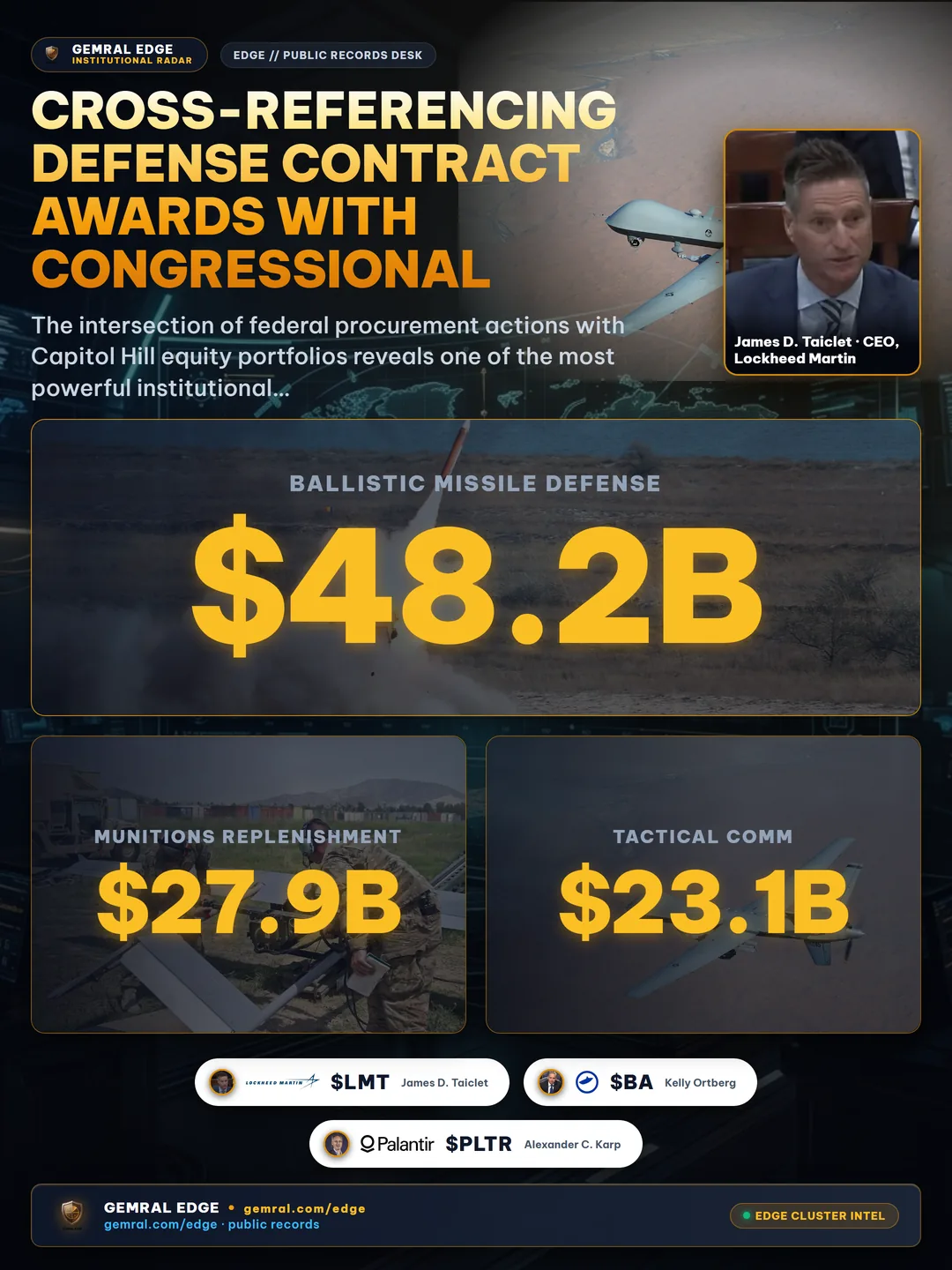
While retail commentary often fixates on isolated trades in mega-cap consumer tech equities, the data demonstrates that congressional trading volume is disproportionately concentrated in aerospace, defense electronics, enterprise cybersecurity, and specialized industrial contractors. Members assigned to key committees—specifically the House Committee on Armed Services, the Senate Committee on Armed Services, and the Subcommittees on Defense within the House and Senate Appropriations Committees—exercise direct oversight over defense authorization bills, programmatic budget line items, and secret procurement appropriations.
| Ticker | Company Name | 2026 Disclosed Buys | Congressional Filer Cohort | Key Committee Jurisdiction | FY2026 Prime Obligations |
|---|---|---|---|---|---|
| LMT | Lockheed Martin | 14 Filings | House Armed Services, Senate Appropriations | Tactical Aviation, Ballistic Missile Defense | $48.2B |
| RTX | RTX Corporation | 11 Filings | House Armed Services, House Foreign Affairs | Air Defense Systems, Munitions Replenishment | $27.9B |
| GD | General Dynamics | 9 Filings | Senate Armed Services, House Intelligence | Naval Nuclear Propulsion, Tactical Comm | $23.1B |
| BA | Boeing Company | 8 Filings | House Transportation, Senate Armed Services | Aerial Refueling Tankers, Maritime Patrol | $19.8B |
| HON | Honeywell International | 7 Filings | House Energy & Commerce, Senate Armed Services | Defense Avionics, Nuclear Weapons Facilities | $12.4B |
| PLTR | Palantir Technologies | 12 Filings | House Oversight, Senate Intelligence | Enterprise AI, Battlefield Data Fusion | $1.85B |
When multiple lawmakers across bipartisan caucuses accumulate equity in the same prime defense contractor within a concentrated 60-day calendar window—coinciding with the obligation of major multi-billion-dollar contract modifications—the transaction density exceeds standard statistical distribution thresholds. Cross-referencing our database of over 12,770 legislator historical trading profiles with definitive agency obligation feeds isolates these high-conviction clusters before they are packaged into conventional Wall Street research notes.
Institutional Procurement Radar: Tracking Real-Time Federal Contract Awards for Market Anomalies
Modern quantitative surveillance of federal contract awards requires automated ingestion pipelines capable of resolving entity hierarchies, categorizing award vehicles, and flagging anomalous obligation surges in real time. Rather than relying on lagging quarterly 10-Q filings, systematic investors build algorithmic listeners that monitor daily contract award releases directly from federal contracting commands.
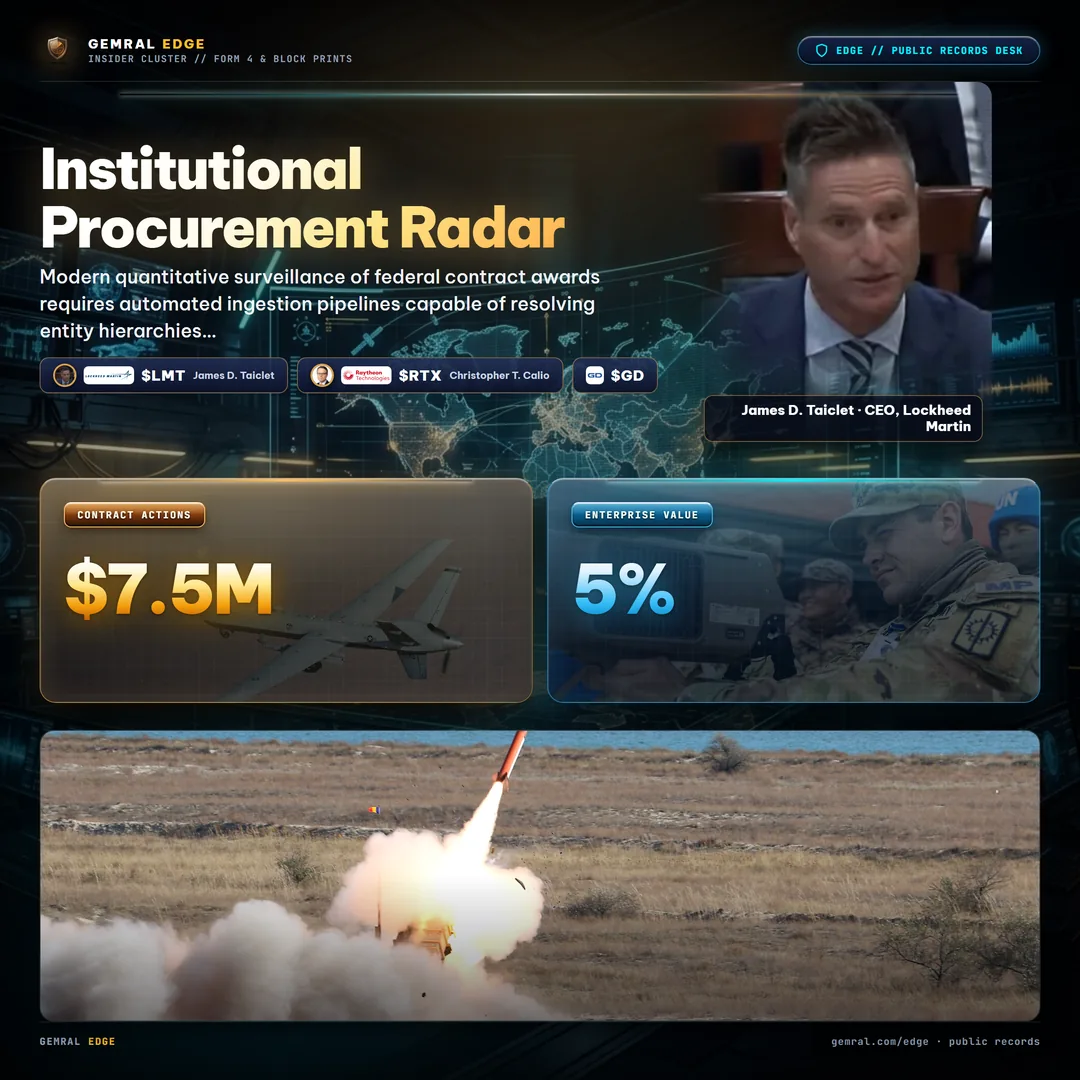
Every afternoon at 17:00 Eastern Time, the Office of the Under Secretary of Defense for Acquisition and Sustainment publishes its official daily contract digest, detailing all contract actions valued at $7.5 million or higher. These daily digests capture definitive obligations across the Army, Navy, Air Force, Defense Logistics Agency (DLA), Missile Defense Agency (MDA), and Defense Advanced Research Projects Agency (DARPA). An effective surveillance framework deploys three algorithmic layers:
1. Obligation Magnitude Normalization: Measuring transaction-level obligations as a percentage of the contractor's trailing twelve-month revenue and market capitalization, flagging actions exceeding 5% of enterprise value.
2. Entity Disambiguation Engine: Resolving obscure joint ventures, consortium task orders, and subsidiary CAGE codes back to the parent publicly traded ticker symbol.
3. Multi-Dataset Convergence Trigger: Cross-referencing prime award obligations against simultaneous corporate insider acquisitions and congressional STOCK Act Periodic Transaction Reports to detect unified institutional conviction.
By automating the ingestion, disambiguation, and cross-dataset correlation of federal contract awards, analysts strip away political rhetoric and focus entirely on verified capital commitments. In an equity landscape dominated by macro sentiment and algorithmic momentum, tracking the direct, legally binding obligations of the world's largest consumer—the United States government—provides an empirical anchor for institutional decision-making. Forensic market participants auditing cross-dataset procurement telemetry can inspect the underlying obligation stream on gemral.com/edge/s/federal-contract-awards-convergence to verify award timing against public disclosure records.
Frequently asked questions
What is the difference between a federal contract award and a ceiling?
A federal contract award represents a definitive obligation of funds that an agency is legally committed to pay upon delivery or milestone completion. In contrast, an award ceiling or contract ceiling represents the maximum potential value that an indefinite delivery vehicle (IDV) or multiple-award schedule could reach over multiple option years, without guaranteeing actual capital disbursement.
How can retail investors look up federal contract awards?
Public contract awards are accessible through official procurement feeds and federal spending disclosures. By filtering for definitive contracts, prime contractor UEI identifiers, and specific awarding agency sub-tiers (such as NAVAIR, DLA, or Air Force Materiel Command), market participants can inspect transaction-level modification history, base values, and obligated funding amounts.
How do bid protests affect federal contract award execution?
When competitors file a formal bid protest with the Government Accountability Office (GAO) or the Court of Federal Claims within statutory deadlines, the Competition in Contracting Act (CICA) generally triggers an automatic stay of contract performance. This delays revenue recognition and obligation drawdown until the protest is resolved or dismissed, often within 100 days.
Why do congressional stock disclosures correlate with federal contract awards?
Lawmakers serving on authorization and appropriations committees oversee agency budgets, defense authorization bills (NDAA), and strategic procurement priorities. When members of Congress accumulate equity positions in defense primes or enterprise IT contractors that simultaneously receive concentrated federal contract awards, the convergence provides cross-dataset visibility into multi-year program funding.