Stocks Congress Is Buying: When Three Independent Trails Converge on One Ticker
Across 393 congressional stock purchases disclosed in 2026 spanning 164 distinct tickers, only 20 public equities exhibit simultaneous activity across federal prime contract obligations and corporate executive insider disclosures. Within that 20-ticker cohort, just 5 companies—Microsoft (MSFT), International Business Machines (IBM), Salesforce (CRM), Boeing (BA), and Abbott Laboratories (ABT)—achieve triple-positive convergence, where sitting lawmakers, federal contracting officers, and corporate officers or directors are all committing capital in the same calendar year. Investors who monitor the live congressional stock trading tracker can observe how isolating single-source Capitol Hill transactions from multi-trail institutional convergence changes the analytical baseline.
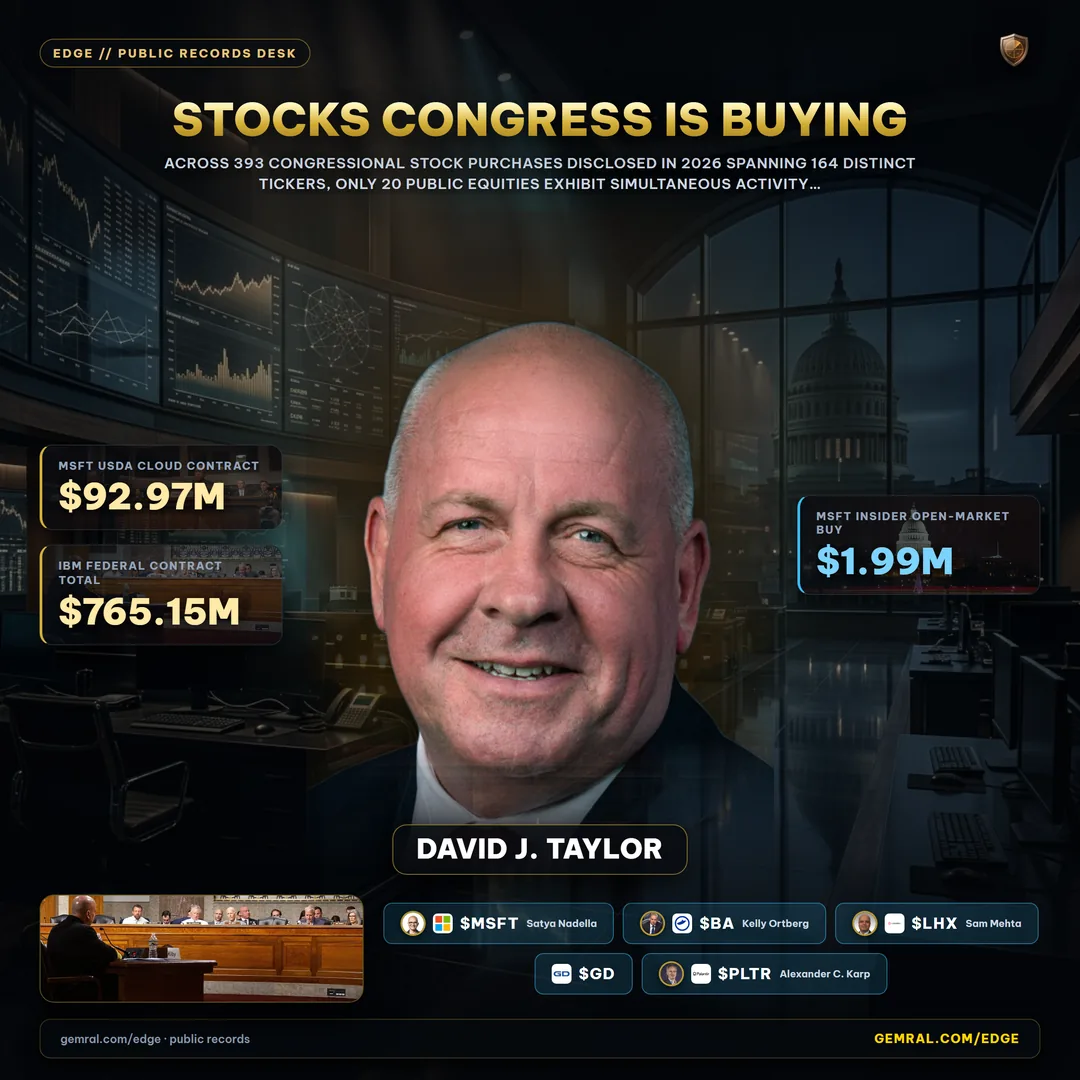
Most retail observers treat congressional stock disclosures as standalone curiosity items, scanning individual Periodic Transaction Reports (PTRs) filed with the Office of the Clerk of the U.S. House of Representatives without checking whether federal agencies are actually awarding multi-year contracts to those same issuers or whether corporate insiders are buying or liquidating their own shares. When we cross-reference 25,980 historical congressional trade records across 12,770 legislator profiles against 3,807 federal contract records (including 1,088 ticker-resolved prime awards) and 35,044 corporate insider transaction disclosures, a sharp structural filter emerges. Out of 164 tickers purchased by members of Congress in 2026, 24 overlap with active federal contract obligations, 20 overlap with both federal contracts and 2026 corporate insider filings, and 5 record open-market insider cash purchases alongside congressional accumulation.
Stocks Congress Is Buying in 2026: The 20-Ticker Multi-Trail Convergence Audit
Evaluating the stocks Congress is buying in 2026 requires separating broad portfolio rebalancing from concentrated multi-member accumulation. Across the 393 buy transactions recorded since January 2026, lawmakers distributed capital across 164 distinct equity tickers. However, the vast majority of those 164 tickers represent isolated single-filer allocations—often executed through third-party wealth management accounts in standard $1,001 to $15,000 or $15,001 to $50,000 statutory brackets—with zero corresponding activity in federal procurement ledgers or corporate executive purchase logs.
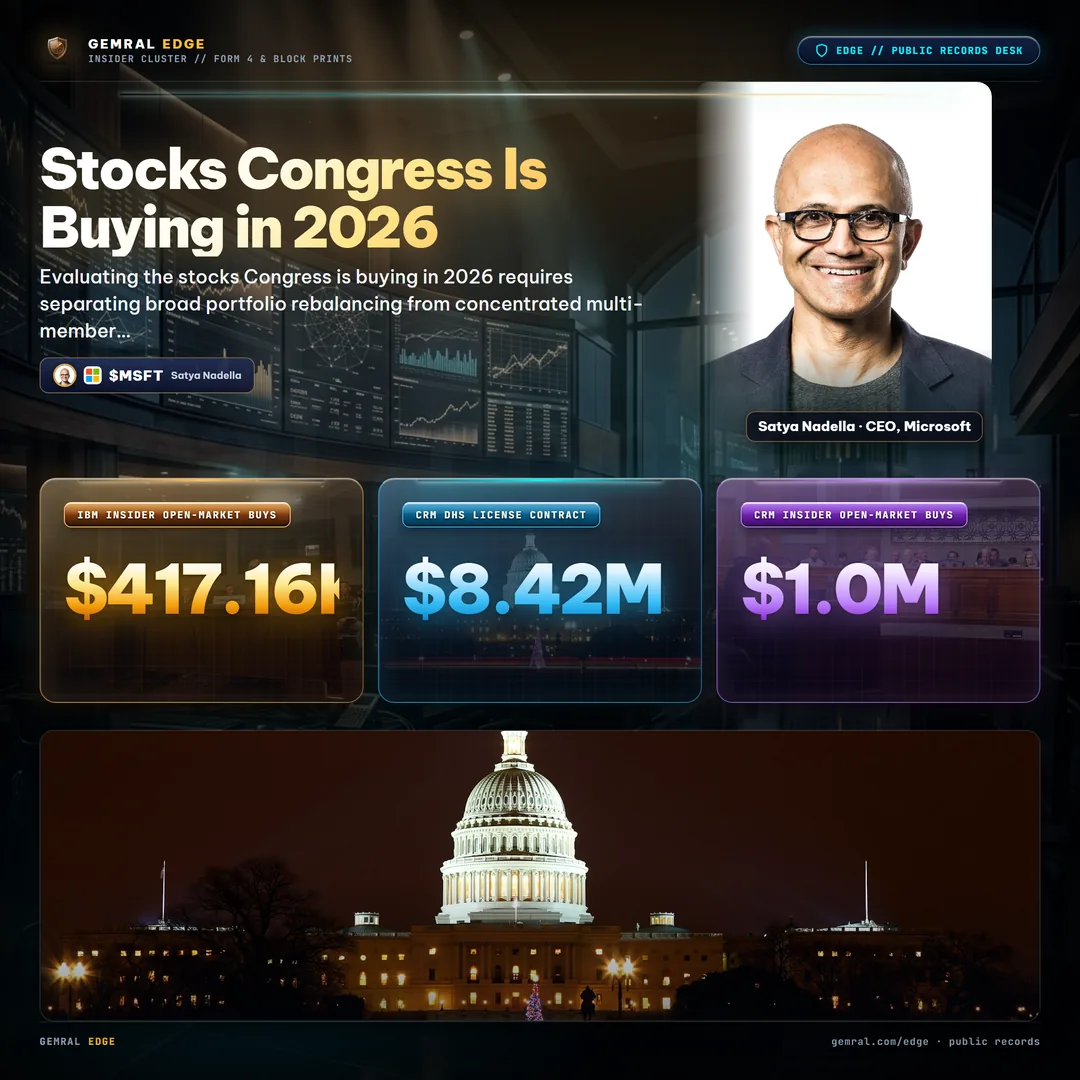
When we apply a three-trail convergence audit across the 2026 dataset, the universe narrows from 164 tickers down to 20 equities that register across all 3 independent public records: (1) 2026 congressional purchase disclosures, (2) federal prime contract obligations, and (3) 2026 corporate insider transaction filings (which total 927 filings across the 164 congressional buy tickers). Within this 20-ticker convergence group, transaction density is heavily skewed toward enterprise cloud infrastructure, aerospace and defense primes, federal health diagnostics, and specialized systems integrators.
| Ticker | 2026 Congress Buys (Lawmakers) | Disclosed Congress Buy Range | Federal Contracts (Agencies) | Total Federal Contract Obligations | 2026 Insider Filings (Open-Market Buys) |
|---|---|---|---|---|---|
| MSFT | 13 buys (7 lawmakers) | $13,013 – $195,000 | 1 contract (1 agency) | $92.97M ($92,969,660.86) | 2 filings (1 buy · $1.99M) |
| LTH | 12 buys (1 lawmaker) | $54,012 – $285,000 | 1 contract (1 agency) | $175,051 | 5 filings (0 buys) |
| IBM | 5 buys (3 lawmakers) | $33,005 – $145,000 | 13 contracts (7 agencies) | $765.15M ($765,150,135.14) | 3 filings (3 buys · $417.16K) |
| CRM | 3 buys (2 lawmakers) | $31,003 – $115,000 | 1 contract (1 agency) | $8.42M ($8,416,761.92) | 3 filings (2 buys · $1.0M) |
| AMGN | 3 buys (1 lawmaker) | $3,003 – $45,000 | 1 contract (1 agency) | $839.88M | 2 filings (0 buys) |
| GE | 3 buys (2 lawmakers) | $3,003 – $45,000 | 10 contracts (3 agencies) | $324.91M | 4 filings (0 buys) |
| EME | 3 buys (1 lawmaker) | $3,003 – $45,000 | 3 contracts (3 agencies) | $141.05M | 2 filings (0 buys) |
| BA | 2 buys (2 lawmakers) | $16,002 – $65,000 | 174 contracts (4 agencies) | $88.96B ($88,962,476,653.21) | 5 filings (1 buy · $499.97K) |
| LHX | 2 buys (2 lawmakers) | $2,002 – $30,000 | 20 contracts (6 agencies) | $9.54B ($9,543,147,809.85) | 4 filings (0 buys) |
| ACN | 2 buys (2 lawmakers) | $2,002 – $30,000 | 38 contracts (13 agencies) | $4.45B ($4,451,573,860.51) | 16 filings (0 buys) |
| ABT | 2 buys (2 lawmakers) | $2,002 – $30,000 | 5 contracts (1 agency) | $13.64M ($13,642,578.29) | 8 filings (2 buys · $3.1M) |
| GD | 1 buy (1 lawmaker) | $1,001 – $15,000 | 59 contracts (11 agencies) | $6.4B ($6,400,765,859.07) | 5 filings (0 buys) |
| PLTR | 1 buy (1 lawmaker) | $1,001 – $15,000 | 17 contracts (7 agencies) | $305.39M ($305,386,999.30) | 13 filings (0 buys) |
Notice the immediate structural distinction between single-lawmaker repetition and multi-member convergence. Life Time Group Holdings (LTH) logged 12 congressional buy transactions totaling $54,012 to $285,000 in 2026, yet all 12 purchases originated from a single lawmaker, federal contract obligations stood at just $175,051 across 1 award, and corporate insiders recorded 0 open-market purchases across 5 filings. By contrast, Microsoft (MSFT) attracted 13 buy transactions across 7 distinct lawmakers ($13,013 to $195,000), backed by a $92.97 million federal cloud obligation and a $1.99 million open-market insider purchase.
How Three Independent Public Trails Converge on a Single Equity Ticker
Why does cross-referencing 3 independent public datasets produce a fundamentally cleaner signal than reading any single disclosure feed in isolation? Because each of the 3 trails—Capitol Hill Periodic Transaction Reports, federal agency contract obligations, and corporate executive transaction filings—is governed by a different institutional actor operating under separate legal mandates and financial incentives.
- Trail 1 — Congressional Capital Allocations: Filed by sitting House and Senate members under the Stop Trading on Congressional Knowledge (STOCK) Act of 2012. These reports capture personal, spousal, joint, or dependent capital allocations exceeding $1,000, reflecting how legislators position their household balance sheets relative to macroeconomic policy, appropriations schedules, and committee oversight trends.
- Trail 2 — Federal Agency Contract Obligations: Published by executive branch procurement offices across defense and civilian departments via federal contract award trackers and official Department of Defense contract announcements. Unlike speculative market commentary, obligated contract dollars represent binding multi-year revenue streams backed by congressional appropriations.
- Trail 3 — Corporate Executive and Director Purchases: Disclosed under Securities and Exchange Commission Section 16 reporting rules and tracked on corporate insider transaction monitors. While executives sell shares routinely for tax withholding and diversification, open-market purchases (Transaction Code P) require officers or directors to deploy personal after-tax cash at prevailing market prices.
A single congressional trade can be an automated wealth-advisor rebalance. A single federal contract can already be priced into consensus revenue estimates. A single insider purchase can be an isolated contrarian bet. When all 3 trails converge on the same ticker within the same year—lawmakers accumulating shares, federal agencies obligating multi-million-dollar task orders, and corporate insiders buying stock on the open market—the probability of random coincidence drops sharply.
This multi-layered verification framework is the core architecture behind our public-record intelligence engine. Rather than relying on narrative speculation, signals are surfaced through our public brand layers—such as QUASAR POINT for multi-trail cross-signal convergence, SUNSTRIKE for rapid disclosure velocity, and DEEP FLOW for sustained institutional capital commitments—allowing researchers to audit the exact underlying filings by date, dollar bracket, and agency.
The Five Triple-Positive Stocks Where Lawmakers, Federal Agencies, and Insiders Align
Out of the 164 stocks Congress is buying in 2026, only 5 equities pass the triple-positive test: positive congressional buy disclosures, active federal prime contract obligations, and verified open-market corporate insider purchases (Transaction Code P). Below is the forensic breakdown of each of the 5 triple-positive tickers from public records.
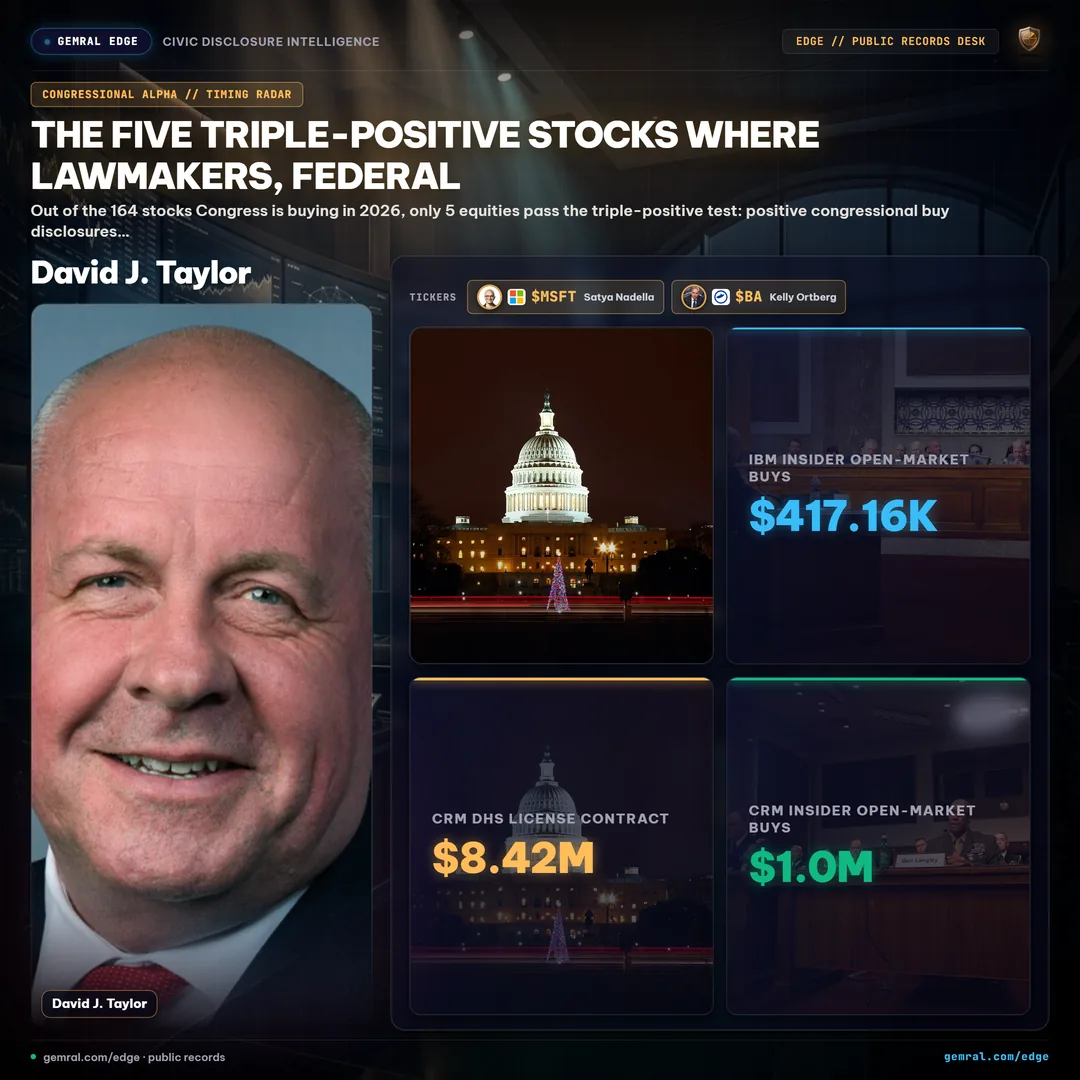
1. Microsoft Corporation (MSFT) — 13 Congress Buys · $92.97M Federal Cloud Award · $1.99M Insider Buy: Microsoft is the most widely accumulated multi-trail stock on Capitol Hill in 2026, logging 13 separate purchase disclosures across 7 lawmakers for an aggregate statutory range of $13,013 to $195,000. Buyer records include Rep. David J. Taylor (R-OH) executing 4 purchases across January, February, and July 2026; Rep. Cleo Fields (D-LA) logging 3 purchases across March, June, and September 2026; Rep. John McGuire (D-CT) reporting 2 spousal purchases in January and April 2026; Rep. Richard McCormick (R-GA / R-NY profile entries) filing 2 purchases on March 19, 2026; Rep. Michael A. Rulli (R-OH) buying on February 5, 2026; and Rep. Jared Moskowitz (D-FL) buying on June 17, 2026. On the federal procurement trail, the Department of Agriculture obligated $92,969,660.86 ($92.97 million) on September 22, 2026 for Microsoft Azure Stratus cloud infrastructure. On the corporate insider trail, a Microsoft insider executed an open-market purchase of 5,000 shares at $397.35 per share ($1,986,750 total value) on February 18, 2026.
2. International Business Machines (IBM) — 5 Congress Buys · $765.15M Across 13 Contracts · $417.16K Insider Buys: IBM demonstrates broad multi-agency federal demand alongside bipartisan congressional accumulation. Three lawmakers logged 5 buy transactions totaling $33,005 to $145,000 in 2026: Rep. Lloyd Doggett (D-TX) executed 3 consistent $1,001 to $15,000 purchases in March, June, and September 2026; Rep. David J. Taylor (R-OH) bought $15,001 to $50,000 on January 8, 2026; and Rep. Maria Elvira Salazar (R-FL) bought $15,001 to $50,000 on May 21, 2026. Simultaneously, IBM secured 13 federal contract obligations across 7 agencies totaling $765,150,135.14 ($765.15 million), led by a $310.86 million Department of Veterans Affairs enterprise sustainment award on September 15, 2026, a $151.51 million General Services Administration E-Gov Travel Service (ETSNext) contract on September 11, 2026, and a $77.4 million Social Security Administration mainframe order on September 25, 2026. Corporate insiders matched that momentum with 3 open-market purchases totaling 1,484 shares ($417,156.72): 1,000 shares at $304 per share ($304,000) on January 30, 2026, plus 434 shares at $233.33 ($101,265.22) and 50 shares at $237.83 ($11,891.50) on February 25, 2026.
3. Salesforce, Inc. (CRM) — 3 Congress Buys · $8.42M DHS License Award · $1.0M Insider Buys: Salesforce recorded 3 congressional purchases across 2 lawmakers for a combined range of $31,003 to $115,000: Rep. David J. Taylor (R-OH) purchased $1,001 to $15,000 on January 29, 2026, while Rep. Maria Elvira Salazar (R-FL) filed 2 consecutive $15,001 to $50,000 purchases on April 6, 2026 and June 2, 2026. On the federal procurement trail, the Department of Homeland Security obligated $8,416,761.92 ($8.42 million) for Salesforce enterprise licenses on September 18, 2026. On the corporate insider trail, insiders executed 2 open-market purchases totaling 5,141 shares ($1,000,439.74): 2,570 shares at $194.62 ($500,173.40) on March 18, 2026 and 2,571 shares at $194.58 ($500,266.34) on March 19, 2026.
4. The Boeing Company (BA) — 2 Congress Buys · $88.96B Across 174 Contracts · $499.97K Insider Buy: Aerospace prime Boeing logged 2 congressional buy disclosures from 2 lawmakers totaling $16,002 to $65,000: Rep. Julia Letlow (R-LA) bought $1,001 to $15,000 on February 2, 2026, and Rep. Maria Elvira Salazar (R-FL) bought $15,001 to $50,000 on March 19, 2026. Across the federal procurement ledger, Boeing holds 174 contract records across 4 agencies totaling $88,962,476,653.21 ($88.96 billion), anchored by a $22.65 billion National Aeronautics and Space Administration International Space Station obligation on August 17, 2026, a $13.4 billion Department of Defense award on September 11, 2026, and a $10.52 billion NASA Space Launch System hardware obligation on August 25, 2026. On March 3, 2026—just 16 days before Rep. Salazar's purchase—a Boeing insider purchased 2,230 shares on the open market at $224.20 per share ($499,966 total value).
5. Abbott Laboratories (ABT) — 2 Congress Buys · $13.64M VA Diagnostics Awards · $3.1M Insider Buys: Abbott Laboratories recorded 2 congressional buy disclosures on June 12, 2026 ($2,002 to $30,000 range) alongside 5 Department of Veterans Affairs diagnostic procurement obligations totaling $13,642,578.29 ($13.64 million), including a $4.72 million chemistry analyzer award and a $3.12 million point-of-care system order on October 1, 2026. Crucially, Abbott leads all 5 triple-positive equities in open-market insider buying dollar volume, with 2 open-market purchases totaling 28,800 shares ($3,101,367.27): 18,800 shares at $107.13 per share ($2,014,044) on January 23, 2026 and 10,000 shares at $108.73 per share ($1,087,323.27) on February 4, 2026.
Defense and Enterprise IT Primes: Comparing Capitol Hill Buys Against Corporate Insider Activity
What happens when the first two trails—congressional stock buying and multi-billion-dollar federal contract obligations—flash green, but the third trail (open-market corporate insider buying) stays completely flat? A comparative audit of the remaining convergence equities reveals a striking divergence across major defense contractors and federal IT systems integrators.
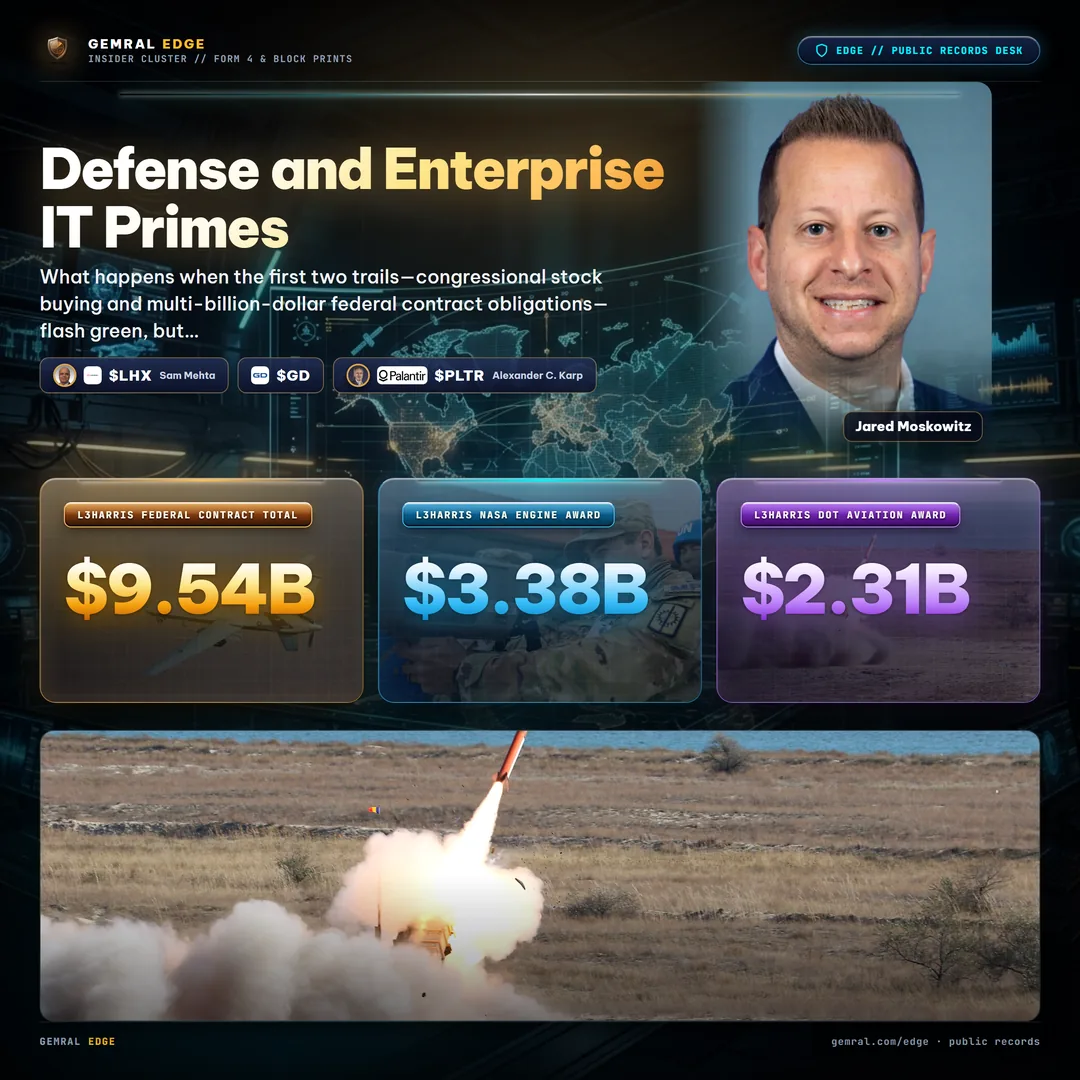
Consider the defense and enterprise IT leaders where lawmakers disclosed 2026 stock purchases and federal agencies obligated hundreds of millions or billions of dollars in prime contracts, yet corporate executives recorded 0 open-market stock purchases in 2026:
- L3Harris Technologies (LHX): 2 congressional buy records ($2,002 to $30,000) and 20 federal contracts across 6 agencies totaling $9,543,147,809.85 ($9.54 billion)—including a $3.38 billion NASA RS-25 engine production restart obligation on September 15, 2026 and a $2.31 billion Department of Transportation award on August 14, 2026—paired with 4 corporate insider filings containing 0 open-market purchases.
- General Dynamics Corporation (GD): 1 congressional buy disclosure by Rep. Jared Moskowitz (D-FL, $1,001 to $15,000 dependent account purchase on March 23, 2026) and 59 federal contracts across 11 agencies totaling $6,400,765,859.07 ($6.4 billion), led by a $1.75 billion Department of State global security engineering obligation on August 28, 2026 and an $841.79 million General Services Administration C5ISR task order on August 24, 2026—paired with 5 insider filings and 0 open-market buys.
- Accenture plc (ACN): 2 congressional spousal buy disclosures from Rep. Dan Newhouse (R-WA, July 10, 2026) and Rep. Scott Franklin (R-FL, August 26, 2026) totaling $2,002 to $30,000, backed by 38 federal contracts across 13 agencies totaling $4,451,573,860.51 ($4.45 billion, including a $942.27 million Department of Education digital modernization task order on August 27, 2026)—paired with 16 corporate insider filings and 0 open-market buys.
- Palantir Technologies (PLTR): 1 congressional buy disclosure by Rep. Michael A. Rulli (R-OH, $1,001 to $15,000 on January 9, 2026) and 17 federal contracts across 7 agencies in the ticker-resolved dataset totaling $305,386,999.30 ($305.39 million), including a $73.64 million Department of Veterans Affairs analytics platform award on October 1, 2026 and a $23.21 million Department of State analytics contract on August 31, 2026—paired with 13 insider filings and 0 open-market buys.
This divergence aligns with our broader analysis of AI companies with government contracts and Pentagon procurement awards as well as our weekly audit of insider buying this week across public filings. In high-momentum defense and enterprise software contractors, executive compensation is heavily structured around performance stock units and scheduled option exercises. Consequently, corporate insiders rarely deploy personal cash on the open market when shares trade near multi-year valuation multiples, even as federal procurement backlogs expand and members of Congress add exposure.
Statutory Reporting Windows: Why Congressional, Executive, and Federal Award Lags Create Asymmetry
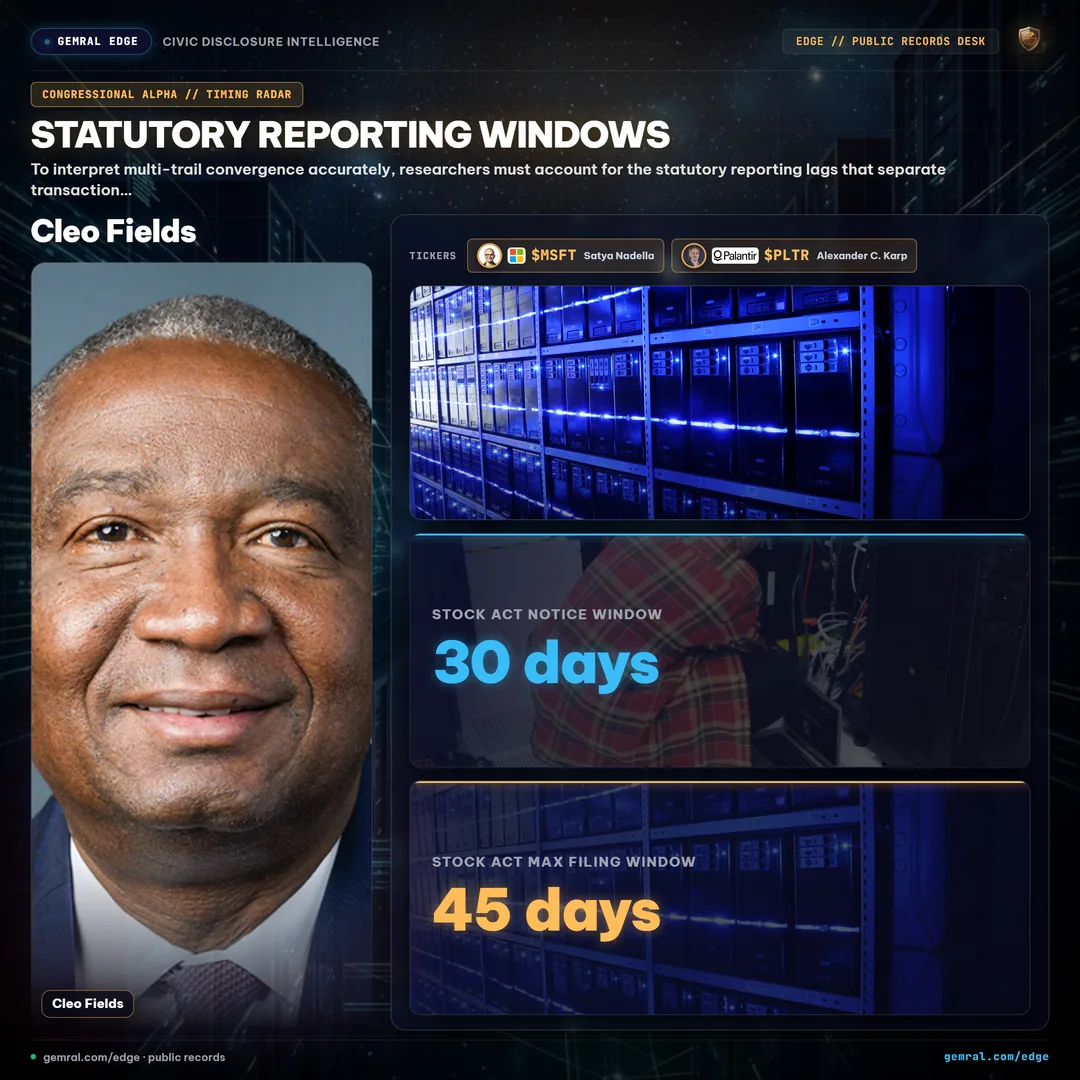
To interpret multi-trail convergence accurately, researchers must account for the statutory reporting lags that separate transaction execution from public visibility across each of the 3 disclosure regimes. When an investor sees a congressional trade, a federal contract announcement, and a corporate insider purchase in the same week, those 3 events rarely occurred on the same day.
| Disclosure Trail | Governing Mandate | Statutory Reporting Window | Disclosure Granularity |
|---|---|---|---|
| Congressional Stock Trades | STOCK Act of 2012 | 30 days from notice · 45 days max from trade | Broad dollar brackets ($1,001–$15,000; $15,001–$50,000) |
| Corporate Insider Filings | SEC Section 16 Rules | 2 business days after transaction execution | Exact share count, exact execution price, and total dollar value |
| Federal Contract Obligations | Federal Procurement Reporting | Daily threshold announcements to multi-week ledger updates | Exact obligated dollar amount, awarding agency, and contract ID |
The 45-day maximum reporting window under the STOCK Act introduces wide dispersion in congressional filing velocity. In our 2026 convergence dataset, Rep. Cleo Fields (D-LA) disclosed his September 10, 2026 Microsoft purchase on the exact same day (September 10, 2026), whereas Rep. Michael A. Rulli (R-OH) executed purchases of Palantir Technologies on January 9, 2026 and Microsoft on February 5, 2026 that were disclosed months later on August 7, 2026. Similarly, as documented in our review of senator stock trades and monthly disclosure patterns, comparing the transaction date (`tx_date`) rather than the publication date (`disclosure_date`) is essential when aligning Capitol Hill buys against 2-business-day corporate insider purchases and federal contract action dates.
How to Track Stocks Congress Is Buying Live Across Public Disclosures
Building a repeatable research workflow around the stocks Congress is buying requires moving beyond headline alerts and applying a structured 3-step verification protocol to every new Periodic Transaction Report:
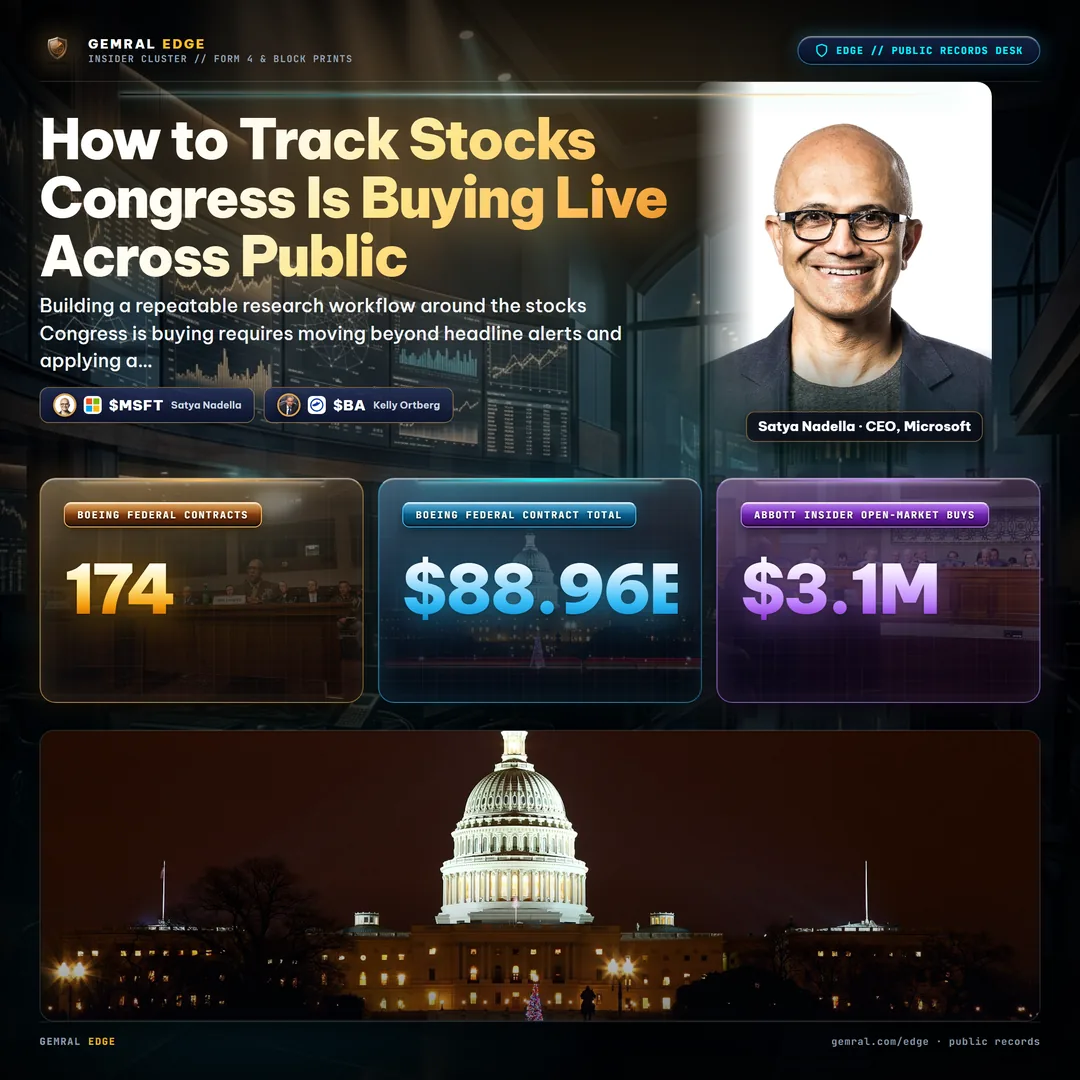
- Filter for Multi-Member or Multi-Batch Accumulation: Check whether a ticker is being accumulated by multiple independent lawmakers across parties and chambers—such as the 7 House members buying Microsoft (MSFT) across 13 transactions or the 3 lawmakers buying IBM across 5 transactions—rather than a single legislator's automated account rebalancing.
- Cross-Check Federal Agency Obligation Velocity: Verify whether the issuer is actively receiving prime contract obligations across defense or civilian agencies. Multi-agency revenue commitments—such as IBM's 13 contracts across 7 agencies ($765.15 million) or Boeing's 174 contracts across 4 agencies ($88.96 billion)—provide fundamental cash-flow insulation that purely narrative equities lack.
- Confirm Open-Market Insider Skin in the Game: Inspect corporate insider filings for Transaction Code P (open-market purchases) executed within the 2-business-day reporting window. When corporate insiders commit $3.1 million in Abbott Laboratories (ABT), $1.99 million in Microsoft (MSFT), or $1.0 million in Salesforce (CRM) while lawmakers and federal procurement officers are active on the same ticker, all 3 public trails confirm institutional conviction.
Researchers can audit all 393 congressional buy disclosures, inspect legislator profiles on the congressional trading hub, and cross-reference active contract and insider convergence in real time via Gemral Edge Congressional Intelligence.
Disclaimer: Public data · not investment advice. All congressional transaction records, federal contract obligations, and corporate insider filings cited in this analysis are compiled strictly from official public disclosures for informational and educational research only.
Frequently asked questions
What stocks is Congress buying the most in 2026?
Among multi-trail equities in 2026 public Periodic Transaction Reports, Microsoft (MSFT) leads with 13 buy disclosures across 7 House members ($13,013 to $195,000), followed by Life Time Group Holdings (LTH) with 12 purchases ($54,012 to $285,000), IBM with 5 purchases across 3 lawmakers ($33,005 to $145,000), and Salesforce (CRM), Amgen (AMGN), GE Aerospace (GE), and EMCOR Group (EME) with 3 purchases each.
Which stocks Congress is buying also have open-market insider buying and federal contracts?
Only 5 out of the 164 tickers bought by Congress in 2026 show simultaneous federal contract obligations and open-market corporate insider purchases (Transaction Code P): Microsoft (MSFT), International Business Machines (IBM), Salesforce (CRM), Boeing (BA), and Abbott Laboratories (ABT).
How long do members of Congress have to disclose stock purchases under the STOCK Act?
Under the Stop Trading on Congressional Knowledge (STOCK) Act of 2012, House and Senate members must file a Periodic Transaction Report (PTR) within 30 days of receiving notification of a transaction over $1,000, and no later than 45 days after the actual transaction date.
Why do defense and IT contractors bought by Congress often show zero open-market insider buys?
In major federal contractors like L3Harris Technologies (LHX, $9.54 billion across 20 contracts), General Dynamics (GD, $6.40 billion across 59 contracts), Accenture (ACN, $4.45 billion across 38 contracts), and Palantir Technologies (PLTR, $305.39 million across 17 contracts), executive equity compensation is heavily weighted toward scheduled restricted stock units and option exercises, resulting in corporate insider disclosures with zero open-market cash purchases.