Standing Repo Facility: Fed Liquidity Backstop, Collateral Stress, and Money Market Mechanics
The architecture of United States dollar money markets has undergone a profound structural transformation over the past five years. Following severe funding disruptions in September 2019 and March 2020, the Federal Reserve established the standing repo facility (SRF) as a permanent operational backstop designed to put an administrative ceiling on short-term interest rates. In this institutional research report, we audit the operational mechanics of the facility, evaluate the quantitative thresholds governing market activation, examine collateral friction during Treasury auction settlement and corporate tax dates, and analyze how sovereign liquidity transmission shapes broad capital allocation.
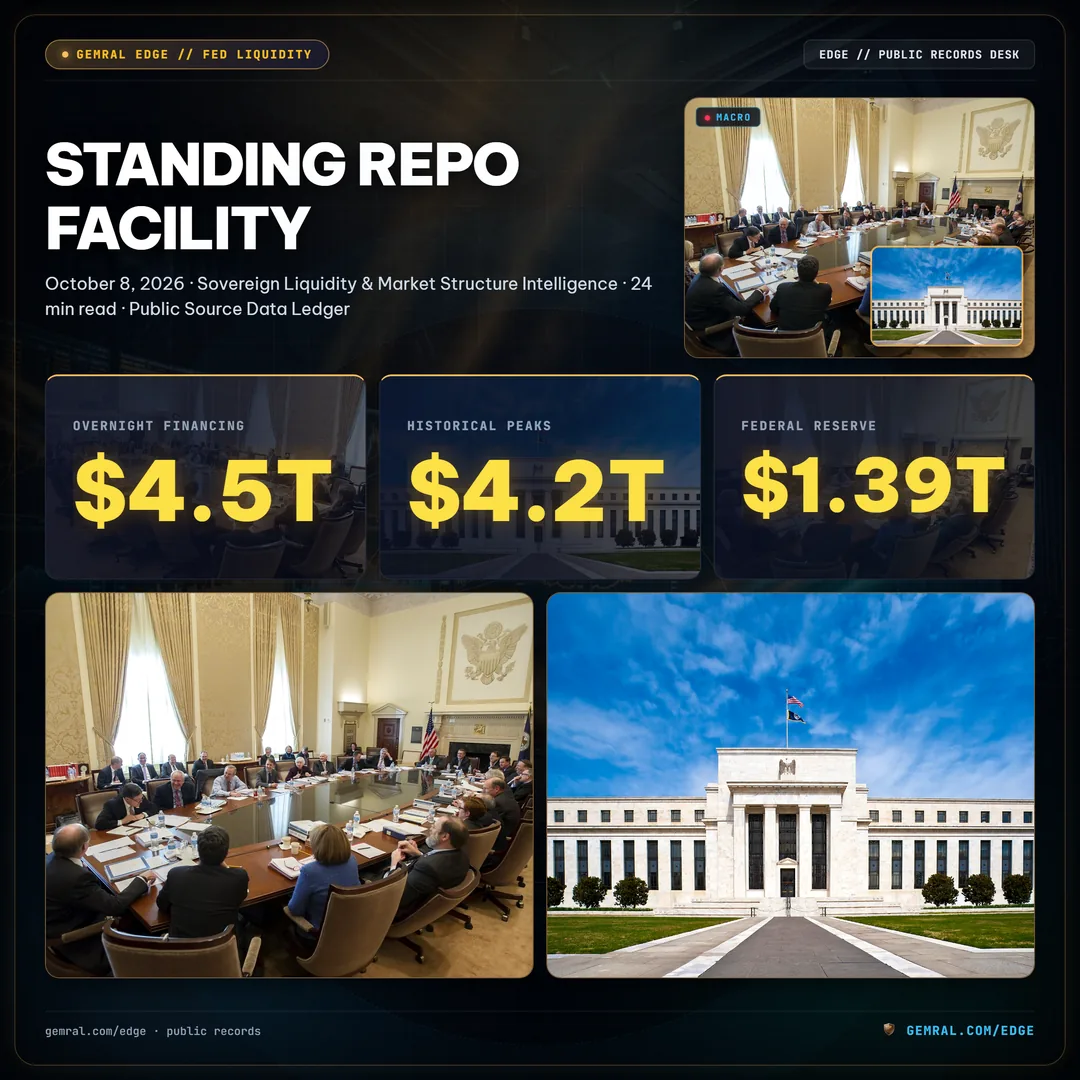
Short-term collateralized lending markets, commonly designated as the repurchase agreement (repo) complex, intermediate more than $4.5 trillion in daily overnight financing across United States sovereign securities, agency debt, and agency mortgage-backed securities. When structural liquidity is abundant, these transactions execute smoothly within the Federal Reserve's target range. However, as quantitative tightening gradually contracts aggregate commercial bank reserves from historical peaks near $4.2 trillion toward the estimated non-linear minimum operating threshold of $3.1 trillion, settlement friction increases dramatically. Understanding the mechanics of the standing repo facility is indispensable for evaluating institutional counterparty solvency, collateral velocity, and cross-asset funding stress.
Standing Repo Facility Liquidity Backstop: Federal Reserve Architecture and Operations
The standing repo facility serves as an institutional safety valve established by the Federal Open Market Committee (FOMC) in July 2021. Under standard operating protocols, eligible market participants can deliver high-quality sovereign collateral to the Open Market Trading Desk at the Federal Reserve Bank of New York in exchange for overnight cash deposits. The transaction takes the legal form of a true purchase and sale agreement, paired with a simultaneous contractual commitment to repurchase the identical securities the following business day at an agreed-upon forward price reflecting the official facility bid rate.
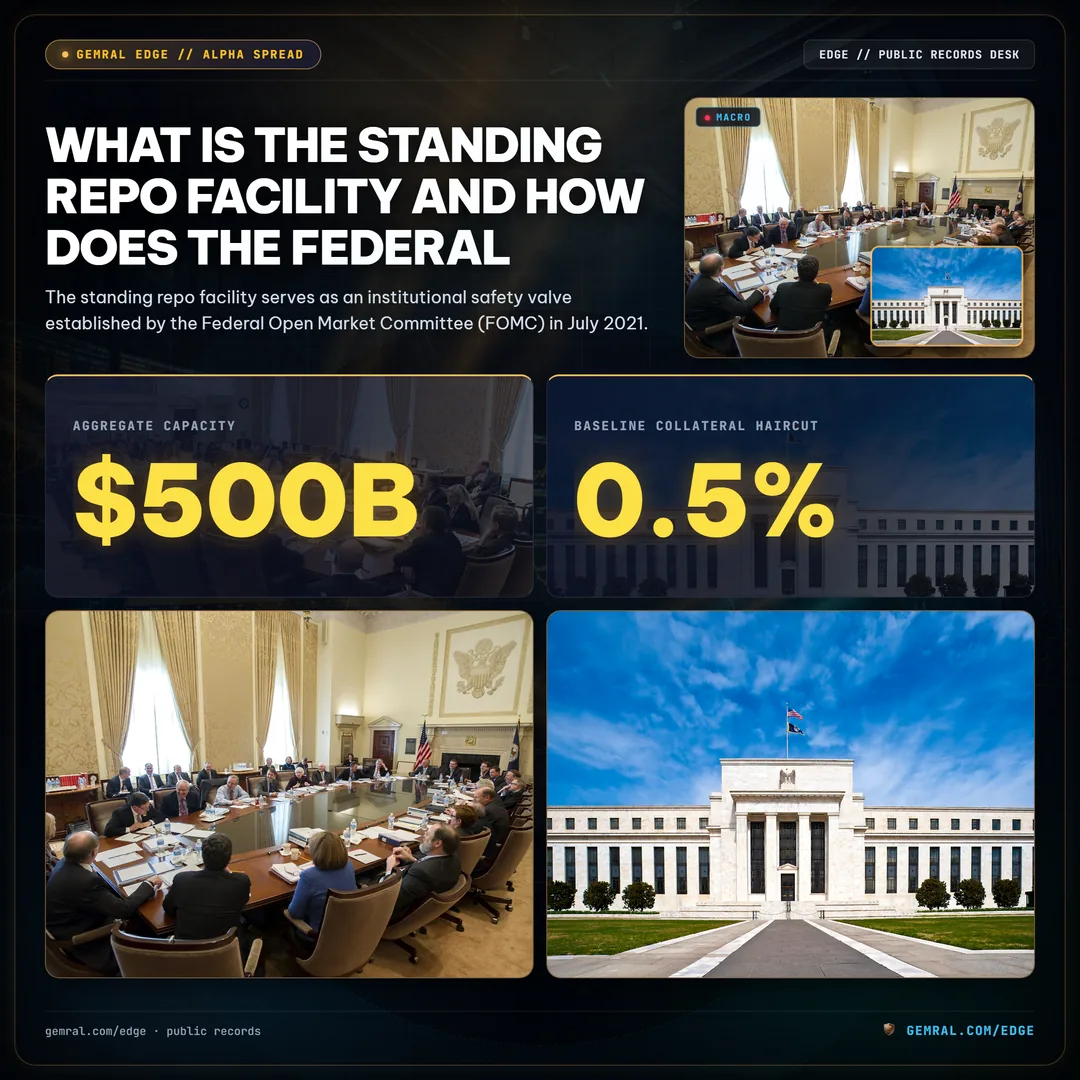
The operational framework of the facility is defined by several explicit structural constraints designed to prevent private-market substitution under normal economic conditions while ensuring unlimited availability during liquidity freezes. The central bank establishes an aggregate daily capacity of $500B, applies a baseline collateral haircut of 0.5% against on-the-run Treasury collateral, and operates an operational execution window of 15 minutes each business morning:
- Collateral Eligibility: The facility accepts exclusively United States Treasury bills, notes, bonds, TIPS, Agency debentures, and Agency mortgage-backed securities (MBS) held in the System Open Market Account (SOMA) eligible pool. Corporate bonds, municipal paper, and asset-backed securities are strictly ineligible.
- Aggregate Capacity Limit: The Federal Reserve maintains an aggregate daily operation limit of $500 billion, with the explicit administrative authority for the Desk to expand capacity should systemic financial stress warrant emergency intervention.
- Individual Counterparty Limits: Individual primary dealers and participating depository institutions are subject to maximum individual allocation limits, preventing single-institution monopolization of central bank liquidity during operational settlement windows.
- Operational Schedule: The Desk conducts daily morning operations between 8:15 AM and 8:30 AM Eastern Time, directly coinciding with the peak volume window for interdealer clearing and sovereign collateral settlement.
Unlike discretionary overnight repo operations utilized during prior historical monetary regimes, the standing repo facility functions as a standing, continuous backstop. Counterparties know with mathematical certainty that if cash rates in private interdealer markets spike above the facility's minimum offering rate, immediate liquidity is available against prime sovereign collateral without regulatory delay.
Structural Origins: The September 2019 Money Market Shock and the Genesis of the SRF
To comprehend why the Federal Reserve implemented the standing repo facility, institutional analysts must dissect the catastrophic liquidity breakdown of September 16-17, 2019. During that 48-hour window, the Secured Overnight Financing Rate (SOFR) experienced an unprecedented intraday dislocation, rocketing from 2.42% to an astonishing peak of 5.25%, with bilateral repo trades printing as high as 10.00%. The effective federal funds rate (EFFR) breached the statutory upper bound of its target band by 5 basis points, signaling an alarming failure of central bank monetary transmission.

The 2019 repo shock was not generated by corporate credit insolvency or banking counterparty panic. Instead, it was caused by the unfortunate synchronization of two large-scale structural cash drains totaling billion acting upon an artificially depleted reserve foundation:
Because no standing repo facility existed at the time, primary dealers holding vast inventories of Treasury paper were legally unable to convert those sovereign assets into overnight central bank reserves without paying extreme distress premiums. Commercial banks possessing surplus reserves chose not to lend their cash into the repo market due to internal liquidity stress metrics, Basel III intraday liquidity ratios, and regulatory risk aversion.
| Money Market Metric | September 13, 2019 | September 17, 2019 | Dislocation Magnitude | Current Structural Guardrail |
|---|---|---|---|---|
| SOFR Benchmark Rate | 2.14% | 5.25% | +311 bps Spurt | Capped by SRF Minimum Bid Rate |
| Bilateral Treasury Repo High | 2.25% | 10.00% | +775 bps Spike | Arbitraged via Standing Repo Window |
| Effective Fed Funds Rate (EFFR) | 2.14% | 2.30% | Breached Target (+5 bps) | Target Corridor Intact via IORB/SRF |
| Commercial Bank Total Reserves | $1,440B | $1,385B | -$55B Acute Drain | Monitored above $3,100B Reserve Floor |
| Treasury Cash Balance (TGA) | $184B | $270B | +$86B Sterilization | Integrated into Daily Desk Projections |
The institutional trauma of the September 2019 episode convinced central bank authorities that a corridor system relying purely on administered rates—namely Interest on Reserve Balances (IORB) for the floor and the Discount Window for emergency ceiling defense—was structurally defective in modern capital markets dominated by primary dealer balance sheet constraints.
Counterparty Eligibility and Operational Parameters: Primary Dealers vs Depository Institutions
A central design feature distinguishing the standing repo facility from conventional discount window lending is its expanded counterparty network. Historically, the Federal Reserve maintained an artificial institutional wall: the Discount Window served depository commercial banks, while open market operations interfaced exclusively with designated primary dealers.

In modern high-frequency funding markets, however, sovereign securities are concentrated heavily within broker-dealer balance sheets that have no direct access to central bank reserves. Recognizing this vulnerability, the Federal Reserve structured the SRF with an explicit two-tiered counterparty architecture spanning an approved roster of 24 primary dealers and an expanding network of 85 depository institutions representing aggregate balance sheet assets of $14.5T and dedicated capital reserves of $280B:
- Designated Primary Dealers: All 24 primary dealers approved by the Federal Reserve Bank of New York are mandatory eligible counterparties. These institutions include global systemically important banks (G-SIBs) such as JPMorgan Chase, Goldman Sachs, Morgan Stanley, Citigroup, and Bank of America, as well as foreign broker-dealers operating in New York. Primary dealers are expected to participate in regular operational tests of the facility.
- Eligible Depository Institutions: In 2021, the Board of Governors expanded counterparty eligibility to domestic commercial banks and foreign banking organizations holding master accounts at Federal Reserve Banks. To qualify, institutions must maintain active Tri-Party Repo relationships and possess sufficient eligible sovereign collateral under the SOMA custody network.
This counterparty synthesis ensures that liquidity shortages originating in the non-bank broker-dealer sector can be addressed immediately without requiring convoluted interbank loans or strained private repo intermediation. By providing non-bank primary dealers with direct access to central bank cash against Treasuries, the Federal Reserve dismantled the primary transmission failure that triggered the 2019 crisis.
The Spread Mechanics: SOFR, IORB, and the Pricing Rate of the Standing Repo Facility
The price discovery mechanism of the standing repo facility is determined by a strict spread formula tied directly to the Federal Reserve's target corridor. Rather than conducting competitive auction pricing, the Open Market Desk offers overnight repo financing at an administered fixed rate known as the Minimum Bid Rate.
To preserve private-market incentives, the SRF minimum bid rate is deliberately priced above prevailing market yields. Specifically, the FOMC sets the SRF rate equal to the top of the target range for the federal funds rate. Concurrently, the central bank maintains Interest on Reserve Balances (IORB) near the middle or lower tier of the target band, while the Overnight Reverse Repo (ON RRP) offering rate anchors the absolute floor:
• SRF Minimum Bid Rate: Top of Federal Funds Target Range (e.g., 5.50%)
• Interest on Reserve Balances (IORB): Mid-Band Administrative Target (e.g., 5.40%)
• Effective Federal Funds Rate (EFFR): Market Equilibrium (e.g., 5.33%)
• Secured Overnight Financing Rate (SOFR): Market Repo Rate (e.g., 5.31% - 5.38%)
• Overnight Reverse Repo (ON RRP) Rate: Absolute Floor (e.g., 5.30%)
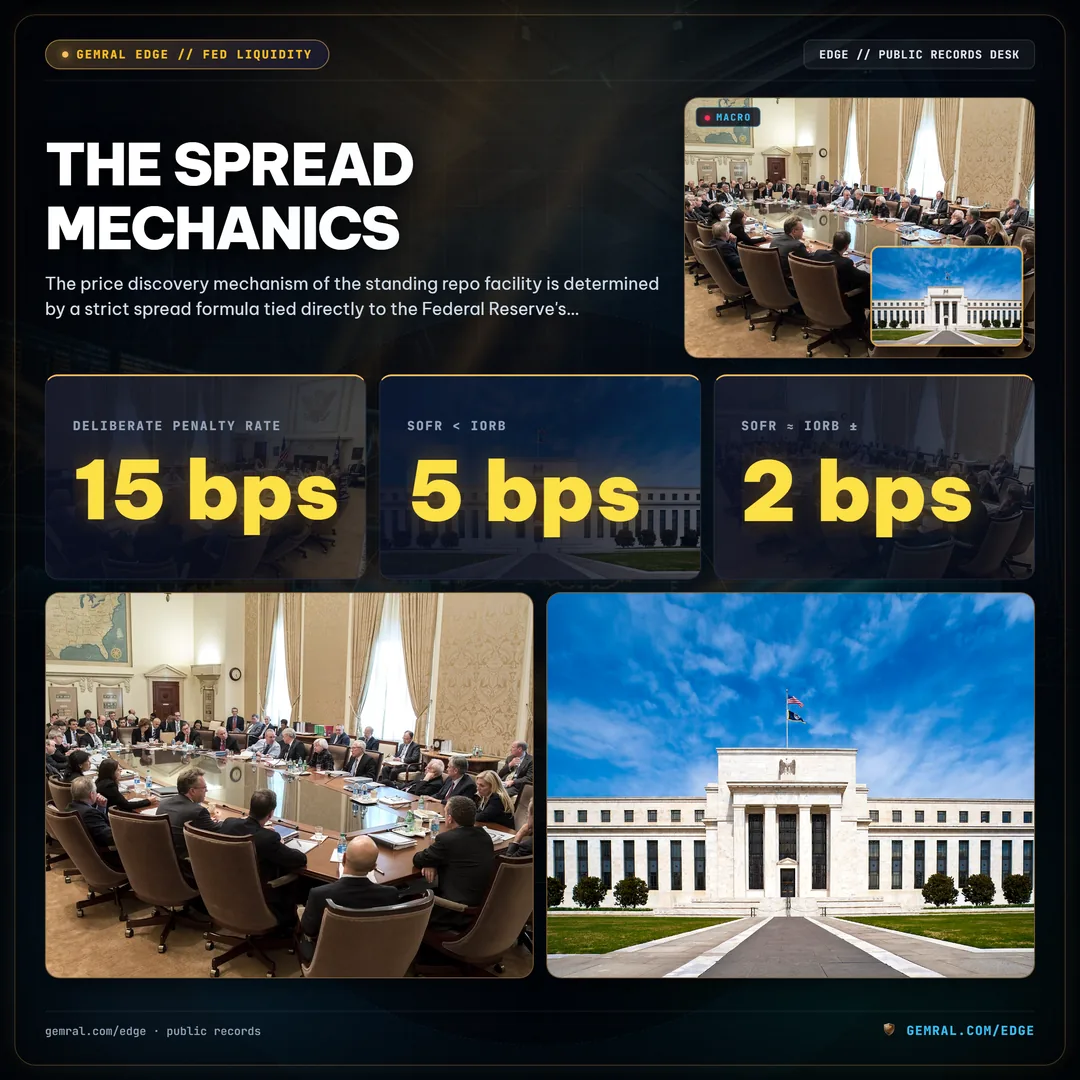
Under this corridor construct, borrowing from the standing repo facility carries a deliberate penalty rate of 10 to 15 basis points relative to normal private-market repo transactions. Consequently, primary dealers and depository institutions will only access the SRF when private market funding rates dislocate upward. When SOFR trades below IORB, facility volume remains at zero. However, when cash scarcity pushes tri-party or GCF repo rates up toward the top of the corridor, the SRF activates automatically, absorbing collateral and capping further yield expansion.
| Operational Regime | SOFR vs IORB Spread | Primary Repo Source | Standing Repo Facility Status | Central Bank Net Balance Impact |
|---|---|---|---|---|
| Structural Cash Surplus | SOFR < IORB - 5 bps | Overnight Reverse Repo (RRP) | Dormant (0 Usage) | Cash Absorbed into Fed Liabilities |
| Balanced Settlement | SOFR ≈ IORB ± 2 bps | Private Interdealer Repo | Routine Test Bids Only | Neutral Reserve Equilibrium |
| Auction Settlement Stress | SOFR > IORB + 5 bps | FICC Sponsored Repo | Threshold Watch | Dealer Balance Sheets Constrained |
| Acute Collateral Dislocation | SOFR ≥ SRF Rate | Standing Repo Facility | Active Liquidity Injection | Reserves Injected into Commercial Banks |
Settlement Bottlenecks: Quarterly Corporate Tax Dates, Treasury Auctions, and Collateral Friction
While the standing repo facility provides an absolute theoretical rate ceiling, private funding markets experience severe friction before market-wide activation occurs. This friction is highly seasonal and predictable, clustering around specific institutional settlement dates on the financial calendar.

The primary source of structural settlement pressure originates from the Department of the Treasury's debt issuance schedule. In fiscal year 2026, the United States federal government will issue more than $21 trillion in gross marketable debt across Treasury bills, floating rate notes, and nominal fixed-rate coupon obligations. When large multi-tranche auctions settle simultaneously on the 15th or final calendar day of a month, primary dealers must deliver substantial cash sums of cash to the Treasury General Account (TGA) while absorbing hundreds of billions of dollars in new paper into their trading books.
Compounding this debt issuance schedule are corporate quarterly estimated tax filing dates, specifically March 15, June 15, September 15, and December 15. On these operational days, corporations across the United States wire tax revenues out of private depository institutions into the TGA account at the Federal Reserve. Over a 72-hour period, corporate tax remittances routinely drain between $60 billion and $120 billion in cash reserves out of the banking sector.
- The Collateral Velocity Squeeze: On major settlement dates, cash balances in the private repo market shrink just as the supply of Treasury collateral seeking financing reaches a local peak. This supply-demand mismatch pushes GC repo rates upward.
- FICC Netting Limitations: Although the Fixed Income Clearing Corporation (FICC) provides multilateral netting services, bilateral non-centrally cleared repo transactions do not net out, forcing primary dealers to consume precious balance sheet capacity under capital regulation.
- The Intraday Settlement Void: Cash flows from Treasury coupon redemptions frequently settle later in the day than outgoing auction debits, creating acute multi-hour liquidity gaps where cash rates spike before evening reconciliation.
During these intervals, market participants closely monitor the standing repo facility. If private repo rates trade above 5.45% while the SRF offers cash at 5.50%, broker-dealers face widening basis spreads that directly impair market-making efficiency across secondary Treasury markets and interest rate derivatives.
Central Clearing Reforms: The DTCC FICC Treasury Repo Mandate and Cash Reallocation
The institutional operational landscape of the standing repo facility is currently colliding with the most sweeping regulatory overhaul in the history of the United States sovereign debt market: the Securities and Exchange Commission (SEC) mandatory clearing rule for Treasury cash and repo transactions.
Finalized under Exchange Act Rule 17Ad-22(e)(18)(iv), this mandate requires covered clearing agencies—principally the Fixed Income Clearing Corporation (FICC), a subsidiary of the Depository Trust & Clearing Corporation (DTCC)—to ensure that all direct participants submit all eligible secondary market Treasury transactions and repurchase agreements for central clearing. The implementation timeline dictates complete compliance across all market segments by 2026.
This structural migration carries profound implications for money market liquidity and SRF utilization:
- Expansion of Sponsored Repo Programs: Under FICC sponsored clearing models, qualified institutional buyers (including money market funds, hedge funds, sovereign wealth funds, and private pension systems) can clear repo transactions directly through FICC via sponsoring broker-dealers. This structure allows multilateral netting across diverse counterparties, reducing aggregate balance sheet consumption by an estimated 35% to 45%.
- Disintermediation of Traditional Dealer Desks: By allowing non-bank cash providers like money market funds to transact directly with non-bank collateral providers like hedge funds through sponsored member accounts, cash flows bypass traditional bank holding company balance sheets entirely.
- Centralized Default Management: In the event of an institutional counterparty failure, collateral liquidation is managed centrally by FICC rather than triggering chaotic bilateral fire sales across interdealer desks.
However, central clearing is not an absolute panacea for systemic cash scarcity. If an aggregate dollar deficit emerges—where total private cash balances seeking repo investment are insufficient to absorb the stock of sovereign debt offered across the market—FICC netting cannot conjure liquidity out of thin air. In such an event, the standing repo facility remains the ultimate external backstop capable of injecting unsterilized central bank reserves into the cleared network.
| Market Dimension | Bilateral Non-Cleared Repo Market | FICC Centrally Cleared Treasury Repo | Impact on SRF Interaction |
|---|---|---|---|
| Balance Sheet Treatment | Gross Balance Sheet Consumption | Multilateral Netting (35-45% Reduction) | Reduces Dealer Capital Bottlenecks |
| Counterparty Risk | Bilateral Credit Exposure | FICC Novation and Guarantee | Eliminates Private Stigma Distortions |
| Margin Requirements | Discretionary Variation Margin | Standardized Initial & Variation Margin | Increases Intraday Cash Clearing Demands |
| Access Topology | Fragmented Tiered Relationships | Sponsored Member Network | Accelerates Cross-System Rate Transmission |
Institutional Capital Constraints: Standing Repo Facility vs the Federal Reserve Discount Window
A critical question frequently raised by institutional portfolio managers is why commercial banks and primary dealers would utilize the standing repo facility rather than borrowing from the Federal Reserve's long-established Discount Window (Primary Credit facility). Both facilities provide central bank credit, yet their economic, legal, and regulatory characteristics are fundamentally divergent.
The primary barrier impairing the operational utility of the Discount Window is the persistent phenomenon of regulatory and market stigma. Since the Great Financial Crisis of 2008, accessing the Discount Window has been interpreted across public markets and supervisory agencies as an implicit indicator of severe institutional insolvency. Commercial banks fear that if their borrowing from the Discount Window is disclosed in quarterly financial statements or leaked to financial media, depositors will execute panic withdrawals and counterparties will slash credit lines.
The standing repo facility was explicitly engineered to dismantle this stigma barrier through four institutional design choices:
1. Legal Transaction Classification: An SRF operation is legally structured as a bilateral repo transaction (a sale and repurchase of marketable securities), not as an emergency collateralized bank loan or discount advance.
2. Regulatory Endorsement: The Federal Reserve and OCC have explicitly issued supervisory guidance confirming that accessing the SRF represents routine, proactive liquidity management rather than an indicator of distress.
3. Standardized Public Reporting: Transaction data for the SRF is published on an aggregated, anonymous basis, with individual counterparty disclosures deferred for two years under statutory open market guidelines.
4. Open Interdealer Co-Location: Primary dealers execute SRF bids through standard tri-party electronic matching systems alongside their normal commercial funding desks.
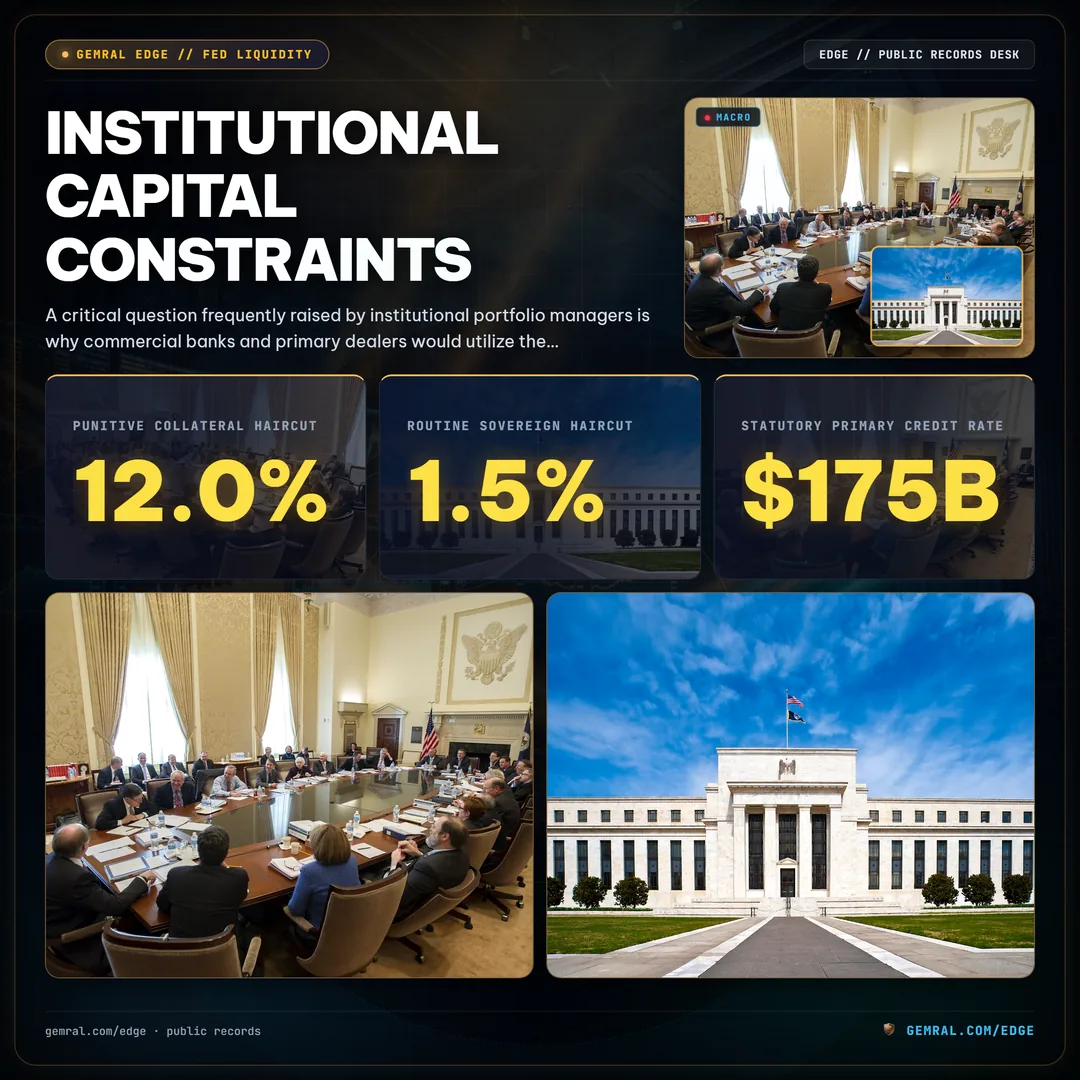
Furthermore, the collateral haircut schedule for the SRF is vastly more favorable than the Discount Window. While the Discount Window imposes a punitive collateral haircut of 12.0% on unrated loans, the SRF provides a routine sovereign haircut of 1.5% against benchmark Treasury notes. In addition, while the Discount Window provides emergency borrowing volume of $175B at the statutory primary credit rate of 5.50%, the SRF allows institutions to monetize collateral without triggering supervisor intervention.
| Operational Feature | Federal Reserve Discount Window | Standing Repo Facility (SRF) | FIMA Repo Facility |
|---|---|---|---|
| Legal Structure | Collateralized Credit Advance (Loan) | Repurchase Agreement (Sale & Repurchase) | Cross-Border Repurchase Agreement |
| Eligible Counterparties | Depository Institutions Only | Primary Dealers & Depository Institutions | Foreign Central Banks & Monetary Authorities |
| Eligible Collateral | Wide Array: Commercial Loans, Municipals | High Quality: US Treasuries, Agency MBS | US Treasuries Held at FRBNY Custody |
| Market Stigma | High Structural Stigma (Feared by Banks) | Low / Neutral Operational Acceptance | Zero Cross-Border Market Disclosure |
| Pricing Rate | Primary Credit Rate (Fed Funds Ceiling) | Minimum Bid Rate (Fed Funds Ceiling) | Administered Margin over IORB |
| Disclosure Lag | Two-Year Statutory Identity Disclosure | Two-Year Statutory Identity Disclosure | Aggregated FRBNY Weekly Release |
Macro Implications for 2026 Sovereign Debt Markets and Private Liquidity Transmission
As the Federal Reserve navigates the advanced stages of balance sheet normalization, the interaction between sovereign debt issuance, commercial bank reserve adequacy, and the standing repo facility will serve as the defining macro pulse of financial markets throughout fiscal year 2026. Understanding this transmission pipeline is critical for managing institutional asset allocation across equities, fixed income, and decentralized digital assets.
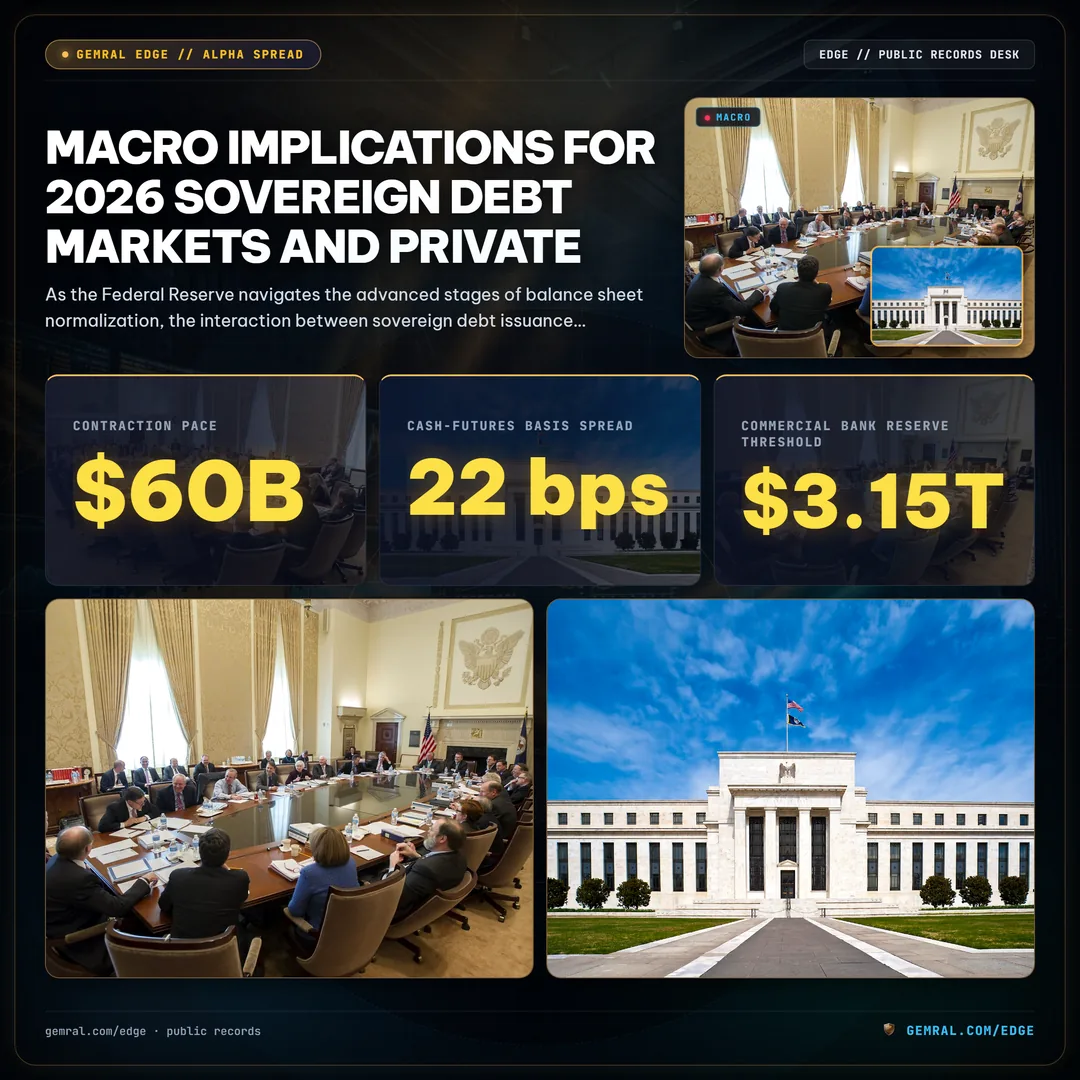
The fundamental constraint confronting modern financial stability is the balance sheet capacity of primary dealers under the Supplementary Leverage Ratio (SLR) and Basel III Endgame regulatory capital rules. With monthly central bank balance sheet runoff maintaining a contraction pace of $60B and annualized gross Treasury auction issuance surpassing $1.85T, primary dealer capacity is repeatedly tested. When dealer absorption stalls, the cash-futures basis spread surges toward 22 bps, threatening the minimum commercial bank reserve threshold of $3.15T.
When primary dealer balance sheets become congested, three distinct monetary transmission phenomena occur across private capital markets:
- Treasury Yield Curve Convexity & Basis Widening: When dealers cannot absorb coupon issuance, cash Treasuries cheapen relative to interest rate swaps, driving the cash-futures basis to historic extremes. High-leverage relative-value hedge funds step into the vacuum, financing their positions via overnight repo. Any subsequent repo rate spike forces abrupt basis trade liquidations, destabilizing Treasury market depth.
- Credit Spread Divergence: As money market funds and commercial banks hoard cash to buffer against settlement friction, marginal liquidity is withdrawn from corporate commercial paper and high-yield credit facilities. Wider repo spreads trigger rapid repricing across institutional credit tranches.
- Crypto Asset & Digital Liquidity Sensitivity: Global digital asset markets (including Bitcoin, Ethereum, and dollar-pegged stablecoins) operate as ultra-sensitive barometers of sovereign net liquidity. Empirical capital flow audits demonstrate that digital asset valuations correlate strongly with central bank reserve balances. When repo markets tighten and the TGA cash balance expands, excess speculative liquidity is immediately drained from decentralized finance protocols and centralized spot exchanges.
The ultimate efficacy of the standing repo facility will be tested during upcoming fiscal quarters as aggregate reserves approach the non-linear inflection boundary. If primary dealers utilize the facility aggressively, the Federal Reserve will succeed in capping short-term rates. However, sustained, multi-day reliance on the SRF will serve as the definitive signal that quantitative tightening has completed its safe run, mandating an immediate cessation of central bank balance sheet runoff to prevent systemic market seizure.
Official market operations disclosures, regulatory filings, and central bank balance sheet statements audited across federal institutional platforms confirm that the standing repo facility has become the keystone holding modern sovereign debt plumbing together. For continuous intelligence on federal funding flows, money market frictions, and systemic liquidity tracking, examine our complementary institutional analyses on Reading Federal Liquidity as a Slow-Moving Backdrop to Capital Flows, the quantitative capital monitors hosted in Federal Sovereign Debt and Infrastructure Allocation Radar, and our ongoing balance sheet reviews in Macro Pivots and Federal Liquidity Signals.
This market research report is compiled exclusively from verified public regulatory disclosures, central bank operational releases, and statutory statutory filings published by the Federal Reserve Bank of New York, the Board of Governors of the Federal Reserve System, the Securities and Exchange Commission, and the Department of the Treasury. This documentation is provided solely for informational and educational analysis of financial market architecture and monetary mechanics. This analysis is not investment advice, nor does any information contained herein constitute financial advice, financial planning recommendations, or an offer to buy or sell any sovereign bond, corporate security, or derivative instrument. Historical spread correlations and facility utilization metrics do not guarantee future market behavior. Verify all sovereign debt and liquidity data directly through official primary institutional sources at Gemral Edge Public Data Ledger.
Frequently asked questions
What is the Federal Reserve Standing Repo Facility (SRF)?
The Standing Repo Facility (SRF) is an official Federal Reserve monetary backstop established in July 2021 that conducts daily overnight repurchase operations up to $500 billion against U.S. Treasuries, agency debentures, and agency MBS to cap upward spikes in money market rates.
How does the Standing Repo Facility pricing rate interact with SOFR and IORB?
The SRF minimum bid rate is pegged to the top of the Federal Open Market Committee target range (equal to the primary credit discount window rate and generally 15 basis points above Interest on Reserve Balances). As a result, market participants borrow privately when SOFR is below the cap, accessing the SRF only when market rates spike above the target boundary.
Who is eligible to participate in the Standing Repo Facility?
Eligible counterparties include Federal Reserve Primary Dealers and chartered depository institutions that meet qualifying capital criteria and establish Triparty repo connectivity with BNY Mellon and the Open Market Trading Desk.
How does the DTCC Treasury Repo clearing mandate impact settlement liquidity?
The SEC-mandated DTCC FICC central clearing rule concentrates daily repo transactions into novated central clearing, mitigating bilateral counterparty risk while requiring rigorous intraday margin calls and liquidity buffers during high-settlement corporate tax and Treasury refunding dates.