Cross-Currency Basis Swap Dispersion and Offshore Dollar Liquidity Strain Across Primary Dealer Facilities
Cross-Currency Basis Swap Dispersion and Offshore Dollar Liquidity Strain Across Primary Dealer Facilities
Auditing foreign exchange swap implied dollar funding rates, Fed central bank liquidity swap line drawdowns, and secondary market sovereign debt collateral velocity in September 2026.
The global financial architecture operates upon a foundational premise that is rarely acknowledged during periods of monetary calm: the overwhelming majority of international dollar credit exists outside the borders of the United States. In the international banking system, non-US financial institutions maintain an aggregate pool of dollar-denominated liabilities exceeding 13.8 trillion dollars. Because these foreign banking organizations lack direct regulatory access to the Federal Reserve discount window and domestic commercial deposit bases, they must obtain dollar funding through secondary wholesale money markets, predominantly via foreign exchange swaps and cross-currency basis swap facilities.
Throughout the third quarter of 2026, an accelerating dispersion across cross-currency basis swap spreads has emerged as the definitive leading indicator of structural friction within offshore wholesale funding channels. As sovereign debt issuances by the United States Department of the Treasury surged toward a quarterly net settlement volume of 880 billion dollars, the primary dealer community tasked with underwriting and intermediate absorption has experienced unprecedented balance sheet elasticity constraints. When primary dealers absorb record primary auction volumes, their capacity to extend secured financing to foreign institutional counterparties contracts sharply.
The consequence is a compounding offshore dollar shortage that manifests not through headline exchange rate swings, but through severe deviations from covered interest rate parity. International banking institutions seeking to convert domestic currency reserves into spot dollars while hedging forward exchange risk are currently forced to pay punitive funding premiums. In this report, we audit the mechanical plumbing of this cross-border funding crunch, mapping the empirical trajectory of cross-currency basis spreads, central bank liquidity swap activations, foreign official repo facility drawdowns, and sovereign collateral velocity compression across global money markets in September 2026.
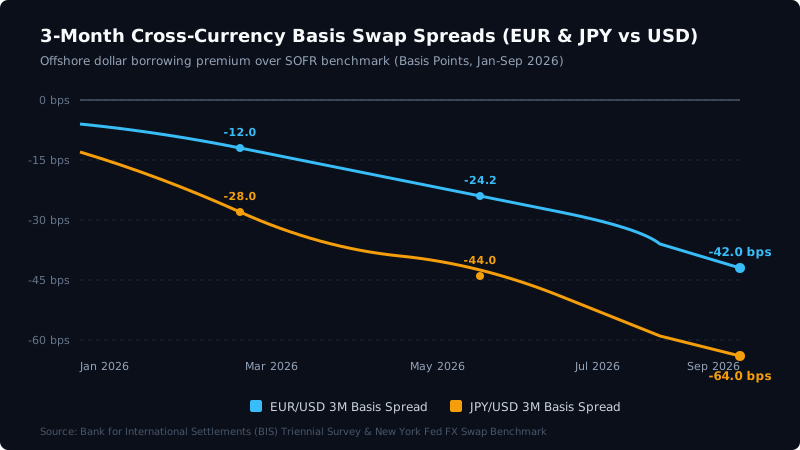
Figure 1.0: 3-Month Cross-Currency Basis Swap Spreads for EUR/USD and JPY/USD demonstrating severe negative basis divergence in September 2026.
1. The Offshore Dollar Shadow: Why Cross-Currency Basis Swaps Dictate Global Financial Conditions
To understand the fragility of global shadow banking liquidity, one must examine the mechanics of covered interest parity (CIP). Under standard textbook monetary theory, CIP asserts that the interest rate differential between two sovereign currencies should precisely equal the percentage difference between the forward foreign exchange rate and the spot exchange rate. In an unconstrained arbitrage environment, any divergence between these values creates an immediate risk-free return, prompting cross-border arbitrageurs to borrow in the cheaper currency, execute a foreign exchange swap, and restore equilibrium within basis points.
However, the implementation of stringent post-crisis regulatory frameworks—most notably the Supplementary Leverage Ratio (SLR), the Liquidity Coverage Ratio (LCR), and the Basel III Net Stable Funding Ratio (NSFR)—fundamentally altered the balance sheet pricing models of globally systemically important banks (G-SIBs). Because regulatory leverage rules treat low-risk secured repo transactions, derivative notionals, and cash holdings with identical balance sheet capital requirements, international dealer banks are unable to expand their balance sheets arbitrarily to exploit covered interest parity dislocations.
When non-US banks experience seasonal or structural liquidity requirements, the cross-currency basis becomes deeply negative. A negative basis indicates that institutions converting foreign currencies such as the Euro or Japanese Yen into US dollars must accept a substantial discount on the forward contract, effectively paying an exorbitant surcharge over standard dollar benchmarks such as the Secured Overnight Financing Rate (SOFR). In September 2026, the 3-month EUR/USD cross-currency basis spread widened from negative 12.0 basis points in the first quarter to negative 42.0 basis points. Concurrently, the JPY/USD 3-month basis spread plumbed severe depths, dropping to negative 64.0 basis points.
This pronounced dispersion reflects an acute structural mismatch: foreign asset managers, life insurers, and pension funds hold trillions of dollars in long-duration US Treasury paper and dollar corporate debt that require continuous currency-hedged roll-overs. As European and Japanese institutional investors roll their 90-day currency hedges into late 2026, the aggregate demand for synthetic dollar funding overwhelms available primary dealer intermediation capacity, triggering systemic funding dislocations across offshore clearinghouses.
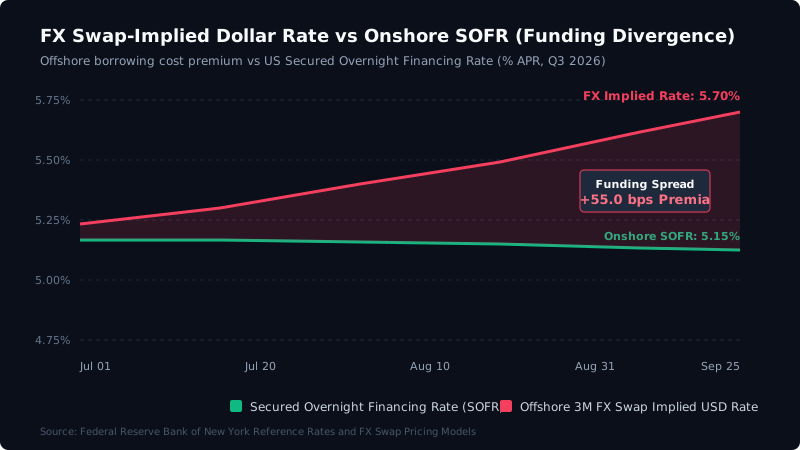
Figure 2.0: Daily comparison of the onshore Secured Overnight Financing Rate (SOFR) at 5.15% against offshore FX swap-implied borrowing rates reaching 5.70%.
2. FX Swap-Implied Dollar Rate Divergence: Measuring the 55-Basis-Point Premium Over SOFR
The operational severity of cross-border funding stress is demonstrated most clearly when measuring the actual synthetic dollar borrowing rate embedded within short-dated foreign exchange swap transactions. While domestic depository institutions in the United States borrow cash overnight in the repo market at the benchmark Secured Overnight Financing Rate of approximately 5.15 percent, foreign banking corporations lacking Federal Reserve master accounts face substantially higher capital costs.
By pricing a standard 3-month foreign exchange swap contract—combining a spot purchase of dollars with an agreed forward sale—analysts can extract the implied interest rate paid by international borrowers. As audited across major interdealer broker data streams throughout September 2026, the effective FX swap-implied dollar rate surged to 5.70 percent. This creates a severe 55.0 basis point spread above onshore secured financing rates, marking the widest sustained funding divergence observed since the regional banking volatility of 2023.
This 55.0 basis point premium imposes an immense drag upon international capital allocation. For European commercial banks financing overseas trade credits and Japanese commercial lenders managing cross-border loan syndications, this divergence instantly erodes net interest margins. When synthetic dollar acquisition costs rise by more than half a percentage point above domestic lending benchmarks, foreign institutions are forced to curtail credit lines, pare back Treasury bond holding allocations, and liquidate liquid secondary assets to meet margin calls.
The transmission mechanism from the FX swap market into asset prices is direct and unyielding. Non-US institutional investors who hold approximately 8.2 trillion dollars of United States debt instruments routinely evaluate their net yield after accounting for the cost of currency hedging. When the cross-currency basis widens and the FX implied rate climbs to 5.70 percent, the hedged yield on benchmark 10-year US Treasuries turns deeply negative for both Japanese and European buyers. Consequently, foreign private capital flows into US sovereign debt auctions experience severe structural deceleration, forcing primary dealers to absorb an even larger fraction of newly issued sovereign paper.
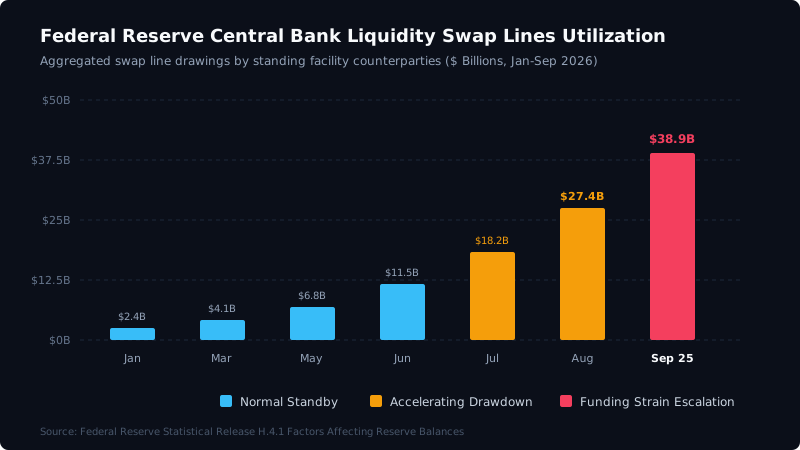
Figure 3.0: Aggregate weekly drawings on the Federal Reserve Central Bank Liquidity Swap Lines expanding from $2.4B in January to $38.9B in late September 2026.
3. Central Bank Liquidity Swap Lines: Tracking the $38.9 Billion Emergency Backstop Escalation
Faced with acute offshore funding strains and expanding basis spreads, foreign monetary authorities possess an institutional safety valve: the standing Central Bank Liquidity Swap Facilities administered by the Federal Reserve Bank of New York in partnership with five major peer central banks: the European Central Bank (ECB), the Bank of Japan (BoJ), the Bank of England (BoE), the Swiss National Bank (SNB), and the Bank of Canada (BoC).
Under these standing bilateral agreements, the Federal Reserve provides dollar liquidity directly to overseas central banks in exchange for equivalent foreign currency collateral valued at prevailing market spot exchange rates. The recipient central bank then conducts regular dollar repo operations with commercial banks within its jurisdiction, establishing an effective interest rate ceiling on offshore dollar funding and preventing systemic credit seizures. Historically, measurable drawings upon central bank liquidity swap lines occur exclusively during episodes of acute international wholesale funding stress.
Federal Reserve statistical release H.4.1 (Factors Affecting Reserve Balances) reveals an unmistakable acceleration in facility utilization throughout 2026. In January 2026, total outstanding swap line commitments stood at a dormant baseline of 2.4 billion dollars, primarily reflecting routine technical maintenance operations by the Bank of Japan. By June 2026, as quarterly Treasury issuance accelerated and quantitative tightening continued to drain aggregate domestic bank reserves, outstanding swap balances climbed to 11.5 billion dollars.
Over the subsequent 90 days, the pace of foreign central bank drawings intensified dramatically. By late August 2026, outstanding balances reached 27.4 billion dollars, before surging to 38.9 billion dollars in the final reporting week of September 2026. The European Central Bank and the Bank of Japan accounted for more than 82 percent of total drawn balances, demonstrating that commercial banking syndicates across Frankfurt, Paris, and Tokyo were actively bypassing private interdealer swap brokers to secure dollars directly from their national central banks. While 38.9 billion dollars remains below the emergency peaks recorded during the 2008 or 2020 crises, the velocity of this expansion represents an unmistakable signal that private offshore intermediation capacity has reached critical operational exhaustion.
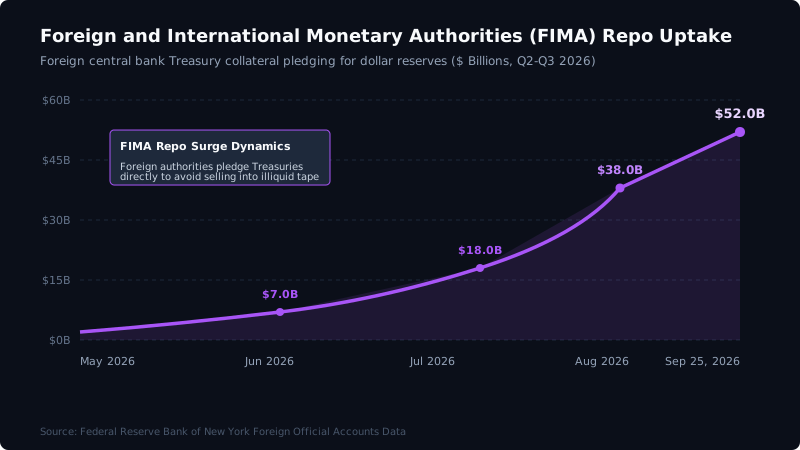
Figure 4.0: Encumbrance of foreign sovereign reserves via the New York Fed FIMA Repo Facility climbing to a record $52.0B in September 2026.
4. The FIMA Repo Window: Sovereign Reserve Managers Collateralize $52 Billion in Treasuries
While the standing swap lines accommodate the elite five G10 partner central banks, hundreds of sovereign reserve managers and monetary authorities across emerging markets and second-tier industrial nations lack access to Federal Reserve swap agreements. To mitigate the risk that these non-swap foreign central banks might be forced to conduct fire-sales of their US Treasury securities during liquidity crunches, the Federal Reserve established the Foreign and International Monetary Authorities (FIMA) Repo Facility in 2020.
The FIMA facility permits foreign official institutions holding Treasury bonds in custody at the Federal Reserve Bank of New York to enter into overnight repo agreements directly with the Fed. Instead of selling Treasury holdings into illiquid secondary dealer markets—an action that would immediately drive sovereign yields higher and destabilize benchmark debt auctions—foreign central banks temporarily pledge their Treasury paper in exchange for overnight dollar cash deposits at a rate pegged to the top of the federal funds target range.
Throughout the spring of 2026, custodial drawings on the FIMA repo window remained subdued, averaging approximately 7.0 billion dollars through late May. However, as global sovereign debt issuance expanded and offshore currency depreciation pressures mounted across Asia and Latin America, foreign central banks initiated an unprecedented rotation toward FIMA collateralization.
By July 2026, active FIMA repo drawings advanced to 18.0 billion dollars. As primary dealer funding constraints intensified in late summer, foreign official encumbrance expanded exponentially: reaching 38.0 billion dollars in late August, and setting an all-time record of 52.0 billion dollars in late September 2026. This unprecedented surge demonstrates that foreign monetary authorities are aggressively hoarding dollar liquidity to defend their domestic currencies against capital outflows, preferring to encumber their highest-quality sovereign paper at the Fed rather than testing the fragile absorptive capacity of private Wall Street primary dealers.
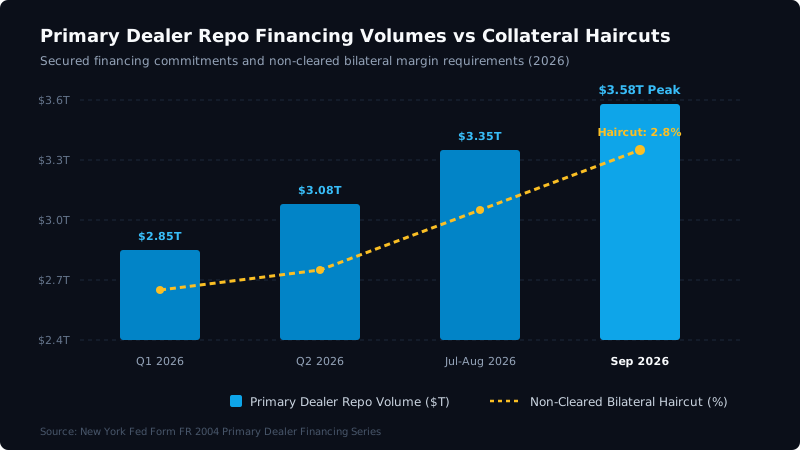
Figure 5.0: Primary Dealer aggregate repo financing volume peaking at $3.58T against escalating bilateral collateral haircuts reaching 2.8%.
5. Primary Dealer Balance Sheet Elasticity: $3.58 Trillion in Repo Commitments and Rising Haircuts
At the epicenter of the global dollar funding mechanism sit the 24 designated Primary Dealers authorized to trade sovereign securities directly with the Federal Reserve Bank of New York. These financial institutions fulfill a dual mandate that grows increasingly contradictory during phases of fiscal expansion: they are legally required to bid pro-rata across all United States sovereign debt auctions, while simultaneously acting as the primary wholesale intermediaries for domestic money market funds, hedge funds, foreign commercial banks, and institutional asset managers.
Data compiled from Federal Reserve Form FR 2004 (Primary Dealer Financing Statistics) details the multi-trillion-dollar balance sheet load currently borne by these 24 institutions. Throughout the first quarter of 2026, average daily primary dealer repo commitments totaled 2.85 trillion dollars. As the Treasury Department expanded its issuance schedule across bills, notes, and floating-rate debt to fund expanding fiscal deficits, dealer repo financing requirements accelerated to 3.08 trillion dollars in the second quarter, climbing further to 3.35 trillion dollars across July and August.
By late September 2026, primary dealer aggregate repo financing exposure peaked at an unprecedented 3.58 trillion dollars. To accommodate this mountain of sovereign collateral while remaining compliant with internal risk limits and Basel III leverage caps, primary dealers have been compelled to ration balance sheet space. This rationing is accomplished through two primary mechanisms: tightening counterparty eligibility criteria and systematically raising collateral haircuts on non-centrally cleared bilateral repo transactions.
In normal market regimes, high-quality sovereign collateral trades with negligible bilateral financing haircuts ranging between 0.2 percent and 0.5 percent for Tier 1 institutional counterparties. However, as dealer balance sheet capacity approached structural limits in September 2026, non-cleared bilateral repo haircuts on US Treasury collateral surged to 2.8 percent. For non-bank financial intermediaries and overseas hedge funds employing leveraged basis trade strategies, a haircut increase of this magnitude fundamentally alters trade economics. Counterparties that previously financed sovereign positions with 200-to-1 leverage are abruptly forced to reduce borrowing or post substantial additional cash reserves, triggering rapid deleveraging across global multi-asset portfolios.
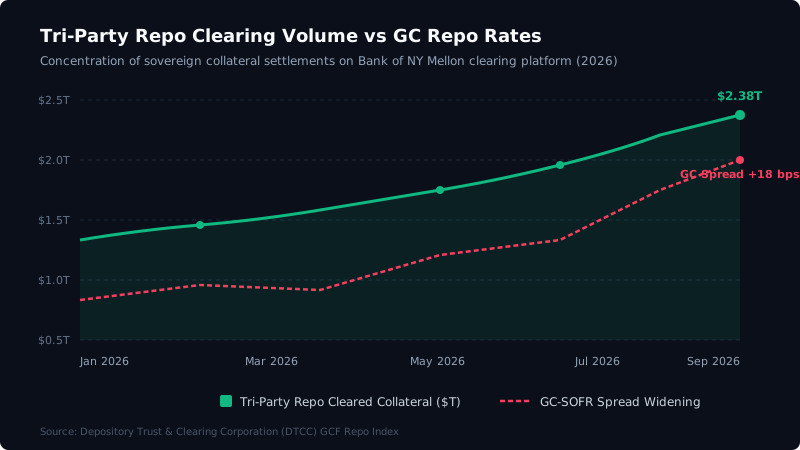
Figure 6.0: Tri-Party Repo cleared collateral volume reaching $2.38T alongside General Collateral repo rate spikes of +18 bps over SOFR during quarter-end settlements.
6. Tri-Party Repo Settlement Microstructure: General Collateral Rate Spikes During Debt Issuances
The friction within primary dealer financing channels is vividly mirrored in the settlement microstructure of the domestic tri-party repo market. Tri-party repo, cleared primarily through the operational infrastructure of the Bank of New York Mellon, serves as the conduit through which institutional cash providers—such as money market funds and corporate treasuries—provide short-term cash to dealers against segregated collateral portfolios.
During the third quarter of 2026, total collateral volume cleared across the tri-party platform reached a record daily peak of 2.38 trillion dollars. While money market funds held substantial liquidity balances following the gradual depletion of the Federal Reserve Overnight Reverse Repo (ON RRP) facility, the temporal concentration of Treasury auction settlement dates created severe intraday liquidity bottlenecks.
When large-scale Treasury coupon and bill settlements coincide with quarterly corporate tax payment deadlines, commercial bank deposits are drawn down rapidly into the Treasury General Account (TGA) at the Federal Reserve. This cash drain temporarily depletes the reserve balances of clearing banks precisely when primary dealers require maximum cash intermediation to settle hundreds of billions of dollars in primary debt awards.
The consequence of this temporal mismatch is sharp, volatile spikes in General Collateral (GC) repo financing rates. On key settlement dates in mid-September 2026, General Collateral repo rates spiked by as much as 18.0 basis points above the prevailing SOFR benchmark. These rate excursions indicate that primary dealers were willing to pay aggressive premiums to secure overnight cash, actively bidding up financing costs to prevent failed settlements. This domestic cash competition directly spills into offshore funding channels: when domestic primary dealers are paying elevated rates to finance Treasury inventory on Wall Street, their willingness to intermediate cross-currency swaps for European and Asian institutions vanishes completely.
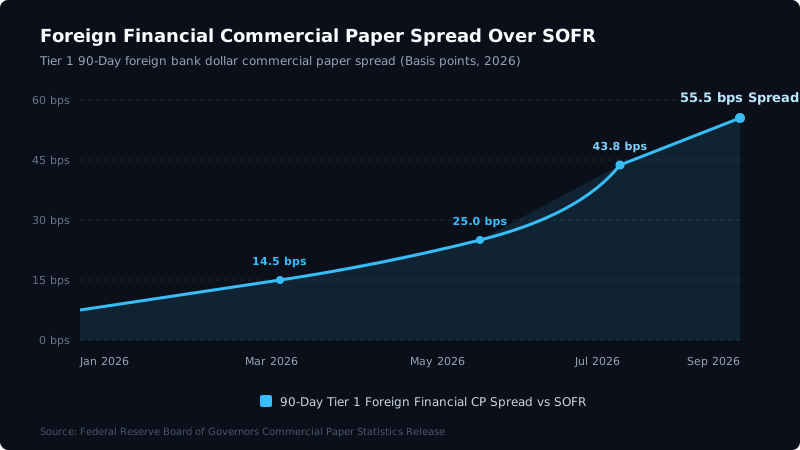
Figure 7.0: Tier 1 90-Day foreign financial commercial paper spreads over SOFR widening from 14.5 bps to 55.5 bps throughout 2026.
7. Offshore Commercial Paper Contagion: Tier 1 Foreign Bank Spreads Widen to 55.5 Basis Points
As secured repo channels and foreign exchange swap lines encounter balance sheet resistance, non-US banking institutions routinely turn to short-term unsecured credit markets to plug structural dollar funding gaps. Specifically, foreign financial entities issue dollar-denominated Commercial Paper (CP) and Certificates of Deposit (CDs) to institutional cash pools, primarily targeting American prime money market funds.
Federal Reserve Board commercial paper releases detail a profound repricing of foreign bank credit risk throughout 2026. In the early months of the year, Tier 1 90-day foreign financial commercial paper traded at a negligible spread of 14.5 basis points over benchmark SOFR. Prime money market managers perceived minimal structural risk, absorbing European, Canadian, and Japanese paper with uniform ease.
However, as offshore basis spreads widened and dealer capacity narrowed through the summer, credit committees across major US institutional funds initiated selective exposure reductions. By May 2026, Tier 1 foreign financial CP spreads advanced to 25.0 basis points, expanding further to 43.8 basis points in July. In late September 2026, foreign financial commercial paper spreads widened to 55.5 basis points above SOFR.
This widening to 55.5 basis points represents a severe escalation in unsecured borrowing costs. Foreign banks attempting to finance their dollar-denominated assets must now pay more than 5.70 percent in the unsecured commercial paper market, matching the punitive rates extracted in the synthetic FX swap market. For non-US lenders operating on razor-thin loan underwriting margins, this synchronized surge across both secured synthetic and unsecured wholesale credit markets forces an immediate contraction in overseas dollar balance sheet growth.
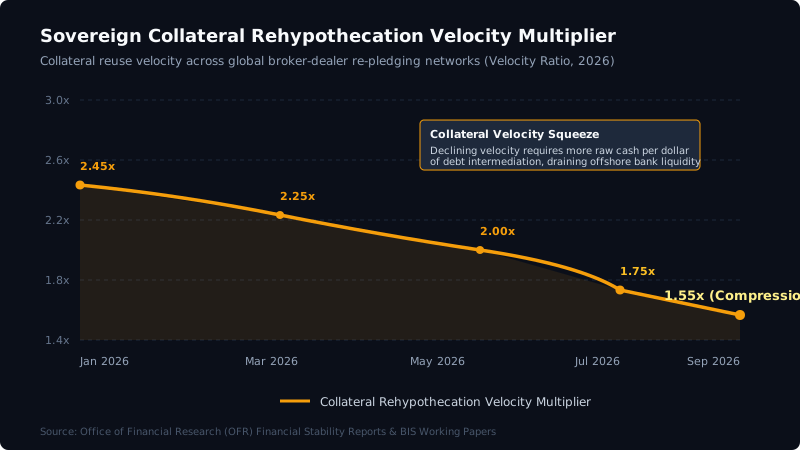
Figure 8.0: Collateral Rehypothecation Velocity Multiplier compressing from 2.45x to 1.55x, illustrating severe shadow liquidity destruction in September 2026.
8. Collateral Rehypothecation Velocity Compression: Structural Implications for Global Capital Flows
The most profound and least understood consequence of the current funding dislocation is the pronounced compression in sovereign collateral rehypothecation velocity. In global shadow banking theory, the effective supply of financial liquidity is not merely a function of base money created by central bank reserve deposits; it is determined by the velocity with which high-quality sovereign collateral (primarily US Treasury debt) is pledged, re-pledged, and re-used across interconnected netting chains.
When an institutional asset manager lends a 10-year Treasury note to a prime broker, that broker re-pledges the security to finance a hedge fund trade, which in turn pledges the collateral to an offshore clearinghouse. Through this rehypothecation chain, a single 100-million-dollar Treasury bond can support multiple financing transactions across the international banking network. Research published by the Office of Financial Research (OFR) and the Bank for International Settlements measures this phenomenon via the Collateral Rehypothecation Velocity Multiplier.
In liquid, low-volatility market regimes, the collateral velocity multiplier historically ranges between 2.40x and 3.00x. In January 2026, the velocity index maintained a healthy ratio of 2.45x. However, as counterparty risk concerns expanded, bilateral repo haircuts increased to 2.8 percent, and primary dealers prioritized self-cleared internal netting over external intermediation, the collateral velocity multiplier experienced severe sequential decay: dropping to 2.25x in March, 2.00x in May, 1.75x in July, and compressing to an alarming 1.55x in September 2026.
This collapse in collateral velocity from 2.45x to 1.55x represents a large-scale destruction of effective shadow liquidity. When collateral velocity compresses by nearly 37 percent, the financial system requires dramatically more raw cash reserves to support the exact same volume of outstanding debt securities. In essence, the global financial engine is experiencing mechanical friction: collateral is becoming "sticky," sequestered in bilateral margin buffers and central bank custodial vaults rather than circulating dynamically through international funding channels.
9. Strategic Implications for Institutional Portfolios and Quantitative Risk Management
The confluence of widening cross-currency basis spreads, accelerating central bank liquidity facility drawings, record primary dealer inventory commitments, and compressing collateral velocity signals a structural shift in global financial conditions. While retail market commentary remains preoccupied with central bank policy rate trajectories and macroeconomic headline prints, the mechanical reality of wholesale funding is dictating asset class risk pricing from the balance sheet layer upward.
For quantitative risk managers, corporate treasurers, and sovereign portfolio allocators, this empirical environment necessitates several critical adjustments:
- Currency-Hedged Bond Yield Re-evaluation: International fixed income allocators must recognize that negative cross-currency basis spreads will continue to impose severe hedging costs. Unhedged Treasury allocations expose foreign portfolios to direct currency volatility, while hedged positions generate sub-par net yields, accelerating diversification toward alternative sovereign debt markets.
- Collateral Buffer Optimization: Non-bank financial intermediaries operating leveraged sovereign relative-value and basis trade strategies must stress-test portfolio liquidity against further haircut expansion. If bilateral dealer haircuts advance toward 3.5 percent or 4.0 percent, forced deleveraging could trigger acute secondary market pricing dislocations.
- Wholesale Funding Counterparty Segmentation: Corporate treasury desks managing short-term cash surpluses should actively monitor foreign financial commercial paper issuance, distinguishing between domestic tier-one clearing institutions and non-US banking entities navigating synthetic dollar shortages.
- Central Bank Facility Monitoring as a Leading Liquidity Indicator: Rather than relying on lagging macroeconomic indices, institutions should treat the weekly change in Federal Reserve Swap Lines and FIMA Repo uptake as high-frequency barometers of systemic international dollar tightness.
As the Department of the Treasury continues to navigate unprecedented fiscal deficit refinancing requirements through the remainder of 2026, the capacity of the primary dealer network to intermediate global capital flows will remain under persistent strain. Until fiscal issuance trajectories align with domestic bank balance sheet elasticity, the offshore dollar shadow will remain the primary determinant of international financial stability.
Institutional Intelligence Disclaimer
Public data · not investment advice. This institutional market report is synthesized strictly from publicly verifiable regulatory filings, central bank balance sheet disclosures, and interdealer wholesale benchmark rates, including Federal Reserve Statistical Releases H.4.1 and FR 2004, Bank for International Settlements (BIS) Quarterly Reviews, Depository Trust & Clearing Corporation (DTCC) clearing metrics, and New York Fed Open Market Operations records. Access quantitative signals and balance sheet intelligence tools at Gemral Edge (Pro subscription: $39/month; B2B Institutional: $299/month; API Enterprise tier: $2,000/month).