Revolving Door Lobbyists: 44% of Filings Name a Former Government Insider
3,703 of 8,370 federal lobbying filings list at least one lobbyist who previously held a government job. Here is who they are, which companies lean on them most, and what the filings do not tell you.
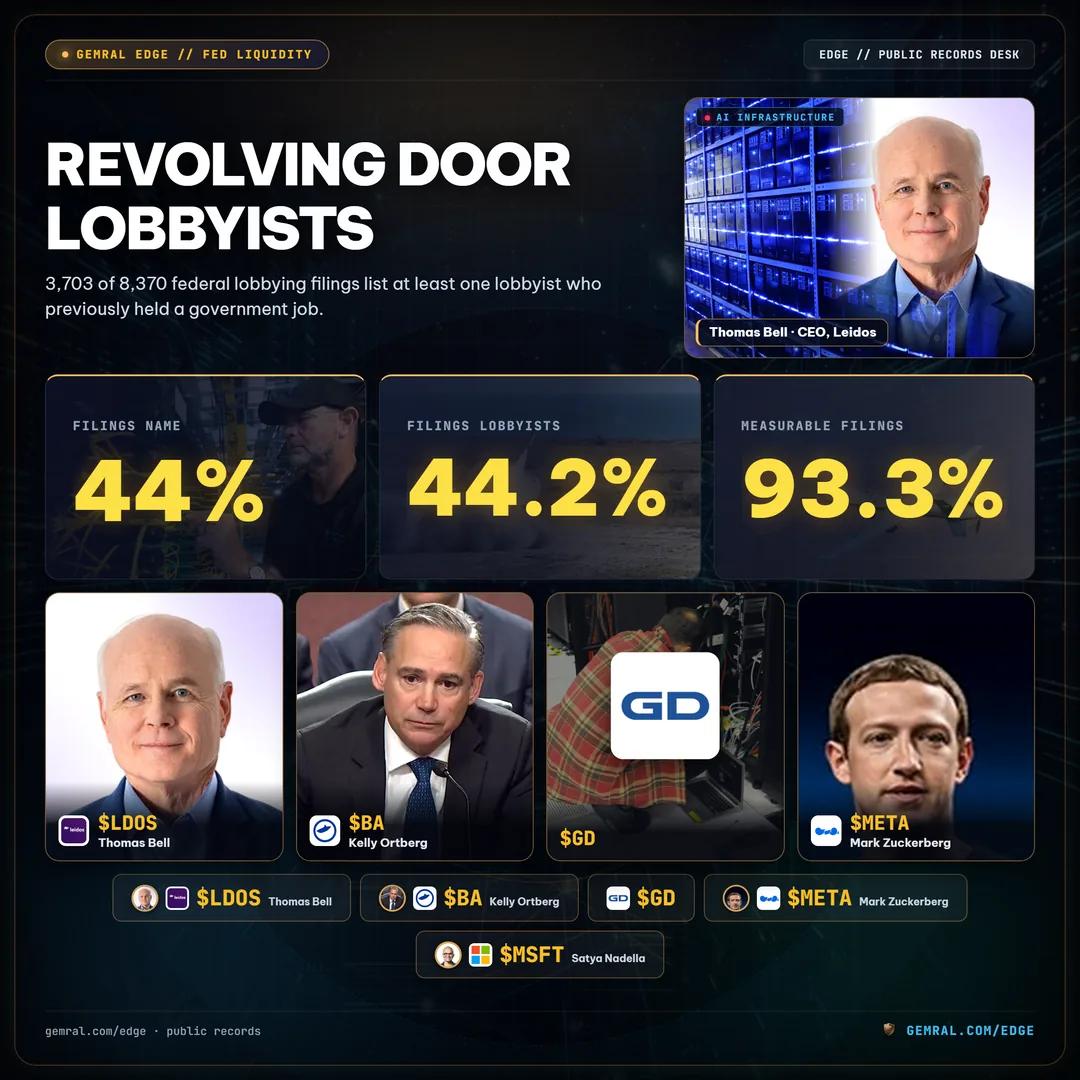
3,703 out of 8,370. That is the number of federal lobbying filings, across 2018 to 2026, in which at least one named lobbyist reports a prior government position. In 44.2 of every 100 filings, somebody on the lobbying team used to work inside Congress, the White House or a federal agency. This is the revolving door, and it is written down in plain sight on every disclosure form. We counted it. Our lobbying intelligence hub tracks the underlying filings.
The question behind the search term revolving door lobbyists is simple: how many lobbyists used to work in government, and where do they land? The filings answer both, with caveats we spell out below. For the spending side of the same dataset, see our earlier breakdown of who spends the most on lobbying, and for how to read the filings themselves, our guides to the lobbying database and the corporate lobbying tracker.
How Many Lobbyists Used to Work in Government?
Among 5,787 distinct lobbyists named in 8,370 filings, 1,802 report a covered government position. That is 31.1%, close to one lobbyist in three. Federal rules require lobbyists to disclose certain prior executive and legislative branch jobs held within the last 20 years, so this field is the closest thing to an official revolving door ledger.

The clients are even more exposed. Of 2,185 companies and organizations in the dataset, 1,249 (57.2%) filed at least once with an ex-government lobbyist on the roster. More than half of everyone paying for lobbying has bought access to someone who used to sit on the other side of the table.
Where did these lobbyists come from? Reading the disclosed job titles, "House" appears in the positions of 469 of the 1,802 lobbyists, "committee" in 454, "chief of staff" in 336, "counsel" in 325 and "Senate" in 318. Titles overlap, so these are mentions, not exclusive buckets. The pattern is plain: the pipeline runs through congressional staff, the people who draft and mark up the text of bills.
Which Companies Lean on the Revolving Door the Most?
Defense and technology dominate. Counting filings that name at least one lobbyist with a prior government role, the biggest users in the dataset are:
- Leidos (LDOS): 75 of 84 filings, 89.3%.
- The Boeing Company (BA): 79 of 118 filings, 66.9%.
- General Dynamics (GD): 140 of 228 filings, 61.4%.
- Meta Platforms (META): 89 of 178 filings, 50.0%.
- Microsoft (MSFT): 121 of 253 filings, 47.8%.
- Lockheed Martin (LMT): 74 of 205 filings, 36.1%.
Leidos stands out: nearly nine in ten of its filings carry a former-government name. General Dynamics logs the highest raw count, 140 filings. The spread inside a single sector is just as telling. Lockheed Martin sits at 36.1% while Boeing reaches 66.9%, two aerospace primes with very different staffing habits.
The Counter-Intuitive Number: Lower Reported Amounts
Here is the part that does not fit the usual story. Filings that name an ex-government lobbyist report an average amount of $109,131. Filings that do not name one report $237,502. That is 54% lower. The median tells the same story in a narrower range: $50,000 against $60,000.

This is a correlation inside a self-reported field, not proof of anything about influence. One plausible reading is composition: smaller clients and boutique firms staffed by former Hill aides file many small-dollar reports, while the largest in-house operations spread large budgets across many lobbyists, some with no disclosed government history. The takeaway for researchers is narrower and more useful: the revolving door is not a feature of only the biggest budgets. It runs through the whole market.
What the Filings Do Not Tell You
Measurable filings (93.3%): only filings that name a lobbyist can be counted. Dataset size (8,975 filings): 2018 to 2026 as ingested.
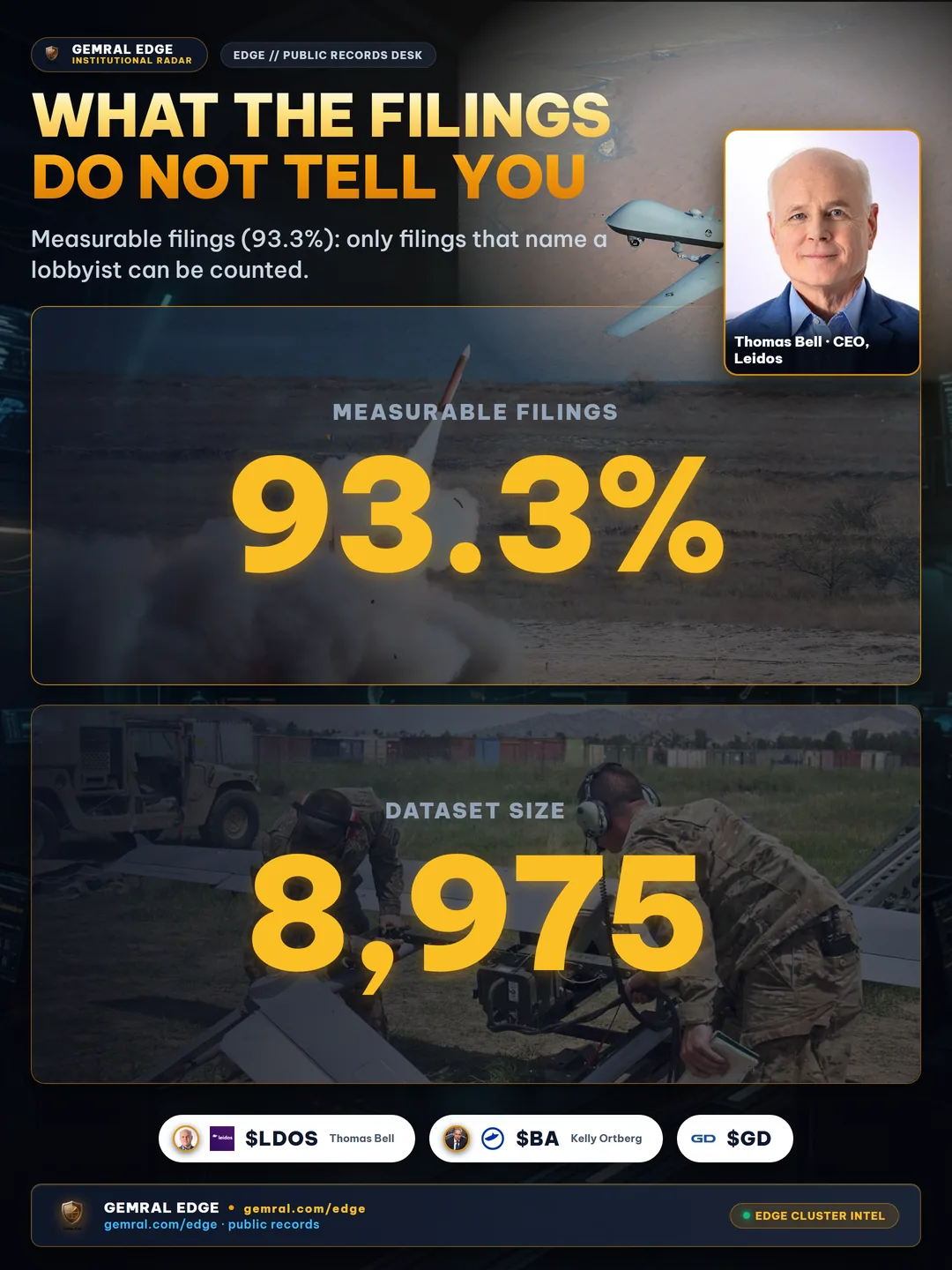
Three limits matter before anyone builds a signal on this field. First, the covered-position field is free text. We removed placeholder entries such as "n/a", "none" and "see prior filing" before counting, which is why the figures here are lower than a raw count of non-empty cells. Second, the field records a past job, not a current relationship or a specific meeting. Third, the dataset covers 8,975 filings from 2018 to 2026 as ingested, and the measurable share, filings with a named lobbyist, is 93.3% of that total. The rest cannot be measured at all. It is not every filing ever submitted, so shares describe this dataset, not the entire lobbying industry.
What the data does support is a repeatable measurement: for any company, what share of its lobbying filings carry a former-government name, and how does that share move quarter to quarter? A sudden jump in that share can mark a push on a specific bill, agency or contract vehicle before it shows up anywhere else.
Track the Revolving Door by Company and Ticker
Research desks that want the filings behind these numbers can browse the lobbying hub or request a free preview of the structured tables at the data preview page.
Frequently asked questions
What is a revolving door lobbyist?
A revolving door lobbyist is someone who previously worked in Congress, the White House or a federal agency and now lobbies on behalf of a company or organization. Federal filings disclose these prior jobs in a covered-position field.
Which companies use former government lobbyists the most?
By share of filings, Leidos leads with 75 of 84 filings (89.3%), followed by Boeing at 66.9%, General Dynamics at 61.4%, Meta at 50.0% and Microsoft at 47.8%.
Where can I check a lobbyist's government background?
Each quarterly federal lobbying disclosure lists lobbyists and any covered government positions. The Senate Office of Public Records and the Clerk of the House publish these filings.