预测市场套利:跨平台套取Polymarket与Kalshi利差
对跨平台二元事件定价偏差、订单簿深度差异、监管清算摩擦以及CFTC监管的Kalshi与去中心化Polymarket之间延迟机制的实证分析。
全球流动性池中预测市场套利的结构性崛起
The emergence of event contracts as an independent asset class has introduced a novel financial primitive into quantitative finance. Across modern digital trading venues, binary event markets allow participants to trade financial contracts whose payouts depend strictly on the verified occurrence of real-world outcomes. As trading volumes expanded toward $50.6 billion per month, the market fragmented across two contrasting architectural frameworks: the United States Commodity Futures Trading Commission (CFTC) regulated Designated Contract Market (DCM) operated by Kalshi, and the decentralized, smart contract exchange architecture hosted by Polymarket. For traders seeking systematic returns, navigating this cross-venue landscape requires a specialized prediction market arbitrage strategy capable of monetizing divergent event probability distributions.
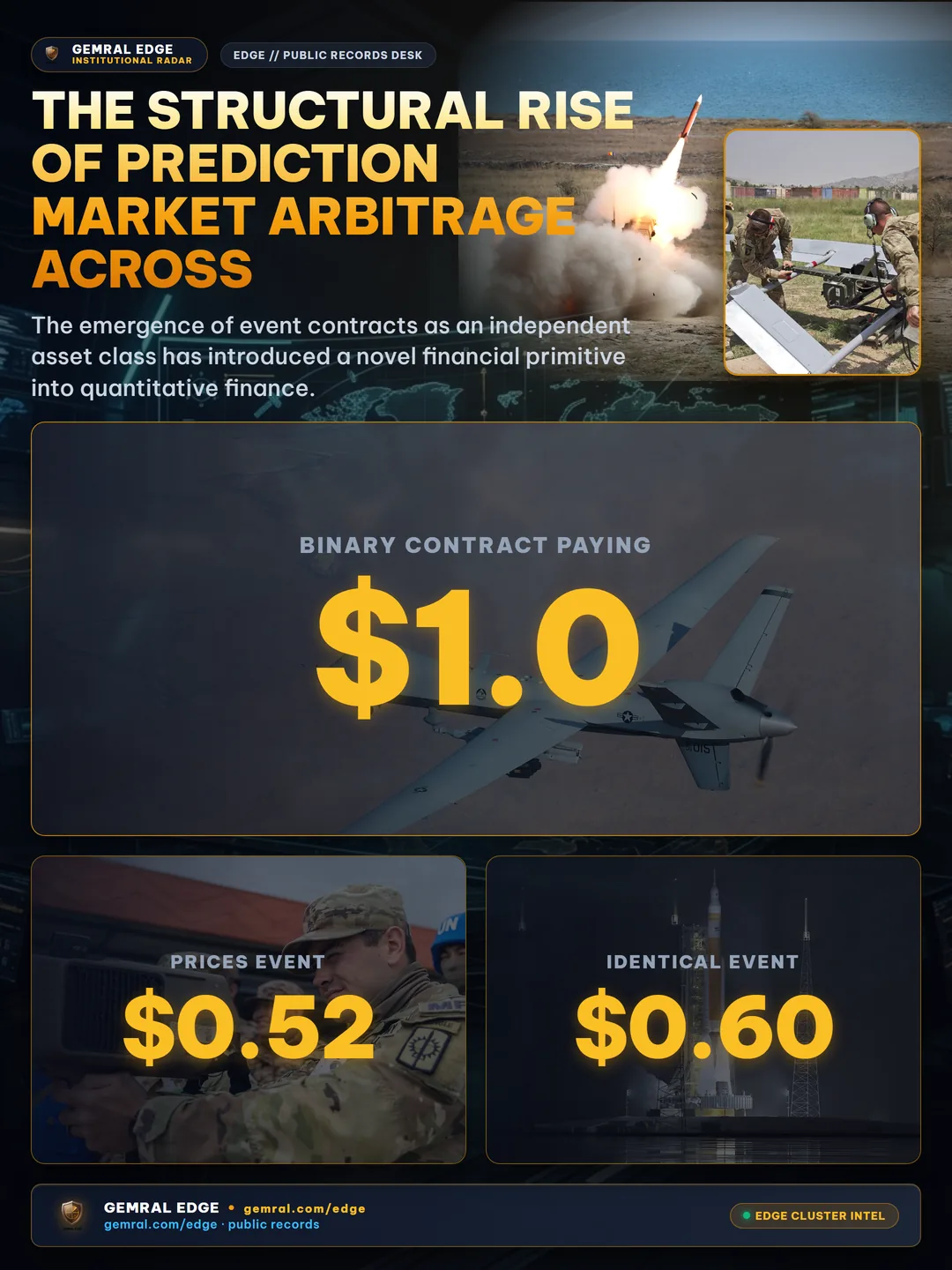
In an ideal, friction-free financial system, two liquid markets pricing the identical real-world outcome—such as a Federal Reserve benchmark interest rate decision, macroeconomic data release, or geopolitical milestone—would clear at identical implied probabilities. A binary contract paying $1.0 upon maturity if an outcome occurs should trade at the exact discounted expectation of that event. If Platform A prices the event at $0.52 and Platform B prices the identical event at $0.60, a theoretical pricing discrepancy of 8 percentage points emerges. In equity or foreign exchange markets, high-frequency market makers eliminate such divergences within microseconds. In event contracts, however, structural walls prevent instantaneous equilibrium.
The persistence of cross-venue probability dislocations represents one of the few remaining structural arbitrage frontiers in retail and semi-institutional finance. Unlike traditional financial instruments where market makers share unified prime brokerage clearing lines, prediction market venues exist in distinct regulatory and technical silos. This architectural separation creates friction, capital drag, and fragmented order books, generating wide arbitrage spreads that can persist for minutes or hours rather than milliseconds. For live telemetry and market depth anomalies across binary event contracts, see our public story breakdown.
二元合约平价数学机制与合成利差捕捉
Every binary prediction market contract operates on a terminal payoff function bounded strictly between $0.00 and $1.00. For any mutually exclusive and collectively exhaustive set of binary outcomes—Yes and No—the fundamental pricing theorem states that the combined market price must equal the terminal payout value:

Within a single venue, intra-market arbitrage bots ensure that if the combined price of Yes and No falls below $0.99, an arbitrageur buys both outcomes simultaneously, spending less than $1.00 to guarantee a terminal settlement of exactly $1.00 at contract resolution. This simple structure locks in a riskless payout regardless of which outcome materializes. However, cross-venue arbitrage introduces asymmetric legs. Similar to structural relative-value mechanics documented in the Treasury basis trade, event contract arbitrage identifies identical binary outcomes across Platform A and Platform B, seeking conditions where:
When this mathematical condition is satisfied, the quantitative trader purchases Yes on Venue A at $0.45 and No on Venue B at $0.48. The combined capital outlay equals $0.93 per unit of exposure. If Total_Friction_Fees account for $0.02, the net cost basis totals $0.95. Upon final resolution, exactly one of the two venues will settle to $1.00 while the opposing venue settles to $0.00. The gross payoff yields $1.00, generating a locked-in net profit of $0.05 per contract, or an unannualized return on invested capital of approximately 5.26%.
监管分割:CFTC监管的Kalshi与去中心化Polymarket对比
To understand why spreads between 3% and 12% regularly develop across these platforms, one must evaluate the regulatory and technological architecture governing each order book. Kalshi is registered as a DCM with the CFTC, operating under strict federal compliance mandates. Onboarding requires full identity verification, banking integration through standard automated clearing house (ACH) transfers or domestic wire networks, and strict position limits designed to prevent market manipulation. Institutional participants face standardized clearing rules, and capital settlement takes place entirely in legal tender United States dollars.
Conversely, Polymarket utilizes smart contracts deployed on the Polygon blockchain network, operating a hybrid decentralized exchange model. Orders are matched off-chain through a high-throughput Central Limit Order Book (CLOB) and settled on-chain via conditional token frameworks. Collateral is denominated entirely in digital USD stablecoins (USDC). International capital flows into Polymarket liquidity pools without statutory position caps, creating an order book dominated by global decentralized finance participants, crypto-native algorithmic funds, and international macro traders.
Because capital cannot flow frictionlessly across the boundary separating traditional domestic banking rails from public blockchain networks, two non-fungible liquidity ecosystems develop. When major geopolitical or macroeconomic headlines break, market participants on Polymarket frequently react within seconds, repricing binary contracts across high-frequency crypto trading desks. On Kalshi, retail and domestic institutional flows adjust at a different tempo. This structural divergence generates the probability spreads that algorithmic arbitrage engines are designed to harvest.
执行摩擦:费率表、跨链延迟与流动性损耗
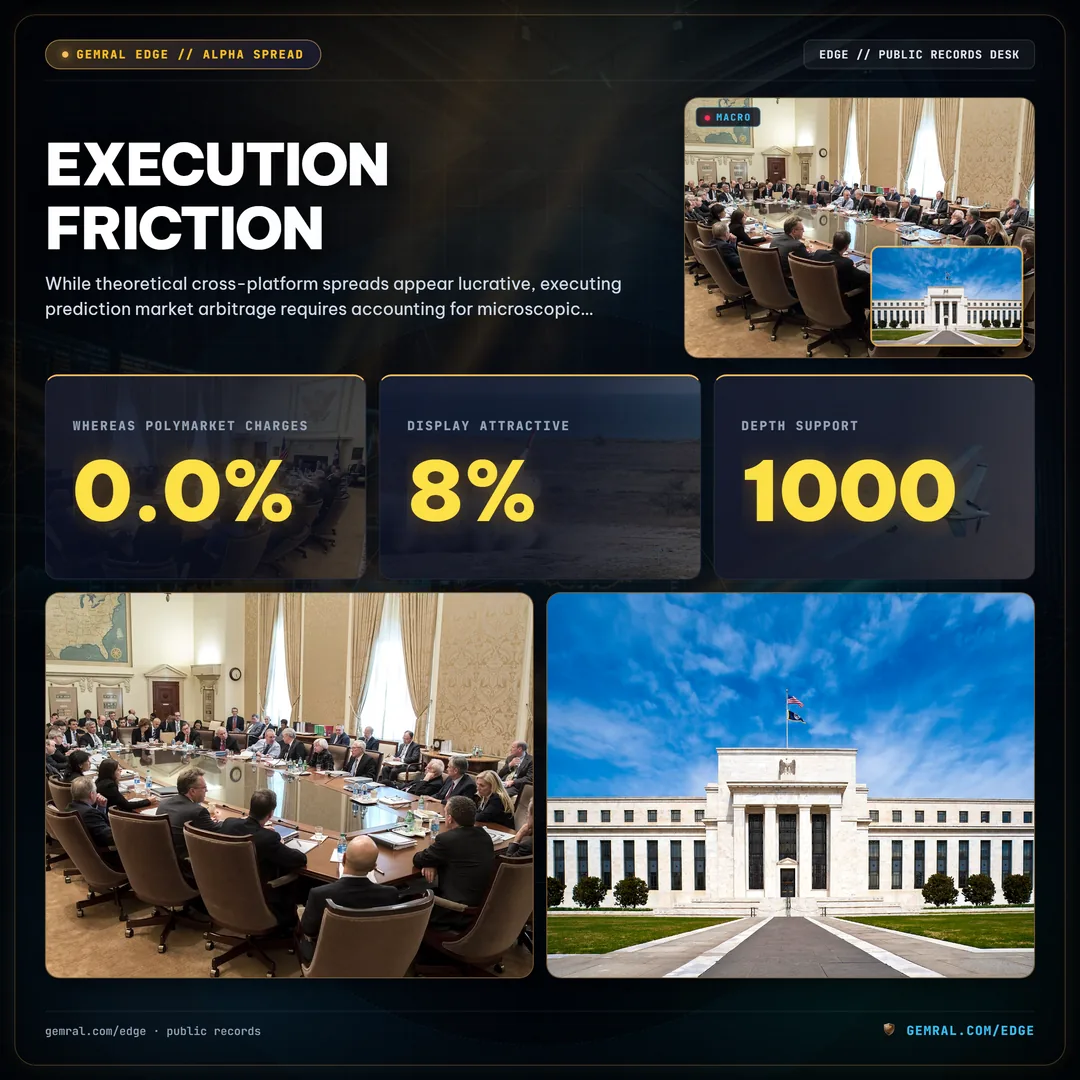
While theoretical cross-platform spreads appear lucrative, executing prediction market arbitrage requires accounting for microscopic operational frictions. The three primary friction components include trading fee structures, cross-venue settlement latencies, and order book slippage:
-
Venue Fee Friction: Kalshi enforces a volume-tiered fee schedule where taker transactions incur fees reaching up to 1.5% of contract value, whereas Polymarket charges 0.0% taker fees on standard binary event pools but embeds microscopic relayer gas compensation costs. An apparent 3% probability spread can be heavily compressed once double-sided taker execution fees are deducted.
-
Cross-Chain Settlement Latency: Rebalancing inventory between Polygon USDC and domestic USD bank deposits requires navigating centralized exchange fiat gateways. Typical bridging and bank settlement windows range from 3 to 15 minutes during regular banking hours, and can extend across weekends. Arbitrageurs must maintain pre-funded collateral pools on both venues to execute concurrently without leg risk.
-
Liquidity Depth and Slippage: While top-of-book prices may display an attractive 8% spread, market depth may only support 1000 contracts ($1000 notional) before slippage moves the order book by 4 cents. Executing larger institutional sizes requires advanced execution algorithms that sweep liquidity across synthetic tick levels.
Quantitative trading teams monitor WebSocket order book streams with average transport latencies below 45 milliseconds, calculating the net executable spread in real time after adjusting for the instantaneous depth of the bid-ask matrix.
Institutional Alternative Data Telemetry & Quantitative Architecture
Gemral Edge delivers empirical market intelligence, alternative data feeds, and institutional telemetry covering prediction market liquidity, capital flow tracking, and cross-venue signal dispersion. Access institutional data coverage and test live quantitative feeds.
监管与方法论免责声明
The quantitative methodologies, probability formulas, and historical market metrics discussed in this document are derived from publicly available data provided by the Commodity Futures Trading Commission (CFTC), Kalshi Exchange public rulebooks, and the open-source smart contract protocols of Polymarket. The Edge intelligence platform provides financial technology, empirical analytics, and quantitative intelligence architectures. Past performance and mathematical arbitrage simulations are not indicative of future market outcomes. Public data · not investment advice.
Frequently asked questions
What is prediction market arbitrage and how does it generate alpha?
Prediction market arbitrage involves identifying probability dislocations on identical binary event contracts across distinct execution venues (such as Polymarket and Kalshi) or within complementary multi-outcome contract sets. Traders lock in risk-free profit when the sum of payout probabilities across mutually exclusive outcomes drops below 1.00 or crosses 1.00 net of execution fees.
What are the primary operational friction points in cross-platform prediction arbitrage?
Key execution frictions include venue fee structures (taker fees ranging from 0.0% to 1.5%), cross-chain bridge settlement latencies (averaging 3 to 15 minutes between Polygon USDC and ACH/wire fiat rails), and liquidity asymmetry across order books leading to execution slippage.
How does regulatory fragmentation between CFTC-cleared and decentralized venues create spreads?
Kalshi operates under a CFTC-regulated DCM clearing structure with strict individual position caps and identity verification, while Polymarket operates on-chain with global liquidity pools. Institutional capital restrictions prevent unified market making, causing structural pricing divergences of 3 to 12 percentage points.
How can quantitative market participants track real-time prediction market spreads?
Quantitative funds utilize WebSocket order book telemetries and automated execution bots that continuously compute the synthetic implied probabilities, calculating cross-venue spreads minus latency and transaction costs.